Breakthroughs in Domestic Computing SuperNodes and the Open-Source Wave of AI Large Models: A Comprehensive Analysis

China's AI industry advances with SuperNode breakthroughs, open-source multimodal models, and systematic regulation.
China's AI industry is experiencing a pivotal transformation marked by Huawei's Ascend 950 SuperNode achieving ExaFLOPS-level computing with 1024-card interconnection, an open-source wave of multimodal large models from Tencent, Alibaba, and ByteDance, Apple-Alibaba collaboration for localized AI, $600B global data center investments by cloud giants, AI-native enterprise platforms and agents moving toward deployment, and comprehensive regulatory frameworks advancing in parallel.
Apple Teams Up with Alibaba as Foreign AI Deployment in China Accelerates
China's AI industry is showing unprecedented vitality. According to a roundup by Zhuyan AI Tech News, Apple is collaborating with Alibaba to train dedicated AI models for the Chinese market, using a hybrid approach that combines Apple's proprietary models with Alibaba's Qwen (Tongyi Qianwen) technology. This signals that foreign companies deploying their own AI capabilities in China are expected to roll out related services within months.
From a technical architecture standpoint, Apple's "proprietary model plus Qwen" approach is essentially a layered AI architecture. Apple's on-device models (such as the small language models within the Apple Intelligence framework) handle simple inference tasks locally, while tasks requiring deep localization — complex semantic understanding, Chinese-context content generation, and the like — are routed to Alibaba's Qwen cloud models. This architecture preserves Apple's control over user privacy and the on-device experience, while leveraging a domestic model to address critical challenges like Chinese language comprehension and regulatory compliance.
Behind this move lies a clear trend: as domestic technologies from Baidu, Alibaba, and others mature, foreign tech giants are increasingly adopting a "proprietary model + local technology" hybrid approach for deploying AI capabilities in China, balancing compliance with localized user experience. China enforces a filing-based management system for generative AI services, requiring all AI services offered domestically to pass algorithm registration and security assessments — a direct policy driver compelling foreign companies to seek local partners. This is not merely a technology choice but a deep adaptation to China's AI regulatory environment and market characteristics.
The Multimodal and Open-Source Wave Sweeps Across Domestic Large Models
Domestic large models continue to achieve major breakthroughs in the multimodal domain. Multimodal large models refer to unified neural network architectures capable of simultaneously processing and generating multiple data types — text, images, audio, video, 3D, and more. Unlike earlier approaches that trained separate models for each modality, unified multimodal architectures encode different types of information into a shared representational space, enabling cross-modal understanding and generation. For example, a user can input a text description to generate a corresponding video, or upload an image to receive a voice narration.
Tencent's open-source HunyuanVideo series of large models exemplifies this technological direction. It can process text, images, audio, video, and 3D content in a unified manner, reportedly setting 12 new international benchmarks, and is available for free commercial use with no revenue sharing — significantly lowering the barrier to multimodal AI applications. This unified processing capability dramatically reduces integration complexity for developers and represents a critical technological leap from single-modality text interaction toward truly "full-perception" interaction.
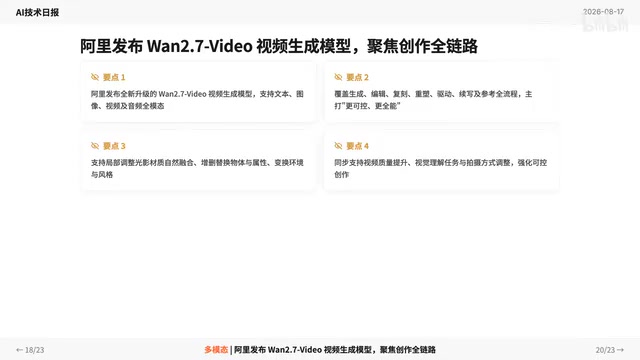
Alibaba has been equally active. Its speech model reportedly topped three global rankings, supporting multilingual and real-time interaction, while Qwen's global downloads have surpassed 3 billion. Meanwhile, Alibaba has also released the new Tongyi Wanxiang 2.7 video model, covering text, image, video, and audio across all modalities, with end-to-end support for generation and editing workflows — positioning itself as "more controllable and more versatile."
Notably, ByteDance's Seed team is planning to train a foundation model with over 5 trillion parameters, currently in the early proof-of-concept stage. Reports indicate the team has rejected the "distillation" route, insisting on native pre-training, with Doubao and Volcano Engine providing the underlying compute — aiming to claim a stake in the AGI discourse.
Understanding this choice requires grasping the fundamental difference between "distillation" and "native pre-training." Distillation refers to using an already-trained large "teacher" model to guide the training of a smaller "student" model; the student mimics the teacher's output distribution to achieve comparable capabilities at far lower training cost. Native pre-training, by contrast, starts from random initialization and trains all model parameters from scratch using massive raw datasets. By rejecting distillation, ByteDance's Seed team is refusing to rely on existing open-source models (such as Meta's Llama series) as knowledge sources, instead building a completely independent model knowledge system. The tradeoff is orders-of-magnitude greater compute investment and longer training cycles, but the advantage is that the model's capability ceiling is not constrained by any teacher model, and there are no potential intellectual property disputes. This is a more fundamental path toward AGI (Artificial General Intelligence). This commitment to "native training" represents the determination of domestic players to achieve true technological independence.
Domestic Computing Power Enters the System-Level SuperNode Era
If models represent the software-layer competition, then computing power is the hardware bedrock of this AI race. Huawei's Ascend progress has been particularly impressive: the Ascend 950 SuperNode physical unit has officially debuted, achieving 1024-card interconnection with computing power at the ExaFLOPS level, marking domestic computing power's entry into a new "system-level SuperNode" era. More than 20 companies have now released SuperNode products.
A SuperNode is a system-level solution that integrates a large number of AI accelerator cards into a unified computing cluster through high-speed interconnect networks. 1024-card interconnection means 1,024 AI accelerator chips work collaboratively through high-bandwidth, low-latency communication networks to jointly complete the training of ultra-large-scale models. The core technical challenge lies in inter-chip communication efficiency — when card counts scale from hundreds to thousands, communication overhead grows exponentially, and poor interconnect architecture design can waste vast amounts of compute on data synchronization and idle waiting. ExaFLOPS-level computing power — equivalent to 10^18 floating-point operations per second — approaches the performance tier of the world's most powerful supercomputers.
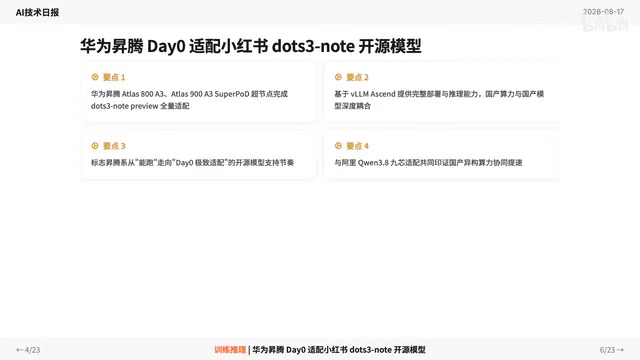
Deep coupling between computing power and models has become the new paradigm. Xiaohongshu's open-source model was adapted for Huawei's SuperNode and fully supported on the very day of release, and Alibaba has also validated the acceleration capabilities of domestic computing power alongside Qwen. Industry analysts predict the domestic SuperNode market could exceed one trillion yuan within three years. The Ascend 950 features 64 cards and 3,192 chips per rack, delivering 8 PFLOPS-level computing power, with the majority of chips being switch chips dedicated to managing inter-card data communication — which explains why demand for switch chips is expected to grow more than tenfold.
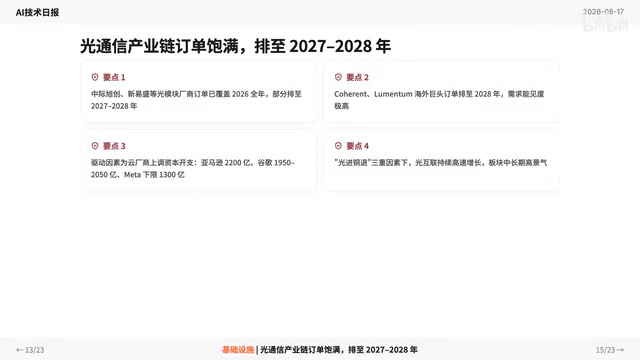
Domestic computing power is entering its "year of deployment," with optical communication orders already booked out for the next two years. On the hardware ecosystem front, companies like Innosilicon have launched domestically produced RISC-V gigabit network interface chips supporting USB 3.2 with transfer speeds up to 5,000 Mbps. Shipments exceeded one million units within three months, with the entire process completed domestically, accelerating the Xinchuang substitution process. RISC-V is an open-source instruction set architecture (ISA) that, unlike ARM and x86, is not subject to patent licensing from any commercial entity — any company can freely design chips based on this instruction set. Against the backdrop of U.S.-China tech competition, RISC-V has become a critical technological pathway for China's chip industry to achieve self-sufficiency. Xinchuang (Information Technology Application Innovation) is China's strategic initiative to drive domestic substitution of IT infrastructure, spanning chips, operating systems, databases, middleware, and the full stack. Innosilicon's million-unit shipment volume demonstrates substantive breakthroughs in domestic substitution at the fundamental network communications layer.
Cloud Giants Bet $600 Billion on Data Centers
Overseas markets are equally heated. Amazon, Google, and Microsoft — the three major cloud giants — have collectively committed $600 billion to data center construction, with Amazon exceeding $200 billion, Google at approximately $200 billion, and Meta at around $130 billion. This infrastructure arms race is driving high-level activity across the entire supply chain.
In terms of business models, enterprise customers can adopt a multi-tenant computing, asset-light operational model, shifting capital pressure to cloud vendors, whose revenues in turn flow upstream to power, optical communications, and chip suppliers. The multi-tenant GPU cloud model allows enterprise customers to rent cloud vendors' GPU/AI accelerator clusters on demand rather than building their own data centers, converting hardware procurement and maintenance costs — potentially tens or even hundreds of millions of dollars — into pay-as-you-go operational expenditure (OpEx). This dramatically lowers the financial barrier for AI startups and enterprise AI transformation. Cloud vendors, in turn, achieve returns through economies of scale and high utilization rates, passing capital expenditures upstream — purchasing GPU chips from NVIDIA/AMD, network chips from Broadcom/Marvell, optical modules from Innolight, along with massive amounts of power and cooling infrastructure. This clear value chain — from end-user AI applications to cloud computing to hardware supply chain — is the underlying logic driving the current AI infrastructure investment boom.
AI-Native Applications and Agents Move Toward Real-World Deployment
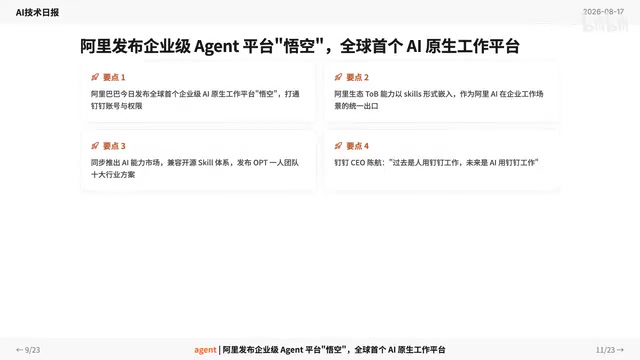
At the application layer, AI-native work platforms have become the new focus. Alibaba released "Wukong," an enterprise-grade AI-native work platform integrated with the DingTalk ecosystem. DingTalk's CEO offered a telling remark: "In the past, people used DingTalk to work. In the future, AI will use DingTalk to work."
An AI Agent refers to an AI system capable of autonomously perceiving its environment, formulating plans, invoking tools, and executing tasks — distinct from traditional "question-and-answer" chatbots. Multi-Agent Systems take this further: an orchestrator agent decomposes complex tasks into multiple subtasks, dispatching each to specialized sub-agents for execution. The Codex multi-agent system adopts precisely this architecture — after the orchestrator analyzes user requirements, it assigns code writing, testing, review, and other subtasks to different sub-models, each optimized for its specific task. Its support for "adjustable reasoning intensity" means users can make tradeoffs between speed and accuracy: lightweight reasoning for simple tasks to save costs, and deep reasoning for complex tasks to ensure quality. Request processing speed has reportedly improved significantly while costs have dropped substantially. This architecture is viewed as the key technical paradigm for AI's evolution from tool to "digital employee."
OpenAI has also launched a cybersecurity-specific model capable of handling approximately 95% of advanced security tasks, currently available only to vetted enterprise clients.
The robotics sector is heating up as well. Digital China has completed a strategic financing round exceeding 100 million yuan, accelerating the commercialization of bionic humanoid robots. Ant Group's Lingbo has initiated a 1.5 billion yuan funding round focused on building a "universal robot brain," already adapted for 17 manufacturers and over 20 types of robots. A "universal robot brain" refers to a general-purpose AI control system capable of adapting to robots of various hardware forms. In traditional robot development, each type of robot — industrial arms, humanoid robots, quadrupeds, etc. — requires separately coded control algorithms, resulting in high development costs and poor reusability. A universal robot brain leverages the generalization capabilities of large models to abstract visual perception, motion planning, and task understanding into a unified software layer, enabling a single AI system to drive different types of robots from different manufacturers — analogous to what Android does for smartphones, where hardware manufacturers focus on building the physical robot while the software platform provides general intelligence. The industry's center of gravity is shifting from pure hardware to a "brain + full-chain" systems approach.
Regulation and Industry Scale Advance in Parallel
Alongside rapid industry growth, regulation is keeping pace. China is accelerating comprehensive AI legislation. The core industry has exceeded 1.2 trillion yuan in scale, with over 6,200 companies, growth exceeding 30% in the first half of the year, and intelligent computing power reaching 2.8 times the level from the same period last year.
The Cyberspace Administration of China is advancing its "Clear and Bright" (Qinglang) special campaign to address AI application irregularities, proceeding in two phases: first, verifying registrations, safety datasets, and content labeling; then targeting issues such as deepfakes. This marks AI regulation's transition from "rule-making" to "enforcement and implementation." Deepfake technology uses generative AI to synthesize realistic but fabricated audio and video content and has become a global security concern, involving fraud, disinformation, and portrait rights infringement, among other issues. China's phased governance strategy — establishing a foundational compliance framework first, then focusing on specific risk areas — reflects regulatory wisdom in balancing innovation encouragement with risk prevention.
Conclusion
In summary, China's AI industry is characterized by four major trends: open-source models, systematized computing power, AI-native applications, and a structured regulatory framework. Domestic computing power has progressed from catching up to achieving system-level breakthroughs. The intensive open-sourcing of multimodal large models is lowering barriers to entry. AI Agents and robots are accelerating toward commercial deployment. And the parallel advancement of legislation and governance provides institutional safeguards for the healthy development of this trillion-yuan industry. The interweaving of these trends is reshaping the landscape of global AI competition.
Related articles

Bilibili's Hit Dify Tutorial: A Practical Guide to Building 20+ AI Apps from Scratch
A distilled guide to Bilibili's top-rated Dify tutorial: Windows + Docker deployment, MySQL connection, five app types, model integration strategy, and publishing.

Agent Skills Beginner's Guide: From Concepts to Multi-Agent Collaboration in Practice
A comprehensive guide to Agent Skills: core concepts, components, the importance of Description, standardization, beginner learning paths, and multi-agent collaboration.

One Neuron Detects Both Cats and Cars? We Reproduced It and Found a New Explanation
The cat-car neuron reinterpreted: researcher Cammarata argues it distinguishes pointy from round, not cats from cars. We reproduced the experiment and found the new explanation holds on most inputs—but cars are the exception. The interpretability debate continues on language models.