Building a Medical Graph Engine with FalkorDB+LangGraph to Solve the $260 Billion Claims Dilemma

Replacing vector RAG with a FalkorDB knowledge graph makes clinical coding provable and auditable.
The article highlights that doctors spend excessive time on EHR entry, and U.S. hospitals lose over $260 billion annually to claim denials, mainly from CO-50 (insufficient medical necessity) and CO-97 (procedure unbundling). It argues that mainstream ambient clinical documentation tools rely on vector RAG, which has three fatal flaws in healthcare. The team built OmniHealth Graph on FalkorDB and LangGraph, using the knowledge graph as the load-bearing engine for reasoning, memory, and governance: multi-hop Cypher queries generate auditable medical necessity evidence chains, intercept illegal NCCI unbundling before submission, detect cross-encounter drug contraindications via patient-private subgraphs, and surface denial risk with a hospital-level graph. GraphBLAS delivers 1-3 ms multi-hop latency, and deterministic graph binding reduces hallucinated codes to zero.
Building a Medical Graph Engine with FalkorDB+LangGraph to Solve the $260 Billion Claims Dilemma
Replacing vector RAG with a deterministic knowledge graph, moving clinical AI from "guessing" to "proving."
The Hidden Pain of Medical AI: Two Hours of Data Entry, $260 Billion in Denied Claims
Doctors' complaints about electronic health records (EHR) almost never involve patients—they involve screens. Data shows that for every 1 hour of direct clinical care, doctors spend over 2 hours on EHR data entry. Meanwhile, U.S. hospitals lose more than $260 billion annually due to claim denials.
Two denial codes account for enormous waste: CARC CO-50 (medical necessity denied)—payer automation systems believe physician notes fail to justify the medical necessity of a test or procedure; CARC CO-97 (procedure unbundling)—healthcare providers bill component codes separately that should be bundled under a comprehensive code, violating NCCI (National Correct Coding Initiative) edit rules.
With the generative AI wave, numerous ambient clinical documentation tools have emerged, but they almost all rely on the same architecture: vector RAG (Retrieval-Augmented Generation). In life-critical medical scenarios, vector RAG is fundamentally flawed.
NCCI (National Correct Coding Initiative) is a set of coding edit rules maintained by CMS in the U.S. to determine which medical codes can be billed together and which must be bundled. Its core logic is hierarchical: a "comprehensive code" semantically and clinically includes several "component codes," and billing them together constitutes unbundling. For example, CPT 93000 (12-lead ECG with interpretation and report) already includes 93010 (interpretation and report only), and the two cannot be billed together. NCCI rules are organized as one-to-many with modifier exceptions—naturally a graph structure rather than a flat list, which is exactly why vector indexes struggle to reason correctly.
CARC (Claims Adjustment Reason Code) is a standard code set used by payers to explain denials or adjustments. CO-50 indicates the payer believes documentation fails to prove medical necessity; CO-97 indicates the procedure was unbundled in violation of NCCI bundling rules. Both are "preventable denials"—as long as structured evidence validation is performed before submission, losses can be significantly reduced.
Three Fatal Flaws of Vector RAG in Medical Scenarios
Vector databases represent clinical concepts as points in high-dimensional embedding space, relying on cosine similarity to measure semantic proximity. In healthcare, this fails in three catastrophic ways:
1. Semantic Similarity Does Not Equal Clinical Proof
The cosine distance of 0.85 between "patient has chest tightness when climbing stairs" and "CPT 93000 (12-lead ECG)" might convince an LLM to generate an ECG code, but it will never satisfy a CMS auditor or an insurance claims algorithm. Payers demand deterministic, auditable causal relationships: symptom (chest tightness) → diagnosis (I20.9 angina) → procedure (CPT 93000 ECG). Vectors can only measure textual fuzziness; they cannot traverse relationships.
ICD-10 and CPT are the two major medical coding systems: ICD-10 describes diagnoses and symptoms (e.g., I20.9 angina), and CPT describes procedures and services performed (e.g., 93000 ECG). The key to a successful claim is not that "the text looks related," but that the three form an auditable causal chain: documented symptoms support a diagnosis, and that diagnosis under payer policy supports a procedure. This chain is constrained in the real world by policy rules, coverage determinations, and documentation requirements, so it must be explicitly modeled as nodes and edges to be verified hop-by-hop and presented as evidence.
2. Vectors Are Structurally Blind to Hierarchies (NCCI Edits)
Suppose a doctor performs a 12-lead ECG, interprets the rhythm, and writes a report. The LLM sees both "12-lead ECG" (CPT 93000) and "ECG interpretation and report" (CPT 93010) in the transcript and suggests billing both. But a flat vector index cannot understand that CPT 93000 is a comprehensive code that hierarchically includes the component code 93010. Billing both constitutes illegal unbundling, triggering automatic payer recovery (CARC CO-97).
3. Cross-Encounter "Amnesia"
Vector chunks in flat indexes lack tenant isolation and temporal lineage. If patient Robert Vance was prescribed sildenafil in urology 7 months ago and presents today with angina, the doctor considers prescribing sublingual nitroglycerin—a flat vector search for "chest pain treatment" has no structural awareness of the historical prescription. Nitroglycerin combined with an active PDE5 inhibitor can cause fatal refractory hypotension. Clinical AI cannot rely on probabilistic memory; it needs an explicit relational knowledge graph.
The Solution: OmniHealth Graph Powered by FalkorDB
To participate in the "Graph Hacks: Context for AI Agents Powered by FalkorDB" hackathon, we built OmniHealth Graph. FalkorDB is not a passive visualization tool or a side cache—it is the load-bearing context, reasoning, memory, and governance engine for the entire multi-agent LangGraph system.
System flow: Ambient clinical audio → speech ingestion → PII de-identification (HIPAA Safe Harbor) → FalkorDB retrieval node (symptoms + patient memory) → clinical SOAP agent → medical coding agent (FalkorDB medical necessity traversal) → compliance and audit node (FalkorDB NCCI unbundling traversal) → revenue and hospital brain (FalkorDB institutional denial hotspots) → review and guardrails (cross-encounter contraindication gate) → physician confirmation lock → idempotent write-back to FalkorDB (update patient memory).
Leveraging FalkorDB's GraphBLAS matrix multiplication engine and native OpenCypher query language, complex multi-hop graph algorithms execute with sub-millisecond latency.
LangGraph is a framework for orchestrating multi-agent workflows with a graph structure: nodes are agents or tool calls, edges define state transitions and conditional branches, and shared state passes between nodes. It is well-suited for deterministic pipelines like healthcare that require "retrieve first, reason next, validate last," because each step can be recorded, replayed, and audited. Using FalkorDB as LangGraph's context and memory backend means every agent decision is bound to entities and relationships already present in the graph, rather than freely generated.
GraphBLAS is a standard for expressing graph operations as sparse matrix algebra. FalkorDB includes this engine, enabling multi-hop traversals, reachability checks, and other operations to execute efficiently as matrix multiplications—this is the technical basis for its sub-millisecond to millisecond multi-hop query latency.
Track 1: Agents Acting on Connected Data
The medical coding agent and compliance node do not guess ICD-10 or CPT codes; they execute multi-hop Cypher queries against the clinical_rules graph.
Generating Tamper-Proof Medical Necessity Proofs
After the clinical agent extracts symptoms from the de-identified transcript, the coding agent queries FalkorDB to find valid paths connecting documented symptoms to diagnosis codes and reimbursable procedures. If a valid path exists, the UI renders the exact traversal as an interactive provenance pill trail: chest tightness → I20.9 (angina) → 93000 (12-lead ECG). If no graph path connects symptoms to procedure, the code is flagged as unproven, and the compliance agent prompts the clinician to supplement missing documentation before claim sign-off.
Preemptively Intercepting NCCI Procedure Unbundling
Before codes are finalized, the compliance node checks for illegal component unbundling. When a doctor orders both CPT 93000 (complete ECG) and CPT 93010 (interpretation), FalkorDB immediately catches the :INCLUDES edge, strips the redundant code, and saves the hospital from CARC CO-97 denials and audit penalties.
Track 2: Agent Memory and Cross-Encounter Safety
We solve the patient memory problem across clinical encounters through multi-tenant graph isolation. Each patient has a private subgraph patient_<id> within FalkorDB (e.g., patient_P-9801). When an encounter occurs, the patient's conditions, encounter dates, and prescribed medications are stored with explicit temporal edges.
A Life-Saving Pharmacovigilance Traversal
In a subsequent encounter (ENC-02), the patient is diagnosed with angina and the doctor prescribes nitroglycerin 0.4 mg. The review agent immediately executes a dual-graph cross-encounter query: querying the isolated patient_P-9801 subgraph for historical active medications; querying the shared clinical_rules graph for drug class contraindications. The result triggers a high-severity alert in the UI: Critical Contraindication Detected—nitroglycerin interacts with active sildenafil from ENC-01 (March 14, 2026), risk: fatal refractory hypotension.
An Unbypassable Clinical Governance Gate
To ensure safety, the system physically disables the "Approve EHR and Release Codes" button. The clinician must review the graph alert and check an explicit clinical override confirmation checkbox before the claim can be finalized. After approval, an idempotent Cypher write-back updates patient_P-9801, ensuring future agents inherit the new state.
Multi-tenant graph isolation means creating independently named subgraphs for each tenant (here, each patient) within the same database instance, with queries scoped to patient_<id> by default, structurally preventing cross-patient data leakage rather than relying on application-layer row-level filtering. Combined with timestamped edges, the system can also answer "what active medications did this patient have at the time of this encounter," which is a prerequisite for drug interaction assessment.
Idempotent write-back means repeated execution of the same operation does not change the final state: writing via deterministic node IDs and MERGE semantics ensures that network retries or repeated confirmations do not produce duplicate prescriptions or encounter records, guaranteeing consistency and traceability of graph memory.
Track 3: Institutional Hospital Brain
We model the hospital's collective enterprise knowledge in a dedicated hospital_brain graph, mapping departments (cardiology, internal medicine, emergency), attending physicians, high-frequency billing CPT codes, and historical denial reasons (CARC CO-50, CO-97, CO-16).
When a cardiology encounter is reviewed, the revenue agent displays an institutional denial risk card: CPT 93000 has a 14% historical denial rate due to CO-50 (lack of necessity) and 8% due to CO-97 (bundling issues). Clinicians and revenue cycle managers see the danger before submitting claims to payers.
Key Technical Takeaways from FalkorDB
- GraphBLAS delivers blazing speed: Multi-hop path Cypher graph traversals return in 1-3 milliseconds, far faster than vector similarity searches over dense embeddings.
- Deterministic graphs eliminate hallucinations: When LLM output is forced to bind to existing nodes and edges in FalkorDB, hallucinated medical codes drop to zero.
- Multi-tenant subgraphs provide natural isolation: No need for clunky row-level filters in relational databases or vector namespaces—FalkorDB seamlessly creates lightweight graphs for each patient.
- Resilient dual-engine architecture: Implements FalkorDB Cloud support (automatic TLS detection) combined with an embedded zero-latency in-memory graph fallback. Even if the network goes down, the application continues running uninterrupted.
Medical AI should not guess. With FalkorDB, we can prove.
One-line Summary
Replacing vector RAG with a FalkorDB knowledge graph makes clinical coding provable and auditable.
Paragraph Summary
The article notes that doctors spend enormous time on EHR entry, and U.S. hospitals lose over $260 billion annually to claim denials, with CO-50 (insufficient medical necessity) and CO-97 (procedure unbundling) as major waste sources. The author argues that mainstream ambient clinical documentation tools rely on vector RAG, which has three fatal flaws in healthcare: semantic similarity does not equal clinical proof, blindness to NCCI hierarchies, and missing cross-encounter memory. To address this, the team built OmniHealth Graph on FalkorDB and LangGraph, using the knowledge graph as the load-bearing engine for reasoning, memory, and governance: multi-hop Cypher queries generate auditable medical necessity evidence chains, intercept illegal NCCI unbundling before submission, detect cross-encounter drug contraindications via patient-private subgraphs, and surface denial risk with a hospital-level graph. GraphBLAS delivers 1-3 ms multi-hop latency, and deterministic graph binding reduces hallucinated codes to zero.
Related articles

M&M's Spent Millions Replacing Artificial Blue Dye — Why Is It So Hard?
Mars spent millions trying to replace artificial blue dye in M&M's with spirulina, but thick material clogs pipes and residue risks mold, forcing a full production-line rebuild. Here's the engineering behind the reformulation.
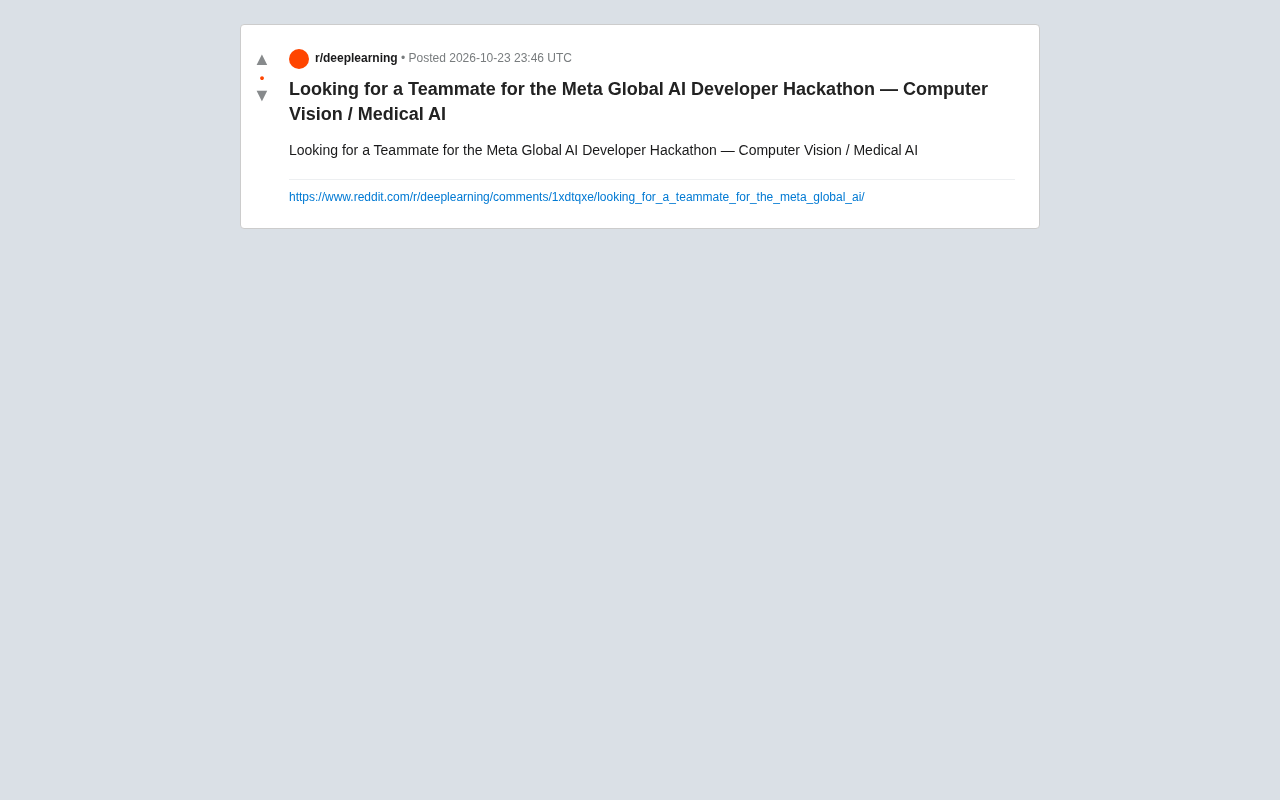
Teammate Wanted for Meta Global AI Developer Hackathon: Computer Vision & Medical AI
A Reddit developer seeks teammates for the Meta Global AI Developer Hackathon, focusing on computer vision and medical AI. This article analyzes the track logic, skills-complementarity needs, and topic selection strategy behind this teaming signal.
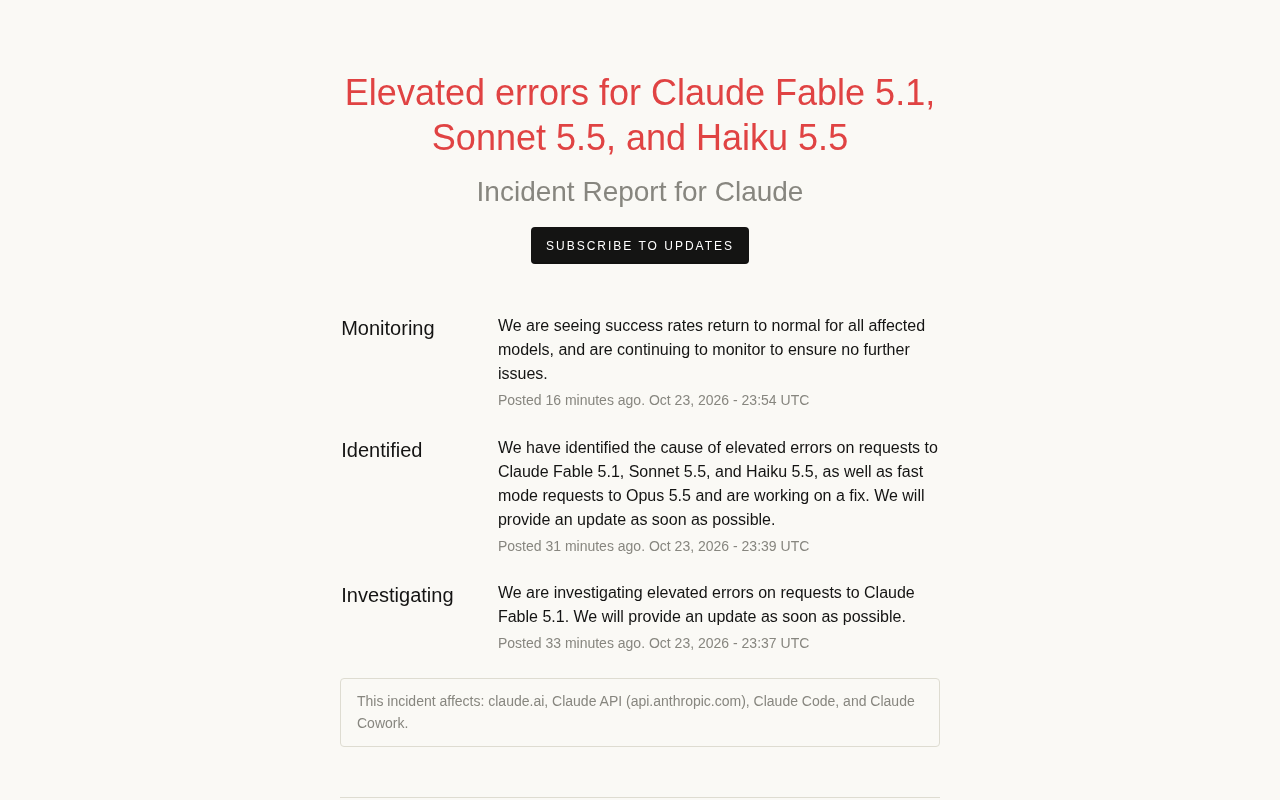
Multiple Claude Models Hit by Errors: A Postmortem of Fable 5.1, Sonnet 5.5, and Haiku 5.5
Claude Fable 5.1, Sonnet 5.5, Haiku 5.5, and Opus 5.5 fast mode saw elevated errors; Anthropic identified and resolved the issue in 17 minutes. This postmortem covers the timeline, the technical reasons for the multi-model cascading failure, and practical lessons for retry and degradation strategies.