Building an AI Agent from Scratch: The ReAct Paradigm and Architecture Blueprint

Break down how AI Agents work: ReAct loop at the core, plus Provider adapter, context, tools, and user entry points.
This article systematically explains the operational paradigm and engineering architecture of AI Agents. The core paradigm, ReAct (Reasoning and Acting), breaks execution into a closed "think–act–observe" loop, stopping tool calls when the model determines it has enough information. To handle multi-model switching, the architecture introduces a Provider Adapter as a decoupling layer, keeping core logic independent of specific model APIs. A complete Agent system also requires a context system for memory, a tool system for capabilities, and user entry points via platforms like WeChat or DingTalk. The layered architecture provides a clear, executable blueprint for implementation.
After clarifying "what an Agent is" in the previous section, the real question emerges: how does an intelligent agent actually work? This section breaks down the Agent's operational paradigm and the modules that make up a complete Agent system. Understanding this architectural blueprint will keep you from getting lost in the details when writing code later.
The Dominant Agent Paradigm: Why ReAct Is the Gold Standard
There's more than one way to run an Agent. Three popular paradigms exist today: ReAct, Plan and Execute, and Multi-Agent (multi-agent collaboration). Each has its own use cases, but the most widely used and the one most worth mastering first is ReAct.
ReAct stands for Reasoning and Acting. It originated from a paper published in October 2022, and despite the years that have passed, it remains the universally recognized gold standard in the Agent field. The vast majority of Agent products on the market run on ReAct under the hood. In other words, if you want to get serious about Agent development, understanding ReAct is non-negotiable.
The other two paradigms are worth a brief overview. Plan and Execute splits a task into two phases: a Planner generates a complete execution plan upfront, and an Executor carries it out step by step. This works well when tasks are structured and steps are predictable, but it relies heavily on plan quality — if the initial plan is wrong, errors tend to compound. Multi-Agent has multiple specialized agents working in parallel, each handling a specific subtask. It suits complex workflow automation but comes with increased scheduling and communication overhead. ReAct's claim to the gold standard lies in how it interweaves planning and execution — every step can dynamically adjust based on the latest observations, making it more fault-tolerant and better suited to the reality of incomplete task information.
The ReAct Loop: A Closed Cycle of Think, Act, Observe
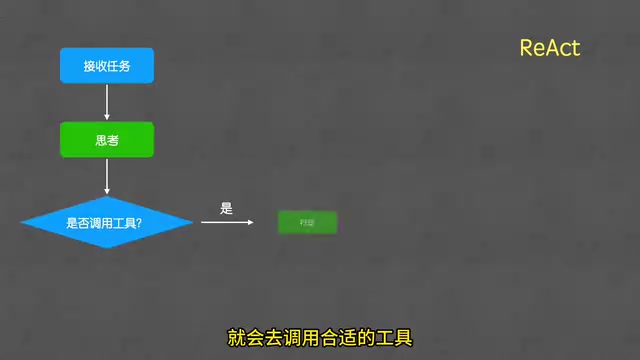
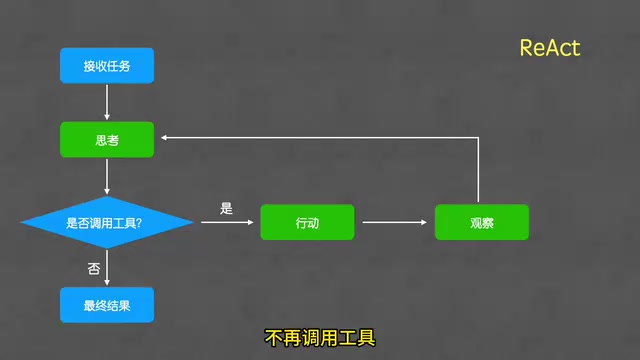
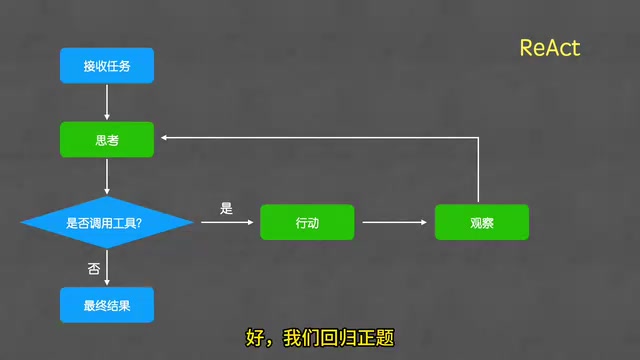
The ReAct process breaks down into a continuously repeating three-step cycle.
Step one: Reasoning. After receiving a task, the Agent starts by reasoning — figuring out what to do next and whether any external tools are needed.
Step two: Acting. If the conclusion is "a tool is needed," the Agent calls the appropriate tool — reading a file, modifying a file, and so on.
Step three: Observation. After the tool runs, the Agent examines the result — what content was read from the file, whether the modification succeeded, etc.
After observing, the Agent loops back to reasoning and decides again whether another tool call is needed. If yes, the "think–act–observe" cycle repeats. If no, the Agent outputs the final result. This continuously repeating process is what's famously called the ReAct Loop.
It's worth pointing out something here: "Loop" sounds impressive, but it's fundamentally just a loop. The AI field is full of intimidating-sounding new terms that, once stripped of their packaging, turn out to be surprisingly straightforward concepts.
The Critical Decision: When Does an Agent Stop Calling Tools?
The most critical step in the entire ReAct loop is the final judgment — the Agent decides no more tool calls are needed and outputs the final result. The logic behind this is worth unpacking.
Recall the core conclusion from the previous section: LLMs on their own cannot perceive or change the external environment. With tools, however, they gain the ability to do both. So when an Agent decides "no more tools are needed," it's essentially saying: the available information is already sufficient to complete the task.
What if the output still isn't satisfactory? If the information is already sufficient, the problem must lie with the model's own capabilities. It's like students who "understand a math problem at a glance but get it wrong when solving" — the conditions are all there, but the problem-solving ability itself is the bottleneck. The solution is straightforward: switch to a more capable model.
This also surfaces a potential risk: infinite loops. If the model lacks sufficient capability or the task goal is poorly defined, the Agent may fall into a dead loop of repeatedly calling tools without ever meeting the stopping condition. Engineering practice typically sets a Max Iterations limit as a safety valve — once exceeded, execution is forcibly terminated and the best available result is returned. The stopping judgment itself also depends on the model's reasoning ability: the model needs to correctly assess whether "the existing information is sufficient," which places high demands on the model's instruction-following capability. This is precisely why the choice of underlying model directly impacts overall Agent performance.
From Core Engine to Complete Architecture
The act of switching models directly surfaces a practical architectural design challenge.
Provider Adapter: Decoupling Models from Core Logic
There are many models out there — domestically, DeepSeekAd; internationally, OpenAI and Anthropic — and every provider has a different API. If you hardcode a specific model's API directly into the Agent's core code, you'll need to modify that code every time you switch models, which is extremely costly.
The solution is to introduce an intermediate layer: a Provider Adapter. All LLMs connect through this adapter, and the Agent's core logic interacts only with the adapter. Switching models then only requires adjusting the adapter — the core code stays untouched. This is a classic decoupling design approach.
At this point, the Agent's core engine takes shape: ReAct Loop + Provider Adapter. The structure is intuitive and clean.
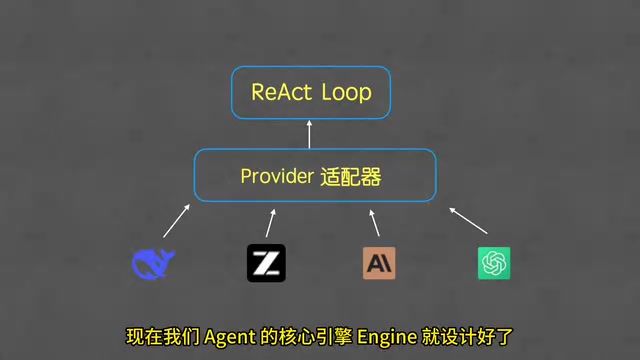
The Provider Adapter is a direct application of the Adapter Pattern from software design: define a unified interface specification, have different model APIs implement that interface, and write core logic against the interface rather than any concrete implementation. In practice, OpenAI has become the de facto interface standard — DeepSeek and several domestic providers offer OpenAI-compatible modes, which reduces adapter work to some extent. However, models still differ in context window size, function calling format, streaming output behavior, and other details. The adapter must handle these edge cases to prevent silent errors when switching models.
Adding Memory and Tools
A core engine alone isn't enough. Returning to the formula from the previous section: Agent = LLM + Memory + Tools. The core engine handles the LLM invocation. Now we need to add memory and tools.
Memory is essentially context — it requires a context system to maintain conversation and task state. Tools require a tool system to uniformly manage all callable capabilities. With these two components added, the Agent's main framework is essentially complete.
User Entry Points: Making the Agent Actually Usable
One final piece is missing — the user entry point. You can't expect every user to run code just to use the Agent. This means integrating with everyday communication tools like WeChat, DingTalk, or Feishu, so users can simply send a message to direct the Agent.
With that, the complete Agent architecture is in place: Core Engine (ReAct Loop + Provider Adapter) + Context System + Tool System + User Entry Points. The entire design is logically clear and builds progressively, laying the blueprint for the hands-on coding that follows.
Summary
The value of this section lies in transforming the abstract concept of an Agent into an actionable engineering blueprint. The ReAct three-step loop is the operational core, the Provider Adapter ensures flexibility, memory and tools fill in the capability gaps, and the user entry point brings the entire system within reach of actual users. With this structure clearly understood, the next coding phase has a well-defined direction to follow.
Related articles

Bilibili's Hit Dify Tutorial: A Practical Guide to Building 20+ AI Apps from Scratch
A distilled guide to Bilibili's top-rated Dify tutorial: Windows + Docker deployment, MySQL connection, five app types, model integration strategy, and publishing.

Agent Skills Beginner's Guide: From Concepts to Multi-Agent Collaboration in Practice
A comprehensive guide to Agent Skills: core concepts, components, the importance of Description, standardization, beginner learning paths, and multi-agent collaboration.

One Neuron Detects Both Cats and Cars? We Reproduced It and Found a New Explanation
The cat-car neuron reinterpreted: researcher Cammarata argues it distinguishes pointy from round, not cats from cars. We reproduced the experiment and found the new explanation holds on most inputs—but cars are the exception. The interpretability debate continues on language models.