Building Reliable Data Analysis Agents: Lessons from NVIDIA KGMON at KDD Cup

NVIDIA KGMON's KDD Cup runner-up result proves that shrinking the agent harness beats stacking more tools.
NVIDIA's KGMON team placed second at the KDD Cup data agent competition with a counterintuitive approach: instead of adding more tools and complex planning modules, they actively shrunk the execution harness. Data analysis demands high precision, and errors in multi-step reasoning compound quickly — an overly complex toolchain only amplifies that risk. A smaller harness yields more predictable behavior, easier failure diagnosis, and cleaner execution tracing, forming the foundation of production-grade agent reliability. The core principles: constraints are a feature, observability is infrastructure, and reliability beats capability stacking.
Data analysis agents are becoming one of the hottest applications for deploying large language models in enterprise settings — yet a massive gap remains between polished demos and reliable production systems. NVIDIA's KGMON team placed second in the KDD Cup data agent competition, and their core insight is worth paying close attention to: make the agent's execution harness smaller and more controllable, rather than piling on increasingly complex toolchains.
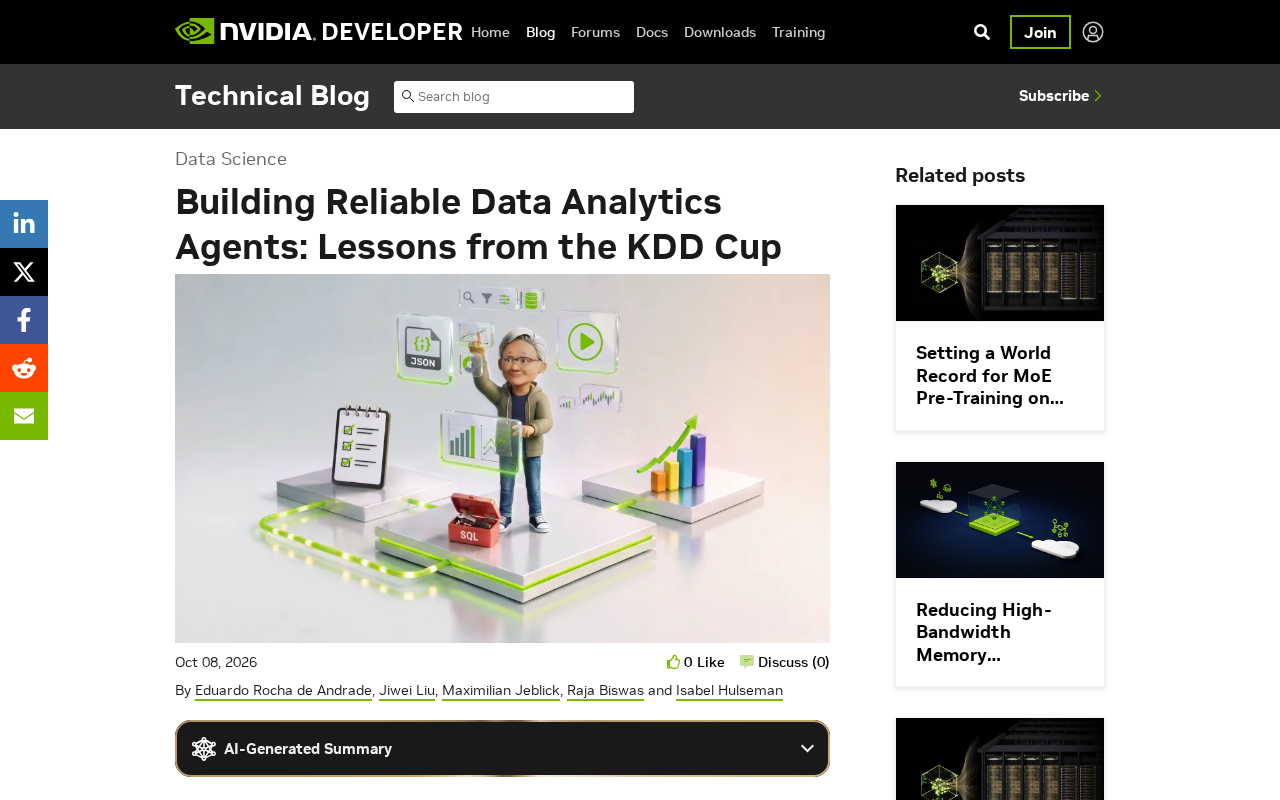
Why Data Agents Are Hard to Rely On
Data analysis tasks present unique challenges for agents. Unlike open-ended conversation, which can tolerate ambiguity, data analysis demands precise understanding of structured data, accurate SQL or code generation, and consistent multi-step reasoning. A failure at any single step can cause the final result to go completely off the rails.
In real-world scenarios, agents must contend with dirty data, ambiguous field names, and vague user queries. A seemingly simple request like "summarize regional sales for last quarter" actually involves understanding table schemas, mapping fields, handling aggregation logic, and managing edge cases. When an agent is given too much freedom and an overly complex toolset, errors compound across each reasoning step.
From an architectural standpoint, data analysis agents typically follow one of two dominant patterns: "ReAct" (Reasoning + Acting) or "Plan-and-Execute." ReAct has the model execute an action immediately after each reasoning step, observe the result, and iterate until reaching an answer. Plan-and-Execute generates a complete plan upfront before executing it step by step. Both patterns suffer from "error accumulation": a misjudgment in an early step gets accepted as a premise by subsequent steps, causing systematic drift in the final answer. The KDD Cup competition specifically tests whether an agent can maintain logical consistency across multiple reasoning rounds in a controlled but complex data environment — which is precisely where today's LLMs are most fragile on structured tasks.
A Smaller Harness: The Philosophy of Simplicity
The KGMON team's central argument is to shrink the agent's execution harness. The "harness" here refers to the scheduling and tool-orchestration layer that wraps the model — it determines which tools the model can call, in what order, and how intermediate results are handled.
The industry's prevailing instinct is to keep adding capabilities to agents: more tools, longer prompts, more sophisticated planning modules. But this often backfires. The more tools available, the higher the probability the model picks the wrong one. The more complex the steps, the harder it becomes to debug and assign blame. KGMON took the opposite approach, using a leaner framework to improve reliability.
A smaller harness means each step is more predictable and easier to verify. When system behavior is sufficiently transparent, developers can clearly identify failure points instead of endlessly trial-and-erroring inside a black box. This design philosophy is especially valuable in the high-pressure environment of a competition — a reproducible, debuggable system outperforms a hastily assembled "do-everything" solution.
In agent engineering, the "harness" concept corresponds to the "agent executor" layer provided by mainstream frameworks like LangChain, LlamaIndex, and AutoGen. This layer manages the tool registry, decides when to invoke tools, injects tool return values into context, and determines when to terminate the reasoning loop. The relationship between tool count and reliability is nonlinear: research and practice alike show that when available tools exceed 5–7, the model's probability of selecting the wrong tool increases significantly, because it must make judgments across a much larger action space. KGMON's "shrink the harness" strategy is fundamentally about deliberately compressing this action space — trading domain constraints for reasoning accuracy.
Engineering Lessons from Competition to Production
Reliability Over Capability Stacking
The value of competitions like KDD Cup lies in how unified evaluation criteria surface truly effective engineering practices. KGMON's second-place finish demonstrates that in the data agent space, doing things consistently right is more valuable than occasionally doing something brilliant. Enterprise deployments aren't one-off demos — they're repeated thousands of times, and any uncontrolled variability gets amplified at scale.
Constraints Are a Feature
Setting clear boundaries for an agent may seem like it limits capability, but it actually raises the overall trustworthiness of the system. An agent that handles a small number of tasks reliably every single time is far more production-ready than one that claims to do everything but fails unpredictably. This aligns directly with the Unix philosophy of "do one thing and do it well."
Observability Is Infrastructure
When the harness is simple enough, intermediate states become observable and loggable. This lays the groundwork for monitoring, evaluation, and continuous improvement. A production-grade data agent doesn't just need to work once — it needs to maintain quality over long-term operation, which requires clear traceability of every execution step.
In traditional software engineering, observability is achieved through the three pillars of Logs, Metrics, and Traces. But agent systems introduce new complexity: the model's step-by-step "thinking" itself is intermediate state that needs to be captured. The industry has already produced LLM-specific observability platforms such as LangSmith, Langfuse, and Arize Phoenix, which can record the inputs and outputs of every tool call, token consumption, and latency. For data analysis agents specifically, observability also means tracking the semantic correctness of generated SQL — not just whether it executes successfully. A SQL query that runs but returns the wrong result is more dangerous than one that throws an error, because the system will silently accept it.
Practical Takeaways for Your Team
For teams actively building data analysis agents, KGMON's experience suggests several actionable directions. Start with the minimal viable toolset and only add capabilities when genuinely necessary. Design verifiable outputs for each critical step rather than relying on end-to-end black-box behavior. Treat debuggability as a first-class concern in architecture decisions.
The competition results themselves may not transfer directly to every business context, but the methodology of "simplify the framework to gain reliability" is broadly applicable. As more enterprises push LLM agents into production, finding the right balance between capability and controllability will be the deciding factor in whether those projects succeed.
Conclusion
NVIDIA KGMON's work at the KDD Cup data agent competition offers the broader industry a grounding reference point: truly reliable agents aren't built by stacking endless features — they're refined through disciplined design, well-defined boundaries, and observable execution logic. In a moment when agent technology is evolving at breakneck speed, this kind of engineering pragmatism is especially valuable.
Related articles

The Chaotic Aesthetics of Apple's HomeView Ad: A Marketing Code Only Parents Can Read
Apple's HomeView smart display ad ditches minimalist style for chaotic family mornings to win over parents. We analyze why it confuses most viewers but resonates instantly with families — and the trade-offs and risks of Apple's targeted marketing.

Cerebras CEO Pushes Back on AI Doomerism: Stop Spreading Panic
Cerebras CEO Andrew Feldman publicly pushes back on AI doomerism at TechCrunch Disrupt, arguing excessive risk focus drowns out AI's real opportunities.

Retooling in Minutes: Industrial Next Redefines Factory Robot Flexibility
Industrial Next aims to let factory robots retool in minutes instead of weeks, automating complex delicate tasks and advancing flexible manufacturing and small-batch production.