Burned Through 1.3 Billion Tokens and Tens of Thousands of Yuan to Build 500 Websites with AI
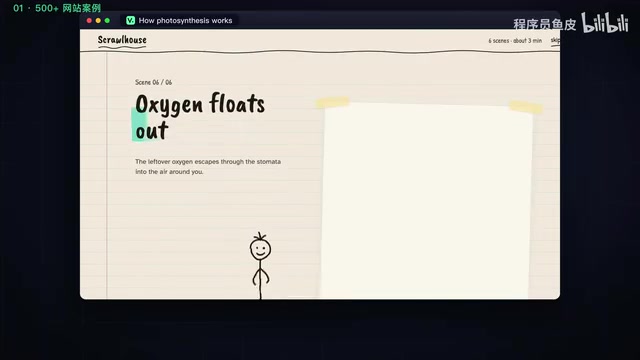
Bilibili creator Yu Pi built Vibefather, an AI website template library with 500+ AI-generated sites and full prompts.
Vibefather is an AI website template library by Bilibili creator Yu Pi, featuring 270+ templates and 500+ live sites all generated from scratch by AI coding tools. Each template includes full prompts and design docs (up to 70,000+ characters), covering tech stack, copy, colors, fonts, animations, and licenses—open-sourced on GitHub. Cases span industry sites, web PPTs, interactive courseware, 3D games, and app prototypes. Integrate via Skill, MCP, or CLI for AI-driven template search. The library has consumed over 1.3 billion tokens, cross-generated with 9 models and 7 tools, with zero paying users so far.
AI coding tools can already generate websites—that's not news. But if you start from scratch every time, telling the AI "build me a landing page," what you get is often generic and obviously fake. The real problem isn't whether AI can do it, but whether you can articulate your requirements clearly—color schemes, fonts, layouts, animations, even the copy for each section. That process is both time-consuming and token-burning.
Bilibili creator Yu Pi (hereafter "Yu Pi") solved this by stepping on all the landmines in advance and putting the refined prompts and finished websites right out in the open. He built an AI website template library called Vibefather, which currently hosts over 270 templates and more than 500 websites you can open online—all generated from scratch by AI coding tools. By his count, the entire library has burned through over 1.3 billion tokens, and the membership fees across various AI services add up to "several thousand to tens of thousands of yuan, easily."
What 500 Websites Look Like: From Sushi Restaurant Sites to 3D Games
The cases on Vibefather span a wide range. The most common are official sites and landing pages across industries—sushi restaurants, gyms, boutique hotels, aquariums, hot air balloon tours, music festivals, perfume, watches, streetwear limited drops—each with its own complete visual style.
The more interesting ones are the less "traditional" cases. For example, a web-based PPT you can flip through with arrow keys, with data charts that animate along; or interactive courseware that includes a pop quiz while explaining sorting algorithms. In Yu Pi's words: "There are plenty of tools for making PPTs with AI, but turning a PPT into a website means you can add any interaction you want—the freedom is far greater."
Knowledge-explainer sites are also systematic: a hand-drawn photosynthesis explainer where scrolling down makes a little stick figure draw the sun and leaves stroke by stroke; sites explaining how the heart beats, sorting algorithm visualizations, how large models predict the next word, and draggable 3D models showing the Colosseum from foundation to completion to ruin.
There are also plenty of 3D games you can play right in the browser—mountain obstacle courses, city driving, first-person sci-fi shooters, and even a 3D electronic wooden fish. You can even build entire app interfaces: a danmaku video community, vertical short videos, livestream shopping rooms, a community with a trending list—more than enough for product prototypes.
The Prompts Are the Core Asset: One Over 70,000 Characters Long
Each template's detail page includes the complete prompt that generated it and a design style document. The prompt explains how the entire website should be built, while the design document separately organizes visual specifications like colors, fonts, and animations. Both documents have a Copy button next to them.
Yu Pi revealed that these prompts are extremely thorough—typically 10,000 to 20,000 characters each, with the longest exceeding 70,000 characters—covering the tech stack, page structure, copy for each section, color schemes, fonts, animations, the open-source license of every dependency, and even how each step of a sorting algorithm should be implemented. All spelled out clearly.
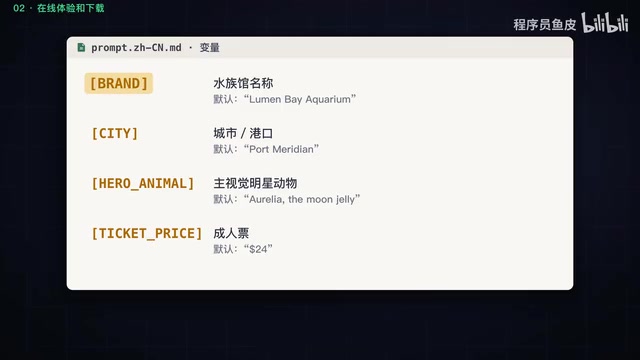
Places in the prompt that need replacing are marked with square brackets. For the aquarium template, for instance, swap in your own name, city, star animal for the main visual, and ticket prices, and the AI will rewrite all the copy for the entire site. For the same aquarium template, GLM5.3 and DeepSeekAd V4.1 Flash each produced a case—click to switch between previews. The DeepSeek case was made by taking the same prompt and swapping the variables to a butterfly conservation center—the color scheme and layout are identical, but the star changed from jellyfish to blue morpho butterflies.
If you already have a finished project and just think the interface isn't pretty enough, you can hand just the design document to the AI and have it restyle the interface without touching the original content or functionality. And if you want to skip even the AI generation step, you can just download the source code—unzip it and you have a runnable project.
Prompt Engineering and Context Length
The "10,000 to 70,000 characters" prompts mentioned in the article touch on a key metric for large models—the context window. Character count doesn't directly equal token count: English roughly maps 4 characters to 1 token, while Chinese typically maps 1 character to about 1–2 tokens, so a 70,000-character prompt alone could consume tens of thousands of tokens. This explains two things: first, why the cost of a single generation isn't low; second, why models need long-context capabilities to fully "understand" the entire requirement. Early models had contexts of only 4K or 8K tokens—nowhere near enough for prompts of this scale. Today's mainstream models commonly support 128K or more, which is what makes "one document describing an entire website" feasible. The core of prompt engineering is breaking vague requirements into structured constraints the model can execute—tech stack, page structure, copy, colors, animations, each spelled out—reducing deviations caused by the model's free interpretation.
Agent Skills and MCP
The Skill, MCP, and CLI mentioned repeatedly in the article are three types of integration in the AI coding tool ecosystem. A Skill is a preset capability description and workflow for an AI agent—after reading it, the agent knows "when a website-building request comes in, first search for templates somewhere, then download the prompt." MCP (Model Context Protocol) is an open protocol proposed by Anthropic that lets AI tools connect to external data sources and tools in a unified way—essentially a standardized "plug" for the model; once connected, it can query the template library and read prompts. CLI is a command-line tool, suitable for direct invocation in the terminal. All three are fundamentally the same: turning external resources into capabilities the agent can invoke autonomously, so you don't have to manually paste everything into the conversation—saving tokens and reducing manual labor.
Why It's Worth Using: Token Costs and Model Comparisons
Yu Pi calculated that, assuming the prompt is already refined, the median token consumption for AI to build a website is about 4.6 million. If you factor in the process of figuring things out from scratch and going back and forth, it's only more. So his logic is straightforward: rather than having AI start from zero every time, let it build on already-validated templates—faster and more token-efficient.
There are three ways to integrate. The simplest is to click "Use in AI" on a template's detail page, which jumps you to various AI tools with the instructions pre-filled. More recommended is installing Vibefather's Skill—one command does it. Once installed, you just tell the AI "help me make a coffee subscription landing page, warm style," and it will search Vibefather for suitable templates and pick a few with online demos for you to choose from.
He actually tried it with Codex: the agent first read Vibefather's skill, quickly found two templates—"warm-toned café" and "natural farm"—and provided demo links for him to pick a direction; after choosing, the agent downloaded the template's prompt and design document into the project, asked for the brand name and other details, then built the website according to the prompt. There are also MCP services and CLI command-line tools—once integrated, AI can search templates and fetch prompts at any time.
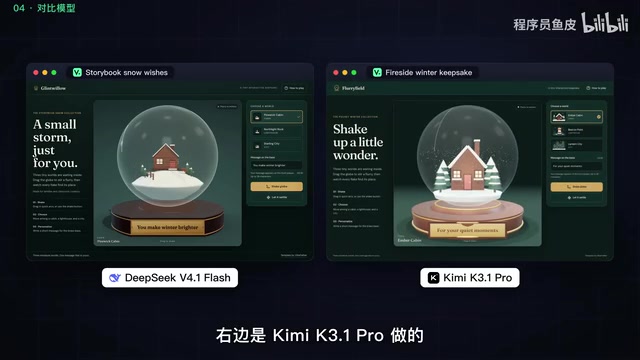
Another hidden value is comparing different models' results. For the same prompt template, Yu Pi generally used two or more models to generate, and the site has dedicated comparison pages. For example, a snowball toy template: the left side is DeepSeek V4.1 Flash's version, the right is Kimi K3.1 Pro's—the structure is essentially identical, but Kimi's version has noticeably more refined snow on the cabin roof and the cedar trees beside it.
The stats page also aggregates some interesting data: AI's favorite tools for building websites are React and TailwindCSS, used by over 80% of sites; nearly 30% are multi-page sites; the median number of files per site is 32. Currently, 9 models have been used across the site—including Claude, GPT, Gemini, Grok, Kimi, GLM, and DeepSeek—running in 7 AI tools such as Claude Code, Codex, and Cursor.
Tokens and Cost Accounting
A token is the basic unit of text processed by large models, with input and output billed separately—output usually costs more. The "median of about 4.6 million tokens to build a website" is a substantial amount—roughly estimated at a few dollars to a dozen-plus dollars per million tokens, a single website's generation cost could reach tens of yuan, and with repeated revisions and error retries, actual expenses multiply. This is exactly where the template library's value lies: the templates have already paid the trial-and-error cost upfront, so users only need to do variable substitution on validated prompts, compressing what would have been millions of tokens of "exploratory consumption" into one relatively deterministic generation. It's worth noting that different models and tools (Claude Code, Codex, Cursor, etc.) have different billing methods and context management strategies, so actual costs vary significantly—4.6 million is only an order-of-magnitude reference, not an exact bill.
The Cost Truth: How 1.3 Billion Tokens Were Burned
These 500+ cases were each built by a real AI agent from zero in an empty project, based solely on one prompt. For the same prompt template, Yu Pi generally ran it through multiple models.
He opened memberships for Zhupu, GLM, Kimi, GPT, Grok, and others, and whenever the 5-hour usage limit was maxed out, he'd just wait for the next 5-hour refresh before letting the AI continue working. Back and forth like this, just generating templates took several weeks.

Generating templates isn't the end either. He also had the agent screen-record each website to demonstrate its actual effect, then checked them one by one—if the effect wasn't good, he'd go back and adjust the prompt, regenerate, and re-record. Before each website goes live, there's also automated checking: whether there are console errors, whether it secretly requests external resources, whether the dependencies and fonts used can be commercially licensed, plus screenshots reviewed on both desktop and mobile.
"These are all costs," he said in the video. As of now, paying users are still zero. His plan is to first get the content and template quality right, then continuously optimize SEO and GEO so the site gets seen by more people and more AI.
Usage Quotas and the Cost of Multi-Model Comparisons
Premium memberships for AI coding tools generally use a "rolling time window + usage cap" mechanism—for example, quotas reset every 5 hours, and once exhausted you can only wait for a refresh or downgrade to a weaker model. This design is sufficient for ordinary users but unfriendly for batch generation scenarios like "running the same prompt across multiple models"—1.3 billion tokens wasn't done in one go, but pieced together through multiple accounts, multiple models, and multiple rounds of waiting. Multi-model comparison also has methodological significance: keeping the same prompt fixed and only changing the underlying model is the only way to attribute differences to model capability rather than requirement description—this is the controlled-variable approach. The snowball toy template comparison in the article (Kimi being more refined in snow and cedar details) is a direct product of this method, with practical reference value for model selection.
Open Source and the Name: Everything Is Vibe
The prompts and design documents are all open-sourced on GitHub, with one folder per template, and prompts come with Chinese translations. The Vibefather website itself is in English—it's an overseas product, after all—but you can still learn from it even if you don't read English.
Regarding the name, Yu Pi explains it clearly: many people assume vibe means the vibe in vibe coding, but he intends more than that—vibe can refer to any AI-generated content. Currently the site mostly features industry and creative websites, but animated knowledge explainers and web-based PPTs are essentially AI-made animated videos delivered via a website. Websites are just Vibefather's initial form—"everything is vibe from now on."
He spent a lot on the domain name alone, and immediately after buying it, he also grabbed the package name on NPM—all within three hours. This is his second attempt at going overseas; he'll continue adding new templates and, whenever a new model is released, will be the first to run it through.
Vibe and SEO/GEO
The term "vibe" became popular thanks to vibe coding, coined by Andrej Karpathy, referring to a programming approach where you describe intent in natural language and AI generates the code. The article extends it to "any AI-generated content," emphasizing that websites are just one medium. Another concept worth adding is GEO (Generative Engine Optimization), which differs from traditional SEO in that SEO fights for rankings on search engine results pages, while GEO fights to be cited and recommended by large models in their answers. For content-based products like template libraries, making website structure and documents friendly to AI crawling and understanding is becoming a customer acquisition method as important as traditional keyword optimization.
One-line Summary
Bilibili creator Yu Pi built the AI website template library Vibefather, hosting 500+ AI-generated sites and full prompt sets.
Paragraph Summary
Vibefather is an AI website template library created by Bilibili creator Yu Pi, hosting over 270 templates and 500+ websites openable online—all generated from scratch by AI coding tools. Each template's detail page includes the complete generation prompt and design style document, the longest exceeding 70,000 characters, covering tech stack, page structure, copy, colors, fonts, animations, and even open-source licenses, and is open-sourced on GitHub. Cases cover industry sites, web-based PPTs, interactive courseware, 3D games, and app interface prototypes. Users can integrate via Skill, MCP, or CLI so AI can search templates and build on them, significantly saving tokens. The entire library has consumed over 1.3 billion tokens, with the author maxing out usage across multiple AI memberships. The same prompts were cross-generated with 9 models and 7 tools, with model comparison and stats provided—currently with zero paying users.
Related articles

DeepSeek SuperAgent Architecture Explained: A New Multi-Task Concurrent Agent Paradigm
DeepSeek Harness proposes SuperAgent architecture: a Router+Worker two-layer team model solving context confusion, loop blocking, and local sleep in multi-task Agents.

AI Now Generates GIFs Directly: The Era of Unlimited Custom Stickers Has Arrived
AI can now generate GIFs directly. Learn how to use GPT's Images 2.6 to create sticker GIFs with reference images and story prompts, plus sprite sheet frame-level editing, real-person performances, and chat log generation.
Claude Code Practical Guide: Installation, Permission Modes, and Productivity Tips
Based on a Bilibili creator's hands-on sharing, this guide covers Claude Code installation (NPM recommended), permission modes, slash commands, CLAUDE.md configuration, context management, and practical tips for stable use and avoiding account bans.