DeepSeek SuperAgent Architecture Explained: A New Multi-Task Concurrent Agent Paradigm

DeepSeek proposes a Router+Worker two-layer SuperAgent architecture that uses team collaboration to break through multi-task Agent bottlenecks.
The DeepSeek Harness team proposes the SuperAgent architecture to solve the three pain points of single-session Agents in multi-task parallelism—blocking loops, context confusion, and local-sleep shutdowns. Drawing on project team management, it designs a Router (project manager) + Worker (engineer) structure, combined with event-driven fast/slow path filtering, chain of recall, speculative execution, full-duplex communication, and storage-compute separation with BYOM, achieving continuous, efficient, proactive, and persistent capabilities. Experiments show doubled speed and greater stability, but Token consumption is 2-4x higher, and security and long-term memory remain open questions.
Traditional AI Agents are falling into an awkward bottleneck: they get better and better at individual tasks, but when you handle multiple tasks at once, the human ends up being the busiest "messenger." The SuperAgent architecture proposed by the DeepSeek Harness team attempts to give Agents truly continuous, efficient, proactive, and persistent working capabilities through a "project manager + engineer" team collaboration model.
The Three Major Pain Points of Traditional Agents
Current mainstream Agents—whether Claude Code, Codex, or DeepSeekAd Harness—all work in units of "sessions." You open a session to assign a task, and the Agent loops through the "think-act-observe" React Loop until the task is complete. This is efficient in single-task mode, but as soon as multiple tasks run in parallel, problems surface.
As DeepSeek itself puts it: the ceiling for a single task depends on model capability, while the ceiling for multiple tasks depends on human attention. A person can typically only follow three to five active sessions at once—the more capable the AI, the more exhausted the human. Even if you connect the Agent to channels like Feishu via CLI and MCP to auto-receive tasks, as long as the underlying layer remains single-session, you'll hit three hard limitations: the entire loop stalls when executing time-consuming commands, multiple requests crammed into one session cause context confusion, and the Agent runs on a local computer that stops working the moment it sleeps.
The React Loop (the think-act-observe cycle) is the core execution paradigm of current mainstream Agents: the model first reasons out the next action, calls a tool to execute it, observes the returned result, then continues reasoning based on the new observation, repeating until the task is done. This half-duplex, serial loop structure means the Agent cannot process new input while waiting for a time-consuming tool (such as compilation, crawling, or long commands) to return—which is also the root cause of "stalling" and "context confusion" in multi-task scenarios. Understanding this is key to understanding why SuperAgent transforms it into event-driven and full-duplex asynchronous communication.
SuperAgent's Four Core Characteristics
DeepSeek defines SuperAgent as "a continuous worker that can remember context across sessions, advance multiple things simultaneously without interfering with each other." It has four foundational characteristics:
- Continuous: Whether communicating in a Feishu group or on GitHub, the Agent can keep up with context switches. For example, if you say in the group to use Plan A, and later change to Plan B in a PR, it seamlessly follows along.
- Efficient: It can advance multiple things at once and can accept the next instruction even before finishing the previous one.
- Proactive: It watches group messages and tickets on its own, proactively handling what should be handled and staying quiet about what it shouldn't touch.
- Persistent: It's always online and can recover on its own when problems arise.
DeepSeek has a real running case internally: a user raised a request in a group, hoping that the fonts for body text, code, and terminal could be configured separately. A maintainer @-mentioned SuperAgent, and it quickly went to GitHub and submitted improvement code. Following up on questions in the group and the maintainer's suggestions on GitHub, it kept pushing the request all the way to code merge. It can even identify bugs on its own from product user groups, autonomously reproduce them in the background, find the root cause, and directly post the fix code along with before-and-after comparison screenshots.
Architecture Breakdown: Router Layer and Worker Layer
SuperAgent's architecture is directly inspired by real-world project teams. Suppose you have 20 things on your plate at once: hand them all to one person, and information flows but everything queues up; find a new person for each task, and they can all start simultaneously but information gets out of sync and reporting becomes chaotic. The real-world solution is to hire a project manager and pair them with a few engineers.
SuperAgent is divided into two layers: the upper Router layer acts as the project manager, always online, where messages from all channels first converge. It remembers the global picture, communicates with you, and assigns work to engineers. The lower Worker layer acts as engineers—each Worker has its own independent context, focuses on doing one thing well, reports back to the project manager when done, and the project manager then replies to you on their behalf. You always face the same point of contact.
The Router layer doesn't do the work itself—it only handles communication and task assignment, so a lightweight model suffices. What truly determines delivery quality is the Worker, which is where the strongest model is needed. Won't all messages going through the Router overwhelm it? In practice, DeepSeek found this isn't a big problem: while the Router is processing a batch of messages, new messages accumulate and are reviewed and dispatched together once it's free. With this batching mechanism, the more messages there are, the faster the average processing becomes. Workers generally don't communicate directly with each other—if two Workers modify the same PR, they both receive new activity on that PR simultaneously and can coordinate on their own. When a task is too complex, a Worker can pull in a few SubAgents to help—essentially an engineer bringing along their own interns.
Event-Driven and Fast/Slow Path Filtering
Traditional Agents do work each time you say something; SuperAgent is driven by what happens in the environment. A new message arrives in a group, someone comments on a PR, a code build fails—DeepSeek collectively calls these events Triggers.
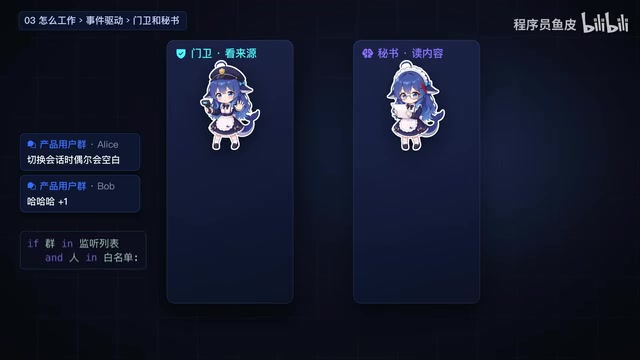
But letting AI watch group messages directly reveals too much noise, and having the large model judge every message is both slow and expensive. DeepSeek's approach is two-tier filtering: at the door there's a "gatekeeper" that only looks at message source—such as whether it's a monitored group or whether the sender is on the whitelist—which can be judged instantly with ordinary code. Behind it there's a "secretary" responsible for reading content; messages that pass the gatekeeper are then handed to the large model, which decides whether to handle them based on rules written into the prompt. This is the FastPath/SlowPath concept from computer systems.
After task assignment, how much material to give the Worker is also a science: give too much and the key points get buried; give too little and the Worker has to repeatedly come back to ask. DeepSeek borrows two compiler concepts—Inline (conveniently attaching a few surrounding chat messages and related ticket numbers) and Spill (for a tens-of-thousands-word document, provide only a summary and an ID saying "see here for the full content")—to build a Chain of Recall system. Every message, every ticket, and every Worker has an ID; cards contain only summaries and associated IDs, and when an old matter is brought up across platforms, you simply follow the IDs down the chain.
The FastPath/SlowPath concept originates from operating system and network system design: high-frequency, rule-clear requests go through the fast path, handled in seconds with cheap logic (such as hashing, whitelists, or regex); only complex requests that cannot be quickly judged enter the slow path, where expensive resources (such as large models) perform deep processing. This layered filtering significantly reduces average system latency and cost. SuperAgent migrates this to message filtering, using the "gatekeeper + secretary" two-tier mechanism to avoid triggering large-model inference on every group message—a typical cost-latency optimization technique in Agent engineering.
Speculative Execution and Full-Duplex Communication
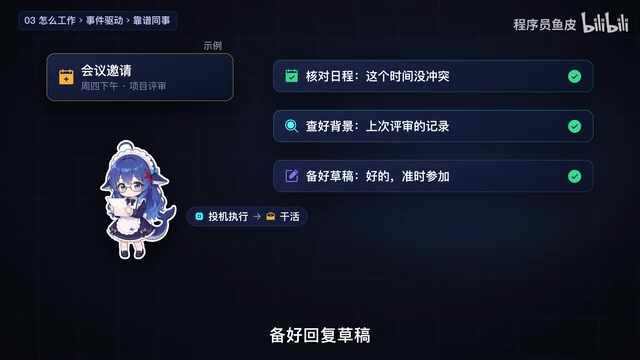
SuperAgent also borrows the idea of CPU speculative execution: precompute ahead when it's uncertain whether a piece of computation will be used—if it's used, great; if not, discard it. For example, when you receive a meeting invitation, it first verifies your schedule, looks up background materials, and prepares a draft reply in the background—you just confirm and send. Of course, proactive doesn't mean reckless. In DeepSeek's open-source prototype, proactive work that no one requested must be backed by rules the team has written in advance, and by default it starts in observation mode—only recording what it plans to do without actually acting—until you've confirmed its judgment is reliable enough to enable.
Traditional Agents ignore new messages once they start working, because the React Loop is half-duplex—like a walkie-talkie where only one side can talk at a time. SuperAgent replaces the walkie-talkie with a telephone, achieving full duplex: time-consuming tool calls are changed into asynchronous commands that return immediately upon launch, allowing the Agent to keep chatting with you, with the result sent back as a new message once the command finishes. There are also rules for speaking across different channels: in Feishu it only sends messages when you need to make a decision, with each reply capped at 100 words; on GitHub and email it must clearly describe the problem background, changes, and verification results.
Speculative Execution is a classic optimization in CPU pipelines: before a branch outcome is determined, the most likely branch is executed in parallel in advance—if guessed correctly the result is used directly, and if guessed wrong it's discarded and rolled back, thereby hiding waiting latency. In the Agent context, it means completing part of the work in advance based on high-probability intent (such as checking schedules or preparing drafts) without waiting for an explicit user instruction, so that once the user confirms, it can respond instantly. The risk is that "guessing wrong" wastes compute and may even produce side effects, so SuperAgent pairs it with rule constraints and observation mode—recording without executing first—introducing speculative capability in a controlled way.
Storage-Compute Separation and BYOM
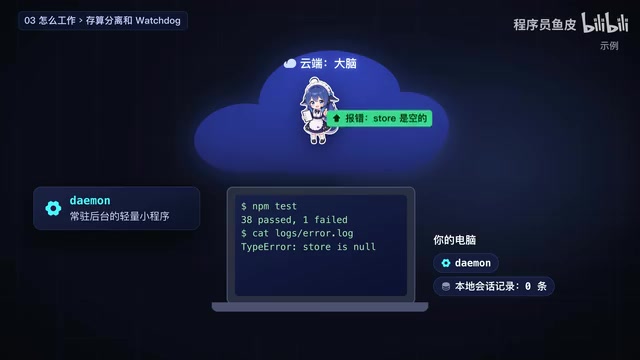
Local Agents bind computation, session state, and execution environment to the same computer—when the computer sleeps, everything stops. DeepSeek borrows the storage-compute separation concept and splits them apart in two steps: first, computation goes into cloud containers that can be replaced at any time, and session state is stored in a database, so if a container fails you just swap in another without losing a single record. Second, what about code, keys, and intranet services that can't be moved? Keep the brain in the cloud and install only a lightweight daemon on your computer—it stores no session records and only executes commands per cloud instructions and returns results. DeepSeek calls this BYOM (Bring Your Own Machine): even if your laptop isn't powered on today, once it comes back online the cloud will automatically finish the things that should be done on that machine.
Beyond the main system there's also a Watchdog session, akin to a duty supervisor making periodic rounds. It doesn't just check whether employees are on duty—it checks whether tasks are making progress. When an Agent has problems, it's often not that the program has crashed, but that the model is spinning in place or has gone off track. As soon as an anomaly is detected, Watchdog steps in to fix it.
Storage-Compute Separation originally refers to decoupling data storage from compute resources so that each can scale and tolerate faults independently—a cornerstone of cloud computing and database architecture. In the Agent context, it solves the "local computer sleeps and everything stops" problem: session state (memory) is stored in a persistent database, and computation runs in cloud containers that can be replaced at any time, so a container failure only requires rebuilding without losing state. BYOM (Bring Your Own Machine) further keeps the parts that can't be moved—code, keys, intranet services—on the user's machine, using only a lightweight daemon to execute commands issued from the cloud, balancing persistent online presence with local resource accessibility.
Does It Really Work? Costs and Open Questions
According to DeepSeek's comparative experiments, SuperAgent is twice as fast as traditional single-session Agents and works more stably. But the cost is that maintaining multiple sessions simultaneously causes read-cache Token consumption to be two to nearly four times that of the single-session approach.
DeepSeek also candidly raises several open questions: as task scale continues to grow, is one project manager still enough? What about long-term memory after running continuously for months? Once you're no longer staring at a session, how should humans collaborate with the Agent—is the chat window still the best interface? How can personal assistants and team-shared SuperAgents cooperate without leaking privacy? The more proactively an Agent engages, the more untrusted information it encounters—what if it's compromised by prompt injection?
Security is indeed the biggest hurdle for Agent deployment. Do you dare let AI watch group chats 24/7 and operate your computer? A single malicious message could fool the AI, putting data and privacy at risk. But the value of this architecture lies in bringing a mature team management methodology into the AI world—solving engineering bottlenecks through organizational design, which is more noteworthy than simply throwing more model parameters at the problem. Those interested can check out this research prototype on GitHub.
One-line Summary
DeepSeek proposes a Router+Worker two-layer SuperAgent architecture that uses team collaboration to break through multi-task Agent bottlenecks.
Paragraph Summary
The DeepSeek Harness team proposes the SuperAgent architecture to address the three major pain points exposed by traditional single-session Agents in multi-task parallelism—time-consuming commands blocking the loop, context confusion, and local sleep causing shutdowns. Drawing on real-world project team management, it designs a Router (project manager) + Worker (engineer) two-layer structure. The Router stays online to handle communication and task assignment, while Workers have independent contexts and focus on execution. Combined with event-driven and fast/slow path filtering, chain of recall, speculative execution, full-duplex asynchronous communication, and storage-compute separation with BYOM, SuperAgent achieves continuous, efficient, proactive, and persistent working capabilities. Comparative experiments show doubled speed and greater stability, but Token consumption is 2 to 4 times that of the single-session approach, and security and long-term memory remain open questions.
Related articles
AI Now Generates GIFs Directly: The Era of Unlimited Custom Stickers Has Arrived
AI can now generate GIFs directly. Learn how to use GPT's Images 2.6 to create sticker GIFs with reference images and story prompts, plus sprite sheet frame-level editing, real-person performances, and chat log generation.

Burned Through 1.3 Billion Tokens and Tens of Thousands of Yuan to Build 500 Websites with AI
Bilibili creator Yu Pi built Vibefather, an AI website template library with 270+ templates and 500+ live sites, consuming over 1.3 billion tokens. Each template includes full prompts and design docs, open-sourced and integrable via Claude Code, Cursor, and more.
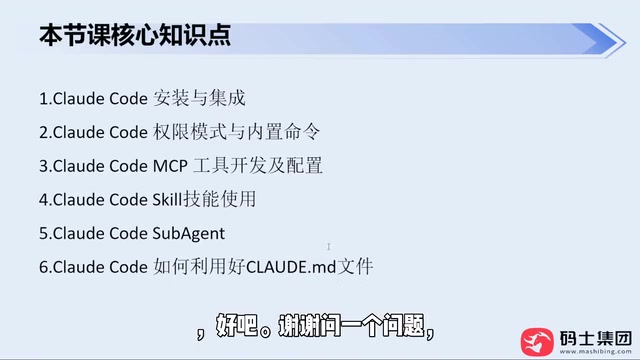
Claude Code Practical Guide: Installation, Permission Modes, and Productivity Tips
Based on a Bilibili creator's hands-on sharing, this guide covers Claude Code installation (NPM recommended), permission modes, slash commands, CLAUDE.md configuration, context management, and practical tips for stable use and avoiding account bans.