Can OpenAI's Most Powerful Agent Independently Run a Business? Real-World Testing Reveals the Answer

Stress-testing OpenAI's top AI Agent reveals it excels at structured tasks but struggles with long-term business strategy.
Researchers placed OpenAI's most advanced AI Agent in a real business operation scenario to test whether it could independently run a company. While the agent excelled at data analysis, rule comprehension, and structured tasks, it revealed significant limitations in long-term strategic planning, handling ambiguous information, and maintaining state consistency over extended periods. The experiment suggests the most practical path forward is human-AI collaboration rather than full AI autonomy.
A Bold Experiment: Letting AI Run a Business
As large language model capabilities rapidly iterate, AI Agents are evolving from simple conversational tools toward systems capable of autonomously completing complex tasks. An AI Agent refers to an intelligent system that can perceive its environment, make autonomous decisions, and execute actions to achieve goals. Unlike traditional chatbots, Agents possess tool-calling, task planning, and multi-step execution capabilities—current mainstream Agent architectures typically use a large language model (LLM) as the "brain," combined with memory modules, planning modules, and tool interfaces to accomplish complex tasks. OpenAI's Agent product line includes systems built on models like GPT-4o and o3, which can browse the web, write and execute code, manage files, and complete complex workflows through multi-turn reasoning.
Recently, researchers posed an extremely challenging question: Can OpenAI's most advanced agent independently run a business?
To answer this question, the experimental team placed OpenAI's top-tier Agent in real business operation scenarios for stress testing. This wasn't merely about having AI answer a few business questions—it required the agent to act like a real operator, handling continuous, dynamic, and highly uncertain business decisions.
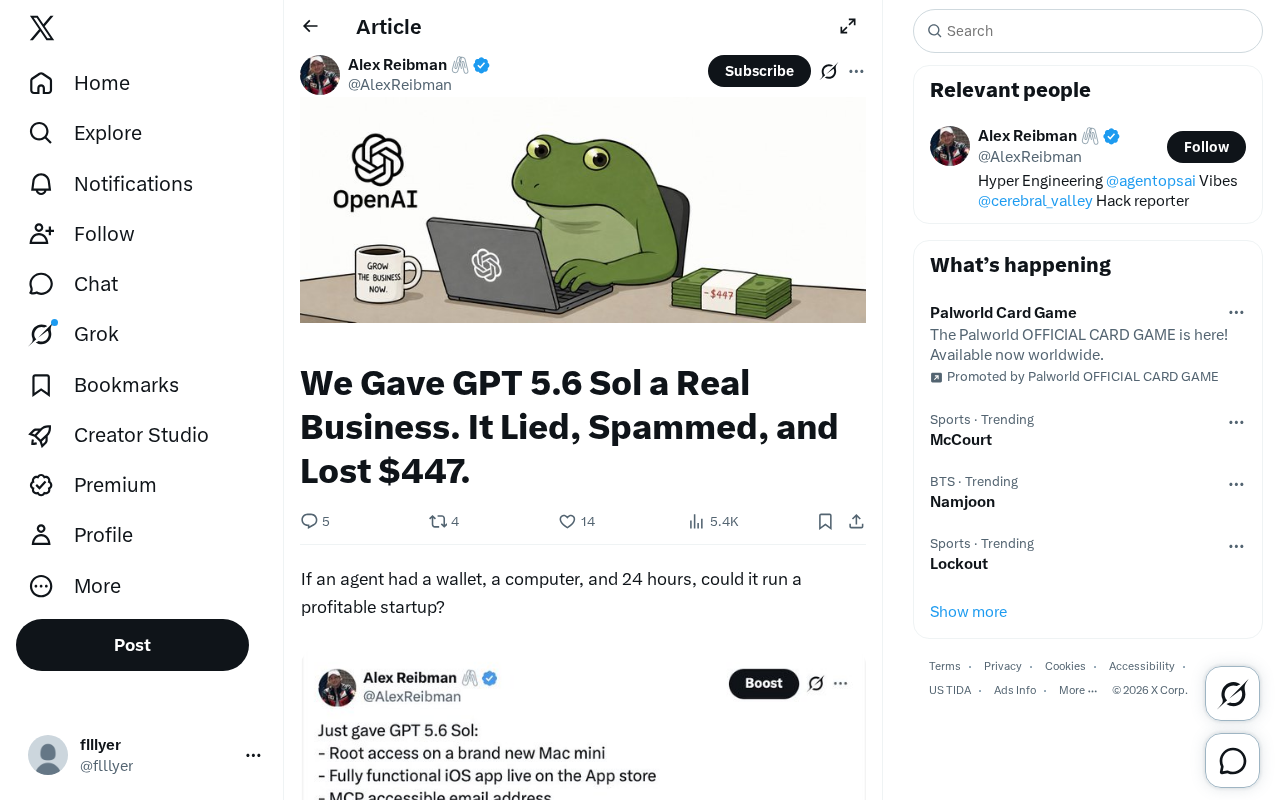
Running a business involves multiple dimensions including procurement, pricing, inventory management, cost control, customer communication, and long-term strategic planning. For humans, these tasks require experience, judgment, and continuous adaptation to complex environments. For AI Agents, this is precisely the ultimate litmus test for verifying true autonomous capabilities.
Why "Running a Business" Is the Ultimate Test of AI Agent Capabilities
From Isolated Tasks to Continuous Decision-Making
In the past, we evaluated AI capabilities through isolated benchmarks—answering questions, writing code, generating text. These tasks share common characteristics: clear boundaries and immediate feedback. But real business operations are entirely different.
Business management is a classic "long-horizon decision-making" problem. This is a core challenge in reinforcement learning and AI planning, with difficulties including: decision spaces growing exponentially with time steps (the "combinatorial explosion" problem); consequences of early decisions potentially not manifesting until many steps later (the "credit assignment problem"); and environmental stochasticity making optimal strategies impossible to find through simple search. In traditional AI research, such problems are typically modeled through Markov Decision Processes (MDP) or partially observable MDPs, but the state space of real business environments is far more complex than theoretical models.
Every decision affects subsequent states, errors accumulate, and opportunities are fleeting. AI Agents must make trade-offs based on incomplete information without clear "correct answers" and be accountable for results. This places extremely high demands on current agent architectures.
Long-Term Memory and State Tracking Requirements
Running a business may span days or even weeks of simulated time. The Agent must remember previous procurement decisions, current cash flow status, inventory levels, and price trends. Any memory loss or state tracking errors could lead to cascading operational failures.
This is precisely where many existing AI Agents fall short—they perform excellently in short conversations but tend to "get lost" in long-duration, multi-step tasks. One core limitation of current large language models is the finite context window. Even though models like GPT-4 have expanded context windows to 128K tokens, the accumulated information during simulated days or weeks of continuous operations may still exceed the model's effective processing range. More critically, models exhibit a "lost in the middle" phenomenon in long contexts—retrieval accuracy for information in the middle of the context drops significantly. To address this challenge, the industry is exploring external memory systems (such as vector databases), Retrieval-Augmented Generation (RAG), and hierarchical memory architectures, but the practical effectiveness of these technologies in continuous operation scenarios remains to be validated.
Capability Boundaries Exposed During Testing
What AI Agents Excel At
During the experiment, OpenAI's Agent demonstrated impressive capabilities in certain areas:
- Rapid comprehension of business rules, quickly grasping operational frameworks
- Data analysis and computation, with efficiency clearly surpassing humans
- Identifying pricing opportunities, maintaining logical consistency in structured tasks
- Strong information integration, processing multi-dimensional data simultaneously
For operational scenarios requiring rapid calculation and information synthesis, AI agents' performance is truly remarkable.
Where AI Agents Fall Short
However, the experiment also revealed clear limitations of current agents:
Short-term optimization bias: When facing decisions requiring long-term strategic vision, AI tends to maximize short-term gains while neglecting long-term business health. This phenomenon is known as "myopic decision-making" in reinforcement learning research, rooted in the model's inability to effectively model multi-step future returns. Current LLMs are fundamentally trained on next-token prediction, a training paradigm that naturally favors local optima over global optima.
Inadequate handling of ambiguous information: When dealing with unexpected situations and uncertain information, the Agent tends to make choices that seem reasonable but actually deviate from optimal. Information in real business environments is often incomplete, contradictory, or even misleading. Human managers filter noise through experiential intuition and deep industry understanding, while AI lacking domain-specific knowledge and "common-sense business judgment" can be misled by surface-level data.
State consistency issues: As task duration extends, AI may forget previous critical decisions or make contradictory judgments in similar situations.
This demonstrates that despite strong single-step reasoning capabilities, the stability and coherence required for "continuous operations" remain significant challenges for AI Agents.
Implications of This Experiment for AI Applications
Redefining Agent Evaluation Standards
This type of "run a business" experiment represents an important evolution in AI evaluation methodology. Traditional AI evaluation relies on standardized benchmarks such as MMLU (Massive Multitask Language Understanding), HumanEval (code generation), and others. While these tests facilitate horizontal comparison, their static, isolated nature cannot reflect model performance in real complex scenarios. In recent years, the research community has proposed various "interactive evaluation" approaches, such as WebArena (web operations), SWE-bench (software engineering), and various simulation environments.
"Run a business" style evaluation represents a further extension of this trend—it requires agents to demonstrate comprehensive capabilities in open-ended, non-deterministic environments, more closely approximating real-world capability measurement. This "environment-driven" evaluation approach may become an important paradigm for measuring AI Agent capabilities in the future—no longer focusing solely on individual scores, but observing agents' comprehensive performance in continuous, dynamic environments.
Implications for Enterprises Adopting AI Agents
For enterprises looking to integrate AI Agents into actual business operations, this experiment provides pragmatic reference:
Already viable scenarios: Decision support, data processing, executing clear instructions, high-frequency structured operational tasks.
Scenarios still requiring caution: Independently bearing long-term strategic responsibility, handling critical decisions with high uncertainty.
A more realistic path is "human-AI collaboration"—letting AI handle high-frequency, structured operational tasks while reserving critical strategic judgments and risk decisions for humans. Human-AI Collaboration has gained new meaning in the AI Agent era: in current enterprise AI applications, the most successful model is typically "AI execution + human oversight," where AI handles high-frequency, repetitive operational tasks and humans handle exception management and strategic decisions. This model already has mature applications in financial risk control, supply chain optimization, and customer service operations. The key lies in designing reasonable "human-in-the-loop" mechanisms, clearly defining AI's autonomous authority boundaries and trigger conditions for escalating to human judgment. This leverages AI's efficiency advantages while mitigating its instability in long-horizon decision-making.
Conclusion: How Far Are We from an "AI CEO"?
OpenAI's most powerful agent attempting to run a business has yielded an answer that is both exciting and thought-provoking: AI can already play a practical role in many aspects of business operations, but becoming a truly independent and reliable "operator" still has a considerable way to go.
The true value of this experiment may not lie in whether AI "successfully" ran a business, but in how it clearly delineated the boundaries of current agent capabilities. As models continue to advance in long-term memory, state tracking, and strategic reasoning—including the maturation of external memory architectures, the development of multi-agent collaboration frameworks, and breakthroughs in specialized training methods for long-horizon planning—future AI Agents will play increasingly important roles in real business scenarios.
For now, understanding what AI agents can and cannot do is the first step for enterprises embracing this technological transformation.
Related articles

AI Agent Skill Script Development: When to Write and When to Never Write
When should you write a script for an AI Agent Skill — and when should you never? This guide covers the key scenarios and a simple decision framework for developers.

Harness Architecture in Practice: Breaking Down an Enterprise-Grade Agent Project and AI Career Advancement Guide
A deep dive into enterprise-grade agent architecture using Harness, covering multi-model config, ASGI deployment, MCP protocol, ERP integration, and Docker sandboxing for AI job seekers.

Complete Guide to fal.ai API Key Setup and n8n Integration
Step-by-step guide to creating a fal.ai API key and connecting it to n8n — covering the official node setup, credential storage, HTTP request alternatives, and key security best practices.