Can't Keep Up With Open-Source Models? This Model Directory Site Has You Covered

An open-source model directory that helps you efficiently discover and filter LLMs and AIGC models.
A Bilibili creator built and open-sourced a structured model directory site to tackle the problem of open-source models updating too fast and information being too scattered. The homepage covers recent hot models, LLMs, and AIGC models from the past two months. The LLM section filters by open-source models, community acceleration projects, and deployment methods, while the AIGC section covers image and video generation. The site also addresses slow Hugging Face downloads in China by suggesting domestic mirrors. It's designed as a discovery and quick-reference navigator, not a documentation replacement.
Why We Need an Open-Source Model Directory
Open-source models are evolving faster than most people can follow. New LLMs and AIGC models drop nearly every few days, making it genuinely difficult for everyday users and developers to cut through the noise and quickly answer: which models are worth paying attention to, and which deployment setups actually fit my environment?
A Bilibili creator tackled this pain point by building and open-sourcing an "Open-Source Model Directory" — the source code is publicly available, and the core goal is simple: aggregate scattered new-model information into one place, present it in a structured way, and lower the cost of staying current.
The value of a tool like this lies in aggregation and filtering — it's not meant to replace model hosting platforms like Hugging Face, but to serve as a navigation and quick-reference entry point, letting users get the big picture first before deciding whether to dive deeper.
Homepage: A Quick Glance at Recent Hot and New Models
The homepage is divided into three sections: Recent Hot Models, Recent LLMs, and AIGC Models. According to the creator's design philosophy, most users will find the homepage alone is all they need.

From the homepage, users can quickly see what new models have emerged over the past two months and which ones have gained strong community traction. This combination of a time window + popularity signal directly addresses the core anxiety of "there are too many new models — I don't know which ones to follow." For users who don't have a specific project in mind and just want to stay in the loop, the homepage functions as an efficient information dashboard on its own.
LLM Section: Filter Models and Deployment Options by Need
For more specific requirements, you can head into the dedicated LLM section. This breaks things down further across three dimensions: open-source models, community projects, and deployment methods.

Users can filter and search for models based on their actual needs, with direct search also supported. The "Community Projects" section covers inference acceleration frameworks with strong community feedback, while the "Deployment Methods" section aggregates the various deployment options available.
This categorization is especially useful for real-world deployment. When developers choose a model, they're not just evaluating raw capability — they also need to know whether there's a mature acceleration solution and a ready-made deployment path. Having all these dimensions side by side significantly cuts down on trial-and-error time.
The "model acceleration frameworks" mentioned here refer primarily to inference optimization tools such as llama.cpp (which quantizes models into GGUF format for CPU inference), vLLM (a high-concurrency GPU inference serving framework), and Ollama (a locally-focused, one-click deployment wrapper). Each option makes different trade-offs around hardware requirements, throughput, and ease of use: llama.cpp suits environments with limited or no GPU, vLLM is better for production deployments requiring speed and concurrency, and Ollama is ideal for individual developers who want to get up and running locally with minimal friction. Understanding these differences is just as important a decision as choosing the model itself.
AIGC Section: Image and Video Generation Models
The AIGC section follows the same organizational logic as the LLM section — it supports need-based filtering and covers models for image generation, video generation, and related directions.

Each model has a detail page you can click into, which includes a brief introduction and deployment instructions. The creator is candid about the site's scope: for more in-depth or specialized requirements, it's best to consult the model's official documentation. The directory is primarily designed for discovery and quick reference, not as a replacement for comprehensive documentation.
Practical Tip: Faster Downloads via Domestic Mirrors
The creator shares a practical tip when introducing the Community Projects section.
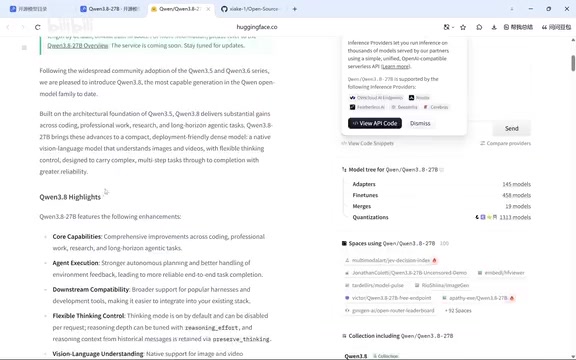
Since downloading models directly from Hugging Face can be painfully slow in mainland China, users can note down the model name from the directory site and then head to a domestic mirror to download it. This small detail reflects a tool designed around real usage scenarios, not just a list of information.
Commonly used Hugging Face mirrors in China include third-party acceleration services like hf-mirror.com, as well as domestic model hosting platforms like ModelScope (魔搭社区) — the latter hosts a large collection of popular models synchronized with Hugging Face. The typical approach is to replace
huggingface.coin your download command with the mirror domain, or use the mirror platform's own CLI tool to pull models. For large models that can easily run tens of gigabytes, mirror acceleration can compress download times from several hours down to something manageable — it's a standard first step for developers deploying local models in China.
Why Tools Like This Matter
In an era of rapid model iteration, information overload is itself a cost. A well-structured, sensibly categorized open-source model directory helps users focus their attention on updates that actually matter.
This project stands out for a few reasons: it's fully open-source, the homepage gives you an instant overview, models are categorized by deployment and acceleration framework dimensions, and it makes pragmatic accommodations for the download realities of users in China.
For anyone who wants to stay on top of the open-source model ecosystem without drowning in information, it's worth bookmarking. That said, it works best as a navigation entry point — for deep research, you'll still want to return to official documentation and model hosting platforms.
Related articles

Bilibili's Hit Dify Tutorial: A Practical Guide to Building 20+ AI Apps from Scratch
A distilled guide to Bilibili's top-rated Dify tutorial: Windows + Docker deployment, MySQL connection, five app types, model integration strategy, and publishing.

Agent Skills Beginner's Guide: From Concepts to Multi-Agent Collaboration in Practice
A comprehensive guide to Agent Skills: core concepts, components, the importance of Description, standardization, beginner learning paths, and multi-agent collaboration.

One Neuron Detects Both Cats and Cars? We Reproduced It and Found a New Explanation
The cat-car neuron reinterpreted: researcher Cammarata argues it distinguishes pointy from round, not cats from cars. We reproduced the experiment and found the new explanation holds on most inputs—but cars are the exception. The interpretability debate continues on language models.