Claude Code Advanced Guide: MCP Integration, Writing Skills, and Subagent Code Review

Bilibili livestream systematically covers advanced Claude Code usage: the six-segment path and account ban risk warnings.
Based on a Bilibili technical livestream, the article outlines advanced Claude Code usage in production. The presenter considers Claude Code and Codex superior to Cursor and Tree for code and document generation, though this is personal experience. Content covers six segments: installation and integration, built-in commands, MCP tool integration, Skills distillation, subagent review, and CLAUDE.md project configuration—a complete path from "installed and usable" to "used professionally." The article also discusses account bans, which the presenter attributes to Anthropic's official account risk control and proposes bypassing login; the author notes this is single-source experience with compliance risks and not operational advice. The key takeaway: what creates the efficiency gap is the quality of peripheral structure building, not the model itself.
Many developers still use Claude Code at the "chat-style coding" stage—throw in a requirement, wait for it to spit out an implementation, then manually copy and paste. This usage only taps into a small fraction of the tool's capabilities. A technical livestream from Bilibili systematically walks through advanced usage of Claude Code in production environments, covering installation and integration, built-in commands, MCP tool integration, writing Skills, subagent code review, and CLAUDE.md configuration.
Why Claude Code Deserves Its Own Deep Dive
The presenter's basic judgment: in today's development environment, the share of "hand-cranking code" or so-called "ancient-style programming" has dropped significantly, with more work being assisted by webcoding tools. For domestic programmers, the commonly used coding agents are concentrated around Claude Code, Codex, Cursor, and Tree.
In his view, Cursor and Tree are easier to get started with, while Claude Code and Codex perform better on code and document generation, so he recommends prioritizing the latter two. He also admits this is just personal experience—if you're already very familiar with another agent, choose according to your own needs. This view aligns with what many developers in the community feel: the gap between coding agents often shows up in complex scenarios like long tasks, multi-file changes, and document output, rather than single-round completion.

The Six Segments Covered in the Course
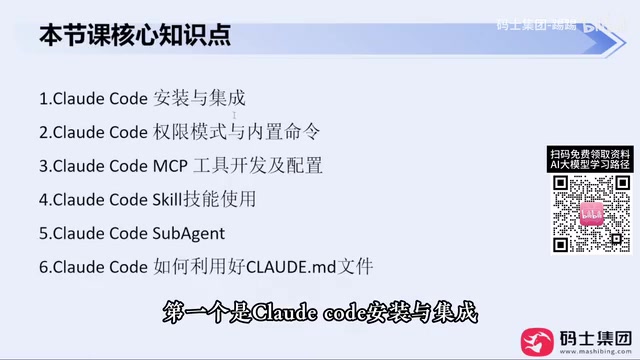
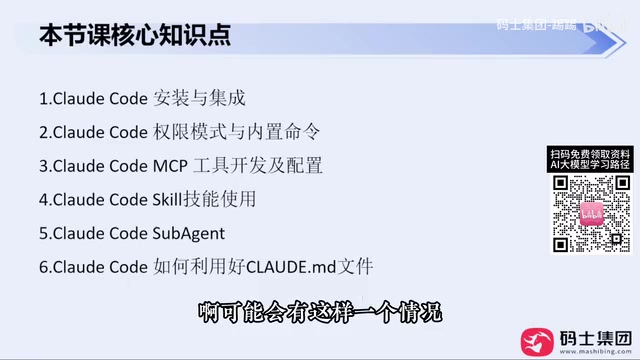
The content of this sharing is split into six parts: installation and integration of Claude Code; interaction modes and corresponding built-in commands; development and configuration of MCP tools; usage of Skills (the original spoken audio said "SQL skills," which should be a slip of the tongue for Skills); Subagents; and the role of the CLAUDE.md file.
These six segments actually correspond to a complete path from "installed and usable" to "used professionally." Installation and integration solve environment issues, built-in commands improve single-interaction efficiency, MCP connects external tools to the model context, Skills distill reusable operational workflows, subagents handle splitting complex tasks, and CLAUDE.md makes project-level conventions persist. Missing any one link keeps tool usage at a relatively shallow level.
MCP (Model Context Protocol) is an open protocol for establishing standardized connections between AI models and external data sources and tools. You can think of it as the "USB interface of the AI world": the model declares through MCP what tools or resources it needs, and external services expose capabilities according to the protocol, with neither side needing to write adapter code for each combination. Common uses include letting Claude Code query databases, call internal APIs, read the local file system, or connect to third-party SaaS. Compared with stuffing data into prompts, MCP's advantages are controllable permissions, auditable calls, and structured injection of tool descriptions into the model context, so the model knows "what tools are available and how to fill in parameters."
Skills, on the other hand, encapsulate a set of reusable operational workflows (instructions, scripts, templates) into skill units that the model can invoke on demand. Unlike MCP, which leans toward "connecting external capabilities," Skills lean more toward "distilling internal experience": for example, writing the release process, code style checks, or scaffolding steps for a specific framework into a Skill, so that the model automatically loads and executes it when encountering similar tasks, without having to repeat explanations in every conversation. MCP solves "what can be called," Skills solve "what process to follow," and only the combination of the two can move an agent from single Q&A to stable engineering collaboration.
The Real Problem of Account Stability
The sharing spent considerable time discussing a practical issue: many people get banned while using Claude Code. The presenter's explanation is that the root cause of bans is accounts being blocked by Anthropic's official website, related to its content moderation and political leanings, so some accounts are more likely to get hit.
His proposed approach is to bypass account login—not registering an account at login, thereby avoiding the ban issue, and he claims he has never been banned from the first day of installation to now. It should be noted that this part is single-source personal experience; bypassing official login methods may involve risks under the terms of service, and readers should assess compliance themselves. This article only faithfully relays the presenter's statements and does not constitute operational advice.
Two concepts need to be distinguished: account bans and API access restrictions. Anthropic enforces account-level risk control on consumer products (such as the Claude web version and Claude Code's subscription login), and once a violation is determined, the account is directly suspended; while calling models through official API Keys belongs to a different billing and compliance system with different risk control logic, but is likewise subject to usage policies. The so-called "bypassing account login" usually means not going through the consumer account system and instead using APIs or third-party relays, but this does not mean it is free from terms restrictions.
From a compliance perspective, terms of service generally prohibit circumventing regional restrictions, sharing accounts, reselling access rights, and similar behaviors, and violations may lead to API Key revocation or legal risk. For teams, a more prudent approach is to use officially supported enterprise solutions, comply with regional availability policies, and retain call logs for auditing. The "never banned" in personal experience cannot be generalized as a universal conclusion, because risk control strategies adjust over time and the sample size is extremely small.
The Key Dividing Line from "Can Use" to "Use Thoroughly"
Looking at the framework of this sharing as a whole, the capability layers of Claude Code are actually quite clear. The entry level is conversational code generation; the advanced level is plugging in MCP tools so the model can call external services and data; further up is Skills, solidifying recurring operations into invocable skills; as task complexity rises, subagents handle code review and task decomposition; and CLAUDE.md is responsible for maintaining consistent conventions and context at the project level.
For most teams, what truly creates an efficiency gap is not the model itself, but the quality of building these peripheral structures. Whether tool integration is smooth, whether skills are properly distilled, and whether the review step is automated determine whether the agent is "a chat box that can write code" or "a collaborator that can participate in engineering."
One-line Summary
Bilibili livestream systematically covers advanced Claude Code usage: the six-segment path and account ban risk warnings.
Paragraph Summary
The article is based on a Bilibili technical livestream and outlines advanced usage of Claude Code in production environments. The presenter believes that among coding agents, Claude Code and Codex outperform Cursor and Tree in code and document generation, though this is personal experience. The content is divided into six segments: installation and integration, built-in commands, MCP tool integration, Skills distillation, subagent review, and CLAUDE.md project configuration, forming a complete path from "installed and usable" to "used professionally." The article also discusses the account ban issue, which the presenter attributes to Anthropic official website account risk control and proposes bypassing login; the author explicitly notes this is single-source experience with compliance risks and does not constitute operational advice. The core conclusion: what creates the efficiency gap is the quality of peripheral structure building, not the model itself.
Related articles

9 AI Subscription Plans Compared: The Real Cost Per 100M Tokens Revealed
Bilibili creator tests 9 AI subscription plans from Volcano, Alibaba, Tencent, Baidu, Zhipu, Xiaomi, MiniMax and more, converting them all to real cost per 100M tokens, breaking down fixed-quota vs. three-tier coefficient billing and how caching, time-of-day discounts, and window limits affect actual quota.

Vibe Coding for Beginners: Expressing Intent Instead of Handwriting Code
What is Vibe Coding? A 137-episode Bilibili course defines it: the core is expressing intent, not writing code. This article analyzes Vibe Coding's productivity logic, target audience, and entry expectations to help beginners decide if it's worth learning.

LangChain Beginner's Guide: An Agent Development Roadmap from LangGraph to Deep Agents
Clarify the encapsulation relationship among LangChain, LangGraph, and Deep Agents, and master the learning path and selection logic for agent development frameworks—suitable for beginners in large model development.