Claude Code Is More Than Coding: A Practical Guide to Its Seven Artifact Types
A Bilibili creator shows how Claude Code's seven Artifact types cover office work, connect to real data, and upgrade to web apps in one prompt.
The article reviews a Bilibili creator's full experience with Claude Code: it has expanded from a terminal coding assistant into a productivity platform covering seven Artifact types—whiteboard, design system, design, slides, document, data, and sheets—each generatable from a single prompt and editable at any time. Documents and design canvases work together in the same session for writing-plus-illustration content production; with bypass permissions enabled it can read local files, and via a custom MCP server it connects to Revolut Business for real transaction data and payment drafts, though final payments are still reviewed by a human. An Artifact can also become a formal web app deployed with Vercel + Convex + GitHub in one prompt. The creator concludes that software is becoming "ephemeral" while noting the demo comes from a single creator and has promotional elements.
Claude Code's positioning is shifting. It's no longer just a coding assistant in the terminal—it's gradually becoming a productivity platform that covers documents, spreadsheets, design, whiteboards, slides, and even full web applications. A Bilibili creator demonstrated this entire workflow in a long video, and the core takeaway is: Claude Code, together with its seven Artifact types, is currently the Agent platform best suited to business scenarios.
Seven Artifact types covering the main forms of everyday office work
According to the creator's demo, Claude Code currently supports seven kinds of editable Artifacts, each of which can be generated with a single prompt:
- Whiteboard: for mapping out business processes or conceptual relationships; once generated, you can keep asking Claude to modify it
- Design System: defines foundational brand specs like color palette, typography, and spacing
- Design: interaction logic close to Figma; you can leave comments directly on an element and Claude will pick up the revision instructions automatically
- Slides: reuse an established design system to maintain visual consistency
- Document: similar to Google Docs, with multi-tab editing
- Data: for presenting structured data
- Sheets: the type the creator uses most often, with an experience close to Google Sheets
What these Artifacts have in common is that they're "editable at any time." The creator demonstrated live adding a new sheet to a spreadsheet Artifact, generating a payment calendar, and having a Gantt chart auto-generated below it. Because Claude Code can connect to office tools like email and Slack, the data behind these charts can come from real business data rather than just being illustrative.
Artifact is an interaction format Anthropic introduced in the Claude product: rich content generated by the model (code, documents, charts, pages, etc.) is no longer just a block of text in the chat log, but is rendered as an independent, iteratively editable object—conversation on the left, preview on the right—and users can keep giving instructions about specific elements. It first appeared on Claude.ai as code snippets and web page previews, then expanded to document, slide, and other types closer to office deliverables. The key to understanding this is that Artifacts merge "generation" and "modification" into the same context; the model always holds the complete state of the object, so every adjustment is incremental and the user doesn't need to re-describe the full requirements. This is also the technical basis for the "editable at any time" experience described in the article.
Document and design canvas working together: an underrated content production pipeline
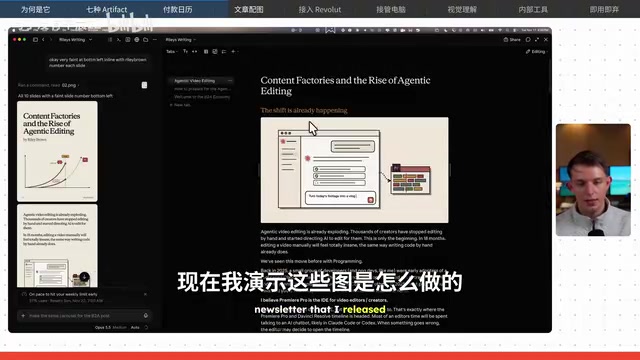
The creator showed his favorite use case: treating Claude Code as a writing environment while keeping a document Artifact and a design Artifact open at the same time. You can switch between the two via the session rail, and the design board holds illustrations that Claude generated with code and then converted to images.
Specifically, you @Claude in the document and ask it to generate one illustration for each Artifact type that conveys the core value, with the requirement that it be "clean, flawless, and written in my voice as a newsletter." A few minutes later, the images first appear on the design board, then are automatically inserted into the corresponding positions in the document. If you're not happy with a particular image, just leave a comment on it asking for a redo.
The value of this workflow is that the text and illustrations are completed in the same session, with no need to repeatedly export and import between a writing tool and a design tool. The creator noted that using Opus 5.5 to generate this kind of high-quality graphic is "more than enough."
Only with local files and business systems does an Artifact get real data
The second reason lies in Claude Code's ability to access the local environment. After enabling bypass permissions mode, it can read files on your computer and generate Artifacts based on them. The creator had Claude analyze storage usage across the entire computer and generate a spreadsheet Artifact: a list of large files sorted by "most worth cleaning up," a breakdown by location and file type, and the ability to keep commenting on the chart to change a bar chart into a pie chart.
On the business side, the creator gave Claude Code the Revolut Business API documentation and had it build a custom MCP server covering balances, transactions, virtual cards, team, and payment drafts. After that, you can directly ask "how much did I spend on AI tools last month," or have Claude read invoices, match payees, generate a batch payment draft covering editors in London, Lisbon, and Sydney, and automatically verify exchange rates.
There's a noteworthy boundary design here: the Agent is only responsible for preparing drafts, and the final payment is still reviewed and manually executed by a human in Revolut Business. The same goes for virtual cards—Claude can create them and set limits, but verification happens in the app. This division of labor—"the Agent does the work, the human makes the call"—is a fairly pragmatic approach when connecting Agents to money-related business today.
MCP (Model Context Protocol) is a protocol proposed and open-sourced by Anthropic in late 2024 to let models connect to external tools and data sources in a standardized way. It abstracts integration into three layers: Host (the client hosting the model, such as Claude Code), Client (the protocol connector), and Server (the service side that exposes specific capabilities). An MCP server can package the capabilities of a given API into model-callable tools, readable resources, and preset prompts. The article's "give Claude Code the Revolut Business API docs and have it build a custom MCP server" essentially means having the model automatically generate this adaption layer according to the protocol spec. Compared with writing a separate plugin for each system, MCP's value is that it's implemented once and reused in many places, and it also lets third-party business systems connect to Agents at lower cost.
Bypass permissions mode is one setting in Claude Code's permission system. By default, Claude Code asks the user for confirmation before each operation such as reading or writing files or running shell commands; bypass permissions skips these confirmations and lets the Agent execute autonomously and continuously. It significantly improves the smoothness of long-running tasks, but it also means the model's actions no longer have a human gate, so the official recommendation is to enable it only in controlled environments (containers, dedicated VMs, or trusted local directories). The article uses it to read storage usage across the entire computer, which is a typical trade-off of this mode: you gain efficiency while shifting risk control to the isolation of the runtime environment.
Visual understanding is the underlying support
The third reason is the model's own visual capability. Every week, the creator hands over the scattered notes in iPhone Notes along with Twitter bookmarks to Claude and asks it to generate a "weekly Agent update" document, which comes out as a presentation-style document with visual layout. His assessment: once a visual style is given, Claude almost never gets Artifacts wrong—"they're never ugly"—and only minor tweaks are needed.
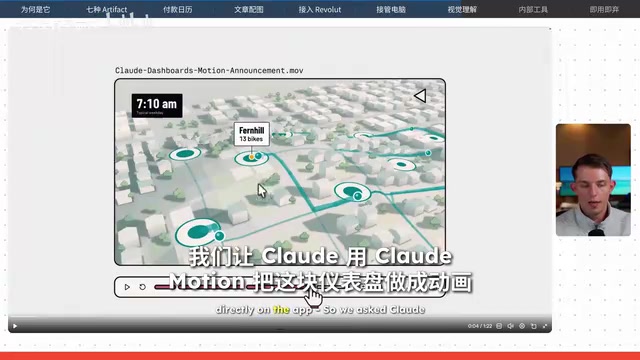
On top of that, Anthropic has another capability not yet fully rolled out, Claude Motion: turning dashboards into animated narratives, supporting comments directly on the video for adjustments, allowing colleagues to join the discussion, and finally exporting to design tools. Currently this feature is only available on team plans.
From Artifact to web app, the barrier is almost zero
The creator repeatedly emphasized one judgment: the boundary between an Artifact and a web app is "almost zero." He first used an Artifact to create a visual draft of an internal tool for the fictional company Halyard Agent Works, then asked in a single prompt to turn it into a real internal tool, specifying Vercel, Convex, and GitHub as the tech stack. The result: it automatically created a code repository, hooked up a Convex database, and deployed to Vercel, yielding a real, shareable link with login authentication.
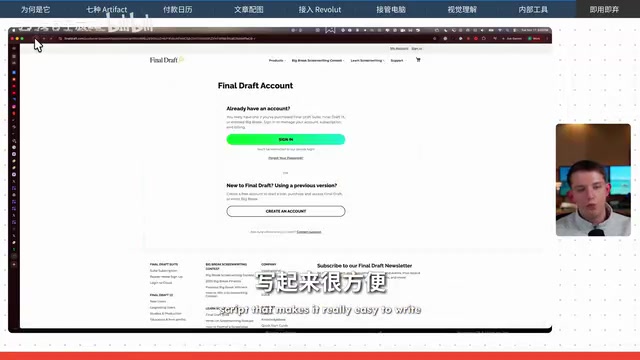
A more concrete example is a screenwriting tool. Professional screenwriting software Final Draft costs about $200 a year in monthly payments, and the creator didn't want to pay it, so he had Claude list all its features and "reproduce it exactly," building a web app deployed to Vercel with Convex as the database. The final version took shape after three prompts, and after comparing feature by feature he considered his own version "better on every count"—for example, it supports inserting images directly into the script, offers more flexible comment styling, and implements keyboard shortcuts that Claude verified online.
He also noted that Artifacts' capability boundary goes beyond the seven standard types. Anthropic's Felix once made an entire game as an Artifact, and the creator himself opened this playable game page. Each Artifact is private by default but can generate a shareable link.
The tech stack mentioned in the article deserves a brief explanation. Vercel is a hosting platform focused on front-end and full-stack deployment, supporting automatic builds and releases from Git repositories and providing preview links and access control; Convex is a database and function runtime offered as backend-as-a-service, with real-time subscriptions and type-safe interfaces, so developers can get persistent storage and a business logic layer without building their own servers. The significance of combining them is: at the Artifact stage you only need to handle the interface and interactions, and when upgrading to a real application you add data and deployment—and these are exactly the parts the model can complete automatically. Creating repositories, connecting databases, and triggering deployments can all be done through CLI or API calls. The so-called "almost zero barrier" means that the engineering configuration along this path is absorbed by the Agent.
The practical significance of this workflow
Taking all of the above together, the creator's view can be summarized as: software is becoming ephemeral. When you need a small tool, you don't have to look for an existing product or pay for a subscription—just have Claude Code generate an Artifact, and if necessary upgrade it in one sentence into a formal application with a database and deployment. The three words GitHub, Vercel, and Convex, plus free starting quotas, form a complete path from idea to usable tool.
It should be noted that the above experience comes from a single creator's demo and carries an obvious promotional flavor (the video includes sponsored segments), and comparative conclusions like "better on every count" are personal judgments rather than independent reviews. However, the operational workflow and Artifact types shown can be reproduced in Claude Code, and readers can verify them themselves. For business scenarios that require frequent switching between documents, spreadsheets, and prototypes, this integrated workflow is indeed worth trying.
Related articles

Reverse Role-Play: When You Become an LLM's Subagent in a Game
A reverse role-play game appears on Hacker News where players act as an LLM's subagent. This article analyzes its game mechanics, the philosophical implications amid the AI agent boom, and how indie developers use lightweight interaction to explore human-machine power relations.
Celliad: A Daily Excel Game — A French Developer Turns Spreadsheets into a Daily Challenge
Celliad is a daily Excel game with a French interface that helps users practice spreadsheet skills through daily challenges. This article analyzes its product logic, the strengths and limits of the daily game model, and development ideas for niche educational tools.
Can a TV Be Too Big? An In-Depth Look at a 65-Inch OLED Upgrade
Can a TV be too big? An author encountered unexpected challenges after upgrading to a 65-inch OLED. Based on the original report, this article analyzes the trade-offs of large-screen TVs in terms of space, viewing distance, and content quality, offering practical advice for users considering an upgrade.