Claude Code v2.1.331 Update Breakdown: Multi-Platform Code Mode and Enterprise Gateway Enhancements
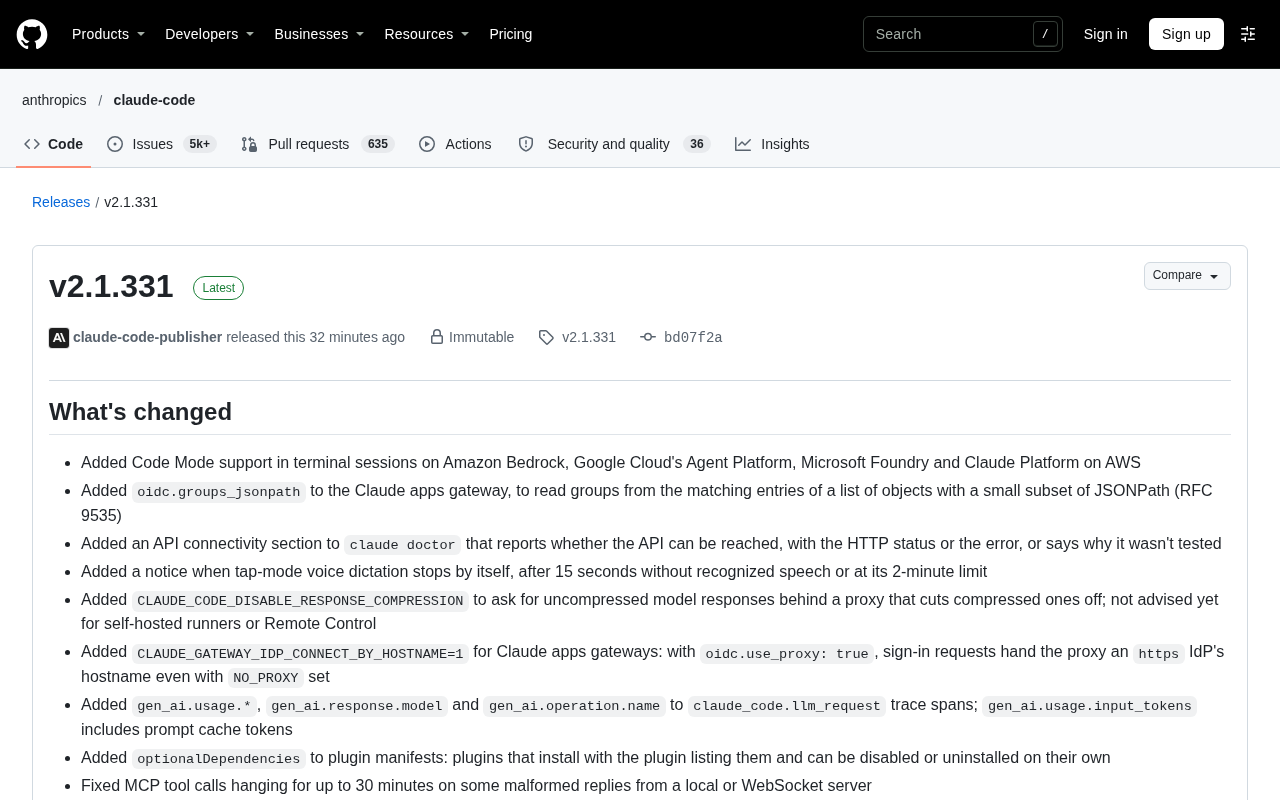
Claude Code v2.1.331 focuses on enterprise cloud integrations, gateway authentication, observability, and stability fixes.
Claude Code v2.1.331 is an update oriented toward enterprise deployment and stability. Code Mode extends to Amazon Bedrock, Google Cloud Agent Platform, Microsoft Foundry, and Claude Platform on AWS, allowing teams to use it directly on their own cloud infrastructure. The enterprise gateway adds oidc.groups_jsonpath and CLAUDE_GATEWAY_IDP_CONNECT_BY_HOSTNAME, improving group permission mapping and IdP connectivity in proxy environments. On observability, claude doctor adds API connectivity checks, and trace spans include attributes such as gen_ai.usage with cached tokens counted. Fixes cover MCP tool calls hanging abnormally for 30 minutes, session restoration losing thinking content and prompt cache, permission hooks and sub-agent rules, and more. The VSCode extension adds features like Add Cell to Chat and Fix with Claude Code and patches numerous interaction defects, while behavior changes such as PermissionDenied retry semantics, default auto-update of plugin marketplaces, and ELECTRON_RUN_AS_NODE require advance planning.
Claude Code has released version v2.1.331, with this update focusing on enterprise integrations and multi-platform support. Code Mode in terminal sessions is now supported on Amazon Bedrock, Google Cloud's Agent Platform, Microsoft Foundry, and Claude Platform on AWS, meaning teams can use this interaction mode directly on their existing cloud infrastructure without migrating to Anthropic's hosted environment.
Refinements to Enterprise Gateway and Identity Authentication
For organizational deployment scenarios, this version adds the oidc.groups_jsonpath configuration option, allowing the Claude apps gateway to read user group information from object lists via JSONPath, providing finer-grained control for permission mapping. The accompanying CLAUDE_GATEWAY_IDP_CONNECT_BY_HOSTNAME=1 option solves a practical issue: when oidc.use_proxy: true is enabled and NO_PROXY is set, login requests can still route https IdP hostnames to the proxy.
These changes may seem minor, but they point in the same direction—making Claude Code easier to deploy in regulated enterprise network environments. When the identity provider sits behind a proxy or when access control needs to be based on user groups, additional infrastructure modifications were often required in the past.
The Role of OIDC and JSONPath in Enterprise Permission Mapping
OIDC (OpenID Connect) is an identity authentication layer built on top of OAuth 2.0. Enterprise IdPs (such as Okta, Entra ID, Keycloak) typically return an ID Token or UserInfo object via OIDC, where claim fields like groups carry the user's group memberships. By default, the gateway can only read fixed top-level fields, but oidc.groups_jsonpath allows JSONPath expressions to locate group information within nested object lists, for example /groups[*].name or $.roles[?(@.type=='team')].id. This means permission mapping no longer depends on modifying claim structures on the IdP side; operations teams only need to adjust configuration to map complex directory trees to Claude Code's access policies. JSONPath is an expression language for querying JSON documents, supporting wildcards, filter predicates, and recursive descent, commonly used for log processing and field extraction in API gateways.
NO_PROXY and Proxy Bypass Semantics
NO_PROXY is a widely used environment variable that declares which hostnames should bypass HTTP(S) proxies and connect directly. The problem is that when oidc.use_proxy: true is set, the login flow needs to go through the proxy, but entries in NO_PROXY cause the client to skip the proxy—conflicting rules can cause IdP hostnames to be incorrectly connected directly and fail. CLAUDE_GATEWAY_IDP_CONNECT_BY_HOSTNAME=1 changes the matching basis: proxy rules are matched by hostname rather than resolved IP or URL, allowing https IdP hostnames to still be routed to the proxy, thereby restoring the login chain in controlled networks.
Enhanced Observability and Diagnostics
claude doctor adds an API connectivity check section that reports whether the API is reachable, the returned HTTP status code or specific error, or explains why the test was not executed. For troubleshooting connection issues caused by network policies, this is far more direct than having users guess.
At the tracing level, the claude_code.llm_request trace span now includes gen_ai.usage.*, gen_ai.response.model, and gen_ai.operation.name attributes, where gen_ai.usage.input_tokens includes prompt cache tokens. This detail has practical significance for cost accounting and performance analysis, since cache-hit tokens differ from regular input tokens in billing and latency characteristics.
OpenTelemetry Spans and GenAI Semantic Conventions
A trace span is the basic unit in distributed tracing, recording the start and end times, attributes, and parent-child relationships of an operation. The gen_ai.usage.*, gen_ai.response.model and other attributes mentioned in the article come from OpenTelemetry's GenAI semantic conventions, which define unified attribute naming for LLM calls so that tracing data from different vendors can be consumed under the same dashboards and alerting rules. gen_ai.operation.name identifies the operation type (e.g., chat, embeddings), and gen_ai.response.model records the model version that actually responded, making it easier to break down latency and cost by model dimension.
Billing Characteristics of Prompt Cache
Prompt cache refers to caching recurring prefixes (system prompts, tool definitions, long documents) so that subsequent requests hitting the cache don't need to recompute those tokens. Major APIs typically bill cache-hit input tokens at a lower rate, and first-token latency drops significantly. Therefore, when gen_ai.usage.input_tokens includes cached tokens, cost curves need to be interpreted alongside cache hit rates; otherwise, the token consumption of a given session may be misjudged.
Stability Fixes: MCP, Sessions, and Permissions
The fix list this time is quite long. One notable item is the LLM tool call hanging issue: when certain local or WebSocket servers return malformed responses, MCP tool calls could hang for up to 30 minutes—this issue is now addressed.
Session restoration fixes are also worth noting. When Code Mode sessions were resumed via --resume or --continue in a different permission mode, thinking content and prompt cache were lost; in sessions started in ask mode, scripts still retained that mode's restrictions. Additionally, the issue where /compact and auto-compact lost parts of conversation summaries when certain XML tags were quoted has been fixed.
On the permissions and hooks side, fixes include: permission rules on Agent tools discarding queued messages sent to sub-agents; PermissionRequest hooks being unable to save Skill(name:*) allow rules outside of local settings; and sub-agent model permission rules (such as Agent(model:*)) blocking subsequent messages.
MCP Protocol and Tool Call Lifecycle
MCP (Model Context Protocol) is an open protocol that lets models access external tools and data sources. Clients and MCP servers communicate via JSON-RPC messages, supporting transports such as stdio and WebSocket. A single tool call involves multiple phases: request, progress notifications, and result response, and the client needs to handle timeouts, cancellation, and format errors. When a server returns a response that doesn't conform to the schema, if the client lacks fallback logic, the coroutine waiting for the response may hang indefinitely—this is exactly the cause of the 30-minute hang mentioned in the article. Fixes typically include validating response structure, setting reasonable request timeouts, and actively canceling hung calls on exceptions.
/compact and Persistence of Thinking Content
/compact is Claude Code's method for compressing context, summarizing historical conversations into a shorter representation to free up the context window; auto-compact triggers when approaching the window limit. Thinking content and prompt cache being lost on session restoration means the restored session loses both the reasoning chain and the ability to reuse cached prefixes, leading to increased costs and inconsistent behavior. Scripts retaining startup mode permission restrictions is caused by permission state not being synchronized when switching modes.
Extensive VSCode Extension Patches
The VSCode extension section lists dozens of fixes and new features. New features include: "Add Cell to Chat" in the notebook cell menu, "Fix with Claude Code" quick fix for errors and failed tests, "Add to Chat" context menu for changed files in the source control view, and "Resolve Merge Conflicts" entry for files with merge conflicts.
Fixes cover interaction details such as diff display, @ mentions, keyboard shortcut conflicts, permission prompts, and false voice dictation status reports. One item worth mentioning separately: the issue where Electron apps and extension tests failed to start from Claude, hooks, or MCP servers has been fixed, but as a workaround, wrappers, hooks, or servers that run VS Code as Node must now set ELECTRON_RUN_AS_NODE=1. This is a behavior change that relevant automation scripts should take note of.
Meaning of ELECTRON_RUN_AS_NODE
VS Code desktop is built on Electron, and its executable launches in Electron main process mode and loads the graphical interface by default. Setting ELECTRON_RUN_AS_NODE=1 causes the same binary to launch as a pure Node.js runtime, without initializing Chromium and the renderer process. If extension tests, hook scripts, or MCP servers launched child processes through this binary, they might have previously inadvertently started a full Electron instance and failed; now the variable must be explicitly set, representing a tightening of launch behavior. Related CI scripts, local development wrappers, and custom launchers all need to be checked and have this environment variable added, otherwise regressions such as child processes failing to start or behaving abnormally may occur.
Behavior Changes to Watch For
Two changes require advance planning. First, the retry: true semantics of the PermissionDenied hook have been adjusted: a denied call is only re-initiated when Claude actually requested that call. Second, it's officially announced that in versions released on or after November 30, 2026, plugin marketplaces in managed extraKnownMarketplaces will auto-update by default; to opt out, set "autoUpdate": false on that entry.
Windows users should also note that managed settings in the registry will be checked before upgrading, because HKLM policies take precedence over managed-settings.json, and a corrupted value could cause startup failure.
Overall, v2.1.331 is not a release that sells itself on new concepts, but rather an intensive polish around enterprise deployment, diagnostic transparency, and daily interaction stability. For teams already using Claude Code in production, the upgrade benefits mainly come from fewer intermittent failures and clearer troubleshooting paths.
One-line Summary
Claude Code v2.1.331 focuses on enterprise cloud integrations, gateway authentication, observability, and stability fixes.
Paragraph Summary
Claude Code v2.1.331 is an update oriented toward enterprise deployment and stability. Code Mode extends to Amazon Bedrock, Google Cloud Agent Platform, Microsoft Foundry, and Claude Platform on AWS, allowing teams to use it directly on their own cloud infrastructure. The enterprise gateway adds oidc.groups_jsonpath and CLAUDE_GATEWAY_IDP_CONNECT_BY_HOSTNAME, improving group permission mapping and IdP connectivity in proxy environments. On observability, claude doctor adds API connectivity checks, and trace spans include attributes such as gen_ai.usage with cached tokens counted. Fixes cover MCP tool calls hanging abnormally for 30 minutes, session restoration losing thinking content and prompt cache, permission hooks and sub-agent rules, and more. The VSCode extension adds features like Add Cell to Chat and Fix with Claude Code and patches numerous interaction defects, while behavior changes such as PermissionDenied retry semantics, default auto-update of plugin marketplaces, and ELECTRON_RUN_AS_NODE require advance planning.
Related articles

Developer Naming Woes: The Technical Names That Drive Us Crazy
Why is technical naming so maddening? From Nginx and Vite to Qt and Sudo, a YouTube creator rants about the chaos of developer naming and pronunciation, revealing the tug-of-war between creators' intentions and community habits, and the cultural roots behind spelling traps like PyPI and GNOME.

Figma Workplace Scandal: Employee Sues CEO for Forcing Confrontation with Harasser
Figma and its CEO are sued by a current employee alleging sexual harassment and discrimination, and forcing the victim to confront her harasser. This article outlines the background, potential impact, and industry reflection.

Jensen Huang and Nvidia: Elite Privilege Behind the Revolving Door of Business and Politics
An opinion piece uses Jensen Huang's reappointment as Nvidia CEO to examine business-government ties and elite impunity, questioning free-market ideals and AI industry governance.