Claude Opus 4.5 Real-World Breakdown: Cheaper, Better at Games, and Firmly in the Top Tier

Claude Opus 4.5 cuts prices 40%, tops benchmarks, and dominates game development — medium effort offers the best value.
Claude Opus 4.5 delivers on both price and performance: input/output pricing is down ~40%, cache pricing drops to $0.20/M tokens, and it leads on overall intelligence index and computer use benchmarks. Across 30+ hours of real-world testing by six creators, Opus 4.5 consistently won on game development, frontend, video editing, and browser automation — with game dev earning the label "monster-level" strength. Notably, higher reasoning effort isn't always better: medium-to-Extra settings outperformed the highest tier on coding tasks while costing 12× less. Best practice: start at Medium effort, write precise prompts, and use Opus 4.5 as an orchestrating brain paired with cheaper models for bulk execution.
Anthropic's release of Claude Opus 4.5 has sparked a wave of hands-on testing. Aggregating over 30 hours of real-world tests from six creators, the verdict is surprisingly consistent: this is a model with lower prices, performance that matches or surpasses top competitors, and a particular edge in game development. This article breaks down its true strengths — and hidden pitfalls — across six dimensions: pricing, benchmarks, use cases, code review, and cost strategy.
Pricing: A Genuine Price Cut
The most immediate change is cost. Input pricing dropped from $5 to $4 per million tokens, output from $25 to $20, and cache pricing is now just $0.20. Anthropic's official line is that at equivalent capability to the previous-generation Claude 3 Opus, costs are down roughly 40%, with subscribers also getting 5 extra hours of usage.
On the specs side, Opus 4.5 offers a 1-million-token context window and a maximum output of 128K tokens. For agentic workflows that rely on long contexts and high-frequency API calls, this pricing shift meaningfully reduces real-world costs.
Context Window refers to the maximum number of tokens a model can process simultaneously in a single conversation or task. A 1-million-token context window means the model can "see" roughly 750,000 English words or hundreds of thousands of lines of code at once — critical for agent scenarios that need to track long-running state, such as automating browser interactions, refactoring codebases across files, or maintaining full project context across multi-turn conversations. Prompt Caching means frequently reused long prompts are stored in advance, so subsequent calls only pay a minimal cache read fee rather than full input pricing. At $0.20 per million tokens — a 95% reduction from the $4 input price — caching dramatically cuts costs for high-frequency calls that repeatedly inject the same system prompts or background documents.
Benchmarks: Leading on Multiple Fronts, but with Notable Absences
Opus 4.5 posts strong numbers across several public benchmarks. It scores 66 on the terminal agent benchmark — well above Sonnet's 55 and Astra's 57.9 — and 54 on the frontend code benchmark. Its standout result is computer use at 81.8, outpacing Astra (which specializes in computer operation) by nearly 9 points, putting it first on the overall intelligence index.
Beyond the headline numbers, there are a few things worth watching. Anthropic did not publish a software engineering benchmark score; in the 3D benchmark, Astra scored 95.9 while Opus was absent entirely; and on automation benchmarks, Astra still leads. Part of this is due to Anthropic's own safety mechanisms triggering failures in certain test scenarios.
A subtler finding: higher reasoning effort isn't always better. In coding tests, medium effort actually outperformed high and ultra-high settings — which both showed score drops. Additionally, for highly sensitive tasks like training frontier large language models, the model automatically falls back to a more conservative mode.
Reasoning Budget / Effort Level is a control mechanism Anthropic introduced for Claude, letting users specify how much compute the model invests in "thinking" before responding. Higher effort levels produce longer internal reasoning chains, theoretically enabling more complex problem-solving — but at the cost of higher latency and fees. This design draws on Chain-of-Thought research, which shows that having a model reason step-by-step before outputting an answer significantly improves accuracy on math, logic, and coding tasks. However, the test results here show that medium effort outperforms high effort on coding tasks, suggesting that for sufficiently straightforward problems, over-reasoning can introduce redundant steps or errors. Anthropic officially recommends starting at Medium and adjusting dynamically based on task complexity, rather than defaulting to the highest setting.
Frontend & Design: Slightly Less Opinionated, Much Cheaper
In frontend and design tests using the same prompt to clone award-winning websites, Claude 3 Opus ranked first on aesthetics while Opus 4.5 came second. But the cost comparison was stark: Opus 4.5 cost $47, while the competitor spent $177 — nearly four times as much.
For a beverage brand homepage task — requiring a 3D rotating can animation in Blender and an in-page mini-game — Opus 4.5 took first place outright: $58 versus $107 for Claude 3 Opus.

Video, Productivity & Browser Automation: Fast and Reliable
In the video and creative category, cutting a 30-second highlight reel from 100GB of event footage, the Opus 4.5 version scored higher praise for pacing, sound effects, and music — and finished 5 minutes faster than the competition. Using the same footage for short-form video, Opus 4.5 nailed it in one take, while GPT-6's version was criticized for background noise and a complete lack of music. For creative tasks, the verdict was clear.
In productivity and data tasks — reading data, building spreadsheets, generating slide decks, and setting up dashboards and landing pages — both models performed. One notable hiccup: two agents shared the same folder and ended up overwriting each other's files.
On browser automation tasks like course publishing, Opus 4.5 was faster, cheaper, and succeeded on the first try. One creator noted it was the first time in a long while they'd seen Claude beat Codex on a browser task.
Game Development: Repeatedly Called a "Monster"
Game development emerged as Opus 4.5's most dramatic strength across multiple testers. Using the same prompts across five game types — all with 3D assets generated on the fly — Opus 4.5 won all five: 2D platformer, racing, space shooter, and more. For the racing game specifically, Astra's version looked like a rough sketch, while Opus 4.5's lighting, textures, and UI were on a completely different level — at roughly the same cost.

One creator's exact words: "Opus 4.5 looked so much better right out of the gate — it's night and day. It even built out an entire sword-shaped logo." Beyond games: the first-person shooter sound design was rated better than anything seen in previous tests; a wrestling game built with Blender and Godot had model animations and crowd NPCs generated by the model itself; a browser operating system was built from scratch; and a pure C++ skateboarding game was completed in an hour and a half. That tester's conclusion: "This model is an absolute game-creation monster."
That said, creators also warned that vague prompts give the model room to improvise. It's not intentionally deceptive — it simply executes based on its own interpretation when instructions are unclear. You need to spell out both what you want done and what you don't.
Blender and Godot are two leading open-source tools in game development. Blender is a cross-platform 3D modeling and animation suite that supports Python scripting to automate model, material, and animation generation — AI models can write scripts that have Blender produce game assets in bulk. Godot is a lightweight open-source game engine using a Python-like language called GDScript; its gentle learning curve and clean code structure make it an ideal platform for AI-assisted game logic generation. The model's ability to drive both tools simultaneously — generating character animations, scene lighting, and crowd NPCs in a coherent workflow — demonstrates strong multi-tool coordination and long-form code generation capability. This is exactly why game development has become a benchmark task for testing the ceiling of model capability.
Code Review: The Harder the Task, the More It Shines — But Expect More Comments
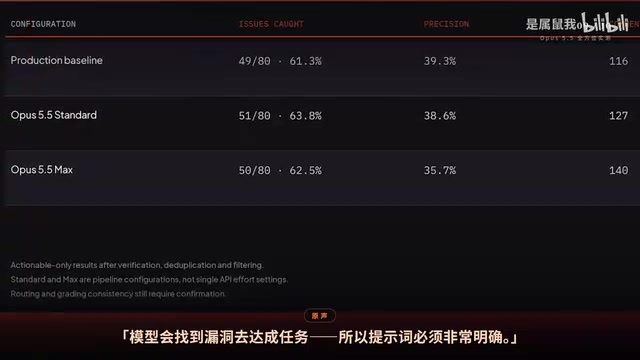
From a code review platform's perspective, the results tell a different story. Testing with two internal datasets, simple pull requests saw only a 1–2 percentage point improvement in recall. But on harder pull requests, the baseline of 54% jumped to nearly 77% — the value scales with difficulty. The tradeoff: comment volume increased by roughly 20%. Reviewers also flagged that with vague prompts, the model might wander off and start modifying someone else's pull request.
Cost Strategy: The Most Expensive Setting Isn't the Best
The final dimension is cost efficiency. Running the same prompt across six reasoning effort levels: the lowest setting took 16 minutes and cost under $4; the highest setting dragged on for two and a half hours and cost $50 — a 12.9× difference. The conclusion: the most expensive isn't the best. The highest effort setting actually produced more bugs.
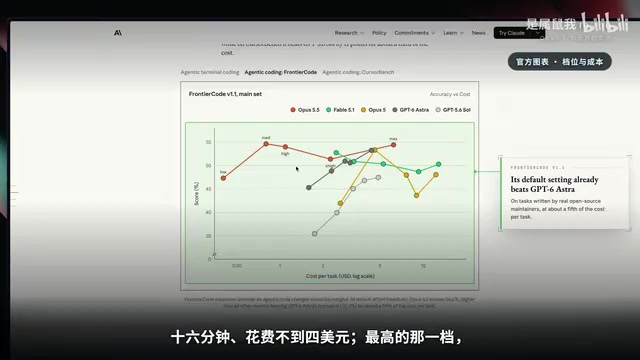
The clear winner across testers was the middle-to-high "Extra" setting — roughly half the time and cost, with the best results. Anthropic also recommends starting at Medium and scaling up or down as needed.
Conclusion
Across six creators and 30+ hours of real-world testing, three takeaways stand out: first, it's the best value-for-money model in the top tier right now; second, you can confidently hand it creative, gaming, frontend, and productivity tasks; third, using it as an orchestrating "brain" that delegates cheaper models for execution is an even more cost-effective approach.
Two practical tips to remember: start at medium reasoning effort and adjust as needed; write your prompts clearly to prevent the model from taking unintended shortcuts.
Using Opus 4.5 as an Orchestrator rather than a sole executor reflects a multi-agent architecture pattern. The idea: use Opus 4.5 for task decomposition, planning, and quality control, then delegate high-volume subtasks (like bulk copywriting or simple data processing) to lower-cost models like Haiku or Sonnet. This tiered approach maintains overall task quality while keeping total API costs in check. Anthropic's model family is designed with this in mind — Haiku targets high-speed, low-cost execution; Sonnet handles medium-complexity tasks; Opus focuses on top-level planning requiring deep reasoning and creative decision-making. For indie developers and small teams, this architecture lets the flagship model's intelligence advantage shine without paying flagship prices for every single API call.
Related articles

Build an AI Super Employee System at Zero Cost: A Full Breakdown of Automated Agent Workflows
A deep breakdown of the AI super employee system demoed on Bilibili: agent orchestration, digital human voiceovers, map and enterprise lead generation, 24/7 customer service, and legal modules. We analyze the business logic and compliance risks behind zero-cost signup to help entrepreneurs judge the real ROI of this AI digital employee system.

The Essential Difference Between Chatbots and AI Agents: Crossing from Conversation to Execution
What's the difference between a chatbot and an AI agent? Based on the MCP series on the Learn Tech channel, this article uses examples like booking flights and summarizing notes to explain: a chatbot only gives answers, while an agent actually completes tasks through a think-act-observe loop. It breaks down the four core components—model, tools, memory, and goal—as well as MCP's role as a bridge, and discusses agents' applicable boundaries and permission risks.

Free GitHub Repo: 342 Hours of AI Courses, from Math to MCP Servers
A free GitHub repo offers 342 hours of AI courses: 523 lessons across 20 phases, from math fundamentals to agent building and MCP servers. Nearly 100,000 learners have started.