Cursor Engineer Reveals: The Real Bottleneck in AI Collaboration Is Trust, Not the Model
Cursor engineer explains how building trust—not better models—unlocks autonomous AI Agent collaboration.
Cursor engineer Lauren argues that the true ceiling of AI Agent collaboration is trust, not model capability. Drawing on his own journey from micromanaging every Agent output to auto-merging PRs and submitting ~800 PRs in half a month, he outlines three key layers: giving Agents self-verification tools (via Chrome DevTools Protocol), using feature maps and Eval mechanisms to maintain skills, and designing codebases for the "dumbest Agent" with hard CI constraints that ban `useEffect`, forbid comments, and enforce process isolation—ultimately enabling non-technical teammates to ship quality code too.
As more and more engineers use AI Agents to write code, an unavoidable question surfaces: do you actually trust the code it writes? Lauren, an engineer from the Cursor team, gave his answer in a technical talk — the real ceiling of AI collaboration isn't model capability, but whether a trust framework between you and the Agent has been established.
From "Micromanaging Every Step" to "Auto-Merging PRs": The Trust Curve
Lauren opens with an analogy: if you're an engineering manager leading a team you don't trust, your working style will inevitably be "micromanagement" — constantly looking over people's shoulders, checking whether they've pushed bugs to production. Working with an Agent is exactly the same.
He sketched a rough but highly convincing "trust curve." A year ago, most people using Agents were stuck at the bottom: deeply involved in every step, watching every output, manually typing prompts, unable to parallelize at all. The reason is simple — when you can't trust a single Agent's output, you can't possibly drive a hundred of them simultaneously.
After five months of climbing that curve, Lauren reached the other end. He admits the claim sounds like "something a lazy fraud would say," but the reality is: he now lets Agents auto-merge PRs. "I woke up this morning and 20 PRs had already landed — I reviewed them directly on the main branch. They were already merged in, and they were good." He submitted 1,000 PRs last month; by the 12th of this month, he was already approaching 800.
This curve maps almost inversely to his contribution volume at Cursor: low output in his first month due to unfamiliarity with the codebase and distrust of the Agent, then a sharp rise as trust was established. He emphasizes that he's not sharing this to boast, but to illustrate — there are no shortcuts from the bottom to the top. This is fundamentally a personal journey of building trust in your Agent.
The Core Skill: Teaching Agents to "Self-Verify"
In Lauren's view, the single most important skill when collaborating with Agents is Verification — giving the Agent the ability to actually run code, capture CPU traces, collect heap memory snapshots, open an iOS simulator, and test and validate its own code the way a real user would experience the product.
"This doesn't guarantee the Agent writes good code, but it at least helps it write correct code — and that's a big step toward building trust." He points out that without verification capability, the human becomes the bottleneck: you ask the Agent to do something, it writes the code, you open a local build, find something's wrong, copy-paste error screenshots back to it, it slowly understands and revises... you're locked in this loop, unable to parallelize.
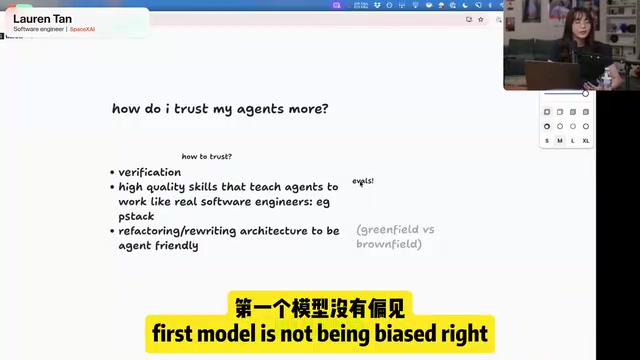
Lauren shared his experience building verification skills for Cursor's Agent window (internally codenamed "glass"). Just one week into the job, he had to tackle a performance issue in a React app before a deadline. He opened Chrome DevTools to capture a trace, tossed the screenshot to the Agent — which would only "confidently" guess at the problem, and turned out to be completely wrong. So he built the "control glass" skill, teaching the Agent to use the Chrome DevTools Protocol to run the app, capture traces, and achieve programmatic control.
Feature Map: Giving the Agent a "Product Map"
Control capability alone isn't enough — the Agent has no idea what the Agent window actually looks like. When users report "the left sidebar is lagging" or "the PR tab isn't working," the Agent wanders around aimlessly, wasting huge amounts of time searching the codebase without finding the feature entry point.
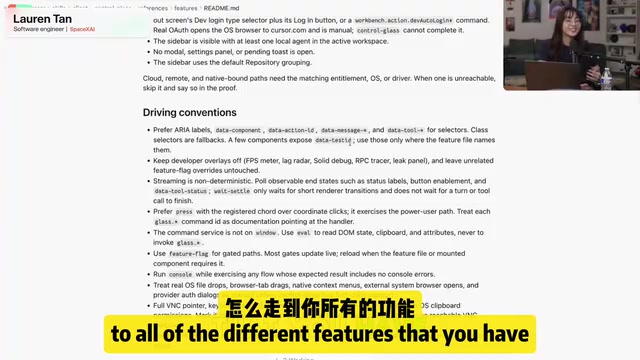
The solution is a unique file called a feature map. It teaches the Agent how to reach every feature in the product: navigation paths from the user's perspective, keyboard shortcuts, even DOM attributes for selecting elements. With it, even if a user drops a blurry screenshot with three question marks — "???" — the Agent can use the context to understand and locate the problem. Lauren's open-source plugin PSAC (a tongue-in-cheek jab at Y Combinator CEO Gary Tan's "G-Stack") includes the ability to create and maintain these kinds of verification skills.
Chrome DevTools Protocol (CDP) is a low-level debugging interface exposed by Google Chrome that allows external programs to programmatically control a browser instance via WebSocket using a JSON-RPC protocol — including capturing network requests, executing JavaScript, recording performance traces, and taking page screenshots. Compared to higher-level automation frameworks like Selenium or Playwright, CDP provides finer-grained access to the V8 engine's CPU Profiler and HeapSnapshot, which is its irreplaceable advantage in performance diagnostics. The "control glass" skill Lauren built is essentially a CDP wrapper that the Agent can invoke as a tool, enabling it to autonomously close the loop of "run → inspect → locate bottleneck → fix" without a human in the middle passing screenshots. This is the key technical foundation for moving from "human as bottleneck" to "Agent self-verification."
Eval: Writing "Unit Tests" for Agent Skills
The product is constantly evolving, with many people committing code to the codebase simultaneously — so how do these skills get maintained? Lauren's answer is Eval — his mental model is "unit tests for Agents."
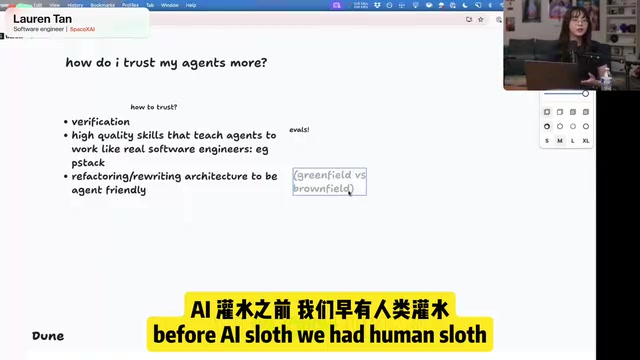
The approach: a primary orchestrator Agent creates a scoring rubric, then spawns multiple sub-Agents, creating directories with deliberately misleading names to hide the fact that they're being evaluated (because once an Agent realizes it's being tested, it changes its behavior). A judge Agent using a different model cross-validates to prevent bias. Thanks to Cursor's support for multiple models, he can evaluate the same skill across the entire model matrix.
Going further, Evals can "hill climb" — using a slash loop command to iterate continuously until every item scores 10/10. Lauren's control skill was polished this way, nearly fully automatically. He also admits that maintaining skills is genuinely hard — it requires a lot of taste and observation. "You have to be good at being a backseat driver," carefully reading through every tool call and thought process the Agent makes, finding where it fails, and then building targeted skills to address it.
The design of "using a different model as a judge for cross-validation" stems from a well-known problem in LLM evaluation called "self-preference": research shows that when the same model plays both generator and evaluator, it tends to score its own outputs higher, even if they aren't objectively better. Introducing a heterogeneous model as the judge (e.g., using Claude to evaluate GPT-generated results, or vice versa) can statistically offset this bias. This mirrors the thinking behind cross-validation in machine learning: using independent evaluators with different inductive biases improves the reliability of conclusions. Lauren engineering this academically-discussed technique into a daily skill evaluation workflow is a prime example of "bringing AI evaluation methodology into software engineering practice."
From Local Trust to Cloud-Scale: The Lesson of the Benny Bot
Lauren's recommended path is: start locally to build verification skills, where you can observe how the Agent interacts with the application; once you trust it locally, expand to cloud Agents.
The power of Cursor's cloud Agents is that once you invest the time to set up the environment, these control and verification skills pay huge dividends — they don't just make one person stronger, they elevate the entire team and even the whole company. He gave the example of an internal Agent called "Benny": Benny receives all bug reports, automatically spins up a desktop environment in the cloud, runs Cursor, and uses the same control skills to reproduce issues users have reported. Once, Benny reproduced a bug — but discovered it had already been fixed on the main branch, and automatically confirmed: "This issue is resolved, just needs another build." This saved the team an enormous amount of time that would have otherwise required manual verification.
That said, Lauren repeatedly emphasizes: this is a journey, and you must build trust first. He explicitly discourages newcomers from jumping straight to "spinning up hundreds of cloud Agents at once" — that approach just burns through tokens and costs a fortune.
Strong-Constraint Architecture: Designing the Codebase for the "Dumbest Agent"
The most insightful part of the talk is Lauren's views on codebase architecture. He boldly defends "rewriting applications" and points out a counterintuitive phenomenon: the legacy baggage of big tech companies has now become everyone's problem.
He worked at Meta, where thousands of engineers work in a giant monorepo. "You'd be surprised — the code quality isn't actually that good." He quips: "Before AI slop, we had human slop." But big-tech infrastructure is precisely designed for "the weakest engineer on the team" — frameworks, conventions, guardrails, permission restrictions to prevent interns from wiping the production database. With that infrastructure in place, Agents actually perform reasonably well, because the guardrails are already there.
The real risk lies in brand-new greenfield projects. Quickly vibe-coded prototypes like Grokbot have almost no guardrails, so Agents solve problems in the most convenient way available, and the codebase eventually "spirals out of control" — what he calls "organic architecture": a mess over-optimized for short-term shortcuts that nobody can fully understand.
Dune Architecture: Turning All Constraints into Hard CI Failures
Grokbot's architecture, codenamed Dune, is what Lauren describes as "Next.js for Electron apps, built for Agents." Its CI is strict to the point of being "annoying":
useEffectis banned: one of React's biggest pitfalls — CI will error outright- Code comments are forbidden: because 99% of the time, Agent-written comments describe irrelevant historical information
- Forced process isolation:
electron-mainandelectron-rendererdirectories with CI checking the dependency graph to prevent heavy computation from accidentally being pulled into the render thread and causing frame drops
Lauren proposes a layered defense mental model. The strongest layer is the codebase architecture itself: since Agents love to copy existing patterns, consolidating all functionality in a single directory and establishing one correct way to do things is the strongest constraint. His core principle is "the shortest path is the best path" — since Agents always take shortcuts, make the shortcut the optimal solution.
Above that come static analysis, compiler diagnostics, and CI checks (hard constraints), and above that come rules, skills, and BugBot (soft constraints). He stresses you should never rely solely on soft constraints: "If all you have are rules, BugBot, skills, and style guides, it's only a matter of time before your codebase turns to garbage."
His golden rule: every time you manually point out "you shouldn't do it this way" in a code review, treat it as a code smell. Ask yourself — how can I turn this into a lint rule? A CI failure? Or eliminate the entire class of problems at the root?
useEffectis a Hook in React function components used to handle side effects — common uses include data fetching, DOM manipulation, and event subscriptions. It's considered "one of React's biggest pitfalls" because its dependency array semantics are extremely easy to misuse: missing dependencies cause stale closures, over-specifying them triggers infinite render loops, and unstable object references cause unexpected re-runs. For AI Agents, this risk is amplified further — Agents tend to follow high-frequency patterns in their training data when completing code, anduseEffectis a constant fixture in Stack Overflow "quick fix" solutions, making it easy to copy indiscriminately into a codebase. Banning it at the CI level is a concrete expression of the defensive philosophy of "eliminating an entire class of errors" rather than "correcting them one by one."
"Greenfield projects" in software engineering refers to brand-new projects built from scratch, unconstrained by any existing systems — in contrast to "brownfield projects" that require iterating on legacy code. Greenfield sounds liberating, but is precisely risky because it lacks the conventions and guardrails that come from historical precedent — especially when Agents are used for rapid prototyping. Agents will follow the path of least resistance: copy wherever there's a reusable pattern, reach for a global variable wherever it saves effort rather than abstracting. In an unconstrained greenfield environment, this behavior accumulates technical debt at an exponential rate, eventually forming what Lauren calls "organic architecture" — functionally complete on the surface, but internally a dependency network nobody can fully understand. This is exactly why he advocates introducing strict CI constraints at the very beginning of a project, rather than trying to remediate after the codebase has already "spiraled out of control."
ROI and Democratization: It's Not Just About Saving Tokens
Faced with the pushback that "ordinary people don't have unlimited tokens," Lauren acknowledges he has a token advantage working at an AI lab, but frames this as an ROI question. The upfront cost of refactoring the codebase does burn tokens (he submitted over 600 PRs for Grokbot's new architecture), but if we're heading toward a world where Agents write all the code, you'll want your team to stay lean — not balloon into a 10,000-person engineering organization.
The real value of Agents isn't "saving tokens on every little thing" — it's enabling you to do things that were previously impossible, like single-handedly enforcing such a high standard of constraints across the entire codebase.
This strong-constraint architecture also produces an unexpected democratizing effect: because Dune's constraints are strict enough, product managers, designers, and even GTM people can directly contribute high-quality code. Grokbot has become their "non-technical Cursor moment" — an interface as friendly as iMessage, where each Agent feels like a person with an identity that can be naturally orchestrated to collaborate. Lauren says PMs are now submitting code too. "They say 'I fixed this bug, take a look,' I review it and it's perfect, I just stamp it" — which is exactly proof that Dune's strict constraints are working.
One-line Summary
Cursor engineer Lauren shares how verification mechanisms, strong-constraint architecture, and a trust curve can transform an AI Agent from a supervised assistant into a collaborator that autonomously merges PRs.
Related articles

LynnReal-Omni: 32B Unified Video Diffusion Model Goes Open Source with Multi-Task Coverage in Four Steps
LynnReal-Omni is a 32B unified video diffusion model on MiniMax H3, covering text-to-video, pose guidance, style transfer, restoration in 4 steps. Flash version generates 540p video in 377ms on one H100.

Anthropic Co-Founder: AI 'Kill Switch' May Need to Be Mandatory by Law
Anthropic's co-founder tells the BBC that AI 'kill switches' may need to be legally mandated. We analyze the industry logic, technical challenges, and the tension between regulation and innovation.

The AI Data Center Boom Is Colliding With Cities Scarred by Heavy Industry
The AI data center boom is clashing with post-industrial communities. Philadelphia's case reveals structural conflicts between AI growth, energy use, water, and environmental justice.