Databricks' New AI Agent: A Corporate Intelligence Revolution That Tells the CEO the Unvarnished Truth
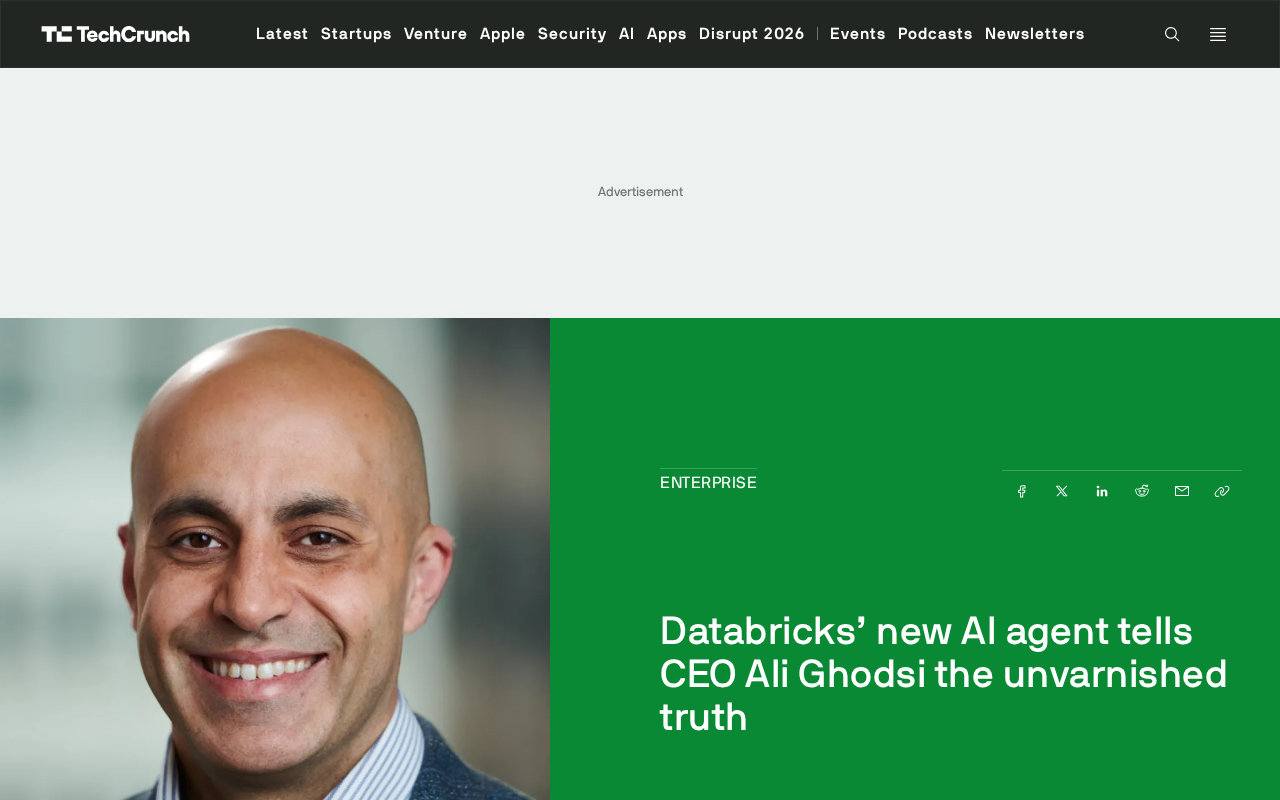
Databricks' CEO uses an AI Agent to bypass information filtering and get frontline truth.
Databricks CEO Ali Ghodsi uses the new Genie Agent to bypass organizational information filtering at 12,000 employees, getting unfiltered frontline truth from internal data. The case shows enterprise AI Agents shifting from efficiency tools to decision-making advisors, while raising data-quality and access-boundary challenges.
Title
Databricks' New AI Agent: A Corporate Intelligence Revolution That Tells the CEO the Unvarnished Truth
Meta Description
Databricks launches a new version of its Genie AI Agent, helping CEO Ali Ghodsi obtain unfiltered frontline truths at a scale of 12,000 employees. This article analyzes the trend of enterprise AI Agents evolving from execution tools to decision-making advisors, as well as the trust and data-boundary challenges behind blunt truth-telling.
Article Content
Corporate executives often sit at the top of an information-filtering pyramid. For various reasons, subordinates find it difficult to feed the most authentic—and even jarring—problems directly back to the CEO. Ali Ghodsi, co-founder and CEO of Databricks, faces the same classic management dilemma with over ten thousand employees at his company. But he has found a new solution: letting an AI Agent become the one who "tells the truth."
From "Information Filtering" to "Direct Dialogue": The Positioning of the Genie Agent
According to the original report, Ghodsi admitted that at a headcount of 12,000, it is impossible for him to know everyone, and employees are unlikely to proactively confess mistakes that occur in their work to him. But he does not need to rely on employees' voluntary reporting. He uses Databricks' recently revamped Genie Agent to obtain this information.
This scenario reveals a key shift in enterprise-grade AI Agents: from customer-service bots aimed at external customers and coding assistants aimed at developers, to an "internal intelligence officer" serving the highest decision-maker. The Genie Agent is not positioned as a simple Q&A tool, but rather plays the role of delivering unvarnished frontline truths directly to the CEO, cutting across organizational hierarchies.
Genie Agent is a natural-language query and conversational analytics component within the Databricks data intelligence platform. Its core capability is automatically translating questions users ask in everyday language into SQL queries against structured data in a data warehouse or lakehouse, and returning results and visualizations. Genie was originally aimed at internal analysts and business users to lower the barrier to data querying; the new version strengthens multi-turn dialogue, contextual understanding, and proactive insight capabilities, enabling it to continuously track dynamic data such as project progress and operational metrics. It is important to distinguish that Genie itself is not a general-purpose autonomous Agent, but a "data Q&A layer" deeply tied to the Databricks data platform, whose output quality depends directly on the quality of underlying data tables and permission configurations.
Why CEOs Need "Unvarnished Truth"
In large organizations, information is often beautified layer by layer as it travels upward. Middle managers tend to highlight achievements and downplay risks, while frontline employees worry that speaking bluntly will bring negative consequences. Ghodsi's pain point is universal: as an organization scales, the CEO's blind spots expand with it.
The value of the Genie Agent lies in the fact that it does not participate in organizational politics and is not bound by interpersonal relationships. It generates descriptions of problems directly based on real internal data—project progress, communication records, operational metrics, and so on. This "disintermediated" information channel allows the CEO to bypass the traditional reporting chain and touch a more raw, more authentic pulse of the enterprise.
Information Filtering in organizational behavior typically refers to the phenomenon in which information is screened, embellished, or even distorted layer by layer as it travels upward, often also called "organizational silence" or "shooting the messenger." Classic research points out that subordinates tend to report information that pleases their managers while withholding risks and mistakes, for reasons including fear of retaliation and impression management. As the CEO sits at the top of the hierarchy, the information they receive has passed through multiple levels of "editing" and is the most distorted. This structural flaw cannot be solved by an "open communication culture" alone, because the motivation to filter is rooted in power asymmetry. Therefore, introducing an automated information channel that does not participate in organizational politics and is unaffected by interpersonal relationships becomes a technical approach to bypassing the filtering mechanism—this is precisely the role context assigned to the Genie Agent.
The Differentiated Path of Enterprise AI Agents
Databricks' move forms an interesting contrast with the direction of current mainstream AI Agent products. Most enterprise AI applications focus on improving efficiency, such as automating processes, assisting with coding, or customer service. The Genie Agent, by contrast, is used to support management decisions at the CEO level, emphasizing the authenticity and penetrating power of information rather than mere task-execution speed.
This also raises a trend worth watching: AI Agents are evolving from "execution tools" into "decision-making advisors." When an Agent can access core enterprise data and possesses sufficient reasoning capability, it may become an extension of the executive team's senses, helping identify signals that have been deliberately concealed or inadvertently overlooked.
Trust and Boundaries: The Challenges Behind AI Speaking Bluntly
Having AI "speak bluntly" to the CEO is not without risk. An Agent's output quality depends heavily on the completeness and accuracy of the underlying data; if the data itself is biased, the AI's "truth" may also be distorted. In addition, how to define the scope of data an Agent can access and how to ensure sensitive information is not misused are questions enterprises must answer when deploying such tools.
Ghodsi's practice at least provides a valuable reference: when an organization grows so large that the CEO cannot personally attend to everything, an AI Agent can become a new kind of management infrastructure. Its significance lies not in replacing human judgment, but in providing inputs closer to the facts for that judgment.
For practitioners focused on enterprise AI adoption, the Databricks case shows that the imagination around AI Agents goes far beyond efficiency gains. When embedded into an organization's power and information structures, they may redefine "what managers can know" and "how truth reaches decision-makers."
One-line Summary
Databricks' CEO uses an AI Agent to bypass information filtering and obtain frontline truths.
Paragraph Summary
Ali Ghodsi, co-founder and CEO of Databricks, faced the information-filtering dilemma common to executives when his company reached 12,000 employees: subordinates are unwilling to report real problems directly. He turned to the new Genie Agent as an "internal intelligence officer" to obtain unvarnished frontline truths directly based on internal enterprise data. This case reveals that enterprise AI Agents are shifting from efficiency tools such as customer service and coding toward decision-making advisor roles serving the highest decision-makers. The article analyzes the value of this shift—a disintermediated information channel unaffected by organizational politics—while also pointing out its challenges: output quality depends on the integrity of underlying data and involves sensitive information access boundaries and data bias risks. Databricks' practice shows that AI Agents may redefine how information flows within organizations.
Related articles

How Do Cursor, Devin, TRAE, and Copilot Compare on Price? Calculate Your Credits Before You Compare Monthly Fees
Side-by-side comparison of individual and team pricing for Cursor, Devin Desktop, TRAE, and Copilot, breaking down credit rules, third-party model inclusion, overage billing, and practical methods for measuring usage before paying, setting spending caps, and choosing the right tool.

Copilot Retires Three Models: Pro Users Left With Only One Alternative
GitHub Copilot retires Claude Opus 4.8, Claude Opus 5, and GPT-5.6 Tera on Nov 16 across Chat, code completion, and Agent mode. Pro users have only GPT-6 Luna left; Legacy annual plans miss Opus 5.5; admins must enable replacements manually.
Gemini 4 Carbon Arrives: The LLM Race Enters the Era of Million-Token Context and Trillion-Parameter Open Source
Google launches Gemini 4 Carbon and multi-agent tool Swarm; Anthropic debuts million-context Fable 5.2 and Mythos 5.2; OpenAI releases security-focused GPT-6 Cyber; Mistral and Kimi open-source trillion-parameter models — the LLM race accelerates across the board.