Deep Agent Sub-Agent Explained: An Enterprise AI Agent Framework in the LangChain Ecosystem

Deep Agent is the LangChain team's highly stable framework for long-horizon tasks, with sub-agents as its core mechanism.
The article explains why LangChain launched Deep Agent: even with LangChain and LangGraph, there is still a need for an agent framework focused on long-horizon tasks with stability first. It maps the ecosystem—LangChain provides parts, LangGraph the runtime chassis, LangSmith monitoring, and Deep Agent assembles them into a complete agent like Spring Boot. The article highlights sub-agents, distinguishes synchronous and asynchronous types, and notes enterprise adoption.
Why Deep Agent?
If you've worked with LangChain or LangGraph, you might wonder: with these frameworks already available, why did the LangChain team introduce Deep Agent? The answer lies in stability for long-horizon tasks. Deep Agent is positioned as an agent framework for building complex, long-horizon tasks, and its core goal is not just to "get it running" but to "keep it running stably over the long term."
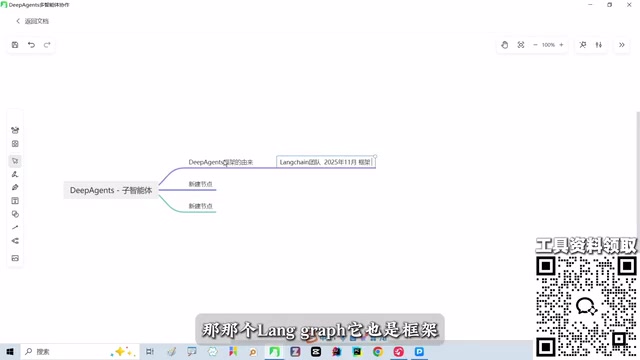
According to the LangChain team, Deep Agent was launched around November 2025. It wasn't built from scratch—it stands on the shoulders of LangChain and LangGraph, using forms like the Harness to help developers build stronger, more autonomous agents.
Long-Horizon Tasks refer to complex tasks that require dozens or even hundreds of steps, spanning multiple tool calls and state transitions to complete—for example, end-to-end code refactoring, writing multi-round research reports, or cross-system ticket processing workflows. These tasks are fundamentally different from single-turn Q&A or short-chain tool calls: the longer the execution chain, the more the probability of errors in intermediate steps accumulates multiplicatively, the context window is easily filled up by historical information, and the model may drift away from its initial goal over multiple loops. Therefore, the key metric for evaluating an agent framework shifts from "single-task success rate" to "stability and recoverability over long sequences of execution"—including retry after failure, state persistence, context compression, and task decomposition capabilities. Deep Agent prioritizes stability, which is precisely the engineering trade-off made to address this pain point.
Deep Agent's Position in the LangChain Ecosystem
To understand Deep Agent, you first need to see the full picture of the LangChain ecosystem. This ecosystem includes LangChain (which encapsulates capabilities like models, RAG, tool calling, memory management, and context handling), LangGraph (which provides runtime mechanisms like state loops, branching, and checkpoint recovery), LangSmith (agent monitoring), and Deep Agent.
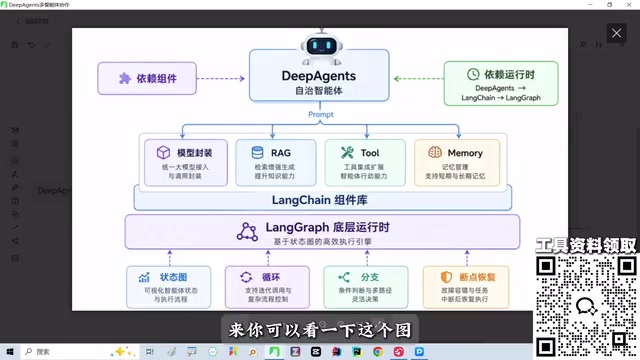
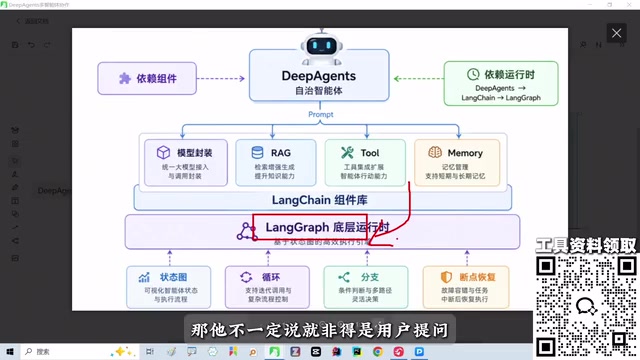
From an architectural perspective, LangChain provides the various "parts," LangGraph provides the "runtime chassis," and Deep Agent assembles the two into a more complete agent. This relationship is similar to Spring Boot in the Java ecosystem—developers don't need to directly manipulate the low-level details of Spring and Spring MVC because Spring Boot has already integrated them. This is exactly Deep Agent's position within the LangChain family.
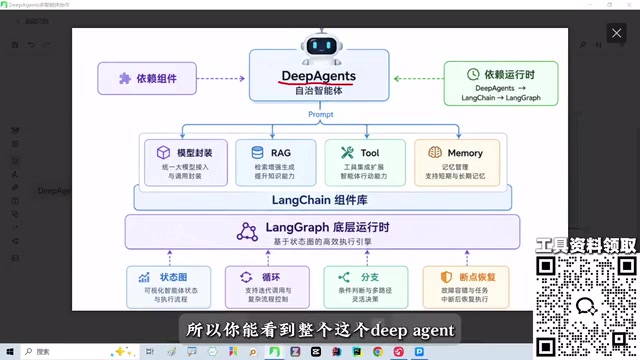
Harness (runtime shell / execution skeleton) is a key concept in agent engineering, referring to the entire execution structure wrapped around the model: it organizes prompts, schedules tool calls, manages loops and interruptions, injects context, handles error retries, and strings the model's individual inferences into a continuously advancing execution flow. You can think of it as the agent's "runtime scaffold"—the model itself only provides reasoning capability, while the Harness determines whether that reasoning capability can be reliably orchestrated into multi-step behavior. Different Harness designs significantly affect an agent's robustness, observability, and cost. Deep Agent appearing in the form of a Harness means it is not just a collection of APIs but a complete agent runtime with a prescribed execution flow, on top of which developers simply fill in business logic.
Sub-Agents: The Core Mechanism of Deep Agent
The focus of this lesson is on Sub-Agents within Deep Agent. Sub-agents are divided into synchronous sub-agents and asynchronous sub-agents, and they are designed to enable the main agent to handle complex tasks more efficiently. Why do this? Because long-horizon tasks often require multiple steps and multiple capabilities working together, and a single agent struggles to balance both stability and flexibility.
The instructor emphasized that many non-VIP students may have only been exposed to Python, LangChain, or LangGraph and may not yet be familiar with newer concepts like Deep Agent and Harness. But there's no need to worry—the course will distill key points in the form of mind maps, so just follow the pace.
Main Agent / Sub-Agent (Orchestrator–Sub-Agent) is a hierarchical collaboration architecture. The main agent acts as the orchestrator, responsible for understanding the overall goal, decomposing tasks, deciding when to invoke which sub-agent, and aggregating results; sub-agents are specialized units focused on a specific domain or a specific toolset, with their own independent context and prompts, focusing solely on their small piece of work. This split brings two direct benefits: first, context isolation—sub-agents don't need to carry the entire history of the main flow, avoiding context bloat and information interference; second, converged responsibilities—each sub-agent only needs to maintain stability within its narrow domain, while the overall system's reliability is backed by the orchestration layer. Synchronous sub-agents need to wait for results before continuing, making them suitable for steps with strict dependency order; asynchronous sub-agents can be launched in parallel and have their results collected later, making them suitable for independent, time-consuming subtasks.
Enterprise Applications and Learning Advice
Deep Agent is not a toy framework. The instructor mentioned that the projects in the VIP course are explained based on this theory, and when enterprises build stronger, more autonomous, and more stable agents, they are essentially all using Deep Agent. For beginners, there's no need to overcomplicate LangGraph—it is essentially the runtime chassis for agents, responsible for mechanisms like state loops, branching, and checkpoint recovery.
When learning Deep Agent, you can treat LangChain and LangGraph as foundational components and focus on understanding how Deep Agent assembles them into a complete agent system. This way, even without deep mastery of the underlying details, you can keep up with the course pace and gradually build a clear understanding of the sub-agent mechanism.
This article is compiled from a segment on Deep Agent sub-agents in the Bilibili video "Complete Beginner's Guide from ChatGPT to Codex | Installation and Login, Interface Walkthrough, and AI Bug Troubleshooting in Practice, All Explained Clearly!"
One-line Summary
Deep Agent is a highly stable agent framework built by the LangChain team for long-horizon tasks, with sub-agents as its core mechanism.
Paragraph Summary
The article centers on Deep Agent, launched by the LangChain team, first explaining its motivation: even with LangChain and LangGraph already available, there is still a need for an agent framework specifically designed for long-horizon tasks with stability as the top priority. It then outlines the division of labor in the LangChain ecosystem—LangChain provides parts like model encapsulation, RAG, tool calling, and memory; LangGraph provides the runtime chassis with state loops, branching, and checkpoint recovery; LangSmith handles monitoring; and Deep Agent, like Spring Boot, assembles the former two into a complete agent. The article focuses on the sub-agent mechanism, distinguishing between synchronous and asynchronous sub-agents and explaining how they enable the main agent to handle complex tasks more efficiently. Finally, it notes that enterprise projects already commonly build more autonomous and stable agents based on this theory, and suggests learners view LangChain and LangGraph as foundational components.
Related articles

Running a Local LLM on a Laptop CPU: Ollama + Qwen3 Gives a Desktop Pet a Brain
An ordinary laptop without a GPU can run a local LLM: a Bilibili creator uses Ollama plus open-source Qwen3 8B on pure CPU to give an original desktop pet a local brain, with DeepSeekHarness handling plugin development and three rounds of debugging — 0 yuan, works offline, privacy stays on-device.

AgentScope 2.0 in Practice: A Guide to Enterprise-Level AI Agent Development in Java
AgentScope 2.0 is Alibaba's Java enterprise-grade distributed agent framework. This article explains why it suits server-side AI applications, contrasts client-side AI apps in permissions, state management, and concurrency, and outlines a practical learning path from environment setup to project integration.

GPT-6 Astra Directly Edits Weights to Fix Models? Full Analysis of the MIT Paper and Leaks
MIT paper shows GPT-6 Astra repairs small models by directly editing weights, raising math scores from 7.9% to 48.1%; OpenAI internal charts hint an unreleased model leads on BenchCAD 2.0; Fable 5.5 pure-code movies and the Claude WiFi radar incident analyzed.