Deep Agents Enterprise AI Development: A Practical Path for Frontend Engineers Transitioning to AI Architecture

Deep Agents is an enterprise-grade LangChain Agent framework offering frontend engineers a clear path to AI architecture roles.
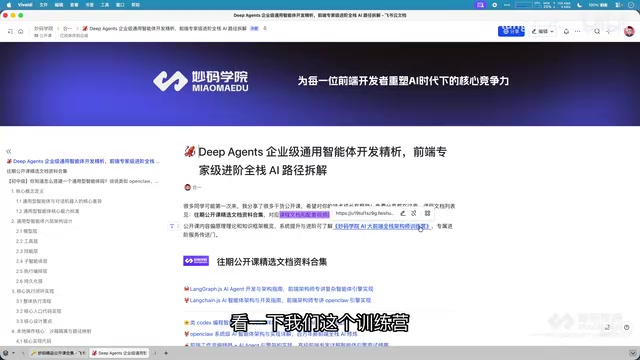
This article maps out the core knowledge system for AI Agent development centered on the Deep Agents framework. It clarifies the escalating capability relationship between LangChain, LangGraph, and Deep Agents — from chained calls to complex orchestration to heavy-duty agents with sandbox execution and Skill invocation — and distills three key interview question tiers: general agent architecture, framework selection logic, and Codex-like product design. Using a Figma AI-style generation engine as a hands-on example, it demonstrates a complete Design to Code pipeline built on a primary agent, parallel sub-agents, and a low-code JSON intermediate layer.
What Problem Does Deep Agents Actually Solve
Deep Agents is a relatively new framework within the LangChain ecosystem. To understand where it fits, it helps to trace the technical evolution: LangChain was originally built to solve chain-invocation problems and standardize AI development APIs — whether for model integration or execution pipelines. LangGraph took things further by supporting complex logic orchestration with loops and branches. Deep Agents pushes capabilities to an even higher level — it can operate on the local file system, supports kill (interruption) mechanisms, invoke Skills, and provides other enterprise-grade capabilities.
In other words, if you want to understand how tools like Codex or Claude Code actually load and execute Skills, Deep Agents provides exactly that underlying paradigm. It's not a simple conversational wrapper — it's a complete enterprise AI deployment solution that covers everything from model loading to sandbox execution.
Three Interview-Level Questions You Can't Avoid
There are three core questions around Deep Agents that build on each other — and they happen to be the exact areas frontend engineers get grilled on when interviewing for AI architecture roles.
How to Build a General-Purpose Agent
The first question is foundational: if an interviewer asks "Have you built a general-purpose agent before? How would you approach something like OpenClaude or Codex?" — you need to be able to walk through the overall architecture. A complete general-purpose agent call chain roughly goes like this: select a model based on the prompt, load the model, load Skills, map them to a local code execution sandbox, complete Deep Agents initialization; then use streaming calls to perform result search and tool-call engine execution; the LLM receives the content, processes and retrieves information, returns the results, and finally shuts down the local sandbox to return the final output.
This pattern isn't proprietary to any single company. Whether it's OpenClaude, Codex, or Claude Code — they all fundamentally run on this same flow. Understand this main chain, and you've grasped the skeleton of this class of agents.
The "execution sandbox" mentioned here is a key concept for understanding tools like Codex. A sandbox in this context refers to an isolated code execution environment — typically built on containers (like Docker) or virtual machines — where AI-generated code runs without direct access to the host machine's file system or network, thereby mitigating security risks. A Skill is a higher-level abstraction over tool calls: not a standalone function, but a capability package with defined input/output schemas, permission declarations, and error-handling logic that an agent can register and unload on demand. Codex's "shell execution" and Claude Code's "file editing" are essentially pre-registered Skills within their respective sandboxes. Streaming solves the UX problem for long-running tasks: instead of waiting for all steps to complete before responding, the agent pushes intermediate states (e.g., "Searching…", "Writing the third function…") to the client in real time — typically implemented on the frontend via SSE (Server-Sent Events) or WebSocket.
How to Choose Between LangGraph, LangChain, and Deep Agents
The second question is intermediate to advanced: compare LangGraph, LangChain, and Deep Agents — what are the differences, and how do you make a technology choice for a specific project? The three aren't alternatives to each other — they represent escalating levels of capability:
- LangChain: Solves chained invocation and API unification; best for linear task flows
- LangGraph: Supports looping and branching complex logic; best for orchestration scenarios requiring state transitions
- Deep Agents: Targets enterprise-grade capabilities like local file operations, sandbox execution, and Skill invocation; best for building heavy-duty agents like Codex
A bit of technical background worth adding: LangChain's core abstraction is the "Chain" — essentially a directed acyclic graph (DAG) where each node receives the previous step's output and passes it forward, making it suitable for linear flows like Q&A, summarization, and translation. LangGraph introduces the concept of a "graph" on top of this, allowing conditional edges between nodes, supporting cycles and backtracking — making feedback loops like "check result → retry if unsatisfied" possible. Its underlying state machine model is closer to a traditional workflow engine. Deep Agents further introduces the concept of "execution environment isolation": each agent run can mount an independent local sandbox, Skills are registered as plugins, and the kill mechanism allows interrupting any running subprocess at any moment. This means it's not just orchestrating logic — it also manages the runtime lifecycle, a capability boundary the previous two frameworks simply don't have. A simple rule of thumb for selection: does the task need to operate on the file system or external processes? If yes, Deep Agents is almost the only choice. If it's just multi-step LLM calls, LangGraph is sufficient.
Designing a Codex-Like Product with Deep Agents
The third question tests the most comprehensive capabilities: if you were to design an AI agent similar to OpenClaude, Claude Code, or Codex using Deep Agents, do you have your own design proposal and a clear sense of the core code implementation? This requires connecting the knowledge from the first two questions and grounding it in concrete architectural decisions.
A Practical, Deployable Demo: A Figma AI-Style Generation Engine
One of the key projects demonstrated in the course is a "Design and Application Generation Engine" similar to Figma AI — capable of calling local Codex or Claude Code to go from a single natural language prompt to a design mockup, then convert it to code with one click.
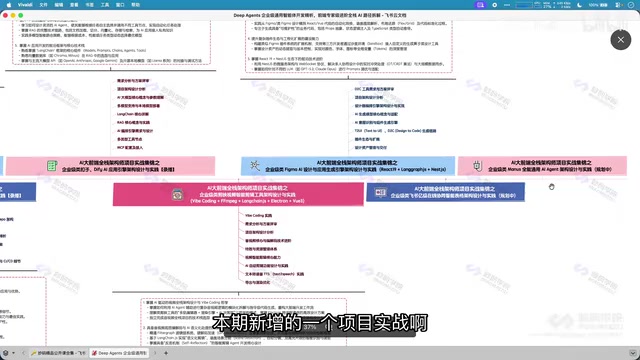
Taking a landing page generation as an example, the entire flow demonstrates a classic multi-agent collaboration pattern: after calling the local model, the primary agent (Hub) executes a Plan and breaks it down into several modules; sub-routes then direct the work to different sub-agents. Once the execution chain and design style are determined, the system creates corresponding partitioned containers, retrieves layout tokens, and completes development with multiple sub-agents running in parallel. The demo shows one primary agent coordinating three to four sub-agents running four blocks in parallel — a textbook Plan-and-Execute architecture with sub-agent division of labor.
Low-Code Platforms as a Critical Intermediate Layer
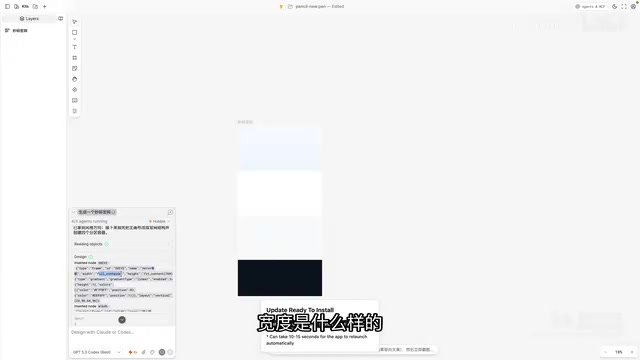
A design detail worth highlighting: AI doesn't output code directly. Instead, it first generates a layout-bearing JSON structure. This JSON describes each block's type, content, dimensions, color values, positioning method, horizontal/vertical arrangement, content spacing, and more — which is exactly the data structure of a low-code platform.
With a low-code platform as the intermediate layer, AI only needs to generate structured JSON, which can then be fed into a visual editing workflow. Users can hover over elements to directly edit content, adjust positioning, and after making changes, convert the Frame to final code with one click via MCP. The demo mentions the ability to self-encapsulate a Design MCP to connect to the Frame's URL, retrieve JSON, and convert it to React code — achieving "whatever you generate on one side, the code on the other side is a 100% pixel-perfect match" with no design drift in between.
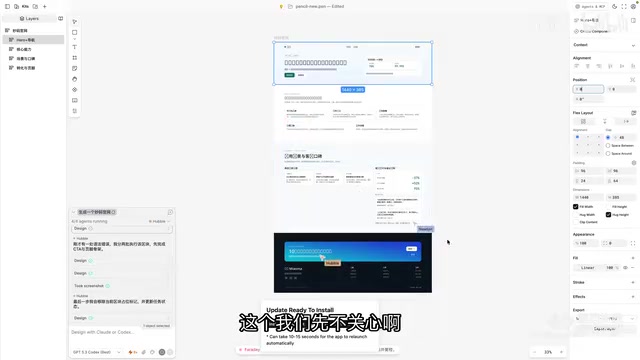
The demo honestly acknowledges issues like garbled text and rendering conflicts (the project isn't fully implemented and is shown for illustration purposes), but this Design to Code pipeline — "natural language → design → code" — is precisely the direction most mid-to-large tech companies are actively pursuing.
MCP (Model Context Protocol) is an open protocol introduced by Anthropic in late 2024 to standardize communication between AI models and external tools and data sources. Its core idea is similar to the USB interface standard: whether it's a file system, database, or design tool, as long as it implements an MCP Server, the model can discover and invoke these capabilities through a unified protocol without writing custom adapter code for each tool. In the Design to Code scenario, the self-encapsulated Design MCP acts as the bridge between the Figma/Frame design tool and the code generation model — the model pulls the Frame's JSON description via MCP and converts it into a React component tree. The advantage of this architecture is replaceability: as long as the JSON Schema stays stable, the underlying code generation model can be swapped at any time (from Claude to GPT or a local model) without affecting the design editing workflow upstream — which is also the technical guarantee behind the "no design drift" promise.
Why Frontend Engineers Should Pay Close Attention to This Paradigm
Here's a counterintuitive but important insight: a strong foundation in frontend fundamentals often matters more than AI knowledge itself. The reason AI-plus-frontend scenarios are deployable in practice is because of deep understanding of layouts, components, and orchestration logic — the ability of a low-code platform's JSON structure to absorb AI output is built on solid frontend engineering capabilities.
For developers looking to break out of pure frontend into AI architecture roles, Deep Agents offers a clear foothold: it connects "general-purpose agent architecture," "framework selection," and "product-level design" into a coherent three-tier skillset. Master this main chain, combine it with a competitive real-world project like Design to Code, and frontend engineers have every opportunity to carve out their own place in the AI application architecture space.
Related articles

How Big Can Stars Really Get? The Physical Limits of the Largest Stars
Red supergiants are the largest stars by volume, with radii up to 2,000 times the Sun, engulfing the inner solar system. But there is no precise upper limit on stellar size—models predict up to 15,000 solar radii. The most massive blue stars are far smaller than red supergiants—biggest and heaviest are two different things.

Apple HomeView Smart Display Full Feature Breakdown: Wall-Mount or Desktop, $299
Apple launches HomeView, a $299 smart display with wall-mount and desktop options, 12MP camera for facial recognition, smart home control, music playback, and recipe step-by-step cooking. Full breakdown of watch faces, apps, privacy, and cooking integration.

Where Did the Promised New Studio Go? Craft Computing Answers After Five Years
Craft Computing's host responds to viewer questions: the new studio promised five years ago was shelved as construction costs soared from $30,000 to $75,000, and was replaced by a 168-square-foot garage conversion.