DeepAgents Framework Explained: The LangChain Ecosystem's Answer to Production-Grade AI Agents
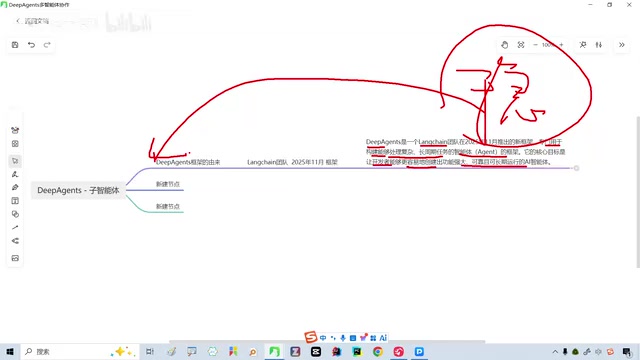
DeepAgents is LangChain's higher-level framework for building long-running, enterprise-grade AI agents.
DeepAgents is a higher-level agent framework from the LangChain team — analogous to Spring Boot in the Spring ecosystem. It sits on top of LangChain (which provides model calls, RAG, tools, and memory) and LangGraph (which provides state management, looping, and checkpoint recovery), packaging both into a unified layer so developers can focus on building stable, long-running autonomous agents. It also introduces Harness engineering — external safeguards like retry policies, human-in-the-loop nodes, and permission controls — to ensure production-grade reliability. This stack has become the de facto choice for enterprise AI agent deployments.
What Is DeepAgents? The LangChain Team's Next Evolution
When it comes to AI agent development frameworks, most developers immediately think of LangChain and LangGraph. DeepAgents, built by the same LangChain team, takes this ecosystem one step further.
By official definition, DeepAgents is a framework for building agents that handle complex, long-running tasks. Its core goal is straightforward — make it easier for developers to create agents that run reliably over extended periods. The operative word here is "stable." You could always build agents with LangChain or LangGraph, but when you need something more capable, more autonomous, and more dependable, DeepAgents has become the go-to choice in enterprise deployments.
One important point worth clarifying: DeepAgents is not a standalone system built from scratch. As explained in this Bilibili tutorial, it's a higher-level framework built on top of LangChain and LangGraph — part of the broader LangChain ecosystem.
Breaking Down the LangChain Ecosystem: Three Layers, Three Roles
To understand where DeepAgents fits, you first need to see how the core components of the LangChain ecosystem work together:
- LangChain: Provides the building blocks — model wrappers, RAG (retrieval-augmented generation), tool calling, memory management, context handling, and other foundational capabilities.
- LangGraph: Provides the runtime engine — think of it as the agent's "chassis," handling state management, loops, branching, and checkpoint recovery.
- LangSmith: Handles monitoring and observability for your agents.
- DeepAgents: Assembles all of the above into a more complete, more powerful agent.
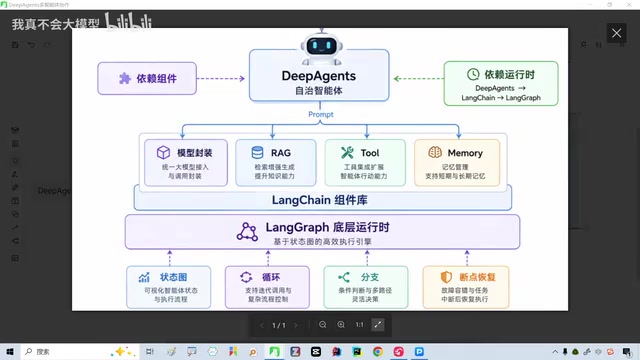
Here's a useful analogy: if LangChain provides the screws and gears, and LangGraph provides the drivetrain that keeps everything moving, then DeepAgents is the hands that assemble it all into a fully functioning machine.
An Analogy Every Java Developer Will Instantly Get
The tutorial offers a spot-on comparison that resonated with attendees: DeepAgents is to the LangChain ecosystem what Spring Boot is to the Spring family.
In day-to-day Java development, you almost always start by spinning up a Spring Boot project — you rarely think about wiring up Spring or Spring MVC directly, because Spring Boot already handles that for you. DeepAgents plays exactly the same role: it abstracts away much of the underlying complexity in LangChain and LangGraph, letting you focus on building the agent itself.
This also means good news for developers: even if your LangChain or LangGraph fundamentals aren't particularly deep, that won't stop you from getting started with DeepAgents. Think of LangGraph as "the runtime chassis for your agent" and move on — no need to dive into its internals right away.
LangGraph's "state management and looping" mechanism deserves a brief explanation. Traditional chain-based calls are linear — they execute and terminate. LangGraph introduces the concept of a Directed Graph, allowing agents to loop, branch, and backtrack between nodes. Each node represents a processing step; edges represent conditional transition logic; and the graph's "current state" is persisted throughout execution. This means that even if a task fails midway or requires human intervention, the agent can resume from the checkpoint rather than starting over. This is the underlying guarantee that makes long-running tasks reliably stable.
How DeepAgents Reuses LangChain's Capabilities
DeepAgents can build powerful agents quickly precisely because it has direct access to LangChain's full toolkit.
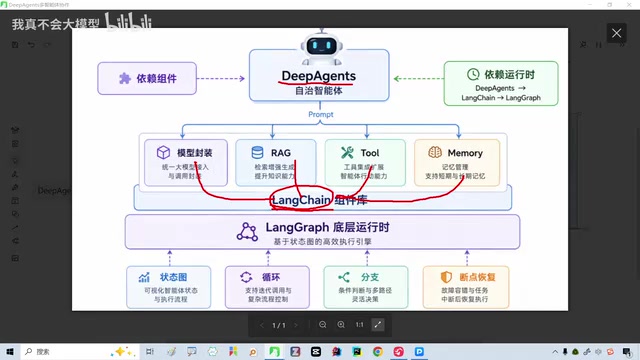
A real-world agent workflow is rarely as simple as "user asks a question → agent answers → done." After receiving a query, the agent typically needs to:
- Analyze the question
- Call tools to retrieve information
- Assess whether the gathered data is sufficient — and if not, perform additional retrieval via RAG
- Use Memory components to maintain context across the conversation
Every one of these steps relies on components that LangChain provides. Learning LangChain and LangGraph is, at its core, about getting familiar with these reusable modules.
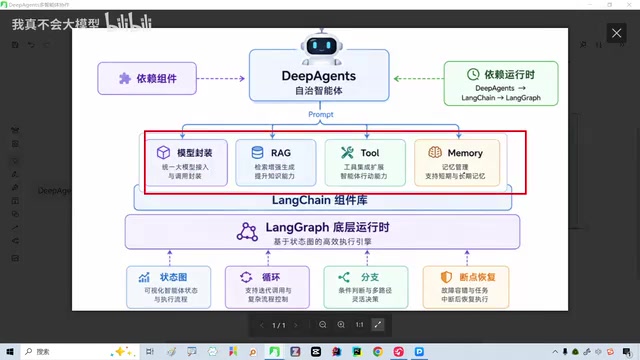
DeepAgents runs on top of LangGraph, which handles the runtime guarantees — state management, looping, branching — that underpin the "stability" emphasized throughout.
RAG (Retrieval-Augmented Generation) is a key pattern in LLM applications: because large models have a knowledge cutoff and cannot directly access private data, RAG dynamically retrieves from an external knowledge base at inference time, injecting relevant document snippets into the prompt as context — effectively giving the model "external memory" to draw from. LangChain provides complete end-to-end support for the RAG pipeline, including document loading, vectorization, vector database storage, and similarity retrieval. This is one of the high-value capabilities DeepAgents can leverage directly.
Harness: A Rising Concept Worth Knowing
Beyond the framework itself, the tutorial introduces a term that's gaining significant traction — Harness (also called Harness Engineering).
DeepAgents relies on various forms of Harness to ensure long-term, stable agent operation. This topic was only touched on briefly in this session and warrants its own dedicated discussion, so it's mentioned here only as a conceptual introduction.
In the context of AI agents, Harness refers to a set of external constraints and safeguard mechanisms built around an agent. These include, but are not limited to: timeout and retry policies, human-in-the-loop approval nodes, sandboxed execution environments, permission controls on tool calls, and real-time monitoring and intervention capabilities. The core idea is this: rather than trusting the model to "behave on its own," you use engineering to put a "safety harness" around it from the outside — ensuring the agent won't go off the rails or produce unexpected side effects during long autonomous runs. This is one of the most critical engineering concerns when enterprises push agents into production.
Summary: Why Enterprises Are Choosing DeepAgents
A few clear takeaways emerge from this overview:
- DeepAgents doesn't replace LangChain — it's a higher-level abstraction built on top of it.
- Its core value lies in building long-running, highly stable autonomous agents.
- In enterprise-grade agent projects, this architecture has become the practical standard.
For developers looking to build AI applications from the ground up, grasping this central thread — "LangChain provides the capabilities, LangGraph provides the chassis, DeepAgents handles the assembly" — gives you the structural backbone of the entire stack.
Related articles
Three Stages of AI LLM Testing: A Practical Guide from Core Concepts to API Calls
A learning path for testers covering LLM fundamentals, prompt engineering, OpenAI SDK calls, API Key vs Token differences, streaming output, RAG, and Agent systems.
Vercel's Chief of Software Looks Back: The Evolution of Agent Building — From Multi-Agent Chains to File System Agents
Vercel's Chief of Software Andrew recaps the agent-building journey at AI Engineer: from giant prompts to multi-agent chains, monolithic memory, file system agents, and the open-source EVE framework.
Tencent's Open-Source BSK in Action: Letting AI Take Over Your Already-Logged-In Browser
Tencent's open-source BSK (Browser Skill Kit) lets AI take over your real, logged-in Chrome via WebSocket. We break down the architecture, setup, and three key pitfalls from real-world testing.