DeepSeek Harness Enterprise Deployment in Practice: From Agent Principles to Multi-Project Development

A systematic review from the four roles of Agents to DeepSeek Harness enterprise deployment paths and eight practical projects.
Based on Bilibili creator Teacher Dayu's livestream course, this article systematically organizes the enterprise deployment path of DeepSeek Harness. It first uses the "interpreter" metaphor to explain why Agents are indispensable — they compensate for four major shortcomings of native large models: no memory, knowledge cutoff, inability to access the internet, and inability to call local tools — and play four roles: interpreter, tool expert, memory steward, and task steward. It then introduces nearly eight practical projects around DeepSeek Harness, covering LMVK automated development, batch Skill generation, e-commerce multimodal Agents, and other directions, emphasizing that a deep technical background is not required and that understanding the logic is key. The article also gives zero-foundation learning path advice, pointing out that one should clarify the approach before looking at source code, and criticizes the drawbacks of homogeneous tutorials. Finally, it briefly describes the three-stage evolution of Agents from tool calling to engineering foundation.
In an era of rapidly iterating AI large models, how to truly deploy DeepSeek Harness into enterprise projects is the question many developers and career-changers care about most. In a nearly 90-minute livestream, Bilibili creator Teacher Dayu took a zero-technical-barrier starting point and systematically explained the enterprise deployment path of DeepSeek Harness, while also throwing out nearly eight practical projects as practice targets. This article, based on the video content, organizes the core viewpoints and technical logic within.
Why Agent Is the Key to Large Model Deployment
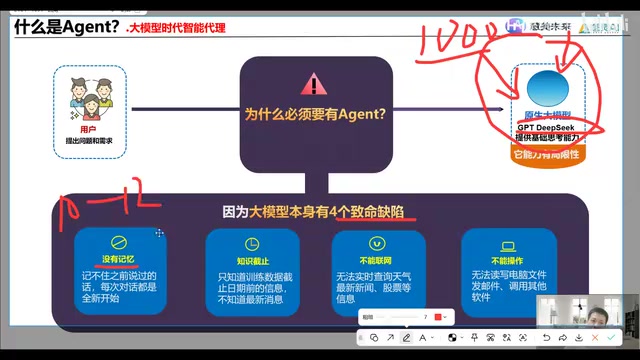
Many beginners ask: since native large models like GPT and DeepSeekAd already exist, why do we still need Agents? In the livestream, Teacher Dayu offered a vivid metaphor — the Agent is the "interpreter" of the large model era.
Native large models have several natural shortcomings. First, no memory: you chat with it for ten rounds, and by the twelfth round it has already forgotten the first ten. Second, knowledge cutoff: the model only learned up to a certain point in time, so ask it about things after that, and it will confidently make things up. Third, no internet access: ask it about tomorrow's weather or stock trends, and it is equally helpless. Fourth, it cannot call tools on your computer.
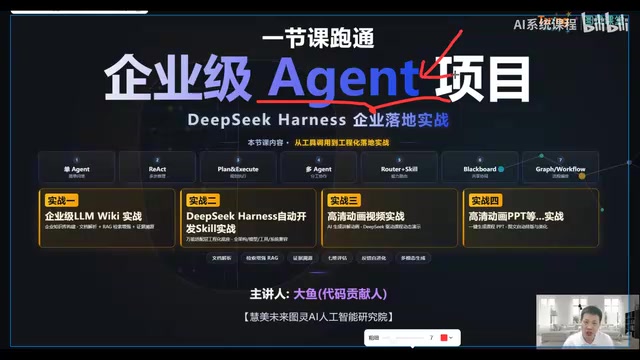
The emergence of Agent is precisely to solve these four problems. It plays four roles: interpreter, translating user needs into instructions the large model can understand; tool expert, helping the large model call APIs to enable internet access and data processing; memory steward, maintaining continuity across multi-turn conversations; and task steward, breaking complex problems into small steps and planning the execution flow.
Teacher Dayu specifically pointed out that products ordinary people use daily, such as Doubao and DeepSeek, are essentially Agents operating behind the scenes — your question is first sent to the Agent, the Agent then calls the large model to process it, and finally returns the processed result to you.
What Are a Large Model's "Memory" and "Context Window"
What native large models call "no memory" is essentially determined by their inference mechanism. Each time a large model answers, it can only see the current segment of text passed in — that is, the "Context Window." It does not have persistent memory like a human, and once the context window closes, the content of that round of conversation is no longer retained by the model. So-called "multi-turn dialogue" is actually just the Agent reassembling the historical conversation into the context each round and sending it to the large model again. Therefore, the length of the context window directly determines the upper limit of "memory"; once exceeded, it will be truncated or compressed. This is also why Agents need a dedicated memory management module, extracting key information from long conversations through summarization, vector retrieval, and other methods to preserve the most important content within a limited window.
The Origin of "Knowledge Cutoff" and RAG
A large model's knowledge comes from the corpus used during training, and after training is completed the parameters are frozen, so its knowledge has a cutoff point in time. For news after the cutoff point, internal enterprise documents, and private data, the model naturally has no way to know, and forced answers easily produce "hallucinations" — outputs that seem plausible but are actually fabricated. The mainstream industry solution to this problem is RAG (Retrieval-Augmented Generation): first retrieve relevant content from an external knowledge base, then feed the retrieval results as part of the prompt to the large model, letting it answer based on these real materials. The enterprise management knowledge base and image knowledge graph mentioned in the article are essentially RAG approaches that attach "external knowledge" to the large model, thereby bypassing the two fundamental limitations of knowledge cutoff and hallucination.
What DeepSeek Harness Can Do: Overview of Practical Projects
The most eye-catching part of the livestream was the nearly eight practical projects centered on DeepSeek Harness. These projects cover multiple directions, from automated development to multimodal applications.
The first direction is automated development of LMVK-type projects, involving technical modules such as a project workbench, enterprise management knowledge base, image knowledge graph, and evaluation system. The second direction is using DeepSeek Harness to automate Skill development, targeting the current efficiency bottleneck of many developers manually writing Skills, and achieving batch automated generation through Harness. The third direction combines e-commerce scenarios to develop multimodal Agents — users only need to have real-time conversations with DeepSeek, with externally attached custom-developed Skills and plugins, to build a genuinely usable e-commerce domain Agent, while also involving the application of model fine-tuning in specific scenarios.
A common feature of these projects is that they do not require students to have a deep technical background, but instead emphasize understanding the logic and approach, then adapting the provided project source code to their own business scenarios.
Skills, Plugins, and Tool Calling
The Skill mentioned in the article can be understood as a packaged capability unit that can be called by an Agent on demand, such as "query orders," "generate weekly reports," or "call a certain internal API." It usually consists of a description (telling the model what this Skill can do and what parameters it needs) plus a piece of executable code. During inference, the Agent automatically determines based on user intent whether it needs to call a certain Skill, fills in parameters, executes it, and then incorporates the result into subsequent reasoning. The concept of a plugin highly overlaps with Skill, with more emphasis on integration with third-party systems. The "batch automated generation of Skills" mentioned in the article refers to using DeepSeek Harness itself to produce these capability units, automating the Skill development process that originally required manual writing, thereby solving the problem of low efficiency when developers write Skills one by one. This is actually a self-reinforcing idea of "using Agents to build Agents."
How to Choose a Learning Path from Zero Foundation
In the livestream, Teacher Dayu repeatedly emphasized one judgment: the current large model application track is similar to the explosive period of Java and Android more than a decade ago, with many positions and few talents. It is a stage of "competing on technology and projects" rather than "competing on degrees." He suggested that students interested in the AI large model field seize the policy direction and learn accordingly, otherwise they can easily fall into confusion.
For zero-foundation students, his specific advice is: focus on listening to the ideas rather than getting stuck on code details, first clarify the entire logical chain, and after obtaining the project source code, reproduce and modify it according to your own scenario. He also criticized the large amount of homogeneous tutorials online — "the whole country comes from the same mold; they only know how to write one, two, three, but if you ask them to write three, two, one in reverse, they cannot" — and believed this is the fundamental reason many people still make no progress after learning for one or two years.
The Three Stages of Agent Technology Evolution
In the latter half of the livestream, Teacher Dayu briefly outlined the three leaps in Agent technology: from early tool calling, to programming orchestration, and then to the current engineering foundation stage. This evolutionary trajectory reflects how Agents are moving from single-point capabilities toward systematic engineering.
However, due to time constraints in the livestream, this part was not fully expanded. From the available information, DeepSeek Harness is positioned more toward an engineering foundation — it attempts to solve how to embed Agent capabilities into enterprise development processes in a standardized and reusable way, rather than remaining at the level of a single conversation or simple tool calling.
Engineering Foundation and Reusability
The so-called "engineering foundation" refers to consolidating the common capabilities that repeatedly appear in Agent development — such as prompt management, tool registration, memory storage, task orchestration, logging, and evaluation — into a standardized framework or platform, so developers do not have to build every Agent from scratch. Its difference from the first two stages lies in the shift in focus: the tool calling stage solved "whether it can be done," the programming orchestration stage solved "how to string multiple steps together," and the foundation stage solves "how to make thousands of Agents go live in a stable, maintainable, and reusable way." For enterprises, the value of the foundation is especially reflected in cost reduction and efficiency improvement — Agents from different business lines can share the same set of memory, tools, and evaluation mechanisms, avoiding reinventing the wheel and allowing Agent capabilities to be embedded into existing development processes like building blocks.
Conclusion
The core value of this livestream lies in two points: first, it clearly explained, with accessible metaphors, the position and irreplaceability of Agents in the large model ecosystem; second, it provided learning path advice from zero foundation to enterprise-level projects. For developers considering an AI transition, understanding the problems Agents solve is more important than mastering any specific tool — tools will iterate, but the four-layer capability framework of "translation, tool calling, memory management, and task decomposition" is the universal key to understanding all Agent products.
One-line Summary
A systematic review from the four roles of Agents to the enterprise deployment path of DeepSeek Harness and eight practical projects.
Paragraph Summary
Based on Bilibili creator Teacher Dayu's livestream course, this article systematically organizes the enterprise deployment path of DeepSeek Harness. It first uses the "interpreter" metaphor to explain why Agents are indispensable — they compensate for four major shortcomings of native large models: no memory, knowledge cutoff, inability to access the internet, and inability to call local tools — and play four roles: interpreter, tool expert, memory steward, and task steward. It then introduces nearly eight practical projects around DeepSeek Harness, covering LMVK automated development, batch Skill generation, e-commerce multimodal Agents, and other directions, emphasizing that a deep technical background is not required and that understanding the logic is key. The article also gives zero-foundation learning path advice, pointing out that one should clarify the approach before looking at source code, and criticizes the drawbacks of homogeneous tutorials. Finally, it briefly describes the three-stage evolution of Agents from tool calling to engineering foundation.
Related articles

Free Unlimited Claude Code Solution: Agnes AI + CC Switch Setup Guide
No paid subscription needed — pair the free AI platform Agnes AI with the open-source tool CC Switch to provide a backend for Claude Code, enabling unlimited free calls to text, image, and video models. This guide covers the full setup, test results, and usage boundaries.

A Complete Zero-Cost Guide to Getting Started with Claude Code for Beginners in China
A beginner's guide to Claude Code for users in China: two installation methods (command line and IDE plugin), full configuration steps for replacing the official API with the free domestic LongCat model, and a hands-on demo of building a small tool with natural language, plus tips.

When the NSA Gets Involved: The AI Supply Chain Crisis Behind Open-Source CVEs and API Key Hijacking
Multiple open-source projects disclosed severe CVEs in one day, PHP flaws alarmed the FBI, and Railway and OpenCode were breached with API keys stolen. This article breaks down the vulnerability window, AI-accelerated exploitation, and the AI supply chain crisis behind the API key black market, with a developer defense checklist.