DeepSeek Open-Sources V4 Multimodal Vision Model as China's AI Ecosystem Accelerates Across the Board
DeepSeek open-sources V4 multimodal vision model as China's AI ecosystem advances on all fronts.
DeepSeek released V4-Flash-Vision-Exp, a 305B-parameter MoE multimodal vision model with only 13B active parameters, under the MIT license. Alongside this, China's AI ecosystem saw hardware-software co-optimization for sandbox scheduling, government procurement policy for AI services, and growing cybersecurity threats from AI-weaponized attacks—highlighting both rapid opportunity and emerging risk.
DeepSeek Releases First Multimodal Vision Model in V4 Series
On August 3, DeepSeek open-sourced the first experimental multimodal vision model in its V4 series—DeepSeek-V4-Flash-Vision-Exp—on HuggingFace. This marks a significant step for the DeepSeek V4 architecture into the multimodal domain, signaling substantial progress in visual understanding capabilities for Chinese-developed large models.
In terms of technical specifications, the model uses a MoE (Mixture of Experts) architecture with approximately 305B total parameters, but only about 13B are activated per token—an extremely low activation rate of roughly 4.6%. MoE is a sparse-activation neural network architecture design. Unlike traditional dense models that activate all parameters during inference, MoE architectures divide the model's internals into multiple "expert" sub-networks, with a gating mechanism selecting only a handful of experts for each inference pass. This means the model can have a massive total parameter count (providing greater knowledge capacity and expressiveness) while the actual computational cost during inference is equivalent to that of a much smaller model. Google's Switch Transformer was an early milestone in large-scale MoE adoption, and DeepSeek has made MoE a core architectural strategy since V2. This design continues DeepSeek's consistent emphasis on cost-efficiency—through sparse activation, it maintains the capability ceiling afforded by a large parameter scale while dramatically reducing actual inference compute overhead.
Architecture Design and Training Approach
The model is built on the V4 Flash architecture, with a vision module layered on top. It acquires image understanding capabilities through continued training. Continued training refers to injecting new modality data (such as visual data) into an already well-pretrained base model for additional training, enabling cross-modal understanding. Compared to training a multimodal model from scratch, this approach fully leverages the language model's existing reasoning abilities, world knowledge, and instruction-following capabilities while significantly reducing training costs. A typical implementation pipeline involves connecting a vision encoder (such as ViT) to the language model's frontend, projecting image features into the language model's embedding space via a projection layer, and then performing alignment training with image-text paired data. Mainstream multimodal models like LLaVA and Qwen-VL all follow similar pipelines. This "text foundation + incremental vision training" approach is the prevailing method for building multimodal large models today, enabling rapid cross-modal capability expansion on top of mature language models.
According to official disclosures, its multimodal Agent capabilities are approaching GPT-4-level performance (the original statement mentioned "close to OPIS 4.8," likely referring to a comparable generation of closed-source model vision capabilities). This is a highly competitive result for an experimental open-source model.
MIT License: A Fully Open Developer Ecosystem
The licensing choice is noteworthy—DeepSeek released the weights under the MIT license. The MIT license is one of the most permissive licenses in the open-source software world. Created by the Massachusetts Institute of Technology, it requires only the retention of copyright and license notices and imposes virtually no restrictions on usage—it permits commercial use, modification, distribution, and private use, and does not require derivative works to be open-sourced under the same license (a key distinction from Copyleft licenses like GPL). In the large model space, many open-source models use custom licenses with restrictive clauses (for example, Meta's Llama license restricts companies with over 700 million monthly active users), while the MIT license means enterprises and individuals of any size can freely incorporate the model into commercial products. Additionally, DeepSeek simultaneously provides reference implementations for tensors and tokenizers, along with minimal PyTorch inference code, allowing developers to deploy and customize the model locally.
This comprehensive delivery of "weights + reference implementation + minimal inference code" significantly lowers the barrier to entry for developers and further solidifies DeepSeek's influence in the open-source community. For teams looking to build multimodal Agent applications, this offers a controllable, commercially usable domestic foundation model option.
Domestic Compute and Infrastructure Accelerating in Concert
Beyond model-level breakthroughs, industry developments that day also showed China's AI infrastructure forming synergies across multiple layers.
Hardware-Software Co-optimization: Major Improvements in Sandbox Scheduling Performance
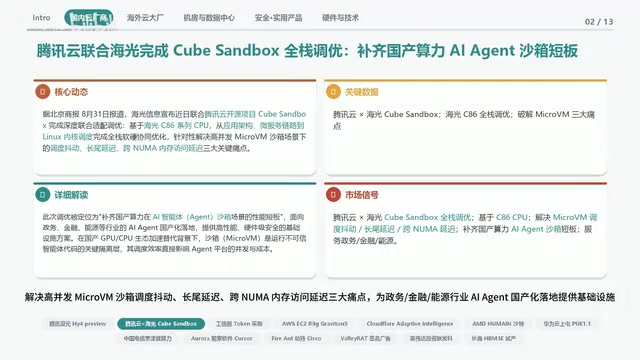
Hygon Information announced a deep adaptation and optimization effort in collaboration with Tencent Cloud's open-source project Cube Sandbox. Based on Hygon's C86 CPU, the joint effort delivered full-stack hardware-software co-optimization spanning application architecture, microservice call chains, and Linux kernel scheduling, specifically addressing three key pain points: high-concurrency MicroVM sandbox scheduling jitter, tail latency, and cross-NUMA memory access latency.
MicroVM (micro virtual machine) is a lightweight virtualization technology, with AWS's Firecracker being a representative implementation. Compared to traditional VMs, MicroVMs can boot in milliseconds with minimal memory overhead, making them ideal for Serverless function computing and secure isolation environments for AI Agent execution. However, under high-concurrency scenarios, scheduling large numbers of MicroVMs produces "jitter"—unpredictable latency spikes for certain instances. NUMA (Non-Uniform Memory Access) is a memory architecture characteristic of multi-socket servers where CPU access to local-node memory is much faster than cross-node access, and cross-NUMA access introduces significant additional latency. The Hygon-Tencent Cloud joint optimization targets precisely these low-level system bottlenecks, bringing domestic CPUs to production-ready stability for AI infrastructure scenarios.
This optimization provides more stable infrastructure support for AI Agent deployment in government, finance, energy, and other industries. As Agent applications increasingly enter production environments, sandbox isolation and scheduling performance become inseparable engineering challenges—deep hardware-software co-optimization is the answer.
Policy Signals Drive Definitive Procurement Demand
The General Office of the Ministry of Industry and Information Technology issued a notice on a special initiative to cultivate AI application service providers, explicitly calling for increased procurement of large model, intelligent agent, and token-based services. The notice proposes establishing a resource pool of over 200 service providers by the end of 2026, with support for connecting to national computing hubs.
This policy opens a window of definitive demand for government and enterprise AI procurement by cloud vendors, meaning domestic large models and compute will gain clearer paths to commercial deployment.
Cloud Vendors and Computing Hubs Continue to Evolve
On the international front, AWS announced general availability of EC2 R9G memory-optimized instances based on its fifth-generation custom chip, Graviton5. Graviton is AWS's in-house server processor series based on the Arm architecture. Since its first generation launched in 2018, it has iterated to the fifth generation. The Arm architecture inherently excels in power efficiency compared to traditional x86, and AWS achieves differentiated competition against Intel/AMD through custom silicon. Compared to the R8G instances based on Graviton3, R9G delivers up to 25% better compute performance, 30% better database performance, 35% better web application performance, and 35% better machine learning performance. It also introduces a formally verified Nitro Isolation Engine for the first time. "Formal verification" means the security isolation logic has been confirmed correct through mathematical proof rather than relying solely on test coverage—this represents the highest verification standard in cloud computing security. R9G instances also come with local NVMe SSDs.
Domestically, the China Telecom Beijing-Tianjin-Hebei Intelligent Computing Center in Wuqing, Tianjin, is reportedly the largest and most technologically advanced green intelligent computing hub in the region for China Telecom, capable of providing approximately 3.76 EFLOPS of domestic high-performance compute. EFLOPS stands for ExaFLOPS (quintillion floating-point operations per second) and is a unit for measuring ultra-large-scale compute. For reference, Frontier—the world's top-ranked supercomputer in 2024—has a peak performance of about 1.7 EFLOPS, making 3.76 EFLOPS quite impressive. The center leverages an independently controllable compute network to create a low-latency service ring of "1 millisecond to Beijing, 2 milliseconds to the Beijing metropolitan area." The "1-millisecond latency ring" concept derives from data center siting strategy—light signals travel approximately 200 km/ms through fiber optics, so a 1-ms latency ring roughly covers a 100 km radius from the data center. This is critical for latency-sensitive applications such as real-time AI inference and financial trading.
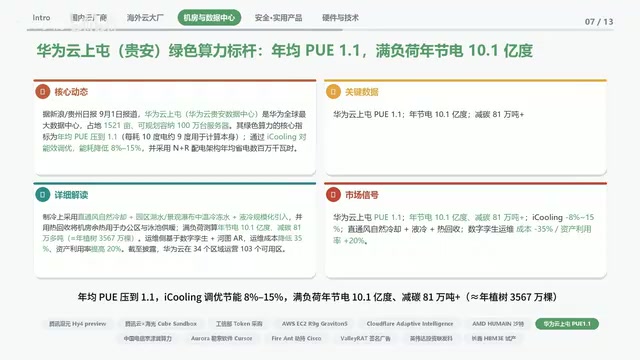
During the World Expo, Huawei Cloud also disclosed data about its Guian Data Center. As Huawei's largest data center globally, it covers 1,521 mu (approximately 101 hectares), is planned to house 1 million servers, and achieves an annual average PUE of 1.1. PUE (Power Usage Effectiveness) is the core metric for data center energy efficiency, calculated as total data center power consumption divided by IT equipment power consumption. The ideal value is 1.0, the industry average is approximately 1.5–1.6, and an annual average PUE of 1.1 is world-class. Huawei achieves this through its iCooling AI intelligent thermal management system, which predicts heat loads and adjusts cooling parameters in real time, while also leveraging Guizhou's low annual average temperatures for natural cooling. The result is an annual carbon reduction of 810,000 tons—equivalent to the carbon absorption of approximately 45 million trees. With global data center carbon emissions accounting for roughly 2–3% of total emissions, green computing has become a binding constraint for the industry.
AI Weaponization: New Forms of Cybersecurity Threats
Alarmingly, the proliferation of AI capabilities is also being exploited by attackers.
Attackers Leverage AI Coding Assistants for Ransomware Operations
Reports indicate that Russian-speaking ransomware gangs are using AI coding assistants (the original report mentions Cursor and its underlying Anthropic Claude) for attack planning and execution—orchestrating attack plans in Russian and proactively excluding CIS-region targets. The CIS (Commonwealth of Independent States) exclusion strategy is a hallmark of Russian-speaking ransomware groups—they typically check system language settings and automatically exit if Russian or other CIS-country languages are detected, avoiding attention from domestic law enforcement. This behavioral pattern itself has become an important indicator for security researchers conducting attribution analysis. In the same vein, complete attack operation toolkits built with AI have also emerged.
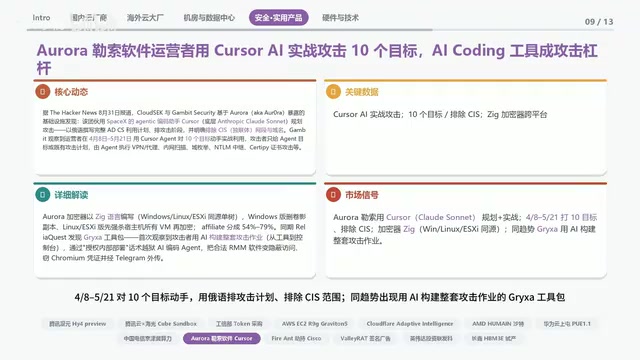
The use of generative AI in cyberattacks manifests primarily in several phases: during attack planning, attackers use AI coding assistants to automatically generate attack scripts and orchestrate attack workflows; during social engineering, AI generates highly customized phishing emails and persuasion scripts; during automated exploitation, AI assists in analyzing target systems and generating exploit code. This reflects a disturbing reality: generative AI is lowering the technical barrier for cyberattacks, enabling attackers to build attack chains faster and at greater scale.
A Fundamental Shift in Defensive Philosophy
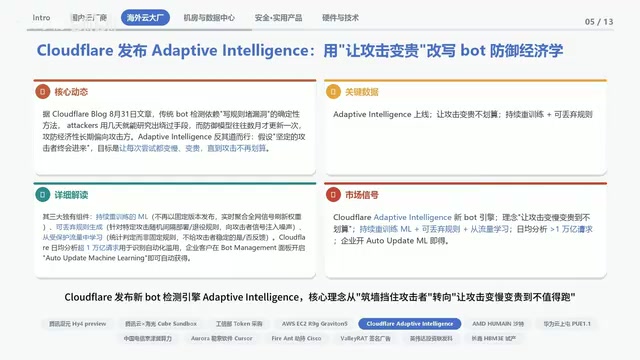
In response to these emerging threats, Cloudflare released a new bot detection engine called Adaptive Intelligence. Its core philosophy shifts from "building walls to block attackers" to "making attacks so slow and expensive they're not worth running." This philosophy stems from the economics of offensive-defensive dynamics—attackers also bear costs (compute resources, time, manpower). If defenders can continuously raise the marginal cost of attacks beyond the expected returns, attackers will rationally move on to other targets.
The engine's core mechanism is "ephemeral rules"—continuously retrained ML models generate and discard detection rules on the fly, preventing attackers from reverse-engineering the defensive logic through prolonged observation and learning from protected traffic. This eliminates the stable feedback signal that attackers rely on to adapt. The engine analyzes over 1 trillion requests daily—Cloudflare handles more than 20% of global internet traffic, giving its ML models an unparalleled training data advantage.
Additionally, China-linked cyber espionage groups have expanded their operations to Cisco IOS XE routers, turning network devices into traffic collection and credential theft platforms. Attacks using DLL side-loading with adware signatures from domestic desktop tools have also appeared. DLL side-loading is an attack technique that exploits the Windows mechanism for loading dynamic-link libraries. When a legitimate program starts, Windows searches for required DLL files following a specific order. Attackers place malicious DLLs in priority search paths, causing the legitimate program to unknowingly load malicious code upon startup. Because the malicious DLL is loaded through a trusted program with a legitimate digital signature, many security solutions treat it as normal behavior and let it pass. Using adware signatures from domestic desktop tools further increases detection difficulty. Together, these cases illustrate that offensive-defensive dynamics in the AI era are entering a new phase of dynamic adversarial engagement.
Conclusion
From DeepSeek open-sourcing a multimodal vision model, to domestic compute hardware-software co-optimization and policy-driven demand, to the security challenges posed by AI weaponization—the day's technical developments sketch multiple facets of AI industry evolution. The openness and democratization of model capabilities are simultaneously giving rise to new industry opportunities and new security risks. How to strike a balance between the two will be a persistent challenge for the industry going forward.
Related articles
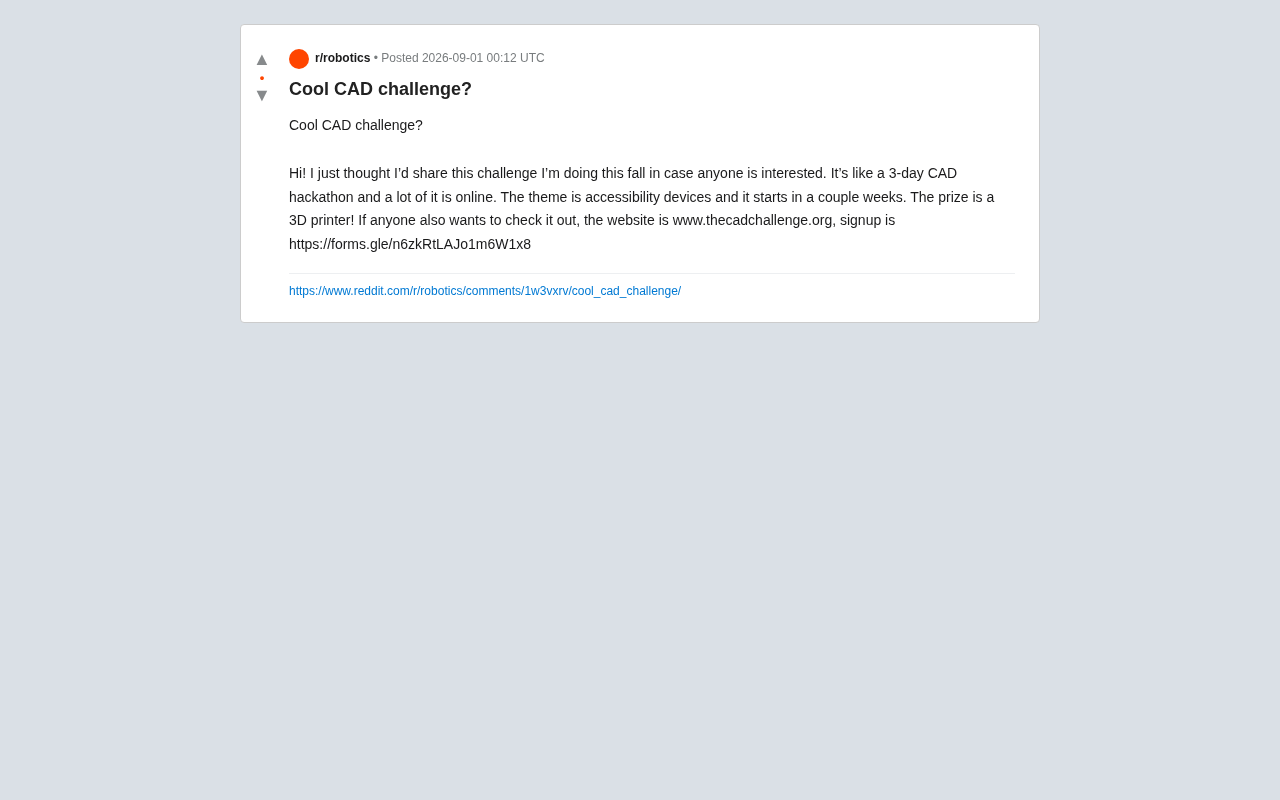
Accessibility-Themed CAD Hackathon: A Complete Guide to the 3-Day Design Challenge
A deep dive into The CAD Challenge accessibility hackathon, covering rules, prep tips, CAD tools, and 3D printing design essentials for this 3-day modeling competition.
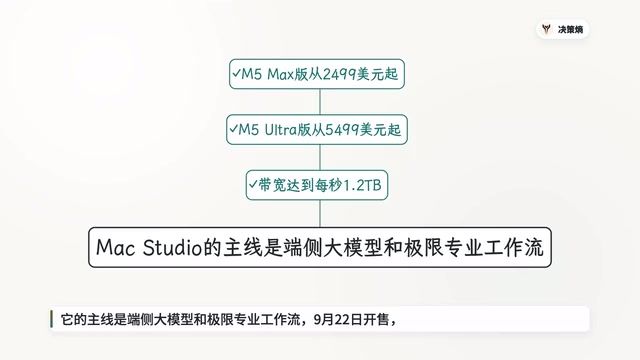
Apple's Four New Macs Decoded: From Desktop Agents to Local LLM Workstations
Apple launches four new Macs from $899 to $5,499+, building a full local AI price ladder. We break down memory budgets, performance bottlenecks, and which Mac runs which model size.
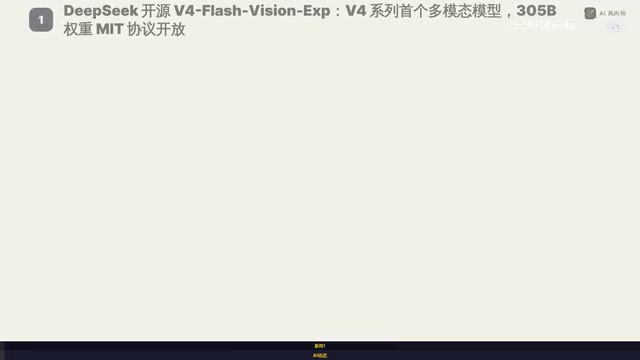
DeepSeek V4's First Multimodal Model Goes Open Source: 305B Weights Fully Released Under MIT License
DeepSeek open-sources V4-Flash-Vision-Exp, a 305B multimodal vision model under MIT license. Built on V4-Flash, it surpasses Opus 4.8 on three benchmarks including Agent's Last Exam.