Developer's Hands-On with Claude Opus 4.5: From Abandoning Claude to Heavy Reliance
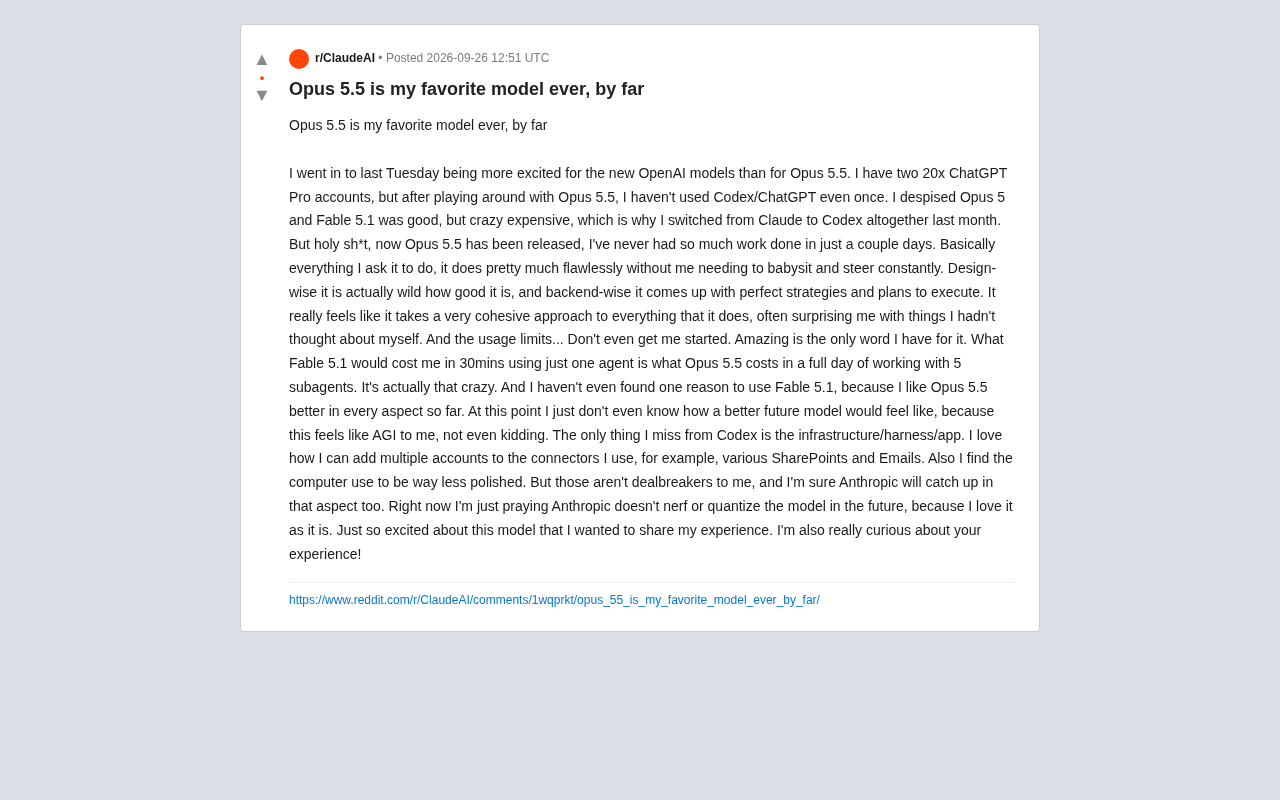
A developer ditched Codex and returned to Claude after Opus 4.5's capability and cost advantages won him over.
A heavy developer who had abandoned Claude for OpenAI's Codex made a complete reversal after Opus 4.5 launched and hasn't opened Codex since. His core praise covers three areas: strong task autonomy, excellent design and backend strategy, and dramatic cost efficiency — roughly an order of magnitude better output than Fable 5.1 on the same budget. Weaknesses remain in infrastructure like multi-account connectors and computer use, but he considers neither a dealbreaker. The article also notes his concern about future model "nerfing or quantization," reflecting broader trust issues around closed-source AI services.
One Developer's Real Transformation
When it comes to choosing AI coding models, heavy users' loyalty often hinges on their most recent hands-on experience. A Reddit user's story is a perfect example: he originally held two ChatGPT Pro accounts (20x plan) and had completely switched from Claude to OpenAI's Codex last month out of disappointment with Opus 5. Then Opus 4.5 launched — and everything changed dramatically. He openly admits he hasn't opened Codex or ChatGPT even once since.
This rapid reversal is telling. He explicitly stated he "hated Opus 5," and while he found Fable 5.1 useful, he considered it "outrageously expensive" — which is what drove him away from the Claude ecosystem in the first place. This shows that both model capability and cost-effectiveness carry equal weight in professional users' decision-making.
Capability Assessment: Breakthroughs in Design and Backend
This user's core praise for Opus 4.5 centers on autonomy. He describes nearly every task handed to the model as being "completed near-perfectly, without constant supervision or repeated guidance" — a critical quality in real production environments, where frequent manual corrections are themselves a productivity killer.
On specific capability dimensions, he offered two assessments:
Design
He used the word "wild" to describe the model's design capabilities, saying its UI/frontend design performance far exceeded expectations.
Backend Strategy
On the backend side, the model produces "perfect strategies and execution plans." Even more impressive to him was the model's overall coherence — it approaches tasks with consistency and even surfaces ideas the user hadn't thought of. This kind of "proactive gap-filling" is the hidden benchmark many users use to judge whether a model is truly useful.
Cost Comparison: An Order-of-Magnitude Difference
If the capability improvements represent incremental gains, the cost performance is what he describes as "amazing." He offered a striking comparison:
The cost of running a single agent with Fable 5.1 for 30 minutes equals what it costs to run 5 subagents with Opus 4.5 for an entire day.
This means that on the same budget, Opus 4.5 delivers roughly an order of magnitude more output. For heavy developers relying on parallel multi-agent workflows, this shift in cost structure directly determines whether a workflow is economically viable. That's precisely why he says he can no longer find any reason to keep using Fable 5.1 — in his view, Opus 4.5 is simply better across the board.
Multi-Agent workflows involve splitting a complex task and having multiple AI instances work in parallel or collaboratively to improve speed and coverage. Subagents are the individual execution units handling specific subtasks — common in parallelizable dev scenarios like code generation, testing, and documentation. This pattern is extremely sensitive to token costs: the cost per session grows linearly or even super-linearly with the number of concurrent agents. This is why model pricing has a far greater impact on heavy multi-agent users than on typical users — when running 5 concurrent subagents all day costs the same as running a single competitor agent for 30 minutes, the difference doesn't just mean "better value"; it determines whether that entire class of workflow is economically feasible at all.
Remaining Weaknesses: Ecosystem and Infrastructure
Despite the glowing praise, this user still points out where Opus 4.5 falls short compared to Codex, primarily in infrastructure, harness, and app layers:
- Multi-account connectors: He appreciates Codex's ability to add multiple accounts to connectors — such as connecting multiple SharePoint instances and mailboxes — which is valuable for enterprise workflows.
- Computer use: He feels Opus 4.5's computer use capability isn't polished enough.
However, he emphasizes that neither of these are "dealbreakers," and he believes Anthropic will gradually catch up in these areas. This assessment honestly captures the gap between raw model capability and product-level engineering — a powerful underlying model doesn't automatically equal a polished product experience.
Computer Use refers to an AI model directly controlling a desktop environment — perceiving screen state via screenshots and simulating mouse clicks and keyboard inputs to complete tasks. Essentially, it turns AI into an automation agent that can operate GUIs. Anthropic was among the first to integrate this capability into Claude in late 2024; OpenAI's Codex offers similar code execution sandboxes and environment interaction. This type of feature holds significant value in enterprise settings — such as auto-filling web forms, operating local IDEs, or moving data across systems — but because it requires precise visual localization and action sequence planning with low error tolerance, polishing it to production quality is far harder than pure text generation. This is the context behind the user's criticism that Opus 4.5 is "not refined enough" in this dimension.
A Cooler Take on "Feels Like AGI"
The user excitedly writes that "this feels like AGI, I'm not joking," even admitting he can't imagine what a better future model would look like. Such statements aren't uncommon in community discussions around model launches — they typically reflect the user's subjective peak experience within a specific workflow, rather than a rigorous capability evaluation.
Also worth noting is his closing "prayer": he hopes Anthropic won't "nerf or quantize" the model in the future. This captures a shared anxiety among many users — model performance at launch sometimes degrades through subsequent version iterations or inference cost optimizations. This fear of "model degradation" is itself a reflection of the broader trust issues surrounding closed-source AI services.
Model Quantization refers to compressing model weights from high-precision floating point (e.g., FP32/BF16) to lower-bit integers (e.g., INT8, INT4), trading slight capability loss for lower inference costs and faster response times. Nerf (borrowed from gaming terminology meaning "to weaken") in the AI community broadly refers to vendors limiting certain model behaviors through adjustments to system prompts, safety filtering policies, or RLHF fine-tuning — causing users to perceive a drop in "intelligence" or "execution ability." Since version changes to closed-source models are opaque to the public, users often can't tell whether a performance drop stems from quantization, policy adjustments, or server-side load issues. This information asymmetry is the fundamental reason communities develop collective anxiety around "model degradation."
Conclusion: The Value and Limits of a Single Experience
While this is one user's subjective account, its value lies in documenting a complete journey — from abandonment to heavy reliance — across three dimensions: capability, cost, and ecosystem. For developers currently weighing Claude, Codex, Fable, and other options, this kind of firsthand experience offers genuine reference value.
Of course, as individual community feedback, its conclusions still need cross-validation from more users. A model's real-world performance varies by task type, usage habits, and budget scale — "favorite model" is ultimately a highly personal judgment.
Related articles

GPT-Next Leak, Gemini 4 Argon Imminent: AI News Roundup
GPT-Next leak suggests extreme efficiency; OpenAI's 28-day shipping pledge boosts speed 50%; Gemini 4 Argon nears release; Anthropic subscription value report sparks debate.

GPT-Next Leaked, Gemini 4 Argon Speeds Up, Fable 5.5 May Launch Today
OpenAI's GPT-Next model leaks, expected to be extremely low-cost and possibly part of the 28-day release plan; Gemini 4 Argon internal testing accelerates, NanoBanana 2.1 is live; Semi Analysis tests show Claude Max's equivalent API value is about 5 times that of ChatGPT Pro; Fable 5.5 may launch today.

Gemini 4 Argon Launches Globally: Key Highlights from the AI Daily Brief
Google opens Gemini 4 Argon globally across Pro and Ultra subscriptions and the API, and demonstrates robot control. This article rounds up open-source models, Agent infrastructure, cost transparency, and safety governance updates.