Dify + Ollama Local Deployment for Smart Knowledge Bases: Build Private AI Apps with Zero Code
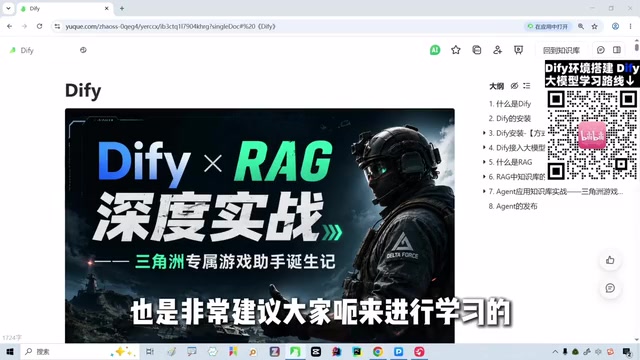
Build a fully private AI knowledge base locally using Dify and Ollama with zero code.
This guide walks through building a fully private AI knowledge base application using Dify and Ollama, entirely deployed on local infrastructure. It covers the complete workflow—from model selection and RAG-based knowledge base construction to visual workflow orchestration—enabling zero-code development of intelligent Q&A systems where all data stays on your own servers.
Dify: An Open-Source Platform for Building AI Apps Without Code
Dify is an open-source AI application development platform that is dramatically lowering the technical barrier to building intelligent agents. Unlike traditional development approaches that require writing extensive code, Dify uses visual workflow design to enable both technical and non-technical users to rapidly build AI applications. This "drag-and-drop" development model abstracts complex operations—such as LLM invocation, knowledge base management, and workflow orchestration—into intuitive visual components, allowing developers to focus on business logic rather than wrestling with underlying implementation details.
There are other tools on the market with similar capabilities, such as Coze. Coze's 3.0 version is even more friendly to non-programmers, supporting rapid generation of mini-programs, web apps, and even mobile applications through natural language. However, it primarily relies on a cloud-hosted architecture. This means enterprise data and business logic must be uploaded to a third-party platform—a model that poses security risks for industries with strict data compliance requirements, such as finance and healthcare.
Dify's core advantage lies in its support for fully private deployment. All data stays on local servers and never flows to any external platform. This architectural design makes Dify especially well-suited for handling sensitive data—enterprises can leverage the full power of LLMs to build intelligent applications while maintaining complete data sovereignty.
Dify's Core Capabilities: From Chat Assistants to Complex Workflows
Dify offers multiple AI application building modes, covering a wide range of use cases from simple to complex:
Chat Assistant Mode: The most basic conversational interaction, suitable for customer service bots, online Q&A, and similar scenarios. Developers only need to configure the LLM interface and set system prompts to deploy a conversational assistant with domain-specific knowledge.
Agent: An intelligent agent with autonomous decision-making capabilities that can automatically invoke tools, query data, and execute operations based on user intent. This mode is ideal for complex tasks requiring multi-step reasoning and tool invocation, such as data analysis assistants and code debugging tools.
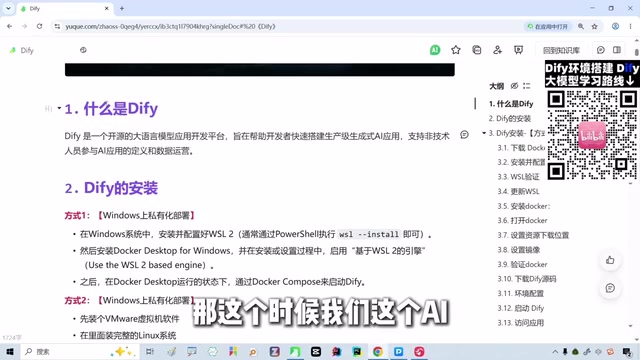
Text Generation Application: Optimized for content creation scenarios, it can batch-generate structured content like copy, reports, and code based on templates and input parameters.
Complex Workflow Orchestration: This is one of Dify's most powerful features. Developers connect nodes to orchestrate workflows with complex logic including conditional branching, loop processing, and parallel execution. Each node can be a different type of operation—LLM invocation, knowledge base retrieval, API request, or data transformation—combined visually into a complete business process.
The core value of workflow design is this: it transforms the technical question of "how to call an LLM" into the product question of "how to design a business process." Product managers or domain experts with no programming experience can drag and drop nodes to turn their domain knowledge into executable AI applications.
Hands-On Local Deployment: Building a Private Knowledge Base with Dify + Ollama
In practice, Dify can integrate with various LLM backends. Ollama is a particularly noteworthy option—it allows users to run open-source models like Llama and Mistral locally, without relying on any cloud-based API. The combination of "Dify frontend + Ollama backend" forms a fully localized, zero-external-dependency AI application development stack.
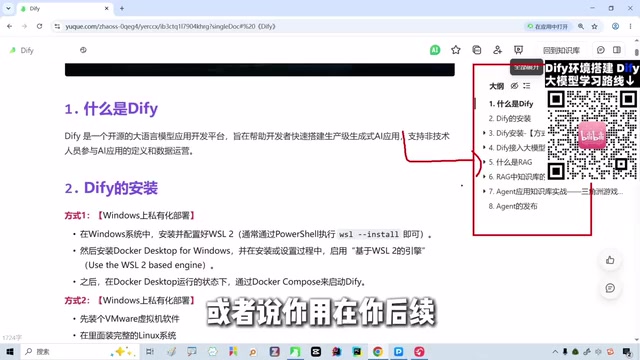
Three Key Elements of the Deployment Architecture
1. Model Selection
Ollama supports a variety of open-source models, which can be flexibly chosen based on hardware configuration and task requirements. Models with 7B parameters can run smoothly on consumer-grade hardware, while 70B parameter models require more powerful GPU resources.
2. RAG Knowledge Base Construction
Dify's built-in knowledge base feature supports vector storage and semantic retrieval. Users can upload documents in multiple formats—PDF, Word, plain text, and more—and the system automatically handles document chunking and vectorization. During actual Q&A, the system first retrieves relevant knowledge fragments through semantic matching, then combines them with the LLM to generate answers. This RAG (Retrieval-Augmented Generation) approach significantly improves answer accuracy and reliability, effectively reducing LLM "hallucination" issues.
3. Workflow Orchestration
For knowledge base Q&A scenarios, a typical workflow looks like: User Input → Knowledge Base Retrieval → Result Ranking → LLM Synthesis and Generation → Output Answer. Each step can be configured with parameters in Dify's visual interface, such as retrieval similarity thresholds, number of returned results, and LLM temperature settings.
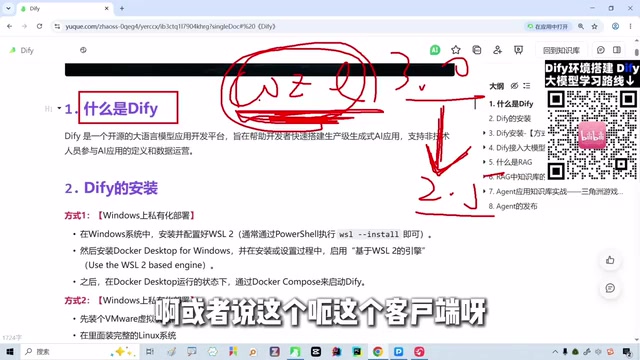
Get Started in 10 Minutes
For beginners, we recommend starting with the simplest knowledge base Q&A scenario. The entire process can be completed in 10 minutes:
- Deploy Dify and Ollama via Docker
- Create a knowledge base in Dify and upload documents
- Configure a simple Q&A workflow
No code is required at any point, yet you'll experience the complete process from data preparation to application deployment.
This foundational architecture is also highly extensible. Once you've mastered the basics, you can gradually explore more complex scenarios: adding multi-turn conversation memory, integrating external APIs, implementing conditional branching logic, building multi-Agent collaboration systems, and more. Throughout this process, the tech stack and toolchain remain consistent, keeping the learning curve relatively gentle.
Real-World Use Cases: From Student Projects to Production-Grade Products
Dify's value extends far beyond learning and experimentation.
For students: Intelligent applications built with Dify can be directly used for graduation projects. A complete knowledge base Q&A system or smart writing assistant—from technical implementation to functional demonstration—is more than sufficient to support the engineering practice section of a thesis.
For developers: Dify enables rapid validation of product ideas and can even serve directly as an MVP (Minimum Viable Product) ready for use.
For enterprise teams: In traditional pure-code development, every business requirement change requires modifying code, testing, and redeploying—a lengthy and error-prone cycle. Visual platforms like Dify separate "configuration" from "code"—stable technical capabilities are encapsulated by the platform, while flexible business logic is implemented through configuration. This approach gives AI application development true agile iteration capabilities.
It's important to emphasize that Dify is not meant to replace traditional programming. Rather, it provides appropriate tools for people with different skill backgrounds. Experienced developers can use Dify as a rapid prototyping tool and a platform for implementing non-core features. Those with limited technical expertise but strong business insight can use Dify to turn ideas directly into usable products. This design philosophy of "lowering the barrier without lowering the capability" represents a key direction in the evolution of AI tools today.
Related articles

WAIC Industry Insights: AI Deployment Now Demands ROI — How Enterprises Can Pick the Right First Task
2026 WAIC signals AI competition has shifted to production systems. This article breaks down compute, Agent, and embodied AI deployment paths with an ROI framework for enterprises.

Rejecting AI as a Differentiator: The Engineering Rationale Behind the Anti-AI Movement
When AI becomes a marketing label, some choose to publicly declare they never use it. This article analyzes the engineering rationale, privacy concerns, and reliability considerations behind the anti-AI stance.
Free Open-Source Linear Algebra & Machine Learning Textbooks: Self-Study Notes from a Student's Perspective
A student compiled self-study notes into two free open-source textbooks on linear algebra and machine learning, hosted on GitHub for community collaboration.