Enterprise Agent Development with LangChain: From Framework Setup to Private Deployment

LangChain connects LLMs to enterprise business flows safely via Components, Chains, and Agents.
The article outlines LangChain's positioning and core concepts. Bare LLM APIs have three limitations: no access to private enterprise data, no ability to act, and no dynamic information retrieval—LangChain exists to bridge this gap. Its three core abstractions are Components (a JDBC-Driver-like unified model interface, so switching models barely changes code), Chains (the orchestration layer linking models, databases, and Embeddings), and Agents (executors that interact with the external environment, key to AI moving from chatbot to productivity tool). It also covers typical use cases—private knowledge base Q&A, dynamic document learning, business process automation—and analyzes private deployment considerations across model decoupling, data layer selection, tool permission auditing, and keeping data on-premises, recommending a Components→Chains→Agents learning path.
Enterprise Agent Development with LangChain: From Framework Setup to Private Deployment
If you can already call an LLM API to build a chatbot, but you want it to access your company's internal databases, automatically send emails, or even search the web before answering—bare API calls won't cut it. LangChain is the open-source framework built for exactly this. Based on a Bilibili tutorial, this article systematically walks through LangChain's core concepts and the path to enterprise-grade Agent development.
Why LangChain: The Three Limitations of LLM APIs
Large language models draw all their data from public internet corpora fed during training. This means the model has zero access to a company's internal databases, private files, or unreleased business documents. According to the analysis by the Bilibili creator in the tutorial, even if you build a chatbot on top of OpenAI's or a domestic model like GLM's API, it still can't answer questions based on your company's internal data.
The second limitation is the lack of "hands-on" capability. You can ask the model to draft an email body, but it can't actually call an email service to send it. The third limitation is the inability to dynamically fetch information—you want the model to first search the official Django documentation and then answer based on those search results, which bare API calls also can't achieve.
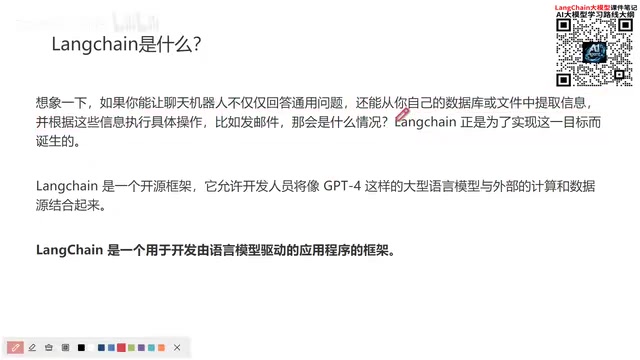
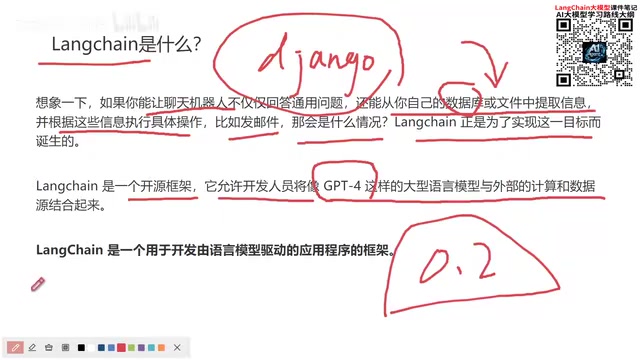
LangChain's purpose is to bridge this gap: it's a framework for developing applications powered by language models, letting developers combine large models like GPT-4 with external computation and data sources. It's worth emphasizing that the models here aren't limited to OpenAI—Google, Microsoft, and domestic providers like Baidu can all be integrated. The tutorial notes that since the 0.2 version upgrade, LangChain's compatibility has expanded further, covering basically all mainstream domestic and international models.
Core Abstractions: Components, Chains, Agents
LangChain enhances capabilities through three core concepts. Understanding them is the key to mastering the framework.
Components: The "JDBC Driver" for LLMs
Components provide a unified interface wrapper for various large models. The tutorial uses a neat analogy: it's like a JDBC Driver—you write code against a set of abstract interfaces, and when you swap out the underlying model (OpenAI, Google, GLM), your business code barely needs to change.
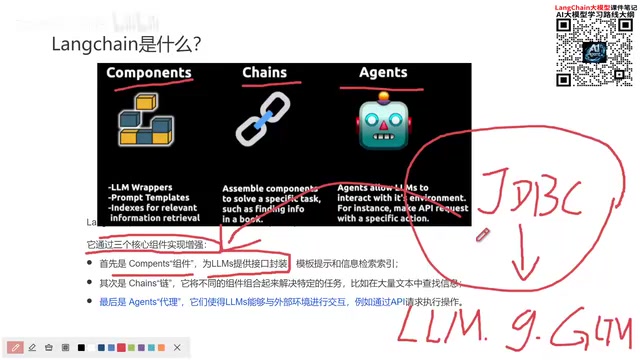
This design matters enormously for enterprise development. Model selection is no longer tied to your code architecture—if a domestic model works well, use the domestic one; if a foreign model performs better, switch to the foreign one. Migration costs are pushed extremely low.
JDBC (Java Database Connectivity) is the API specification in Java for executing SQL statements. It defines a standard set of interfaces, with each database vendor providing a corresponding driver implementation. Developers program against the JDBC interface, so when switching databases (e.g., from MySQL to Oracle), only the driver and connection string need replacing—the business code stays untouched. LangChain's Components borrow this design pattern: it defines a unified abstract base class (BaseLLM/BaseChatModel) for LLMs, and each vendor's model implements that interface through an adapter. As a result, switching models only requires changing configuration, greatly reducing code coupling and migration costs.
Chains: The Orchestration Layer for Components
A Chain connects different components in sequence to accomplish a specific task. An enterprise AI product often needs a large model, a relational database, a vector database, and an Embedding service all at once—the Chain is responsible for connecting these components into an executable pipeline following the business logic.
Embedding is the process of mapping text into high-dimensional dense vectors, where texts with similar semantics are closer together in vector space. It's the foundational step for retrieval-augmented generation (RAG) over private knowledge bases. Vector databases (such as Milvus, Pinecone, Chromadb) are purpose-built for massive-scale vector similarity search. Unlike traditional relational databases that do exact field matching, they achieve millisecond-level semantic retrieval through approximate nearest neighbor (ANN) algorithms. In a LangChain pipeline, the user's question is first vectorized by an Embedding model, then used to retrieve relevant document fragments from the vector store, and finally combined with the LLM to generate an answer.
Agents: Executors That Interact with the External Environment
Agents give large models the ability to interact with the external environment. The tutorial presents a typical scenario: have the model analyze the official Django documentation—the Agent first calls a tool to scrape the documentation content, then hands the data to the large model for processing. Here, "external" can mean official websites, enterprise databases, or product information repositories.
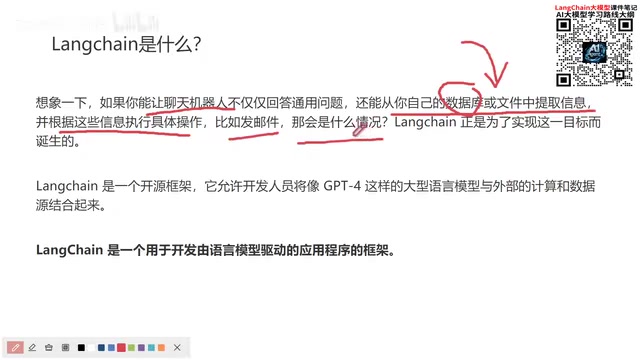
In business terms, this means intelligent customer service can respond precisely based on JD.com's product data, and sales agents can automatically retrieve internal materials to follow up with customers. Agents are the core of LangChain's leap from "conversational tool" to "productivity tool."
Tool Calling refers to the mechanism by which a model, during inference, autonomously judges whether to call external functions based on natural-language instructions, outputs structured parameters for the framework to execute, and then receives the results back to continue reasoning. A Tool in LangChain is typically a Python function with a name, description, and parameter schema. The Agent uses prompts to help the model understand the available tools and when to use them. This iterative decision-making loop (the ReAct pattern: Reason—Act—Observe) enables Agents to complete multi-step tasks, but it also introduces unpredictability. Enterprise environments therefore need to set maximum iteration counts, tool allowlists, and call-log auditing.
Typical Enterprise Agent Use Cases
The tutorial presents several representative requirement chains that are worth referencing in enterprise development:
Private knowledge base Q&A: Feed 100 industry papers into the model, ask consecutive questions about their content, and finally instruct the model to compile the Q&A history into an email sent to a specified address. This chain simultaneously exercises three capabilities: data injection, multi-turn dialogue, and tool calling.
Dynamic document learning: Give the Agent the URL of the official Django documentation, have it scrape and index the docs first, and then answer all subsequent questions within that document scope. This addresses the model's knowledge cutoff and insufficient domain depth.
Business process automation: Through tool calling, complete actions like searching, sending emails, and querying databases—turning AI from "giving advice" into "executing tasks."
The tutorial makes a notable observation: although AI development in the US is fast, there aren't many AI products that are truly deployed in practice—most leading companies focus on model tuning and optimization. Combining large models with a company's own data to complete human-like tasks is where the value of enterprise Agents lies.
Engineering Considerations for Private Deployment
Although the tutorial focuses on concepts, from an enterprise deployment perspective, privately deploying a LangChain application requires attention at several levels:
Model layer: Use Components' unified interface to integrate privately deployed open-source models or enterprise-licensed commercial model APIs, avoiding code being tied to a specific vendor.
Data layer: Vector database and relational database selection must match the enterprise's existing tech stack. The Chain's orchestration capabilities make multi-source collaboration possible.
Tool layer: Tools invoked by Agents (search, email, internal APIs) require permission isolation and call auditing—this is the key difference between enterprise environments and personal projects.
Security boundary: Keeping private data within the domain is the core requirement of private deployment. Model inference services, vector stores, and business databases should all be deployed within enterprise-controlled infrastructure.
Keeping data within the domain means that sensitive enterprise data never leaves the company's self-built or private cloud environment throughout the entire AI processing chain, avoiding the compliance risks of data leakage from calling public cloud APIs. Achieving this goal requires full-stack privatization: large models must be deployed on local GPU servers (e.g., open-source Llama, Qwen series), vector stores and business databases deployed on the intranet, and tool calls and logs kept within the enterprise firewall. This must be paired with network isolation, access authentication, and link encryption. For heavily regulated industries such as finance and healthcare, this is a hard prerequisite for whether a LangChain application can go live.
Suggested Learning Path
For beginners starting from zero, it's recommended to proceed in the order Components → Chains → Agents: first get a single model's call wrapper working, then try chaining two or three components together, and finally introduce tool calling to build a complete Agent. The tutorial emphasizes that these three concepts are LangChain's future focus and will be used repeatedly in real development.
From framework setup to real-world deployment, LangChain's value isn't in replacing large models—it's in connecting the capabilities of large models to enterprise business flows safely and controllably. Once you understand this, Agent development has a clear direction.
Related articles

GPT-Next Leak, Gemini 4 Argon Imminent: AI News Roundup
GPT-Next leak suggests extreme efficiency; OpenAI's 28-day shipping pledge boosts speed 50%; Gemini 4 Argon nears release; Anthropic subscription value report sparks debate.

GPT-Next Leaked, Gemini 4 Argon Speeds Up, Fable 5.5 May Launch Today
OpenAI's GPT-Next model leaks, expected to be extremely low-cost and possibly part of the 28-day release plan; Gemini 4 Argon internal testing accelerates, NanoBanana 2.1 is live; Semi Analysis tests show Claude Max's equivalent API value is about 5 times that of ChatGPT Pro; Fable 5.5 may launch today.

Gemini 4 Argon Launches Globally: Key Highlights from the AI Daily Brief
Google opens Gemini 4 Argon globally across Pro and Ultra subscriptions and the API, and demonstrates robot control. This article rounds up open-source models, Agent infrastructure, cost transparency, and safety governance updates.