Ferndesk: The AI Documentation Assistant That Keeps Your Help Center Evergreen

Ferndesk uses an AI Agent to automatically compare help docs against your product and draft corrections.
SaaS help documentation naturally suffers from a "written today, outdated tomorrow" problem — the gap between product updates and doc updates generates a steady stream of stale content. Ferndesk is an AI-powered help center that runs a built-in AI Agent through a continuous "check–catch–draft" loop, not just flagging outdated content but generating ready-to-review correction drafts, shifting editors from authors to reviewers. It ranked #2 on ProductHunt with 186 upvotes, validating the pain point. Its ultimate effectiveness hinges on three variables: data integration depth for detecting product changes, false positive control, and whether draft quality is close enough to publish-ready. Ferndesk represents AI shifting from content creation toward content maintenance.
In today's world of rapidly iterating SaaS products, help center documentation is almost inevitably destined to fall behind the product itself. Features get updated, interfaces get redesigned, workflows change — yet those help articles often remain frozen in the state they were written months ago. Users following outdated tutorials end up generating more support tickets and having a worse experience overall. A product called Ferndesk, launched on ProductHunt, is attempting to solve this age-old problem at its root using AI.
What Problem Is Ferndesk Trying to Solve
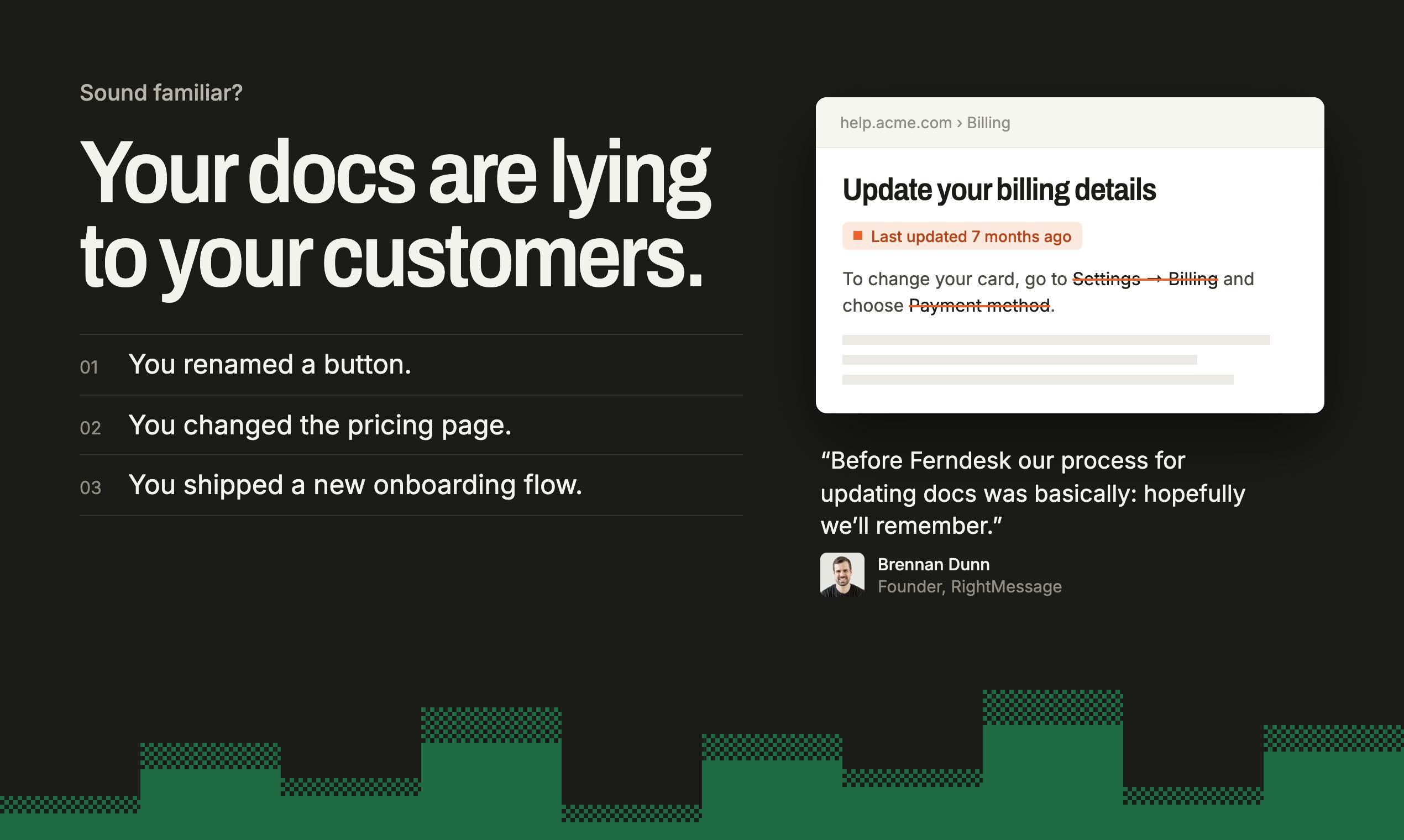
Ferndesk positions itself as "the help center that never goes out of date." It's not just a static documentation hosting platform — it has a built-in AI Agent that continuously compares every help article against your actual product, identifies which content has become invalid due to product changes, and proactively drafts corrections for you.
This approach strikes at the core pain point of content maintenance: keeping documentation up to date is high-effort, low-immediate-reward work that's extremely easy to deprioritize. Product teams rarely have the bandwidth to check each article against the current version one by one, and the result is that documentation quality steadily degrades over time. Ferndesk hands the "audit–detect–fix" cycle over to an AI Agent, aiming to bring maintenance costs down to a minimum.
Core Mechanism: From Reactive Updates to Proactive Correction
Traditional help center workflows are reactive — teams typically don't update an article until a user complains it's wrong or a support agent flags it as outdated. This creates a noticeable lag and leaves significant blind spots.
Ferndesk's approach is to make the process proactive. According to its official description, the AI Agent does three key things:
- Checks: Matches the content of each article against the current state of your product;
- Catches what changed: Identifies parts of the product that have evolved while the documentation hasn't kept up;
- Drafts the fixes: Rather than simply flagging problems, it generates suggested edits ready for human review.
That last step is where the most value lies. Many AI tools stop at "identifying the problem," but the step that actually consumes human effort is "making the fix." By including draft generation in the automation, Ferndesk shifts the editor's role from author to reviewer — which in theory can dramatically compress the content update cycle.
It's worth noting that the "draft the fix" step is technically non-trivial. The AI needs to understand the original writing style, document structure, and target audience level in order to produce edits that are consistent with the existing content — not awkwardly spliced in. The industry refers to this capability as context-aware generation: it requires the model to understand not just "what changed" but also "how to express that change in the right tone and format." This is precisely why many general-purpose writing AIs underperform in specialized documentation contexts — they can produce fluent text, but struggle to maintain consistency with an existing documentation system. Ferndesk will only have truly closed the loop from "identifying problems" to "solving problems" if it executes well on this layer.
Performance on ProductHunt
Ferndesk was launched by Maker Wilson Wilson and received 186 upvotes and 11 comments on ProductHunt, ranking #2 for the day. The product is categorized under Customer Success, Customer Communication, and Artificial Intelligence — a precise positioning aimed at SaaS and support teams that need to maintain knowledge bases.
For a tool focused on a vertical use case, this level of community reception confirms that "outdated documentation" is a genuinely widespread pain point rather than a manufactured problem. Customer success and support teams interact with knowledge bases every day, and any solution that reduces repetitive labor and lowers error rates is easy to rally around.
Key Questions Worth Asking
As a newly launched product, Ferndesk's real-world effectiveness still needs validation from more users. Starting from its core concept, a few critical factors will determine its ceiling:
How does it "detect" product changes? This is the foundation of the entire system. Does the AI Agent identify product changes by connecting to update logs, code diffs, UI screenshots, or some other data source? The depth of data integration directly determines the accuracy of corrections.
How does it balance false positives and accuracy? If the Agent frequently flags unchanged content as "outdated" or misses genuine changes, the tool loses credibility. The design of the human review step is therefore especially important.
Can drafted corrections meet a publishable standard? If the AI-generated drafts still require substantial rework, the time savings diminish significantly. The real value lies in drafts that are close enough to a publishable state.
On the question of detecting product changes, there are currently a few mainstream technical approaches in the industry: connecting to changelogs or release notes and using text comparison to identify affected documents; performing visual snapshot comparisons (screenshot diffs) of the product UI to capture interface-level changes; and integrating with code repositories or API schema change records to extract impact points from structured data. Each approach differs significantly in coverage and noise level — changelogs depend on a team's writing habits, screenshot diffs can't detect logic-layer changes, and code-level integration has a high barrier to entry. In practice, documentation tends to become invalid because of small, undocumented changes — precisely the blind spot that any single data source struggles to cover, and the core of Ferndesk's technical moat.
Implications for Content Operations
Setting aside this specific product, Ferndesk represents a trend that's taking shape: AI is moving from content creation toward content maintenance. The past focus was on "using AI to write documentation," while Ferndesk points toward "using AI to keep documentation correct." The latter's value in long-term operations may be even more underestimated than the former.
For any team maintaining a knowledge base, help center, or technical documentation, this direction is worth watching. The value of documentation isn't in the moment it's written — it's in how well it stays aligned with the product over time. Whoever can crack the "freshness" problem will have solved the hardest piece of content operations to automate.
Related articles

Free Unlimited Claude Code Solution: Agnes AI + CC Switch Setup Guide
No paid subscription needed — pair the free AI platform Agnes AI with the open-source tool CC Switch to provide a backend for Claude Code, enabling unlimited free calls to text, image, and video models. This guide covers the full setup, test results, and usage boundaries.

A Complete Zero-Cost Guide to Getting Started with Claude Code for Beginners in China
A beginner's guide to Claude Code for users in China: two installation methods (command line and IDE plugin), full configuration steps for replacing the official API with the free domestic LongCat model, and a hands-on demo of building a small tool with natural language, plus tips.

When the NSA Gets Involved: The AI Supply Chain Crisis Behind Open-Source CVEs and API Key Hijacking
Multiple open-source projects disclosed severe CVEs in one day, PHP flaws alarmed the FBI, and Railway and OpenCode were breached with API keys stolen. This article breaks down the vulnerability window, AI-accelerated exploitation, and the AI supply chain crisis behind the API key black market, with a developer defense checklist.