Fine-Tuning LLMs to Crack Honeypot Game Equilibria Under Network Mobility
Fine-tuning lets LLMs outperform zero-shot and proprietary models in dynamic honeypot games, but output validity is the bottleneck.
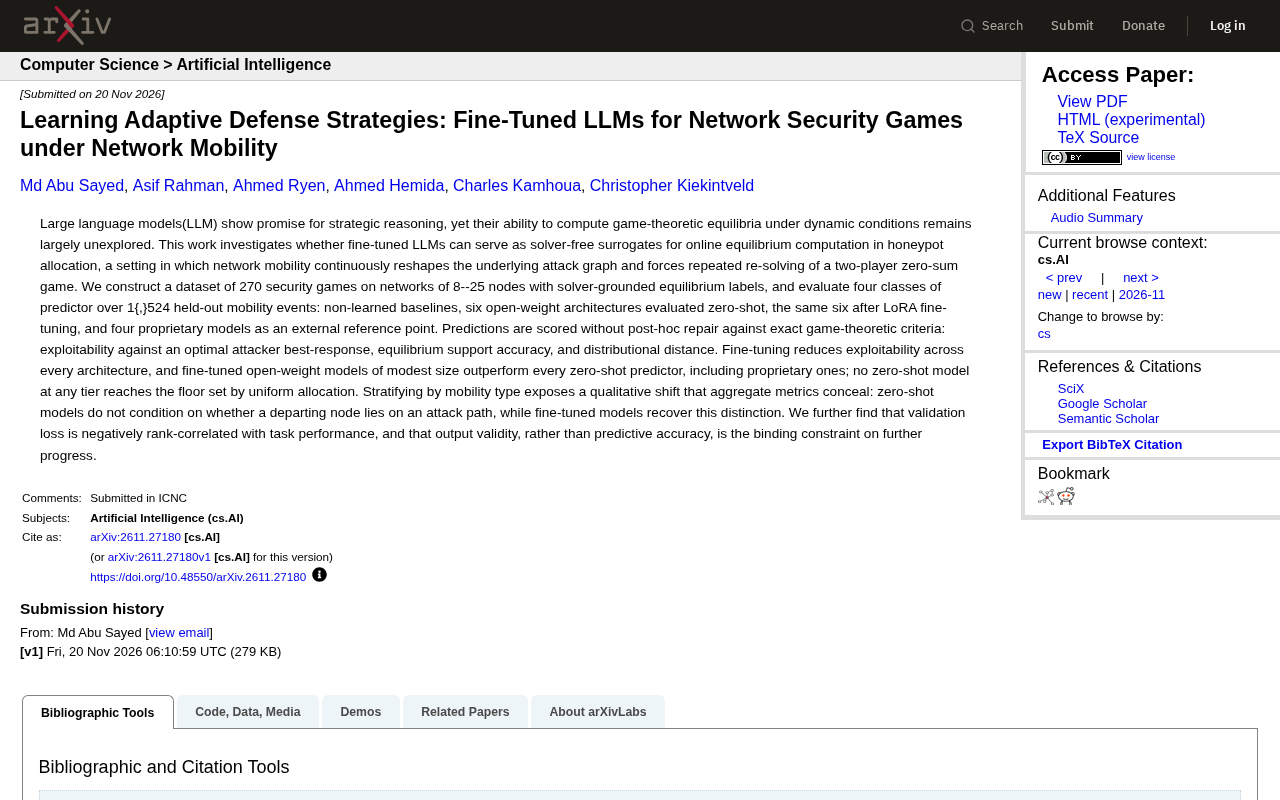
This paper investigates whether LLMs can act as solver-free game equilibrium proxies in dynamic network environments. It builds a dataset of 270 security games covering 1,524 mobility events and compares non-learning baselines, zero-shot open-weight models, LoRA fine-tuned models, and proprietary models using three game-theoretic metrics: exploitability, equilibrium support accuracy, and distribution distance. Key findings: fine-tuning lowers exploitability across architectures, medium-sized fine-tuned open-weight models surpass all zero-shot predictors (including proprietary ones), zero-shot LLMs underperform even the uniform allocation baseline, and fine-tuned models regain the ability to adjust strategies based on attack paths. Validation loss is negatively rank-correlated with task performance, and output validity—not prediction accuracy—is the main bottleneck for further improvement.
Large language models show promise in strategic reasoning, but whether they can compute game equilibria under dynamic conditions remains an open question. A recent paper tackles this gap head-on: in a honeypot allocation scenario where network mobility constantly reshapes the attack graph—forcing repeated solving of a two-player zero-sum game—can a fine-tuned LLM serve as a solver-free proxy that delivers equilibrium solutions online?
Problem Setup: Mobility Makes Equilibrium Computation Expensive
Honeypot allocation is essentially an attacker-defender game: the defender deploys decoys on nodes, and the attacker chooses intrusion paths. When network mobility occurs (nodes joining, leaving, or migrating), the structure of the attack graph changes, and previously computed equilibrium strategies may become instantly obsolete. The traditional approach is to invoke a game solver to recompute, but in online settings, the computational overhead of repeated solving is non-negligible.
The paper constructs a dataset of 270 security games with networks ranging from 8 to 25 nodes, each labeled with solver-generated equilibria. Evaluation covers 1,524 held-out mobility events, comparing four categories of predictors: non-learning baselines, zero-shot performance of six open-weight architectures, the same six models after LoRA fine-tuning, and four proprietary models as external references.
Two-player zero-sum game refers to a game model with only two participants where one side's gain exactly equals the other side's loss. In the honeypot allocation scenario, the defender and attacker form a classic zero-sum relationship: the attacker's gain from a successful intrusion is the defender's loss. The core solution concept for such games is the Nash equilibrium, a state where neither party has an incentive to unilaterally change strategy. For zero-sum games, the equilibrium can be solved via linear programming in polynomial time, but when the game scales up or requires repeated solving, computational cost remains significant. An equilibrium strategy is typically a mixed strategy—randomly selecting actions according to a probability distribution such that the opponent cannot profit from a targeted strategy. In this paper, network mobility causes the attack graph to change, meaning the game's payoff matrix changes accordingly; the original equilibrium strategy no longer applies and must be recomputed.
LoRA (Low-Rank Adaptation) is a parameter-efficient fine-tuning technique that adapts a pre-trained model to downstream tasks by injecting low-rank decomposition matrices alongside the weight matrices while keeping the original model parameters frozen. Specifically, for a weight matrix (W), LoRA introduces two small matrices (A) and (B), such that the updated weight is (W + BA), where the ranks of (B) and (A) are much smaller than the original matrix dimensions. This drastically reduces trainable parameters and fine-tuning cost while avoiding catastrophic forgetting. In this paper, LoRA is used to adapt general-purpose LLMs to the game equilibrium prediction task, enabling the model to learn the mapping between structural changes in the attack graph and equilibrium strategies.
Evaluation Criteria: Focus on Game Quality, Not Prediction Accuracy
This work makes a notable choice in evaluation: predictions are not post-hoc patched but scored directly against exact game-theoretic criteria. The three metrics are:
- Exploitability: the loss against an optimal attacker's best response—lower is better;
- Equilibrium support accuracy: how well the predicted strategy support matches the true equilibrium;
- Distribution distance: the divergence between the predicted strategy distribution and the equilibrium distribution.
This evaluation approach is closer to real-world defense needs than common accuracy metrics—a strategy that predicts something "like" an equilibrium but can be exploited by an attacker has almost no value in security settings.
Exploitability is a classic metric in game theory for measuring strategy quality, defined as the utility difference between the current strategy and the Nash equilibrium strategy, typically measured as "the additional gain an optimal opponent's best response can obtain." For an approximate equilibrium strategy, lower exploitability means the opponent finds it harder to profit from a targeted strategy, and the strategy is closer to a true equilibrium. In security games, exploitability directly corresponds to the fragility of a defense strategy: a highly exploitable strategy means an attacker can easily find and exploit vulnerabilities. This paper adopts exploitability as the core evaluation metric rather than simple prediction accuracy because, in attack-defense scenarios, the "exploitability" of a strategy better reflects actual defense effectiveness than "pointwise agreement with the equilibrium."
Key Findings: Fine-Tuning Brings Comprehensive Improvement
The experimental results show a clear hierarchy. Fine-tuning reduces exploitability for every architecture, and medium-sized fine-tuned open-weight models surpass all zero-shot predictors, including proprietary models. More strikingly, zero-shot models at any level fail to reach the baseline floor set by uniform allocation.
This means zero-shot LLMs are even worse than a simple "uniform allocation" strategy at computing game equilibria. Fine-tuning is not just icing on the cake—it is the critical step that takes models from below-baseline to surpassing all zero-shot approaches.
Mobility Type Stratification Reveals Qualitative Differences
Aggregate metrics mask an important shift. After stratifying by mobility type, zero-shot models do not adjust strategy based on "whether the departing node lies on the attack path"—they are insensitive to this key condition. Fine-tuned models restore this discriminative ability.
This qualitative difference better illustrates what fine-tuning learns than overall metrics: the model begins to understand structural changes in the attack graph rather than merely fitting surface patterns.
Two Findings Worth Heeding
The paper also reports two observations with direct implications for practitioners.
Validation loss is negatively rank-correlated with task performance. In other words, models with lower validation loss may actually perform worse on the game task. This warns researchers that when fine-tuning game-reasoning models, validation loss cannot be the sole basis for model selection.
Output validity, not prediction accuracy, is the bottleneck for further progress. Model-generated strategies must satisfy game constraints (e.g., valid probability distributions, reasonable support sets), and current models' failures in output validity limit performance improvement more than inaccurate predictions. In other words, getting the model to "speak the right language" is more urgent than getting it to "compute accurately."
Rank correlation is a non-parametric statistic used to measure the strength of a monotonic relationship between two variables, with common forms including Spearman's rank correlation coefficient and Kendall's rank correlation coefficient. Unlike Pearson correlation, rank correlation does not require a linear relationship between variables but compares based on data rankings. A negative rank correlation means that as one variable increases, the other tends to decrease. This paper finds that validation loss is negatively rank-correlated with task performance—models with lower validation loss may actually perform worse on the game task. This phenomenon suggests that when fine-tuning game-reasoning models, validation loss may capture signals inconsistent with the task objective and cannot serve as a reliable basis for model selection.
Practical Implications
For researchers working on security automation and game reasoning, this work conveys several signals. Solver-free online equilibrium approximation is feasible, but only with domain fine-tuning; zero-shot LLMs are unreliable on this task, even worse than naive baselines; and evaluation must use game-theoretic metrics, as accuracy can mislead.
The open questions left by the paper are equally clear: how to improve output validity and how to design model selection strategies that do not rely on validation loss are thresholds that must be crossed before practical deployment.
One-line Summary
Fine-tuning enables LLMs to surpass zero-shot and proprietary models in dynamic honeypot games, but output validity becomes the bottleneck.
Paragraph Summary
This paper explores whether LLMs can serve as solver-free game equilibrium proxies in dynamic network environments. The study constructs a dataset of 270 security games covering 1,524 mobility events, comparing non-learning baselines, zero-shot open-weight models, LoRA fine-tuned models, and proprietary models. Evaluation uses three game-theoretic metrics: exploitability, equilibrium support accuracy, and distribution distance. Key findings: fine-tuning reduces exploitability for every architecture, and medium-sized fine-tuned open-weight models surpass all zero-shot predictors (including proprietary models); zero-shot LLMs are even worse than the uniform allocation baseline; fine-tuned models restore the qualitative ability to adjust strategies based on attack paths. Additionally, validation loss is negatively rank-correlated with task performance, and output validity—not prediction accuracy—is the main bottleneck for further performance improvement.
Related articles

David Fincher's New Film Accused of Being AI-Generated? The Truth Behind the Controversy
David Fincher's new film *The Further Misadventures of Cliff Booth* is accused of using AI, with a carriage shot in the trailer sparking controversy. Netflix's acquisition of Ben Affleck's AI company and Fincher's own openness to AI keep suspicions alive. This article sorts out the controversy and the views of all sides.

FCC Clears SpaceX's Space-Based AI Data Centers: A Debate Over Regulatory Boundaries
The FCC approved SpaceX's plan to deploy AI data centers in space but dismissed opponents' key concerns about scientific research impacts as beyond its regulatory authority. This article analyzes the regulatory boundary issues behind the decision, the deeper tensions of space-based AI infrastructure, and its implications for the industry.

Why Are Latinos Nearly Half of the U.S. Border Patrol?
Latinos hold nearly half of the U.S. Border Patrol and about 30% of ICE. Vox's Khalil Green explores their motivations, identity tensions, and why enforcement work ≠ MAGA.