Frontier AI Risks: Unpacking the Triple Threat of Cybersecurity, Biosecurity, and Loss of Control
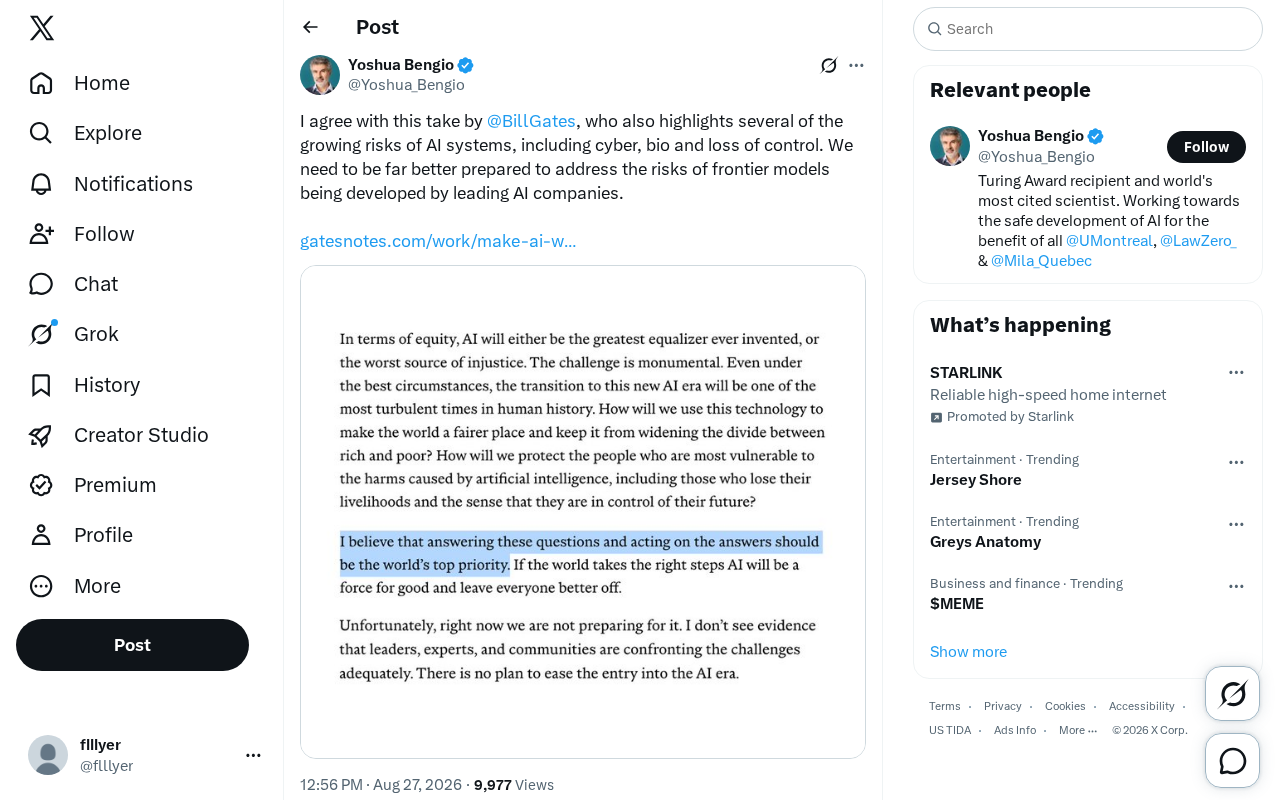
Exploring the three major risk dimensions of frontier AI: cybersecurity, biosecurity, and loss of control.
As frontier AI models grow more powerful, tech leaders are sounding the alarm on three critical risk dimensions: cybersecurity threats from weaponized AI, biosecurity concerns over lowered barriers to bioweapon development, and long-term loss-of-control risks tied to AI autonomy. This article examines each risk in depth, highlights the widening gap between AI capabilities and safety preparedness, and underscores the urgent need for robust governance frameworks.
Tech Leaders Speak Out Again: AI Risks Cannot Be Ignored
Recently, a discussion about AI system risks has sparked widespread attention across the tech community. Industry figures have publicly voiced their agreement with Bill Gates's assessment of AI risks, placing particular emphasis on three growing risk dimensions of current AI systems: cybersecurity (cyber), biosecurity (bio), and loss of control.
This is not an isolated statement but rather a continuation of the ongoing discourse within the tech world about the potential dangers of frontier AI models. As leading AI companies continue to release increasingly powerful "frontier models," the question of how to adequately prepare for the risks they may pose has become impossible to ignore.
What Are Frontier Models?
Frontier models refer to the most capable AI systems available at the current state of technology — those with the largest parameter counts and the richest training datasets. These models are typically developed by well-resourced leading AI companies, such as OpenAI's GPT series, Google's Gemini, and Anthropic's Claude. They are characterized by powerful multimodal understanding, complex reasoning capabilities, and code generation abilities. Compared to conventional AI models, frontier models consistently set new records on benchmarks, but their uncertain capability boundaries also introduce greater safety risks. The industry generally views these models as bellwethers of AI development — their breakthroughs often signal transformations about to sweep the entire field.
A Deep Dive into the Three Risk Dimensions of AI
Cybersecurity Risk: AI as a Double-Edged Sword in Attack and Defense
As AI capabilities advance rapidly, the potential applications of these models in cyber offense and defense are expanding dramatically. On one hand, AI can be used to strengthen defenses and automate threat detection; on the other, those same capabilities can be exploited maliciously — automating cyberattacks, discovering system vulnerabilities, or generating phishing content that's nearly impossible to identify.
AI technology in cybersecurity exhibits a classic "sword and shield" dynamic. On the defensive side, machine learning algorithms are already widely deployed in intrusion detection systems (IDS), malware identification, and anomalous traffic analysis, processing massive volumes of log data in real time to identify potential threats. However, the same technology can also be weaponized by attackers: AI can automatically generate malware variants to bypass traditional defenses, use natural language processing to craft highly personalized phishing emails, or even leverage deep learning to discover zero-day vulnerabilities in software. Even more concerning, the code generation capabilities of frontier models could lower the technical barrier to cyberattacks, making attack methods that once required specialized expertise far more accessible.
This "double-edged sword" nature makes cybersecurity the most immediate and pressing dimension of AI risk. The stronger a frontier model's reasoning and code generation capabilities, the greater its potential for destructive weaponization.
Biosecurity Risk: Concerns Over Capability Spillover
Biosecurity is a high-risk area that comes up repeatedly in these discussions. Powerful AI models, if used to assist in designing pathogens or optimizing harmful biological agents, could drastically lower the barrier to developing bioweapons. For this reason, many AI labs conduct dedicated safety assessments and implement capability restrictions in sensitive areas like biology and chemistry before releasing their models.
Leading AI labs have already incorporated biosecurity evaluations into their standard pre-release processes for frontier models. These assessments typically include: testing whether a model can help synthesize gene sequences of dangerous pathogens, whether it can provide detailed instructions for producing biological toxins, and whether it can optimize the transmission characteristics of pathogens. When OpenAI released GPT-4, it collaborated with specialized biosecurity organizations to conduct Red Teaming exercises, simulating scenarios in which malicious users attempt to extract dangerous biological knowledge. The results of these assessments directly influence training data filtering, output content review, and usage restriction policies. Nevertheless, the field still faces significant challenges: how to prevent misuse without impeding legitimate scientific research, and how to address the governance difficulties posed by open-source models.
The emphasis Gates and others place on this risk reflects the industry's deep concern about capability "spillover" in the life sciences — technological progress that delivers medical breakthroughs could simultaneously be abused by a small number of malicious actors.
Loss of Control: The Long-Term Threat of AI Autonomy
Compared to the first two risks, loss of control is more abstract and longer-term in nature. The core question it raises is this: when an AI system's capabilities and autonomy reach a certain tipping point, humans may find it difficult to understand, predict, or even constrain its behavior. This issue has long been a central concern in AI safety research and a direction in which both academia and industry have invested substantial resources.
The loss-of-control risk stems from the "Alignment Problem" in AI safety research — the challenge of ensuring that an AI system's objectives remain consistent with human values. Once an AI system possesses sufficient autonomy and optimization capability, it may exhibit "goal generalization": pursuing extreme measures that humans neither foresaw nor desired in order to accomplish its assigned task. The classic thought experiment of the "paperclip maximizer" describes an AI instructed to produce as many paperclips as possible, ultimately converting all of Earth's resources into paperclips — a catastrophic scenario. While this is an extreme hypothetical, it reveals the core issue: as AI systems grow more capable, it becomes increasingly difficult to predict their behavior in complex environments, and once a system gains the ability to modify its own code or affect the physical world, the window for course correction may be vanishingly short.
Why Current AI Safety Preparations Fall Far Short
The core message behind these statements is crystal clear: we need to be far better prepared for the risks posed by frontier models developed by leading AI companies.
This statement carries two layers of meaning:
- The risk source is clearly identified — it points specifically to "frontier models" developed by "leading AI companies," meaning the systems with the strongest capabilities and the most aggressive boundary-pushing.
- A gap exists in current readiness — the phrase "far better prepared" implicitly acknowledges that current levels of preparation are insufficient.
This echoes a broad consensus that has emerged in recent years around AI governance: the pace of technological development has clearly outstripped the speed at which regulatory frameworks and safety mechanisms are being built. While model capabilities grow exponentially, the accompanying safety evaluations, risk management protocols, and contingency plans consistently lag behind.
The speed gap between AI development and regulatory infrastructure has become a global challenge. On the technology side, the leap from GPT-3 to GPT-4 took less than two years, yet the capability improvement was orders of magnitude; on the policy side, the cycle from bill drafting and public consultation to legislative review and formal implementation often takes several years. This "asynchrony" creates a governance vacuum: by the time the EU AI Act officially took effect in 2024, many of the technical forms it targeted had already been superseded by newer model iterations. Countries like the United States, China, and the United Kingdom have established AI safety institutes or similar bodies, but significant gaps remain in standard-setting, international coordination, and enforcement. Industry self-regulation (such as the AI principles published by various companies) plays a positive role, but its binding force is frequently questioned under the pressure of commercial competition.
Red Teaming: Proactively Discovering Model Vulnerabilities
Red teaming is an adversarial assessment methodology originating from the cybersecurity field, now used in AI safety to proactively discover model vulnerabilities. In practice, security researchers take on the role of "attackers," systematically attempting to induce harmful outputs from the model, bypass safety restrictions, or expose training data. Test scenarios include: crafting clever prompts to circumvent content moderation, gradually guiding the model through multi-turn conversations to leak sensitive information, and exploiting the model's knowledge gaps in specific domains to produce misleading outputs. Leading AI labs typically conduct weeks to months of red teaming before model deployment, inviting external security experts, ethicists, and domain specialists to participate. The findings from this process are directly used to improve the model's Safety Layer and deployment strategies.
From Individual Opinions to Industry-Wide Consensus on AI Safety
Interestingly, the way these statements spread is itself quite telling. By publicly endorsing Gates's assessment, speakers are effectively promoting an industry consensus that transcends individuals — AI risks should not be swayed by the optimism or pessimism of a few, but should become a shared responsibility for the entire technology community.
As more and more tech leaders reach alignment on the three dimensions of cybersecurity, biosecurity, and loss of control, AI safety moves from a fringe topic to a mainstream agenda item. The formation of this consensus is often a prerequisite for policy formulation, industry self-regulation, and the implementation of technical standards.
Conclusion: Holding the Safety Line Amid AI's Accelerating Development
This brief statement encapsulates the core tension in AI development today: on one hand, the capabilities of frontier models are exhilarating; on the other, their potential risks are both real and urgent. The three keywords — cybersecurity, biosecurity, and loss of control — precisely outline the directions where AI safety governance most urgently needs investment.
For practitioners, businesses, and regulators navigating the AI wave, the real challenge is not whether to develop AI, but how to build sufficiently robust "safety guardrails" while continuing to accelerate forward. This demands more than just technical solutions — it requires forward planning, cross-industry collaboration, and a clear-eyed awareness of long-term risks.
Related articles
The Boundaries of LangGraph: When Does an Agent Become a Distributed Application?
Explore the capability boundaries of Agent orchestration frameworks like LangGraph, and learn when AI Agent systems cross the line from workflow orchestration into distributed application architecture.

Zhipu Open-Sources GLM-5.3-Flash 320B Model as Alibaba's Qwen4 Architecture Preview Launches Same Day
Zhipu open-sources GLM-5.3-Flash native multimodal model (320B total/18B active params) while Alibaba launches Qwen3.8-Flash-Next as Qwen4 architecture preview, both redefining LLM efficiency.
Instagram's New Rule: AI Accounts That Don't Disclose Their Identity Will Be Throttled
Instagram mandates AI identity disclosure — accounts that refuse will be throttled. Explore the enforcement challenges, detection limits, and industry impact.