Fully Automated Video Editing with Claude Code: Build an AI Editing System with Zero Code

A no-code creator uses Claude Code to coordinate seven tools and build a fully automated video editing system.
A YouTube creator who can't write code built a fully automated video editing system with Claude Code, mapping the seven roles of a traditional video team—editing, transcription, animation, research, screen recording, sound design, and quality checking—onto specific tools, with Claude Code acting as project manager. Parakeet handles transcription and HyperFrames handles animation rendering, both free and running locally; Tella and Epidemic Sound are connected via MCP connectors. The core is a Skill file called YouTube-edit with 36 rules, which the author continuously feeds back into so Claude writes lessons back to the file, making each edit more accurate. Editing a single video takes only 10 to 20 minutes, the production cycle shrinks from days to same-day publication, the cost is far lower than hiring a human editor, and the creator becomes a director who only records and gives feedback.
A YouTube creator who can't write code built a fully automated video editing system with Claude Code—all he does is press record and give feedback, with everything else handled by AI working in concert with seven tools. This system not only compresses an editing workflow that used to require a small team into a single person, but also dramatically cuts the production cost per video, shortening the timeline from several days to same-day publication.
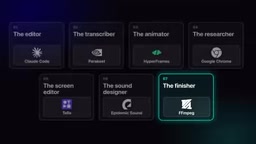
Seven tools, seven "employees"
The core idea of this system is to map each role in a traditional video team onto a specific tool, with Claude Code acting as the "project manager" orchestrating everything. The author emphasizes that Claude Code runs locally, can directly access computer files, invoke other programs, and output finished products to a designated folder.
The first role is the "editor," handled by Claude Code itself: it selects footage, decides on cut points, and plans zoom and animation placement. But Claude itself "can't hear" the video content, so the second role, the "transcriber," is filled by Parakeet, a free tool developed by NVIDIA. It converts footage into timestamped text, letting Claude understand what's being said and where mistakes occur, so it can cut shots precisely.
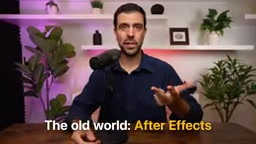
The third role is the "animator." This work used to depend on After Effects, but is now handled by HyperFrames, a free tool developed by HeyGen—Claude writes each animation as a small webpage, and HyperFrames renders it into 4K video, all running locally at no extra cost.
MCP (Model Context Protocol) is an open standard introduced by Anthropic in late 2024 to let large language models securely and structurally connect to external tools and data sources. You can think of it as the "USB-C port" for AI: as long as a piece of software provides an MCP connector, Claude can invoke its functions through a unified protocol without needing to write separate integration code for each piece of software. In this article, Tella and Epidemic Sound are directly controlled by Claude through their respective MCP connectors, which is the technical foundation that allows the whole system to string multiple heterogeneous tools into a pipeline.
Research, screen recording, and sound design
The fourth role is the "researcher." When a video mentions a piece of news or research, it needs verifiable B-roll footage to accompany it. Claude automatically searches via the browser, takes screenshots, and records scrolling pages—it can even highlight or magnify specific areas, ensuring that what appears on screen is genuine footage from the original source.
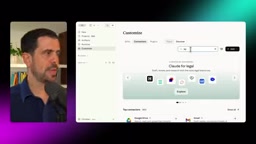
The fifth role is "screen recording editing," which serves the tutorial content the author records extensively. He uses Tella to record both his face and screen simultaneously, and Tella's MCP connector lets Claude directly control the software's internal editing, zooming, and layout operations—the author only needs to complete the recording.
The sixth role is the "sound designer," responsible for music and sound effects. The author pays for an Epidemic Sound subscription and connects it to Claude via a connector. He has trained Claude to understand his preferences: a sense of suspense at the opening, then a shift into low-volume lo-fi hip-hop, with independent rules for sound effects as well.
The seventh role is the "final quality checker," filled by ffmpeg, a free tool with over twenty years of history. It lies beneath almost all mainstream editing software, responsible for stitching all clips together, removing black frames, checking audio-video sync, and completing final checks before the author sees the finished product.
B-roll is a term in video production referring to supplementary footage interspersed between the main narrative shots, used to cover cut points, provide visual evidence, or adjust pacing. Traditionally, B-roll requires a film crew to shoot additional footage or purchase from stock libraries, but here Claude obtains it automatically through searching, screenshots, and screen recordings—ensuring the footage is verifiable while avoiding copyright risks. This step used to be the responsibility of the "researcher + asset manager" in a video team, and is now compressed into a single browser automation operation.
Skill: writing your personal style as a manual
The seven tools each do their job, but they don't know what a "good video" looks like. This key role is handled by Skill—essentially an instruction file that Claude reads before executing tasks, breaking down the author's editing style into specific rules for colors, fonts, animations, sound effects, and more. The author's Skill is called "YouTube-edit," contains 36 rules, and the entire thing was written for him by Claude Code.
The author's training approach is progressive: initially he gave specific feedback only on each small clip (usually the video opening), and started adding sound effect tuning around ten days in. He tried eight to ten sound effects for one opening before finding a satisfactory result, because the AI's initial versions were "too noisy." After each round of feedback, he would ask Claude to write what it learned back into the Skill file, so that the next edit would keep improving.
An important detail: after each feedback session, having Claude save the lessons into the Skill is the key to this system's continuous evolution. The author says that as long as he gives a correction once, it won't make the same mistake again next time.
Skill can be understood as a "persistent memory" or "operating manual" for an AI agent, fundamentally different from one-off conversational prompts. Ordinary prompts only take effect in the current session and are forgotten once closed; but a Skill, once written to a file, is re-read before every task, essentially distilling human experience into a reusable asset. This "execute—feedback—write back to file" loop is the key mechanism that lets AI output quality improve monotonically over time, and is a typical practice in what is currently called "context engineering" in AI agent engineering.
Practical workflow and cost structure
The setup steps aren't complicated: download the Claude desktop app, subscribe to a paid plan, switch to Claude Code mode, choose local execution and specify a working folder, enable auto-permissions, turn on web browsing in settings, then let Claude install the required tools itself. Tella and Epidemic Sound are connected manually via connectors, and HyperFrames can be obtained from a code repository or connector.
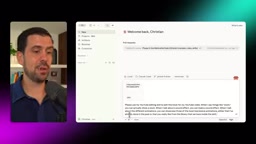
In actual use, the author drops raw footage directly to Claude with instructions like "edit this opening using my YouTube editing Skill," along with specific requirements (where to add zoom, where to add sound effects, which animations to show). The whole process takes about 10 to 20 minutes. He mentions that a two-plus minute raw clip was edited into a 31-second finished product, with the result basically on target and only minor adjustments needed.
On cost: the author uses a Claude Max subscription, a fixed monthly fee, but since he uses it for all his work, he had Claude tally the token consumption per video to estimate the allocated cost. HyperFrames and Parakeet are completely free, and Tella and Epidemic Sound are both annual subscriptions that work out to very little per video. By comparison, a good YouTube editor charges hundreds of dollars or more per video. What the author values more is speed: what used to take three to seven days with repeated revisions can now be planned, shot, edited, and published the same day.
A token is the basic unit of measurement for how language models process text, roughly understandable as a "word piece." Every input and output of the model is billed by token, so the number of tokens consumed per video directly corresponds to its inference cost. The author using Claude to tally token consumption to allocate the monthly fee is essentially estimating the "marginal AI cost per video." This also explains why fixed subscriptions are more cost-effective for high-frequency creators: the more you use it, the lower the fixed cost allocated to each video.
The human is still the director
This system doesn't completely exclude the creator. The author defines his role as "director": responsible for pressing record, giving feedback, and making final judgments. Claude is the editor, responsible for execution. He admits he has no editing skills at all, but precisely because of that, this system isn't an efficiency tool for him—it's an extension of his abilities.
For those who want to replicate this, the author shares the Skill file in his free community. From this, we can see that the form in which AI agents truly land is often not about how powerful a single model is, but about stringing multiple specialized tools together through a coordinator, then constraining output quality with an iterable "style manual"—an approach that can be transferred to many workflows beyond editing.
One-line Summary
A creator who can't write code uses Claude Code to coordinate seven tools and build a fully automated video editing system.
Paragraph Summary
A YouTube creator who can't write code built a fully automated video editing system with Claude Code, mapping the seven roles of a traditional video team—editing, transcription, animation, research, screen recording, sound design, and quality checking—onto specific tools, with Claude Code acting as project manager orchestrating everything. Parakeet handles transcription and HyperFrames handles animation rendering, both free and running locally; Tella and Epidemic Sound are connected via MCP connectors. The core of the system is a Skill file called YouTube-edit containing 36 rules, which the author continuously feeds back into so Claude writes lessons back to the file, making each edit more accurate. Editing a single video takes only 10 to 20 minutes, the production cycle shrinks from days to same-day publication, and the cost is far lower than hiring a human editor, with the creator's role transformed into a director who only records and gives feedback.
Related articles

Full AI Comic Drama Workflow with WorkBuddy: 8 Steps from Zero to Final Cut
A complete eight-step WorkBuddy workflow for making AI comic dramas: topic planning, script and storyboard, image assets, video generation, voiceover, editing, and publishing, plus WorkBuddy's expert-skill mechanism and tips for summoning experts one by one. Suitable for beginners.

Codex Practical Tutorial: From Installation to Multi-Agent Collaboration
Based on a Bilibili Codex practical tutorial, this article systematically covers installation and configuration, CLI interaction, slash commands, AGENTS.md architecture, the MCP protocol, multi-agent collaboration, and enterprise plugin development, helping developers understand engineering usage of AI Agents.

AI Agent Practical Guide: Building an Enterprise-Grade Agent from Scratch
A beginner-friendly guide to AI Agents: the difference from traditional programs, the perception-decision-action loop, technical evolution, the enterprise tech stack (LLM, tool calling, memory, RAG), and use cases.