Fuse AI: Rebuilding the GTM Tech Stack with One SDK and One MCP

Fuse AI unifies the entire GTM stack with one SDK and one MCP, with native AI agent support.
Fuse AI is a GTM infrastructure product for developers and AI agents that uses a single SDK and MCP (Model Context Protocol) interface to consolidate data enrichment, multi-channel outreach, workflow automation, and AI agent invocation — replacing the fragmented multi-tool stacks most growth teams rely on. Positioned as "OpenRouter × Apollo × Clay × Zapier," its core differentiator is native AI agent support, packaging GTM capabilities as MCP-compliant tool interfaces so AI models can orchestrate the full pipeline from lead discovery to outreach. It ranked #3 on Product Hunt with 154 upvotes and currently targets technically capable growth teams. Data quality, channel depth, and MCP ecosystem maturity are the key variables in whether it can deliver on its benchmarking claims.
When GTM Toolchains Get Out of Hand
The tech stacks used by modern sales and growth teams have long since spiraled out of control — one tool for data enrichment, another for multi-channel outreach, yet another third-party platform for automation workflows. Every step means another subscription fee, another API, and another maintenance burden. Fuse AI takes direct aim at this fragmentation problem with an ambitious proposition: cover the entire GTM (Go-To-Market) workflow with a single SDK and a single MCP (Model Context Protocol) interface.
The product earned 154 upvotes on Product Hunt and ranked #3 for the day, placed across the Sales, API, and Artificial Intelligence categories — a positioning that reflects its hybrid identity as both a sales tool and AI infrastructure.
Four Tools Rolled Into One Interface
Fuse is refreshingly direct about its positioning — the official pitch uses a vivid analogy: "Think OpenRouter x Apollo x Clay x Zapier." Each of these four names represents a critical capability in the GTM chain:
- OpenRouter maps to a unified AI model routing layer;
- Apollo represents the sales intelligence database and contact acquisition;
- Clay is the data enrichment and automation orchestration tool that's taken the growth hacking world by storm;
- Zapier stands for cross-app workflow automation.
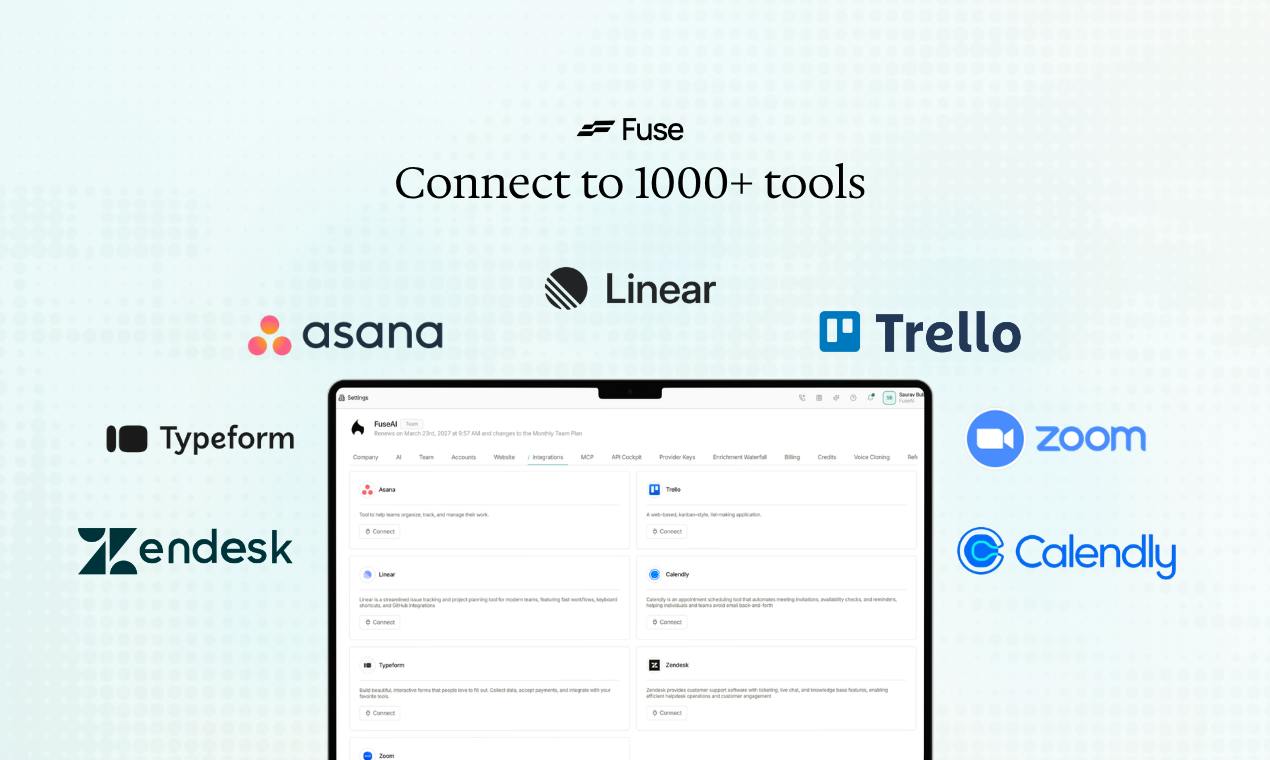
In other words, Fuse aims to consolidate five major modules — web automations, data enrichment, multi-channel outreach, workflows, and AI agents — under a single developer interface. Developers no longer need to stitch together different GTM products for each step of the process.
Understanding these four reference points helps calibrate the scope of Fuse's ambitions. Apollo.io is the dominant B2B sales intelligence platform, with over 270 million contact records; its core moat lies in the breadth and freshness of its data. Clay is the "hyper-enrichment" tool that's risen to prominence in growth circles in recent years — it doesn't own any data itself, but instead aggregates 60+ third-party data sources and uses AI to auto-fill fields, enabling highly customized lead enrichment on a credit-based pricing model. Zapier connects over 6,000 apps through a no-code, drag-and-drop interface. OpenRouter is a unified gateway for AI model calls, letting developers switch between GPT-4, Claude, Gemini, and other major models with a single API key. For Fuse to truly "replace" all four, it faces not just the challenge of replicating features, but the years of accumulated data assets and integration ecosystems these tools have built — which is precisely where their moats are hardest to breach.
Infrastructure Built for AI Agents
What makes Fuse genuinely worth watching is that it explicitly serves both "developers and AI agents." It offers not just a traditional SDK for human engineers to call, but also an MCP interface.
MCP (Model Context Protocol) is a protocol that lets AI models invoke external tools and data sources in a standardized way. By packaging GTM capabilities as MCP-compliant tools, Fuse enables AI agents to directly "understand" and call these functions — automatically completing the full chain from lead discovery and data enrichment to multi-channel outreach. This aligns closely with where the agent ecosystem is heading: tools are shifting from "interfaces built for humans" to "interfaces built for models."
In this sense, Fuse isn't just another sales automation tool — it's more like GTM middleware for the AI Agent era. Developers can build "unlimited workflows and agents" on top of it without worrying about the integration details of each underlying data source and channel.
MCP (Model Context Protocol) was proposed and open-sourced by Anthropic in late 2024, with the goal of providing large language models with a standardized "tool invocation" specification — analogous to USB ports for hardware peripherals. Regardless of what the underlying data source or service is, as long as it implements the MCP protocol, an AI model can discover, call, and retrieve results in a unified way. Before MCP, every tool vendor had to write separate adapter layers for different AI platforms, keeping integration costs stubbornly high. MCP fundamentally changed the logic of building tool ecosystems: a tool provider only needs to expose a spec-compliant MCP server to be directly accessible by any AI agent framework that supports the protocol (such as Claude, Cursor, and various AutoAgent systems). The MCP ecosystem is still in a rapid growth phase, with hundreds of tools already available, but the stability of the spec itself, security auditing mechanisms, and enterprise-grade permission management remain open challenges — and these are precisely the ecosystem risks Fuse AI must navigate by betting on MCP.
It Solves a Real Pain Point — But Leaves Questions Open
Fragmentation in the GTM tool stack is a genuine, persistent headache for growth teams. Stacking subscription costs, shuttling data between tools, brittle integration logic that breaks easily — Fuse is trying to cure all of this with the unified abstraction of "one SDK, one MCP," and the entry point is sharp.
That said, based on publicly available information, several critical questions remain unanswered:
- Data quality: Benchmarking against Apollo and Clay means Fuse must match them on contact data and enrichment capabilities — and that's exactly where these tools have built their hardest-to-replicate moats;
- Channel depth: The actual coverage and deliverability of multi-channel outreach will determine whether it can truly replace dedicated outbound tools;
- Protocol maturity: The MCP ecosystem is still in early days — Fuse's bet on this direction is both forward-looking and risky.
The relatively modest engagement of 10 comments on the product page suggests it's still in the early market education phase, appealing more to technically capable developers who want to build their own workflows than to salespeople looking for an out-of-the-box solution.
Summary
Fuse AI's value proposition is clear: replace bloated multi-tool GTM stacks with a unified SDK and MCP interface, with native support for AI agent invocation. It's positioned at the intersection of a strong trend — tools built to serve agents — and a precise problem. For growth teams bogged down by tool subscriptions and integration costs who also have development capabilities, this is an early-stage solution worth keeping an eye on — provided it can deliver on its promise to match Apollo and Clay on data quality and channel depth.
Related articles

Bilibili's Hit Dify Tutorial: A Practical Guide to Building 20+ AI Apps from Scratch
A distilled guide to Bilibili's top-rated Dify tutorial: Windows + Docker deployment, MySQL connection, five app types, model integration strategy, and publishing.

Agent Skills Beginner's Guide: From Concepts to Multi-Agent Collaboration in Practice
A comprehensive guide to Agent Skills: core concepts, components, the importance of Description, standardization, beginner learning paths, and multi-agent collaboration.

One Neuron Detects Both Cats and Cars? We Reproduced It and Found a New Explanation
The cat-car neuron reinterpreted: researcher Cammarata argues it distinguishes pointy from round, not cats from cars. We reproduced the experiment and found the new explanation holds on most inputs—but cars are the exception. The interpretability debate continues on language models.