Gemini 4 Argon Hands-On: Google Is Back at the Frontier, but 3D Still Trails Claude

Gemini 4 Argon hands-on shows Google is back at the frontier, but its 3D still trails Claude Opus and Astra.
A developer with early access tested Google Gemini 4 Argon on real projects including cyberpunk 3D scenes, Rube Goldberg machines, an Excel clone, and a Fall Guys game clone. Argon improved 14% on the knowledge work benchmark (71%→85%), ranked first on Vibe Code Bench at 91.9%, and generated runnable complex projects in 20-30 minutes. But its 3D graphics are clearly weaker than Claude Opus and Astra, and Terminal Bench is only 57%, behind Opus 5.5's 66.4%. Overall, Google is back at the frontier, but no model dominates every dimension.
Gemini 4 Argon Hands-On: Google Is Back at the Frontier, but 3D Still Trails Claude
Google's Gemini 4 Argon is finally here. A developer who got access a week early put the model through a series of real-world project tests—from cyberpunk 3D animation to an Excel clone, from a Fall Guys game to a Rube Goldberg machine simulation. The conclusion is clear: Google has indeed returned to the top tier of frontier models, but in the realm of 3D graphics, it's still not the strongest.
Hands-On Performance: Complex Output from Simple Prompts
The developer (from a YouTube channel) tested Argon's real limits with a set of highly challenging tasks.
Cyberpunk 3D Scene
The first test was to build a hyper-realistic cyberpunk 3D CD scene using Three.js, featuring neon colors, flying cars, and skyscraper animations, with a requirement of at least 30 FPS (preferably 60 FPS).
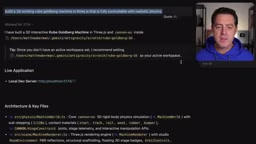
The result was impressive. The scene easily ran at 60 FPS in the browser, packed with numerous 3D buildings and animations. The model even automatically provided theme-switching functionality—2049 amber tones, bio-synthetic green, red syndicate, and other visual styles—along with adjustable neon glow intensity, a toggle for ultra-high quality, control over sky traffic density, and camera modes (auto-director, cockpit HUD, etc.).
In the developer's words, this came from "a very simple prompt" and took about 30 minutes.
Three.js is currently the most mainstream WebGL (Web Graphics Library) wrapper library, running in the browser environment and using JavaScript to directly call the GPU for 3D rendering without needing extra plugins. It provides complete abstractions for scene graphs, cameras, lighting, materials, shaders, and more, allowing developers to build complex three-dimensional interactive scenes with just a small amount of code. The 60 FPS (frames per second) mentioned in the article is the core metric for measuring rendering smoothness: the human eye perceives continuous animation above 30 FPS, while 60 FPS is the target frame rate for most browser animations. Because Three.js's lighting model is primarily real-time rasterization and lacks physically accurate calculations at the ray-tracing level, content generated by the model struggles to achieve photo-realism—this is precisely the technical root of why Argon remains limited even under "hyper-realistic" prompts in the article. Understanding this context helps judge the true boundaries of the 3D performance in the review: it's more a limitation of the runtime environment than of the model itself.
Rube Goldberg Machine Simulation
The second test was to build a fully controllable 3D Rube Goldberg machine with realistic physics. Argon not only completed it but also built in multiple themed levels—living room, Grand Canyon, Las Vegas, clock laboratory, Kyoto temple.
The physics simulation performed quite well: domino chains toppling, pinball effects triggering, balls rolling and driving the entire system. Although there were some clipping issues, the overall physics logic was satisfactory. The developer noted that when given follow-up prompts like "make it more complex" or "add more realistic levels," the model understood and executed them accurately.
But he also acknowledged a key limitation: no matter how much the model was prompted to be "hyper-realistic," Argon could not achieve photo-realism. This may be constrained by the capabilities of Three.js in the browser—if switched to Unreal Engine or Blender, the results could be very different.
Coding Ability and Benchmark Tests
Knowledge Work Benchmark: A Major Leap
In the knowledge work benchmark provided by partner Box, Argon achieved a 14% overall jump compared to the previous generation Gemini 3.1, with the total score rising from 71% to 85%. This test covers real-world scenarios such as data extraction, cross-document linking, law, life sciences, and healthcare.
Specifically, significant improvements appeared in sub-industry benchmarks such as spreadsheet evaluation, PDF extraction, and presentation and image processing.
The Knowledge Work Benchmark was built by cloud content management platform Box specifically to evaluate AI models' comprehensive capabilities in real enterprise scenarios, rather than traditional academic Q&A. Its test tasks include extracting key fields from unstructured PDFs, comparing and linking information across multiple documents, understanding conditional logic in legal clauses, parsing professional literature in life sciences and healthcare, and performing data cleaning, formula derivation, and chart generation in spreadsheets. The difficulty of such tasks lies in the fact that documents are often messy, information is scattered across multiple sources, and multi-step reasoning is required to reach correct conclusions—very different from pure knowledge recall. Box introduced this benchmark because what enterprise customers care about most is not whether a model can answer exam questions, but whether it can reliably replace manual work in document-intensive tasks. Therefore, the 14% overall jump is not just a numerical improvement; it means the model's usability in actual office automation scenarios has seen a substantial boost.
Coding Benchmarks: Solidly in the Top Tier
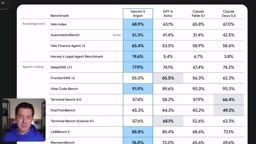
In the comparison chart compiled by the developer (including Astra, Fable 5.1, Opus 5.5, and later Muse Wonder and GPT 6.1 Sol), Argon's performance was as follows:
- Deep Sweep: 77.9%, second only to Muse Wonder Full's 79%, ranking second
- Vibe Code Bench: 91.9%, ranking first
- Terminal Bench: 57%, behind Opus 5.5's 66.4%, and also below Muse and Astra
- OS World (computer control ability): 69%, close to GPT 6.1 Sol's 71.4%
- Agent's Last Exam: 39%, slightly above Opus's 38%
These data show that Argon stands firmly at the frontier on most key benchmarks, but it is not first in every dimension.
Excel Clone: A Runnable Result in 20 Minutes
A rather convincing test was having Argon clone Excel. Since no loop goal was set, the model ran for only about 20 minutes.
The result was a browser-based Excel interface with a fairly complete UI and UX. Double-clicking a cell and entering the formula =1+2 calculated correctly, and operations like drag-fill, row highlighting, and SUM functions were basically usable. The developer commented: "Considering it was only 20 minutes, this runs pretty well—it's crazy just thinking about it."
From this, he offered a broader judgment: the future cost of software will approach zero. If a company's moat is merely lines of code, that is very dangerous—you need to offer something that the latest models cannot easily replicate.
Fall Guys Clone and Game Development Test
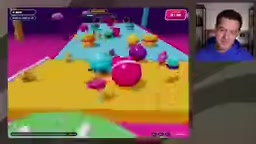
In the game development test, Argon generated a playable game from a simple prompt like "build a complete parody of a Fall Guys clone."
The developer said he iterated several times and set the goal of "keep iterating until there are 10 complex levels and the game is genuinely fun." The final version included complete level design, character collision, physics, and even decent ending animations. During testing, he even took first place.
However, he also pointed out issues: early versions had screen flickering, and some collision detection was not accurate enough (such as collision calculations when spheres roll). But as testing progressed, the model itself improved through iteration.
3D Capability Comparison: Not the Strongest, but Already Good
This is the most critical judgment in the entire review.
The developer clearly stated: Argon is stronger than Meta's newly released Muse Wonder in 3D, but not as good as Claude's Opus and Astra.

Taking an ocean scene rendered in Unreal Engine as an example, the ship and wave details generated by Argon "look good," but the ocean feels repetitive, and it cannot dive underwater—while other models he tested could do so.
By contrast, Meta's Alexander Wang (AI lead) publicly admitted that the team "forgot or did not conduct reinforcement learning training for the model on 3D," which in hindsight was a mistake. But in other areas (such as coding), Muse Wonder remains strong.
This comparison reveals a fact: the capability gap between frontier models is shifting from "who is stronger" to "who is stronger in which area."
Unreal Engine is a professional-grade real-time 3D creation platform developed by Epic Games, widely used in AAA games, virtual film production, and architectural visualization. Compared with Three.js, UE includes physically based rendering (PBR), dynamic global illumination (Lumen), nanoscale geometric detail (Nanite), and complex water and particle systems, enabling near-cinematic image quality. The "Unreal Engine-rendered ocean scene" used for comparison in the article leverages precisely these advanced features, thus placing higher demands on the model's 3D spatial understanding and code generation capabilities—the model needs to generate correct material parameters, lighting configurations, and wave simulation logic, not just place geometry. The developer pointed out that Argon could not "dive underwater," very likely because the model failed to correctly generate camera penetration below the water surface and volumetric fog logic. This also explains why the same model performs so differently in Three.js and Unreal environments: the stronger the environment's capabilities, the stricter the test of the model's spatial reasoning.
Release Rhythm and Industry Landscape
Argon's release approach was somewhat unusual. Google announced benchmark tests and model information several weeks in advance, but did not immediately open access; instead, it first let early testers and security researchers try it.
From a competitive landscape perspective, Google, Meta, OpenAI, and Anthropic now all have their own frontier models. As the developer said: "When competition is sufficient, the winner is the consumer—we get better models, cheaper models, faster models."
Conclusion: Google Is Back at the Table
Gemini 4 Argon proves that Google has returned to the center of frontier model competition. It leads its predecessor by a wide margin on the knowledge work benchmark, stands firmly in the top tier on coding tasks, and can generate impressive 3D scenes and playable games from simple prompts.
But its 3D capability still lags behind Opus and Astra, and it is not the champion on key coding metrics such as Terminal Bench. This does not prevent it from being an excellent frontier model, but it also shows that no single company can dominate every dimension.
For developers, this may be the best era: more choices, lower costs, and continuously rising capability boundaries.
One-line Summary
Gemini 4 Argon hands-on testing shows Google has returned to the top frontier tier with strong knowledge work and coding performance, but 3D capability still trails Claude Opus and Astra.
Paragraph Summary
A developer who gained early access tested Google Gemini 4 Argon across multiple real-world projects, including a cyberpunk 3D scene, a Rube Goldberg machine, an Excel clone, and a Fall Guys game clone. The results show that Argon improved 14% over its predecessor on the knowledge work benchmark (71%→85%), ranked first on Vibe Code Bench at 91.9%, and can generate runnable complex projects in 20-30 minutes from simple prompts. However, its 3D graphics capability is clearly weaker than Claude Opus and Astra, hyper-realistic rendering never reaches the standard, and Terminal Bench is only 57%, behind Opus 5.5's 66.4%. Overall, Google has returned to the center of frontier competition, but no model can dominate every dimension.
Related articles

Cursor AI Programming in Practice: Build a Student Management System from Scratch in 30 Minutes
A Bilibili creator demonstrates Cursor AI programming: generating a student management system in 30 minutes with natural language. Details on Agent mode, Claude selection, prompt techniques, and thresholds.

Top 20 AI Coding Tools Ranking: From Rock-Solid to Lackluster, a Scored Matrix
Bilibili creator releases top 20 AI coding tools ranking, tiered T0–T4 from rock-solid to lackluster, with Claude Code and Codex tied at T0. This article details the scoring dimensions (capability, reliability, robustness, durability, cost, domestic availability) and tool performances to help developers choose the right AI coding assistant.

Vibe Coding Systematic Tutorial: Master AI-Assisted Programming from Zero
A three-month Vibe Coding tutorial from a Bilibili creator covering Codex, ClaudeCode, and Cursor, from core logic to commercial project practice for beginners.