Gemini 4 Argon Lands on Anti-Gravity: How Multi-Agent Systems Are Reshaping the Development Workflow

Anti-Gravity integrates Gemini 4 Argon, using multi-agent loops to turn text prompts into 3D worlds and playable hardware prototypes.
After Google's agent-first development platform Anti-Gravity integrated the Gemini 4 Argon model, it showcased several official demos: through multi-agent looping workflows and visual critique loops, it generates an explorable 3D pagoda world from a text prompt in minutes; with Blender MCP and NanoBanana, it turns a desk photo into a playable 3D racing game; and it completes end-to-end design of a handheld retro game console's bill of materials, wiring diagram, enclosure, and AI game engine. The article notes that the core of these demos is loop iteration and a tool-calling architecture rather than a single all-capable model. The hardware case should be understood as a prototyping efficiency tool rather than a mass-production replacement. Argon is available through three entry points: desktop app, CLI, and Android Studio. Its differentiation lies in multi-agent coordination and visual feedback loops, but actual stability and the burden of human review remain to be verified.
Google is pushing "writing code" into a new phase. After its agent-first development platform Anti-Gravity brought in the Gemini 4 Argon model, several official demos point to the same trend: the developer's role is shifting from line-by-line implementation to describing goals and reviewing results.
According to an official demo video reposted on Bilibili, Anti-Gravity paired with Argon can turn a text prompt into an explorable 3D world in minutes, and can turn a photo of a desk into a playable 3D racing game. These demos may not represent the everyday standard of engineering work, but they are enough to show that multi-agent orchestration is moving from concept to a workable product form.
From Text to Explorable World: The Multi-Agent Looping Workflow
The most intuitive example in the demo is a 3D pagoda model. The team did not build it by hand; instead, they used a multi-agentic looping workflow: Anti-Gravity coordinated multiple specialized sub-agents, iterating repeatedly through visual critique loops, and Argon autonomously shaped the main structure of the building along with its surrounding environment.
The key here is not that "AI can model" but the loop mechanism. After a sub-agent produces a result, a visual critique stage scores it and points out problems, then it returns to the generation stage for correction, forming a closed loop. This structure turns the luck of a single generation into a controllable iterative process—which is also the general approach current agent systems use to improve success rates on complex tasks.
According to the official statement, it takes only minutes to go from a text prompt to an explorable world.

Visual critique loop is a feedback mechanism in agent systems: a model with visual understanding capability (or a set of review rules) renders, screenshots, or compares features of the generated result and outputs structured critique opinions (such as "unbalanced structural proportions" or "missing materials"), which are then fed back as input constraints for the next round of generation. Compared with pure text feedback, visual critique can capture problems in geometry, lighting, and spatial relationships that are hard to describe fully in words, making it especially suitable for tasks whose deliverables are visual, such as 3D modeling, UI layout, and game scenes. Its effectiveness depends on the design of the criteria in the critique stage; if the criteria are too coarse, the loop may converge to a local optimum or even oscillate repeatedly.
A Desk Photo Becomes a Racing Game
Another demo is closer to everyday scenarios: given a photo of a desk, Argon has Anti-Gravity orchestrate sub-agents, invoking Blender MCP and NanoBanana, to turn the everyday objects on the desk into a playable 3D racing game.
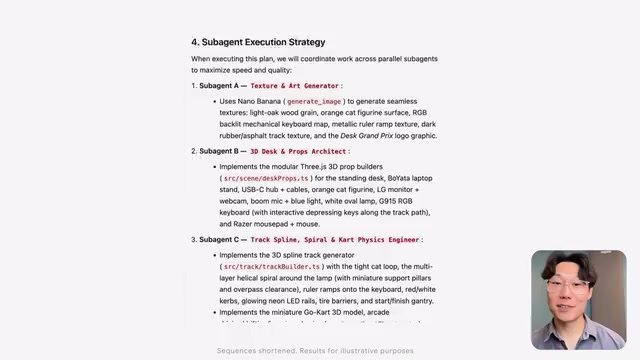
This pipeline is worth breaking down. Blender MCP means external 3D tools are connected to the agent's tool-calling system through the MCP protocol, while NanoBanana handles image-related generation. In other words, Anti-Gravity does not aim to have one model do everything; instead, it lets the orchestrating agent treat professional tools as callable capability units. For developers, this suggests a more realistic path to implementation: rather than waiting for an all-capable model, expose the existing toolchain to agents in a standardized way.
MCP (Model Context Protocol) is an open protocol for exposing external tools, data sources, and services to large models or agents in a standardized way, so that they can discover and invoke these capabilities without writing separate adapter code for each tool. In this article's scenario, Blender MCP is equivalent to encapsulating Blender's modeling, material, and rendering operations into a set of functions callable by the agent, based on which the orchestrating agent arranges the process of "reading the photo—generating assets—building the scene—exporting playable content." The value of MCP lies in decoupling: model capability upgrades and toolchain expansion can evolve independently, and developers only need to maintain a consistent interface at the protocol layer.
From 3D Rendering to Playable Hardware: The Boundaries of End-to-End Design
The most ambitious project is the handheld retro game console. The team says the design was completed end-to-end in Anti-Gravity: generating the bill of materials, wiring diagram, enclosure design, and an AI game engine, ultimately moving from 3D rendering to a playable piece of hardware.

Hardware design involves electrical constraints, structural tolerances, and supply chain selection, with far less room for error than software. What the official demo proves is that the process can be connected, not that every stage reaches mass-production quality. It is more accurate to understand it as an "efficiency tool for the prototyping stage" than as a "replacement for hardware engineers."
In addition, the demo also shows converting a basic 2D tile set into a 3D world running on a Pixel phone, indicating that cross-form migration on the output side is also covered.
The bill of materials (BOM) and wiring diagram are two basic deliverables in hardware design. The BOM lists all components, models, quantities, and supplier information required for a product, directly determining cost and procureability; the wiring diagram describes the electrical connections between modules, including power, signal, and ground routing. The significance of AI generating these two types of documents lies in shortening the upfront preparation time of the prototyping stage, but its output must be manually checked—if details such as pin definitions, voltage levels, and package dimensions are wrong, the result may range from being unable to assemble to damaging components. Therefore, end-to-end generation is closer to "generating a reviewable first draft" rather than a design that can go directly into production.
Available Channels and the Competitive Landscape
Argon is rolling out through three entry points: the Anti-Gravity desktop app, the Anti-Gravity CLI, and Anti-Gravity in Android Studio. The desktop app is aimed at visual orchestration, the CLI at developers accustomed to scripting, and the Android Studio integration directly taps into mobile developers' existing workflows.
For comparison, it is worth noting that agent-first development platforms have become a contested battleground for many vendors, each packaging model capabilities, tool calling, and critique loops into an integrated environment. Anti-Gravity's differentiation lies in emphasizing multi-agent coordination and visual feedback loops, which precisely correspond to task types such as 3D content and games that are hard to verify with pure text.
For developers, the more practical question in the short term is: can such platforms reliably reproduce the demo results, and in real projects, how much of the burden of human review is actually reduced?
One-line Summary
Anti-Gravity brings in Gemini 4 Argon, using multi-agent loops to turn text prompts into 3D worlds and playable hardware prototypes.
Paragraph Summary
After Google's agent-first development platform Anti-Gravity brought in the Gemini 4 Argon model, it showcased several official demos: through a multi-agent looping workflow and visual critique loops, it generates an explorable 3D pagoda world from a text prompt in minutes; with Blender MCP and NanoBanana, it turns a desk photo into a playable 3D racing game; and it completes end-to-end design of a handheld retro game console's bill of materials, wiring diagram, enclosure, and AI game engine. The article points out that the core of these demos is loop iteration and a tool-calling architecture, rather than a single all-capable model. The hardware case should be understood as a prototyping efficiency tool rather than a mass-production replacement. Argon is available through three entry points: the desktop app, the CLI, and Android Studio. Its differentiation lies in multi-agent coordination and visual feedback loops, but actual stability and the burden of human review remain to be verified.
Related articles

AI Abuse Alert: Reports of Child Sexual Abuse Material Surge 8,400% in Two Years
Hacker News reports show AI-related child sexual abuse material reports rose 8,400% in two years. This article analyzes how generative AI lowers the barrier to producing illegal content, the dilemma facing platform detection and legal regulation, and feasible directions for technical countermeasures.

Can Task-Specific 4B Models Replace Large Models?
A developer training Qwen3.5-4B-3D-Coder and LFM2.5-350M finds task-specific small models exceed expectations on 3D scene generation. Insights on epochs, SFT vs RL cost, and full fine-tuning on consumer hardware.
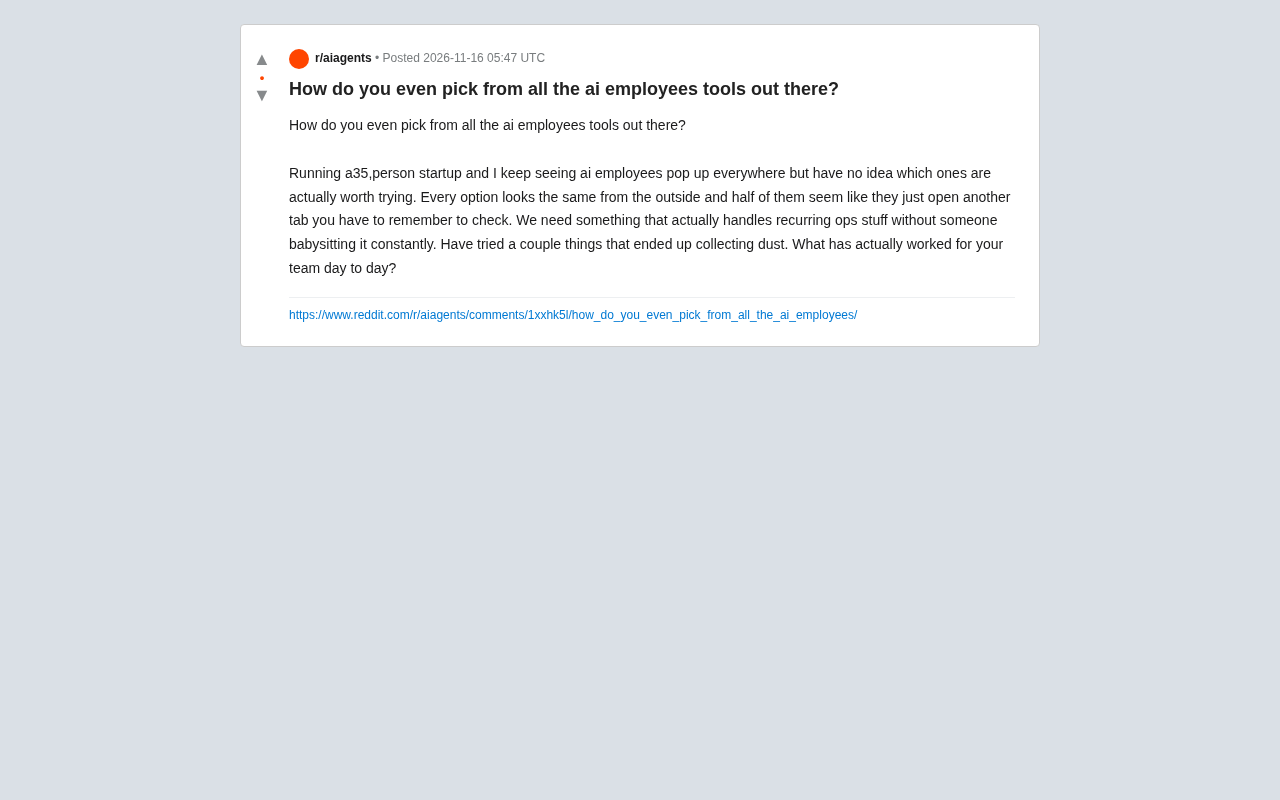
AI Employee Tools Are Everywhere — How Can a 35-Person Startup Pick the Ones That Actually Work?
A 35-person startup struggles with too many AI employee tools. Drawing on real community experience, this article distills three hard criteria—unattended operation, integration depth, and verifiability—to help you pick tools that actually work and avoid shelfware.