Gemini 4 Carbon Lands on AI Gateway: 1M Context + 50% Off

Gemini 4 Carbon hits AI Gateway with 50% off, featuring 1M context and agentic tasks.
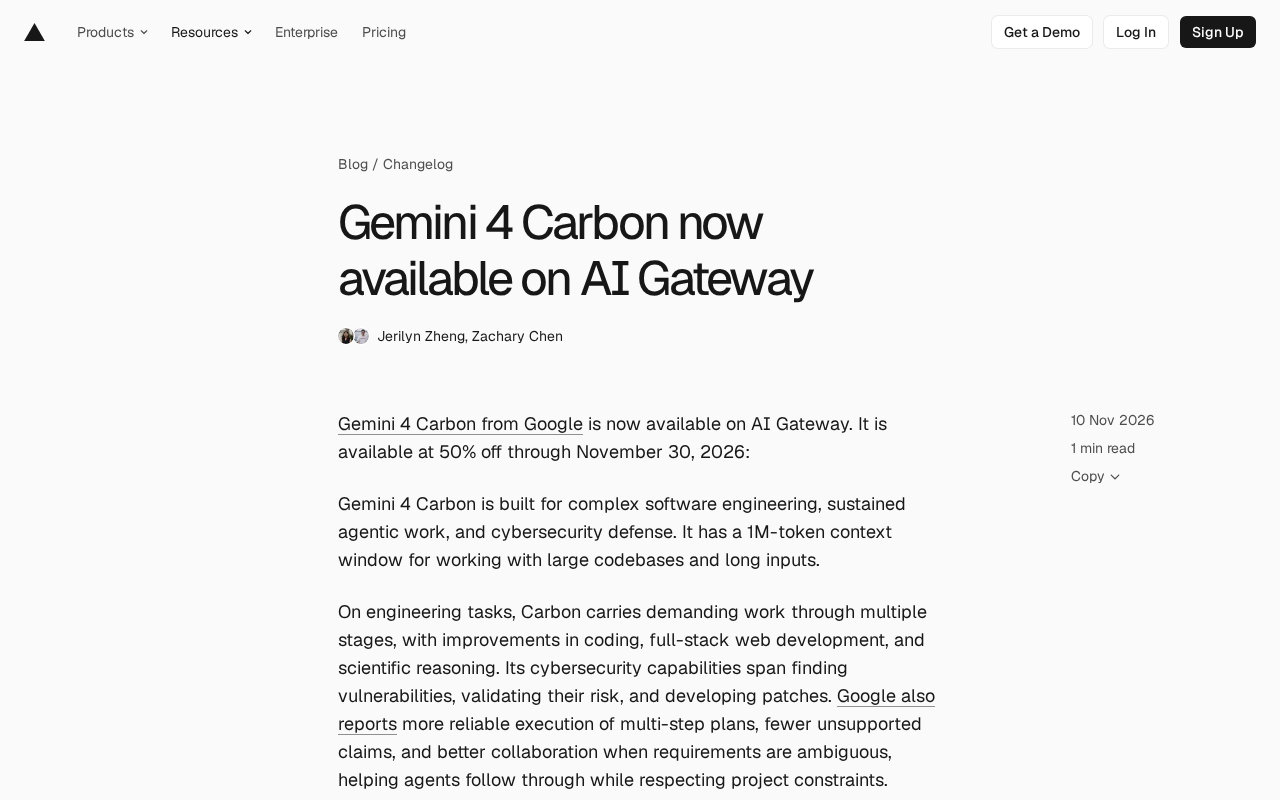
Google's Gemini 4 Carbon is now available on AI Gateway with a 50% discount through November 30, 2026. It targets complex software engineering, sustained agentic tasks, and cybersecurity defense, featuring a 1 million token context window that handles large codebases and long inputs in one pass. Google says it improves multi-step plan execution, reduces unsupported claims, and collaborates better under ambiguous requirements. Developers can call it via AI SDK, Claude Code, fx, and Chat Completions under the model name google/gemini-4-carbon. AI Gateway offers a unified API, usage and cost tracking, retries, and failover, with no markup and no platform fees—giving teams a low-cost trial window.
Google's Gemini 4 Carbon model is now available on AI Gateway, and it comes with a rather attractive promotion: a 50% discount through November 30, 2026. For developers working on complex software engineering, sustained agentic tasks, and cybersecurity defense, this is an option worth paying attention to.
Model Positioning: Built for Complex Engineering and Agentic Work
According to the official description, Gemini 4 Carbon targets three main scenarios: complex software engineering, sustained agentic work, and cybersecurity defense. It offers a 1 million token context window, meaning it can process large codebases and long inputs in a single pass without frequent truncation or segmentation.
On engineering tasks, Carbon is claimed to carry demanding tasks through multiple stages, with improvements in coding, full-stack web development, and scientific reasoning. Its cybersecurity capabilities cover the full workflow of discovering vulnerabilities, validating risk, and developing patches.
Google also reports that the model is more reliable at executing multi-step plans, makes fewer unsupported claims, and collaborates better when requirements are ambiguous—helping agents keep progressing on tasks while adhering to project constraints.
Context window refers to the maximum total number of input and output tokens a model can process in a single request. A token is the basic unit of text a model processes; roughly speaking, one token in English is about 0.75 words, while in code it relates to character count. A 1 million token window means the model can "see" hundreds of thousands of lines of code or hundreds of pages of documentation at once, avoiding information truncation in tasks like cross-file refactoring and long-document analysis. However, context window size does not directly equate to how efficiently a model uses long inputs—the industry's common "needle in a haystack" tests show that even with a sufficiently large window, a model's recall of information in the middle may decline. Therefore, when evaluating such models, beyond the window number, pay attention to their actual performance in locating key information and maintaining consistency across long contexts.
Agent refers to a system driven by a large model that can autonomously plan steps, call tools (such as reading and writing files, executing commands, accessing the network), observe results, and iterate until the goal is achieved. Unlike single-turn Q&A, agentic tasks typically span multiple steps with continuously changing state, placing higher demands on the model's instruction following, error recovery, and multi-step plan reliability. "Sustained agentic work" emphasizes the model's ability to stay on constraints and avoid fabricating progress over long, multi-stage tasks.
Access: Unified Model Name and Multi-Tool Support
Using Gemini 4 Carbon is straightforward; the model name is google/gemini-4-carbon. Developers can call it via the AI SDK, and the example code shows how to make a request and stream results using the streamText function:
import { streamText } from 'ai';

const result = streamText({
  model: 'google/gemini-4-carbon',
  prompt: 'Write a TypeScript helper that safely parses JSON and returns a fallback.',
});

for await (const text of result.textStream) {
  process.stdout.write(text);
}
In addition to the AI SDK, the model supports interfaces such as Claude Code, fx, and Chat Completions. To use it in coding agents like Claude Code, Codex, or Cursor, install the latest Vercel CLI and run npx vercel ai-gateway setup, then select google/gemini-4-carbon in the agent.
AI SDK is an open-source TypeScript library from Vercel that provides a unified calling interface across model providers. Developers only need to change the model string to switch between OpenAI, Anthropic, Google, and other models without rewriting their calling logic. The streamText in the example is one of the AI SDK's core functions, used to initiate streaming generation: the model's returned text is output incrementally through the textStream async iterator, suitable for building chat interfaces and other scenarios that require low-latency first-token response.
Chat Completions is the chat completion API specification established by OpenAI, now the de facto industry standard, with most model providers offering compatible endpoints. This means application code originally written for OpenAI may be able to call other models directly by changing only the base URL and model name. Claude Code is Anthropic's terminal coding agent, while Codex and Cursor are different coding assistant products—they typically support custom model endpoints, so third-party models can be accessed through AI Gateway.
The Value of AI Gateway: Unified API and Cost Control
AI Gateway itself provides a unified API for calling models, tracking usage and costs, and configuring retries, failover, and performance optimizations to achieve higher service availability than providers offer on their own. It includes built-in custom reporting, Zero Data Retention support, API key budgets, routing rules, and more.
On pricing, AI Gateway reflects provider pricing without markup and charges no platform fees for inference, including Bring Your Own Key (BYOK) requests. This means developers can manage multiple models on one platform while keeping costs transparent.
For teams evaluating Gemini 4 Carbon, the 50% discount provides a low-cost trial window, while the million-token context and agent-oriented optimizations are worth validating in real engineering workflows.
Failover and retry are key mechanisms for improving availability at the gateway layer. When a provider endpoint times out, is rate-limited, or returns a 5xx error, the gateway can automatically retry the request or switch to a backup provider if multiple upstreams are configured, reducing failures perceived at the application layer. Zero Data Retention means the provider commits not to store request and response content for training or log retention, which is especially important for teams handling sensitive code or with strict compliance requirements. BYOK (Bring Your Own Key) means developers use their own API keys obtained from the model provider and forward requests through the gateway, in which case the gateway typically handles only routing and observability and does not bill for inference. Understanding these mechanisms helps assess the gateway's real value for stability and compliance beyond cost transparency.
Key Takeaways
- Gemini 4 Carbon is now available on AI Gateway, with a 50% discount through November 30, 2026.
- The model targets complex software engineering, sustained agentic work, and cybersecurity defense, with a 1 million token context window.
- It can be called via AI SDK, Claude Code, fx, Chat Completions, and other interfaces, with the model name
google/gemini-4-carbon. - AI Gateway provides a unified API, usage tracking, retries, and failover, with no markup and no platform fees.
Related articles
How Do Cursor, Devin, TRAE, and Copilot Compare on Price? Calculate Your Credits Before You Compare Monthly Fees
Side-by-side comparison of individual and team pricing for Cursor, Devin Desktop, TRAE, and Copilot, breaking down credit rules, third-party model inclusion, overage billing, and practical methods for measuring usage before paying, setting spending caps, and choosing the right tool.
Copilot Retires Three Models: Pro Users Left With Only One Alternative
GitHub Copilot retires Claude Opus 4.8, Claude Opus 5, and GPT-5.6 Tera on Nov 16 across Chat, code completion, and Agent mode. Pro users have only GPT-6 Luna left; Legacy annual plans miss Opus 5.5; admins must enable replacements manually.
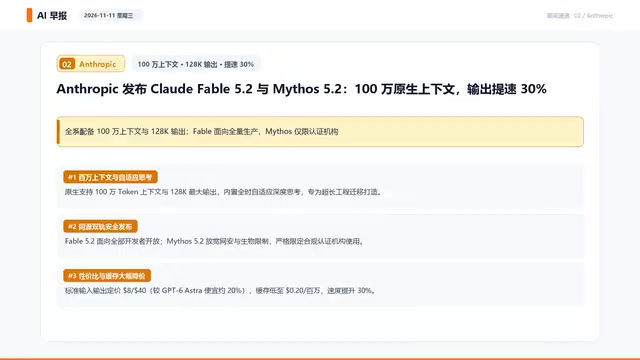
Gemini 4 Carbon Arrives: The LLM Race Enters the Era of Million-Token Context and Trillion-Parameter Open Source
Google launches Gemini 4 Carbon and multi-agent tool Swarm; Anthropic debuts million-context Fable 5.2 and Mythos 5.2; OpenAI releases security-focused GPT-6 Cyber; Mistral and Kimi open-source trillion-parameter models — the LLM race accelerates across the board.