Gemini Managed Agents API Update: Environment Hooks and Free Tier Fully Explained

Gemini Managed Agents API adds environment hooks, model selection, free tier, and default model upgrades.
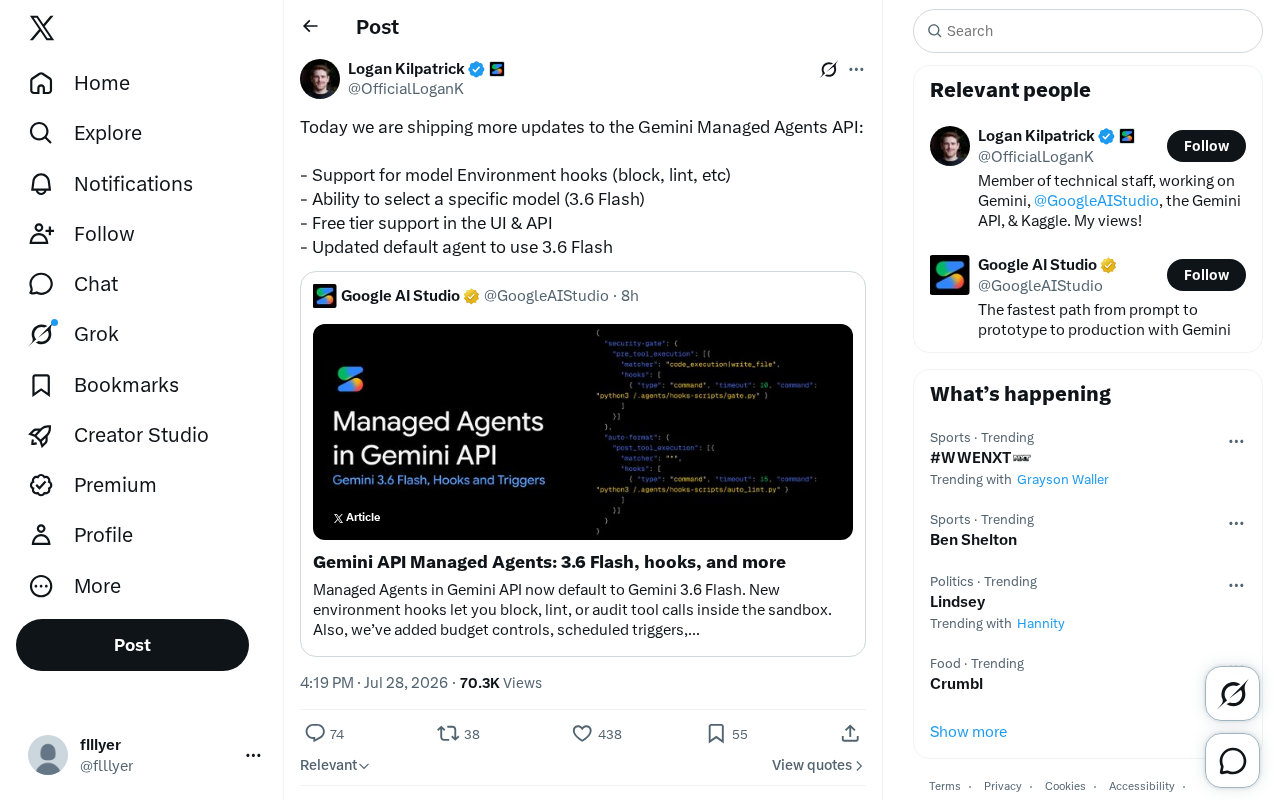
Google's Gemini Managed Agents API receives four key updates: environment hooks (block/lint) for runtime safety governance, explicit model selection supporting Gemini 3.6 Flash, free tier access on both UI and API, and a default model upgrade to 3.6 Flash. Together, these changes enhance controllability, flexibility, and accessibility for AI Agent developers while reflecting Google's competitive strategy in the rapidly evolving Agent platform landscape.
Gemini Managed Agents API Receives Major Updates
Google recently announced a series of new feature updates for the Gemini Managed Agents API, further strengthening the controllability, flexibility, and accessibility of this managed AI agent platform. The updates address several areas developers care most about: environment control, model selection, free tier support, and default model upgrades. For teams exploring AI Agent application deployment, these improvements lower the barrier to entry while providing more fine-grained execution control.
What Is the Managed Agents API
Before diving into the updates, it's worth understanding what the Managed Agents API is designed to do. "Managed agents" refers to AI Agent services where the platform provider (Google) handles the underlying runtime, model scheduling, and execution environment management. Developers don't need to build complex agent orchestration frameworks themselves—they can let models autonomously execute multi-step tasks such as calling tools, reading and writing files, running code, and more. The core value of such services lies in encapsulating the engineering complexity of Agents, allowing developers to focus on business logic.
To appreciate the value of managed agents, you need to understand the basic execution paradigm of AI Agents. A typical Agent follows an "Observe-Think-Act" loop: it first perceives the current environment state, then uses a large language model for reasoning and planning, and finally calls external tools or executes actions to change the environment before entering the next iteration. This seemingly simple loop is extremely complex in engineering practice—you need to manage tool registration and scheduling, handle execution timeouts and error recovery, maintain conversation context windows, implement sandbox isolation, and more. Self-built solutions (using frameworks like LangChain, CrewAI, etc.) offer flexibility but require teams to bear the costs of infrastructure operations, model version management, and security isolation. Managed solutions hand all this underlying complexity to the platform—developers only need to define the Agent's goals, available tools, and behavioral constraints through APIs, while the platform handles reliable execution of the entire Agent loop. This division of labor is similar to the evolution from self-managed servers to serverless cloud functions—trading a moderate degree of control granularity for a significant boost in engineering efficiency.
Detailed Analysis of Four Core Updates
This update includes four aspects, spanning dimensions from execution security to cost accessibility.
Environment Hooks: A Key Mechanism for Agent Safety Governance
The most noteworthy addition is support for environment hooks, including operations like block and lint. This feature allows developers to insert custom interception and inspection logic during Agent execution.
- block: Can intercept when an Agent attempts to perform dangerous or non-compliant operations, such as prohibiting access to sensitive directories or preventing execution of specific commands. This provides critical security guarantees for Agents in production environments.
- lint: Automatically performs static analysis when an Agent generates or modifies code, ensuring output conforms to coding standards or quality requirements.
The introduction of environment hooks means Agents are no longer completely black-box automated executors. Developers can intervene at critical points, implementing "human-in-the-loop" or "rules-in-the-loop" governance models. This is essential for deploying AI Agents in real business scenarios—after all, the more autonomous the system, the more reliable its guardrails need to be.
From a technical evolution perspective, environment hooks represent one implementation of "Guardrails" mechanisms in the AI safety domain. Early LLM application security relied primarily on input/output filtering—setting system instruction constraints at the prompt level or performing content moderation after model output. But the security challenges in Agent scenarios are far more complex than single-turn conversations, because Agents have actual execution capabilities (file operations, code execution, network requests), and loss of control could cause irreversible damage. The industry has therefore progressively developed multi-layered governance architectures: the innermost layer is the model's own alignment, the middle layer is runtime guardrails (such as environment hooks), and the outermost layer is human approval workflows. "Human-in-the-loop" refers to pausing execution at critical decision points and waiting for human confirmation before proceeding; "Rules-in-the-loop" replaces human judgment with predefined automated rules, maintaining execution efficiency without sacrificing safety. Environment hooks are a classic implementation of the latter, enabling developers to define "what operations under what conditions should be blocked or corrected" in a declarative or programmatic way, striking a balance between autonomy and controllability.
Support for Selecting Specific Models (Gemini 3.6 Flash)
The update adds the ability to specify a particular model, with users now able to choose Gemini 3.6 Flash. While this change seems simple, it addresses developers' needs for determinism and cost control.
Previously, managed agents might have used platform-default scheduled models, making it difficult for developers to precisely predict performance characteristics and costs. With explicit model selection now available, teams can proactively choose the most appropriate model version based on task complexity, latency requirements, and budget. The Flash series is known for its low latency and low cost, making it suitable for high-concurrency, lightweight Agent tasks.
Google's Gemini model family uses a tiered architecture design, offering differentiated performance-cost combinations for different use cases. At the top tier, the Pro series (such as Gemini 2.5 Pro) targets tasks requiring deep reasoning, long-context understanding, and complex multi-step planning—with larger parameter counts and stronger reasoning capabilities, but correspondingly higher latency and per-call costs. The Flash series uses techniques like model distillation and architectural optimization to dramatically compress inference latency and computational costs while retaining core capabilities, typically achieving several-fold speed improvements and significant cost reductions. For Agent scenarios, this distinction is particularly important: an Agent may need to make dozens or even hundreds of model calls to complete a single task (each tool selection, parameter generation, and result parsing requires one inference call), so per-call cost and latency get amplified. Choosing Flash means developers can keep the Agent's total execution cost and response time at reasonable levels within acceptable quality bounds—especially critical for real-time applications facing end users.
Free Tier Support: Start AI Agent Development at Zero Cost
Google has now opened free tier support on both the UI and API sides. This is a significant step toward lowering barriers and expanding the developer community.
The significance of the free tier goes beyond "not spending money"—it enables developers to perform prototype validation and technical evaluation without cost pressure. For individual developers, startup teams, and engineers conducting technology evaluations, the free tier dramatically reduces the cost of experimentation and makes the Gemini Agent ecosystem more competitive. In today's increasingly fierce competition among AI Agent platforms, accessibility is often the deciding factor for developer retention.
From an industry perspective, free tier strategies have become standard practice for AI platforms competing for developers. OpenAI's Assistants API charges per token with no free quota, Anthropic's Claude API similarly uses a pure pay-per-use model, and Google had already provided generous free quotas on the basic Gemini API (a certain number of free calls per minute). However, a free tier for Agent APIs faces greater cost pressure, since a single Agent task involves multiple rounds of model calls and compute resource occupation, and the platform needs to maintain sandbox environments for each Agent session. Google's decision to open a free tier at this stage is essentially a "subsidize short-term to build long-term ecosystem" strategy—once developers complete prototype validation on a platform and accumulate tool integration code, migration costs rise significantly. This lock-in effect gives early free-tier strategies long-term commercial value. At the same time, the free tier provides Google with abundant real-world Agent usage pattern data, helping optimize model performance in Agent scenarios.
Default Agent Upgraded to Gemini 3.6 Flash
Finally, the platform has updated the default agent to use Gemini 3.6 Flash. This means that even without any configuration, newly created Agents will run on this updated version by default, achieving better performance-cost balance.
Default model upgrades typically reflect the platform's confidence in that model's stability and overall performance. Setting 3.6 Flash as the default also signals Google's intent to guide most users toward this choice that balances speed and quality.
Strategic Intent Behind the Updates
Looking at these four updates together, it's clear that Google is refining the productization of the Gemini Agent platform across multiple dimensions:
- Controllability: Environment hooks address Agent execution security and compliance;
- Flexibility: Model selection gives developers agency over performance and cost;
- Accessibility: Free tier and default model upgrades lower the entry barrier;
- Continuous iteration: The team maintains a high-frequency feature delivery cadence.
This rapid iteration posture also reflects the intense competition in the current AI Agent space. Whether it's OpenAI's Assistants/Agents capabilities or Anthropic's tool-use ecosystem, everyone is competing for developer mindshare. The core competitive advantage of managed solutions lies precisely in packaging complex Agent engineering into ready-to-use services.
The current AI Agent platform competition exhibits three distinctly different technical paths. OpenAI takes the "all-in-one" approach—its Assistants API (and subsequent evolutions like the Responses API and Agents SDK) provides integrated capabilities including code interpreter, file retrieval, and function calling, attracting developers through deep integration with the ChatGPT ecosystem. Anthropic adopts a "capability composition" strategy—its Model Context Protocol (MCP) attempts to establish an open standard for tool calling, while Claude's Computer Use and Tool Use capabilities let models interact directly with computing environments. Google's Gemini Agent approach emphasizes platformization and enterprise-grade features—leveraging Google Cloud infrastructure to provide more comprehensive permission management, audit logging, and environment isolation capabilities, while integrating with enterprises' existing ML workflows through Vertex AI. Additionally, the open-source camp shouldn't be overlooked—Microsoft's AutoGen, LangChain's LangGraph, and other frameworks provide flexible alternatives for teams that prefer self-built solutions. In this competitive landscape, Google's choice to simultaneously push forward on both safety governance (environment hooks) and accessibility (free tier) addresses enterprise customers' demands for production-grade deployment while also courting individual developers still in the evaluation phase.
Practical Implications for Developers
For developers building AI Agent applications, the practical benefits of this update are clear. First, environment hooks make Agent deployment in production environments more trustworthy—you can lint before code commits and block before dangerous operations. Second, the free tier and model selection reduce the cost of technical evaluation to nearly zero, allowing confident comparison of different models' actual performance.
Developers evaluating the platform should focus on two key points: first, the programmability of environment hooks—whether you can flexibly define your own interception rules; and second, the actual quality of Gemini 3.6 Flash on specific tasks, especially in complex Agent scenarios requiring multi-step reasoning.
Conclusion
While each individual feature in this round of Gemini Managed Agents API updates may seem incremental, together they demonstrate Google's clear thinking on the AI Agent productization path: maintaining autonomous execution capabilities while giving developers sufficient control and economic viability. As governance mechanisms like environment hooks mature, managed AI Agents have moved one step closer to truly production-grade applications. For teams focused on AI Agent deployment, this is a platform worth continuing to follow.
Related articles

LynnReal-Omni: 32B Unified Video Diffusion Model Goes Open Source with Multi-Task Coverage in Four Steps
LynnReal-Omni is a 32B unified video diffusion model on MiniMax H3, covering text-to-video, pose guidance, style transfer, restoration in 4 steps. Flash version generates 540p video in 377ms on one H100.

Anthropic Co-Founder: AI 'Kill Switch' May Need to Be Mandatory by Law
Anthropic's co-founder tells the BBC that AI 'kill switches' may need to be legally mandated. We analyze the industry logic, technical challenges, and the tension between regulation and innovation.

The AI Data Center Boom Is Colliding With Cities Scarred by Heavy Industry
The AI data center boom is clashing with post-industrial communities. Philadelphia's case reveals structural conflicts between AI growth, energy use, water, and environmental justice.