Getting Started with AI Agent Development: A Learning Path from Zero to Deployment

A complete AI Agent development learning path from zero to deployment, covering prompts, RAG, frameworks, and multi-agent systems.
This article outlines a complete learning path for AI Agent development, from LLM fundamentals and prompt engineering to RAG knowledge bases, LangChain and LangGraph frameworks, model fine-tuning, and multi-agent collaboration—helping beginners master the core skills of building practical, deployable LLM applications.
Why AI Agents Have Become the Core Skill of the LLM Era
As the capabilities of large language models (LLMs) continue to leap forward, purely conversational AI can no longer meet the demands of complex business scenarios. What truly creates value are AI Agents that can autonomously plan, invoke tools, and execute multi-step tasks. An Agent is no longer just a passive question-answerer—it actively understands goals, breaks down tasks, orchestrates resources, and ultimately completes an end-to-end work loop.
The rise of the AI Agent concept is no accident, but an inevitable product of LLM capabilities reaching a certain stage of development. After ChatGPT ignited the industry in late 2022, people quickly discovered the ceiling of purely conversational interaction: models couldn't access real-time information, couldn't perform actual operations, and couldn't handle complex tasks requiring multi-step reasoning. In 2023, open-source projects like AutoGPT and BabyAGI pioneered the exploration of enabling LLMs to "act autonomously." Subsequently, the introduction of the ReAct (Reasoning + Acting) paradigm laid the theoretical foundation for the Agent's "think-act-observe" loop. This paradigm allowed models to dynamically invoke external tools during reasoning and adjust strategies based on feedback, thereby breaking through the limitations of single-turn Q&A. By 2024, Agents had moved from proof-of-concept to engineering practice, with vendors like OpenAI and Anthropic rolling out native capabilities such as Function Calling and Tool Use—marking Agents as the mainstream form of LLM applications.
Recently, a highly regarded, beginner-friendly AI Agent tutorial appeared on Bilibili, claiming to guide zero-experience learners through systematically mastering the entire Agent development process. The popularity of such courses itself reflects the strong industry demand for Agent talent—from enterprises to individual developers, everyone is searching for ways to turn LLM capabilities into genuine productivity tools.
Based on the core knowledge framework of this tutorial, this article outlines a complete learning path from beginner to project deployment, helping you understand exactly which key components Agent development requires.
A Panoramic View of the Agent Development Knowledge System
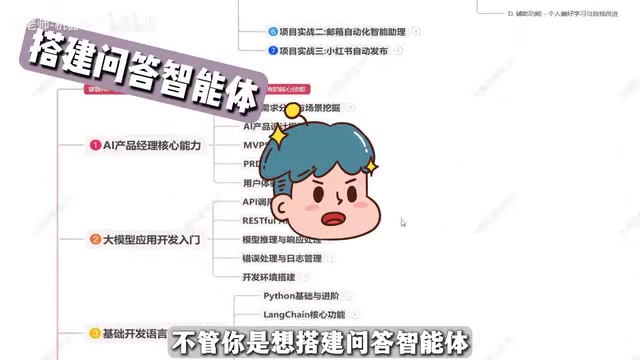
To truly build a usable Agent is by no means as simple as making a single API call. According to the tutorial, a complete Agent development knowledge system comprises the following layers, progressing from basic to advanced.
LLM Fundamentals and Prompt Engineering
The starting point for everything is understanding how LLMs work and where their boundaries lie. You need a clear grasp of the model's capability ceiling, the limitations of the context window, and in which scenarios it will "hallucinate." Building on this, Prompt Engineering is the skill that most directly affects Agent performance.
Through carefully designed prompts, you can guide the model to output structured results, adhere to a specific role, and reason step by step. This is the "language" through which the Agent communicates with the model—and it's the component that's easiest for beginners to start with yet hardest to master.
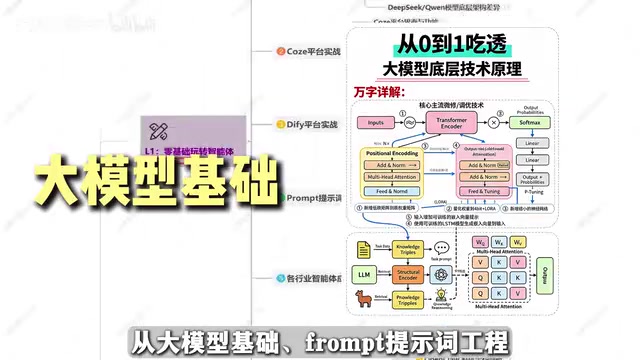
The reason prompt engineering works lies in the "In-Context Learning" capability of LLMs. During training, models are exposed to massive amounts of text and form a statistical understanding of language patterns; prompts essentially guide the model at inference time to activate the relevant knowledge distribution through the input. The industry has developed various mature prompting techniques—for example, Few-shot Learning provides examples for the model to imitate, and Chain-of-Thought uses phrases like "let's think step by step" to guide the model through the reasoning process, significantly improving accuracy on complex tasks. There are also methods like role-playing, output format constraints, and self-consistency checks. For Agents, prompts not only determine the quality of a single output but also carry the crucial responsibility of defining the Agent's behavioral boundaries, tool-calling rules, and decision logic.
Prompt engineering appears simple but is actually the cornerstone of Agent stability. For the same task, different prompt structures can produce vastly different results—which is why many developers must repeatedly refine this aspect.
RAG Knowledge Bases and Intelligent Retrieval
An LLM's knowledge has a cutoff date and cannot access an enterprise's private data. RAG (Retrieval-Augmented Generation) technology exists precisely to solve this pain point. Through vector retrieval, it finds relevant content from an external knowledge base and passes it to the model to generate answers, enabling the Agent to answer professional, real-time, and private-domain questions.

RAG has become the top choice for enterprise deployment because it strikes a good balance between cost and effectiveness. Compared to model fine-tuning, which can require tens of thousands of yuan in compute, RAG only requires building a vector database to help the model "understand" private data. Its technical pipeline typically includes: document preprocessing and chunking, converting text into high-dimensional vectors via an embedding model, storing them in a vector database (such as Faiss, Milvus, or Chroma), computing the similarity between the query vector and vectors in the database during retrieval (commonly using cosine similarity), and recalling the most relevant chunks to splice into the prompt. Throughout this process, the granularity of document chunking, the quality of the embedding model, and the number of retrieved chunks all significantly affect the final results. In recent years, advanced techniques such as reranking, hybrid retrieval, and GraphRAG have also emerged to address the inaccurate recall of simple vector retrieval on complex questions.
Building an intelligent retrieval Agent is the first hands-on project for many learners. It involves a series of engineering details such as document chunking, vectorization, similarity retrieval, and context splicing. Mastering RAG means you can build a private knowledge base Q&A bot—one of the most widely deployed Agent applications in enterprises today.
From Development Frameworks to Multi-Agent Collaboration
A single Agent can only do so much; truly complex tasks often require tool chains and the coordination of multiple Agents.
Development Frameworks: LangChain and LangGraph
Hand-coding an Agent's orchestration logic is both tedious and error-prone, so the industry has developed mature development frameworks. The tutorial mentions LangChain, one of the most mainstream Agent development frameworks today, which encapsulates common capabilities such as model invocation, tool integration, memory management, and chained calls.
LangChain was born in late 2022, almost concurrently with ChatGPT, and quickly became the de facto standard in the developer community thanks to its modular design. Its core idea is to decompose LLM applications into reusable components—Model, Prompt, Chain, Memory, Agent, Tool, and so on—that developers can combine like building blocks. However, as application complexity increased, early LangChain's chained abstraction struggled with scenarios involving loops, branches, and state management, which gave rise to LangGraph.
LangGraph goes a step further by supporting the orchestration of complex Agent workflows in the form of a graph, making state transitions, conditional branching, and loop control visualizable and manageable. Drawing on the concepts of state machines and directed graphs, it models each of an Agent's decision points as a node in the graph, with transitions between nodes controlled by conditional edges—making it naturally suited to expressing Agent logic that requires looping, such as "keep trying until success." For automation task Agents that need to build complex decision logic, such frameworks can greatly improve development efficiency.
Model Fine-Tuning and Multi-Agent Collaboration
When a general-purpose model can't meet the precision requirements of a specific domain, model fine-tuning becomes an advanced approach. By continuing training on a specific dataset, you can make the model better fit the business scenario. However, fine-tuning is relatively costly and is typically considered only when neither RAG nor prompt engineering can solve the problem.
It's worth mentioning that the maturation of parameter-efficient fine-tuning (PEFT) techniques in recent years has dramatically lowered the barrier to fine-tuning. Methods represented by LoRA (Low-Rank Adaptation) train only a small number of low-rank matrix parameters while freezing the main body of the original model, making it possible to fine-tune large models on consumer-grade GPUs—reducing costs from hundreds of thousands of yuan in the past to the level of hundreds of yuan. This has gradually brought fine-tuning from a big-tech-exclusive capability to ordinary developers. Even so, fine-tuning still requires high-quality labeled data and a deep understanding of the training process, so in practical projects it usually serves as an advanced option after RAG.
A more cutting-edge direction is Multi-Agent collaboration. In this architecture, different Agents each have their own responsibilities—some handle planning, some execution, some review—working together to complete complex tasks through Agent orchestration logic. This "division of labor and collaboration" model is becoming a new paradigm for handling complex business processes. Frameworks like Microsoft's AutoGen and CrewAI are exploring this direction; by defining communication protocols and collaboration rules between Agents, they simulate the division-of-labor patterns of human teams, allowing multiple specialized Agents to work together like a project team.
How Learners Should Plan Their Own Path
Faced with such a vast knowledge system, beginners easily fall into the trap of "searching for materials everywhere without forming a coherent system."
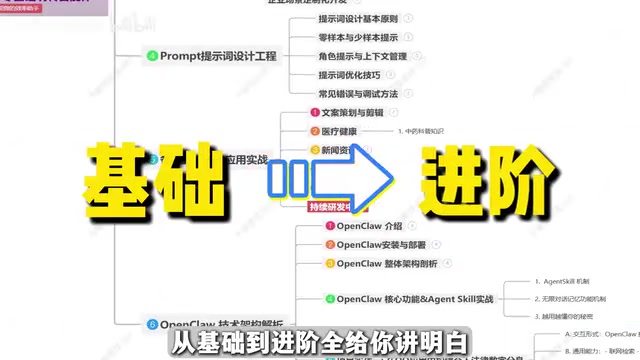
A relatively reasonable learning path is: first build a solid foundation in LLM fundamentals and prompting skills, then build your first hands-on project through RAG, next learn frameworks like LangChain to improve your engineering capabilities, and finally advance to multi-agent collaboration and fine-tuning.
It's worth noting that Agent development is a skill that places extreme emphasis on practice. No matter how many tutorials you watch, without hands-on work—setting up the environment, running projects through to completion, and stumbling through pitfalls—it's very hard to truly master. The tutorial emphasizes a path design of "from environment setup to getting started with your first project," which is precisely the point—only by grounding knowledge in real projects can you form transferable capabilities.
Conclusion: Agents Are the Bridge to AI Application Deployment
The value of AI Agents lies in transforming the "intelligence" of LLMs into executable "productivity." Whether you want to build a Q&A bot, an automation task system, or dive deep into LLM application deployment, mastering the core knowledge of Agent development is an unavoidable step.
Of course, any course claiming to take you "quickly from beginner to expert" should be viewed rationally—mastery requires long-term practice, but a systematic introductory framework can indeed help you avoid detours. The real key still lies in whether you're willing to keep practicing and iterating. In this era of exploding AI applications, Agent development capability is becoming one of the most worthwhile directions for technical professionals to invest in.
Key Takeaways
Related articles

Gluetun VPN Disconnection Troubleshooting: Version-Pinned Users Should Upgrade to v3.41.3
Gluetun version-pinned users may face silent VPN disconnections breaking their arr stack. Learn how upgrading to v3.41.3 fixes the issue and tips to avoid it.

Trump Downplays AI Extinction Risk: 'Whoever Wins AI Wins' Sparks Controversy
Trump downplays AI extinction risks with 'Whoever wins AI wins,' sparking fierce debate over whether AI safety is an urgent reality or a future hypothetical.

David Sacks on AI Regulation: Frontier Models Don't Need Mandatory Legislative Constraints
David Sacks argues OpenAI and Anthropic can self-regulate frontier model development without external legislation. A look at the logic, controversy, and governance dilemmas involved.