Getting Started with Coze: A Complete Breakdown of the Three AI Agent Categories — Tools, Software, and Frameworks

A clear three-category breakdown of the AI Agent ecosystem — tools, software, and frameworks — using Coze as the entry point.
Using Coze as a starting point, this article systematically maps the AI Agent development ecosystem into three categories: builder tools (Coze, Dify, n8n), Agent software (Claude Code, Cursor, Codex), and developer frameworks (LangChain, LangGraph, Deep Agents). It highlights how Coze has evolved across both the tool and software dimensions with version 3.0. For the common question of "what should I learn first," the author offers pragmatic advice: master all three layers, but prioritize tools based on company usage, follow your employer's lead on software, and treat development frameworks as non-negotiable core skills.
Starting with Coze: Three Categories in the AI Agent Ecosystem
If you want to truly get started with AI Agent development, your first step shouldn't be rushing to pick up a specific tool — it should be understanding the classification logic of the entire ecosystem. Using Coze as a starting point, this article breaks down the products currently available for building intelligent agents into three major categories: tools, software, and development frameworks. Understanding this framework will help you find your own learning path amid the noise and avoid unnecessary detours.
Simply put, Coze is a tool for "using an Agent to build an Agent" — you, as the user, leverage it to construct the kind of intelligent agent you need. The core value of this category of tools lies in lowering the barrier to entry: even without programming knowledge, you can assemble a functional AI application through a visual interface.
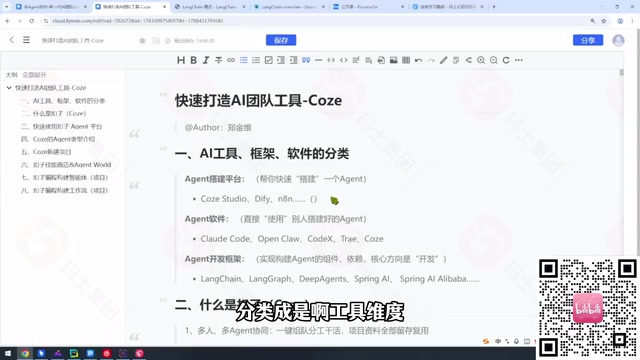
Category 1: Tools for Building Agents
Tool-based products are positioned as "scaffolding for rapidly building Agents." Beyond Coze itself, this category includes Coze Studio, Dify, n8n, and others. There's a nuance worth distinguishing here: Coze and Coze Studio can be thought of as two different forms of the same system — vanilla Coze targets general users, carries some monetization dimensions, and emphasizes "usable without coding"; Coze Studio, on the other hand, requires users to have some programming ability.
Dify and n8n belong to the same track. What they all share is helping users assemble an intelligent agent at low cost and high speed. For those just getting into AI application development, starting with tool-based products offers the gentlest on-ramp.
Dify is an open-source LLM application development platform that supports self-hosted deployment, allowing enterprises to run it on their own servers to meet data security requirements — a major reason it's popular among domestic enterprises. n8n is a tool centered on workflow automation, characterized by its visual node-based approach to connecting various services (email, databases, APIs, etc.). With the recent addition of AI nodes, it has increasingly been brought into the Agent-building toolkit. The two differ in focus: Dify is more concentrated on AI conversational applications and knowledge base management, while n8n excels at cross-system process automation and embedding AI capabilities into existing business workflows. Which tool to choose largely depends on a company's existing technical infrastructure and specific use case.
Category 2: Agent Software That Gets Things Done
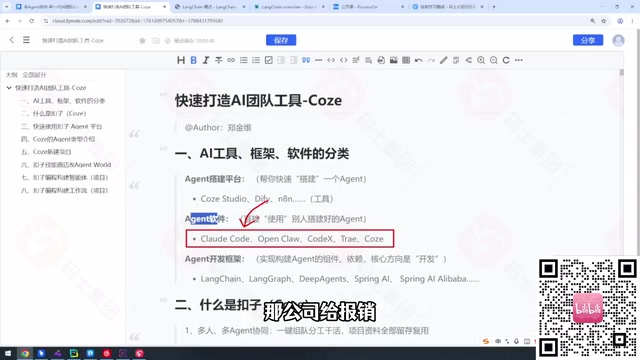
The second category is Agent software. This refers to products where you simply issue a command and the software executes the task for you. The most typical examples are the AI coding assistants (web coding tools) many people use daily — Claude Code, Codex, Cursor, and the like. You tell it "help me do something," and it gets to work.
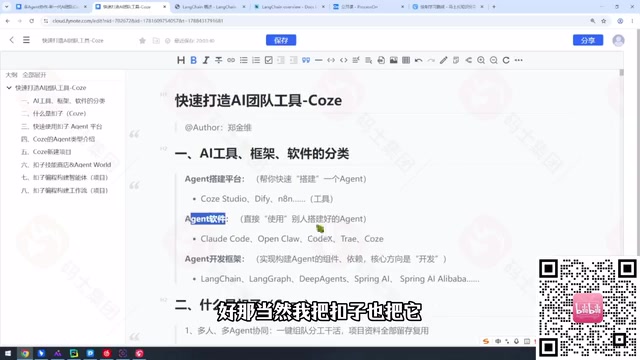
The challenges with software-based tools fall into two dimensions: first, how to get it properly installed and configured, and second, how to articulate your requirements accurately — getting the AI to truly understand what you're trying to build.
It's worth noting that Coze's positioning has evolved. Early Coze leaned more toward the tool category, but as it has iterated through to Coze 3.0, it has developed capabilities that place it squarely in the "Agent software" category as well. This illustrates that product classifications are not absolute — they shift dynamically as features evolve.
Category 3: Agent Development Frameworks
For developers, the most critical layer is the Agent development framework. This is the piece that IT professionals must master if they want to go further and last longer in the field. The author makes it clear: you need to thoroughly command the Python ecosystem for large language models.
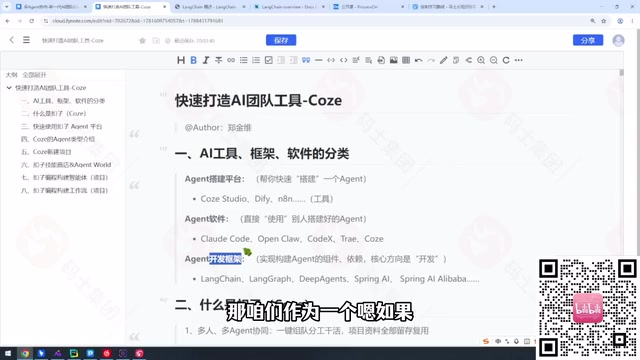
Concretely, the framework layer includes LangChain, LangGraph, Deep Agents, and others in the LangChain ecosystem. For developers coming from a Java background, you may also need to explore solutions like Spring AI or Spring AI Alibaba to bridge your existing tech stack with large model capabilities.
LangChain is currently the most mainstream development framework in the Python LLM ecosystem. Its core idea is to abstract capabilities like model calls, tool usage, and memory management into composable "chains," letting developers build complex AI applications like assembling building blocks. LangGraph is an extension of the LangChain ecosystem specifically designed for building stateful, multi-step Agent workflows — it supports loops, conditional branching, and other complex logic, making it well-suited for tasks requiring multi-round decision-making. Early LangChain struggled with controlling flow in complex Agent logic; LangGraph was created precisely to address that pain point. Spring AI and Spring AI Alibaba are the corresponding solutions for the Java ecosystem: the former is maintained by the Spring team, while the latter is an adaptation by Alibaba Cloud that integrates domestic large models (such as Tongyi Qianwen), allowing Java-background developers to connect to LLM capabilities using familiar patterns like dependency injection and Bean management — no need to learn the Python stack from scratch.
So Which One Should You Learn?
Faced with so many tools, software products, and frameworks, the most common question is "which one should I learn?" The author's answer is direct: adults don't make either/or choices — you need to know all of them, but there is a priority order.
A layered approach to your learning strategy makes things much clearer:
Tool Layer: Learn Based on Need
Quite a few companies use Dify internally — if yours does, prioritize exploring it; if not, you can safely put it off for now. These skills fall into the "necessary but flexibly schedulable" bucket.
Software Layer: Follow Your Company's Lead
Different companies use different Agent software — some use Claude Code, some Codex, some Cursor. The selection principle here is pragmatic: use whatever your company covers or recommends; if your company doesn't cover the cost, pick whichever fits your workflow best.
Framework Layer: Master All of Them
Development frameworks are non-negotiable core competencies. LangChain, LangGraph, Deep Agents — you need to get proficient in every one of them. This is the foundational capability that lets developers continue to grow in the AI era.
Summary
This "tools — software — frameworks" three-part taxonomy gives beginners a clear map. Tool-based products help you get started quickly; software products let you deliver value immediately; and frameworks determine your technical ceiling. What makes Coze special is that it spans both the tool and software dimensions — accessible for complete beginners, yet capable of handling more complex requirements as it continues to evolve. It makes for an excellent entry point into the world of AI Agents.
Related articles

Chain of Thought Isn't Just for AI: How Humans Can Use CoT to Improve Thinking Quality
Chain of Thought isn't just a prompt trick for large models. Starting from a Hacker News discussion, this article analyzes why CoT works for human thinking too, breaks down actionable ways to transfer it, and highlights the key differences between human CoT and machine CoT.
Cloudflare Teams Up with OpenAI: Closi…
Cloudflare Teams Up with OpenAI: Closing the Loop from Vulnerability Discovery to Defense with AI
Cloudflare uses OpenAI Daybreak to investigate security vulnerabilities and generate reviewable remediation plans, while developers use Codex to boost coding efficiency and quality.

Orca Multi-Agent Orchestration in Practice: A Guide to Parallel Collaboration with Claude and Codex
Orca is Stable AI's free open-source agent workbench supporting 34 agents like Claude Code and Codex in parallel. Learn its Git worktree isolation, multi-model orchestration, and mobile management.