Getting Started with Coze: A Complete Guide to the Three Types of AI Agent Tools

A practical guide to choosing the right AI Agent tool across three categories based on your technical background.
This article breaks down the AI Agent tool ecosystem into three categories: Agent building platforms (Coze Studio, Dify, n8n) for visual agent assembly, Agent software (Coze, Cloud Code, Codex) for out-of-the-box use, and Agent development frameworks (LangChain, LangGraph, Spring AI) for professional developers. It provides clear selection guidance based on technical background and explores emerging trends like multi-Agent collaboration.
In the wave of AI application deployment, more and more developers, product managers, and even non-technical professionals are starting to build their own intelligent agents (Agents). In the AI field, an agent specifically refers to a type of software system that can autonomously perceive its environment, formulate plans, and execute actions. Unlike traditional chatbots, Agents possess tool-calling, memory management, and multi-step reasoning capabilities — they don't just answer questions but can proactively break down tasks, call external APIs, operate databases, and even write code. Since 2023, with the leap in reasoning capabilities of large language models like GPT-4, Agents have rapidly evolved from academic concepts to production-ready engineering solutions, becoming one of the core paradigms of AI applications.
But faced with a dizzying array of AI tools, frameworks, and software on the market, many people are understandably confused: where exactly should you start? Coze, Coze Studio, Cloud Code, LangChain... what are the differences between these tools, and who is each one best suited for?
Based on content from Mashi Group's Coze Agent tutorial series, this article outlines the positioning and differences among three major categories of tools in the current AI Agent ecosystem, helping you build a clear cognitive framework before diving into hands-on practice.
The Three-Category Framework for AI Agent Tools
Although there's no official industry-standard classification for AI tools, from a practical standpoint, mainstream AI Agent-related tools can be roughly divided into three tiers: Agent Building Platforms, Agent Software, and Agent Development Frameworks. These three categories correspond to different technical thresholds and user groups. Understanding their boundaries is the first step to getting started with AI application development.
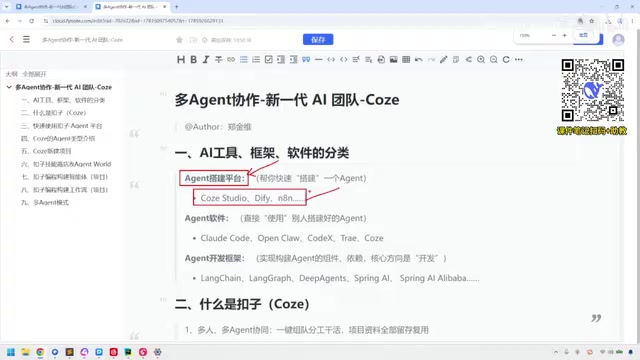
This layered understanding is crucial. Many people feel lost when learning about AI Agents precisely because they conflate low-level frameworks designed for developers with finished software products designed for general users — ending up unable to go deep or use anything effectively. Let's break down each of these three categories.
Category 1: Agent Building Platforms (Coze Studio, Dify, n8n)
Agent building platforms, as the name suggests, are tools that help you quickly build intelligent agents. In many companies, if you're a developer encountering an Agent project for the first time, it's often about building a knowledge base — because this type of requirement is low-cost and relatively simple to implement.
The core technology behind knowledge bases is RAG (Retrieval-Augmented Generation). The principle involves splitting enterprise documents, FAQs, and other unstructured data into text chunks, converting them into vectors using Embedding models, and storing them in vector databases (such as Milvus, Pinecone, Weaviate, etc.). When a user asks a question, the system first retrieves the most relevant text fragments from the vector database, then injects them as context into the large model's Prompt to generate answers. RAG-based knowledge bases have become the go-to scenario for enterprise AI deployment because they effectively address the "hallucination" problem and knowledge timeliness issues of large models, while costing far less than model fine-tuning and allowing an MVP version to go live within days.
A prime example is Coze Studio. It shares the same origins as Coze — both are products under ByteDance. Coze is an AI Bot development platform launched by ByteDance in late 2023, initially targeting overseas markets before expanding domestically. It provides a one-stop agent creation experience where users can quickly build Bots by setting personas, mounting plugins and knowledge bases, and publishing them to channels like Feishu and WeChat with one click. Coze Studio is its open-source, locally deployable version, with code hosted on GitHub, allowing developers to deploy on their own servers — ideal for enterprise scenarios with higher requirements for data privacy and customization. Both share the same underlying workflow orchestration philosophy, but Studio offers deeper node configuration and debugging capabilities. You can download it, deploy and install it yourself, then quickly build an agent or knowledge base through simple drag-and-drop operations.
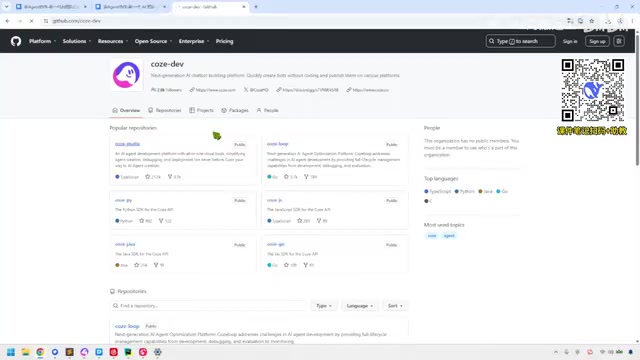
Similar products include Dify and n8n, which belong to the same category — enabling you to assemble functional agents through visual operations without diving deep into AI's underlying technology. Specifically, Dify is an open-source LLMOps platform focused on visual orchestration of "Prompt engineering + RAG + Agent workflows." It comes with built-in vector database integration, multi-model switching (supporting dozens of backends including OpenAI, Claude, and local models), and API-as-a-service publishing capabilities, and is regarded as "middleware" for enterprise-grade AI applications. n8n originated in the workflow automation space (similar to Zapier) and later added AI node capabilities, allowing users to embed large model inference steps within traditional data flows (such as email triggers, database read/write operations, and Webhook calls). The two have different focuses: Dify is more centered on full-lifecycle management of AI-native applications, while n8n excels at embedding AI capabilities into existing business automation workflows.
However, it's worth noting that while these platforms lower the barrier to entry, they still require a certain level of technical proficiency for non-developers. They fall into the "light exploration for developers" category, and complete beginners should approach with caution.
Category 2: Agent Software (Coze, Cloud Code, Codex)
The second category is Agent software — the most familiar type — essentially finished products you can use right out of the box. There are many representatives in this category, such as Cloud Code, Codex, Trae, as well as domestic tools like Zhipu, Tongyi, and various WebCoding-type tools.
These tools represent the emerging category of "AI-native IDEs." Cloud Code is Anthropic's Claude cloud programming environment, while Codex is OpenAI's code generation Agent. Unlike traditional GitHub Copilot-style code completion, these tools emphasize end-to-end task completion — from requirement understanding and architecture design to code generation and bug fixing, the entire process is autonomously driven by AI Agents, with developers playing more of a reviewer role. Trae is ByteDance's AI IDE, integrating multi-model invocation and project-level code comprehension capabilities. These tools are blurring the boundary between "developers" and "non-developers," enabling product managers and even operations staff to generate functional prototypes through conversation.
Their core logic is remarkably consistent: you describe your requirements in natural language, and the tool automatically handles the rest. Take Cloud Code as an example — you can directly say "Help me analyze what I need to build a knowledge base," wait a moment, and it will provide analysis results and implementation ideas. You then iterate through back-and-forth communication, and all the actual coding work is handed off to it.
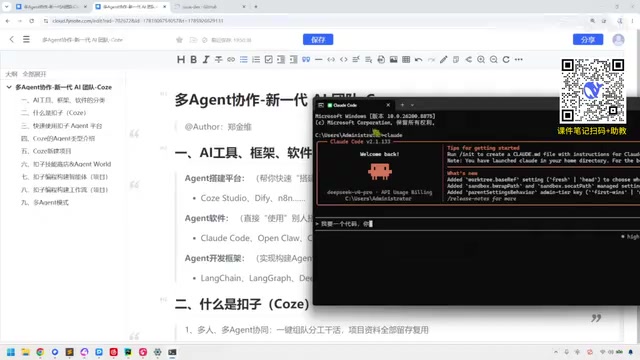
The biggest feature of this category is that it's ready to use out of the box. You don't need to understand how it parses your intent internally, nor do you need to know the details of its Agent architecture. As long as you configure your Token and have the budget ready, it can get the job done for you. This is precisely why Agent software appeals to both developers and non-developers — the former use it to boost efficiency, while the latter use it to accomplish tasks they previously couldn't tackle. And Coze, the protagonist of this tutorial series, belongs to this category of user-friendly Agent products.
Category 3: Agent Development Frameworks (LangChain, LangGraph, Spring AI)
The third category is Agent development frameworks — the most technically demanding of the three, designed entirely for IT developers. When you want to build a highly customizable agent with complex logic, finished software and building platforms often fall short, and that's when you need to turn to underlying frameworks.
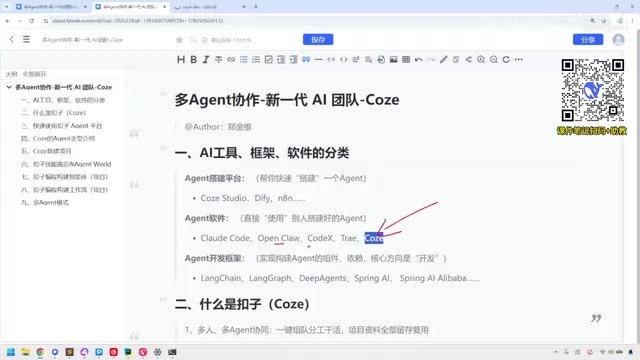
In the Python ecosystem, commonly used frameworks for building complex agents include LangChain, LangGraph, Deep Agents, and more. LangChain is currently the most popular large model application development framework in the Python ecosystem, created by Harrison Chase in 2022. Its core abstractions include Chain (chained calls), Tool (tool binding), Memory (conversation memory), and Retriever, allowing developers to combine these modules like building blocks to construct complex AI applications. LangGraph is an advanced framework from the LangChain team, focused on stateful, multi-step Agent workflow orchestration. Based on a directed acyclic graph (DAG) design philosophy, it supports conditional branching, loop execution, and Human-in-the-Loop intervention, making it particularly suitable for building complex tasks requiring multiple Agent collaboration, such as research analysis, data pipelines, and customer service ticket processing. Deep Agents is an emerging framework for deep reasoning scenarios, emphasizing long-chain thinking and self-reflection capabilities.
If an enterprise prefers to quickly build simple agents using Java, they can look into Spring AI and Alibaba's Spring AI Alibaba. Spring AI is an AI development framework officially launched by Spring in late 2023, aiming to seamlessly integrate large model capabilities into the Java/Spring Boot ecosystem. For the large number of enterprise development teams in China that primarily use Java, this means they can build AI applications without switching their tech stack. Spring AI provides a unified Model API abstraction layer supporting multiple model backends including OpenAI, Ollama, and Azure AI, with built-in core capabilities like vector storage, Function Calling, and Prompt templates. Alibaba built on this with Spring AI Alibaba, deeply integrating the Tongyi Qianwen model series and Alibaba Cloud's vector retrieval services, further lowering the barrier for domestic Java developers to access large models. This trend indicates that AI development frameworks are evolving from a Python-only ecosystem toward multi-language parallel development.
These frameworks are virtually irrelevant for non-developers. On an interesting note, many product managers have also started learning Agent development-related knowledge. Overall, the learning curve for Agent development is relatively low, which is why almost everyone who previously worked in coding is "grinding" in this direction. But once you dig deeper, you'll find that many application scenarios are actually quite simple — this is both an opportunity and a reminder to view tech hype rationally.
How to Choose Among the Three Types of AI Agent Tools
After reviewing these three categories, we can derive a clear selection strategy:
- Complete beginners / non-technical users: Go directly with Agent software like Coze — ready to use out of the box, letting you focus on turning ideas into products.
- Developers with some technical background: Try building platforms like Coze Studio or Dify for more flexible customization on top of visual operations.
- Professional developers: Dive into development frameworks like LangChain and LangGraph to build truly complex, controllable multi-Agent collaboration systems.
It's worth mentioning that Multi-Agent Collaboration is one of the most cutting-edge directions in the AI Agent field today. The core idea is to decompose complex tasks among multiple Agents with different specialties — for example, one responsible for information retrieval, one for code writing, and one for quality review — achieving collaborative completion through message passing and shared memory. Frameworks like AutoGen from Microsoft Research, CrewAI, and MetaGPT are all exploring this paradigm. In practical enterprise applications, multi-Agent systems can simulate a virtual team's workflow, such as automated market research report generation, code review pipelines, or customer service escalation chains.
This tutorial series chose Coze as its entry point precisely because it combines ease of use with extensibility — the Coze platform supports multi-Bot coordination and workflow orchestration, allowing beginners to get started quickly while also enabling the creation of complex applications approaching an "AI team" through multi-Agent collaboration. Now that you understand the full landscape of the tool ecosystem, it's time to officially dive into hands-on practice with Coze.
Conclusion
The world of AI Agents may seem complex, but once you establish the three-tier cognitive framework of "building platforms — finished software — development frameworks," you can quickly find the right entry point for yourself. For most people, rather than agonizing over underlying technologies, it's better to start with user-friendly tools like Coze and gradually deepen your understanding through practice. The value of technology ultimately manifests in its applications, and getting hands-on is always the best way to learn.
Related articles

Bilibili's Hit Dify Tutorial: A Practical Guide to Building 20+ AI Apps from Scratch
A distilled guide to Bilibili's top-rated Dify tutorial: Windows + Docker deployment, MySQL connection, five app types, model integration strategy, and publishing.

Agent Skills Beginner's Guide: From Concepts to Multi-Agent Collaboration in Practice
A comprehensive guide to Agent Skills: core concepts, components, the importance of Description, standardization, beginner learning paths, and multi-agent collaboration.

One Neuron Detects Both Cats and Cars? We Reproduced It and Found a New Explanation
The cat-car neuron reinterpreted: researcher Cammarata argues it distinguishes pointy from round, not cats from cars. We reproduced the experiment and found the new explanation holds on most inputs—but cars are the exception. The interpretability debate continues on language models.