Getting Started with LangChain: A Guide to the LLM Application Development Framework

LangChain is an open-source framework for building enterprise-grade AI applications that compensates for the limitations of native large models.
This article systematically introduces LangChain, an open-source framework for developing large model applications. Its name comes from Language and Chain, emphasizing the chained composition of AI applications. The article points out that native large model APIs have three major limitations—knowledge timeliness, lack of business data connection, and no state management—making it difficult to directly support usable products, hence the need for framework-level extensions. LangChain addresses these shortcomings through pluggable features such as chained construction, state management, tool calling, and security management, enabling models to reason while also connecting to external data, calling tools, and implementing security controls. Architecturally, after LangChain 1.0, it and LangGraph share a unified underlying graph flow. The article also offers learning path suggestions and typical development scenarios for enterprise-grade Agents.
What Is LangChain and Why Do We Need It?
LangChain is an open-source framework for developing large model applications. Its name comes from a combination of "Language" and "Chain," meaning to build AI applications through chained connections. It was born against the backdrop of the rapid spread of large model capabilities, but native large model APIs have three major limitations—and these are exactly the core problems LangChain aims to solve.
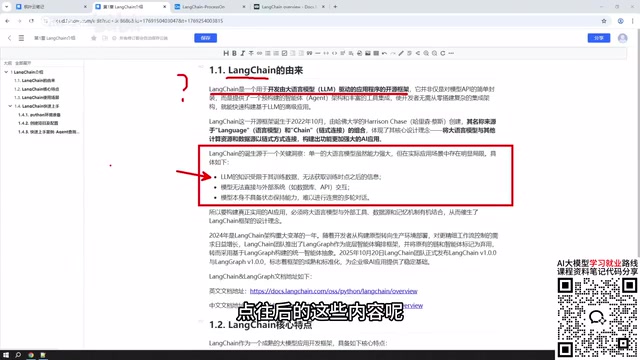
The Three Major Limitations of Native Large Models
- Knowledge timeliness: Large models can only answer based on knowledge up to the cutoff date of their training data and cannot access information after that point in time.
- Lack of business data connection: Model responses are based on training data and have nothing to do with a company's internal business data or external databases, so they cannot answer in the context of business scenarios.
- No state management: A standalone large model has no ability to retain conversation history; each Q&A is independent and has no memory function.
These limitations make it difficult for developers to directly build usable AI applications, and LangChain compensates for these shortcomings by extending native model capabilities.
Stateful vs. stateless is a key distinction for understanding conversation systems. Stateless means the server does not retain any information across requests; each time the large model API is called, the model sees only the current input, and previous Q&A is completely nonexistent to it. Therefore, implementing multi-turn dialogue does not rely on the model's own memory. Instead, the application layer concatenates historical messages according to a certain strategy into the current prompt (commonly known as the context window) and sends them together. This context window has a limited length, so if the history is too long, it needs to be trimmed, summarized, or retrieved via external memory storage. LangChain's state management function essentially helps developers maintain this conversation history and intermediate variables and reliably pass them between different calls, thereby enabling a stateless model to exhibit coherent conversational behavior.
How Does LangChain Solve These Problems?
On top of native large model capabilities, LangChain extends a variety of pluggable features so that AI applications can not only reason but also connect to external data, manage state, call tools, and implement security management.
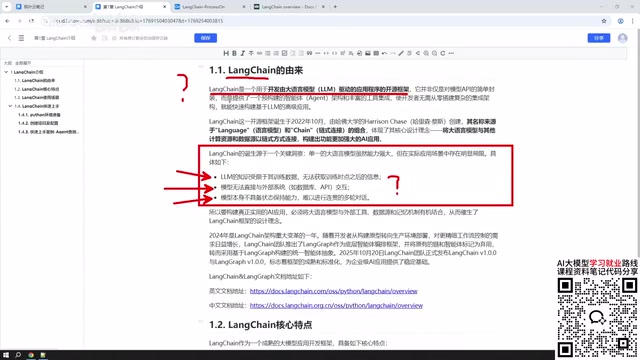
Specifically, LangChain provides:
- Chained construction: Combine large models with external components (such as databases and APIs) in a chained manner to form complete workflows.
- State management: Store and pass conversation history to maintain context across multi-turn dialogues.
- Tool calling: Enable models to call external tools to obtain real-time data or perform actions.
- Security management: Apply security controls to model inputs and outputs.
These features are all pluggable, and developers can combine them as needed to flexibly build enterprise-grade Agent applications.
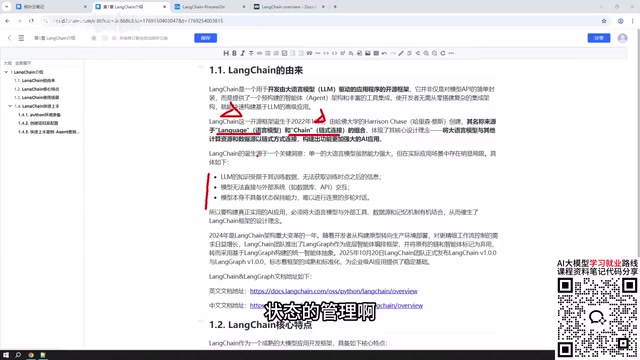
LangChain 1.0 Architecture Changes: The Relationship with LangGraph
After version 1.0, LangChain underwent architectural adjustments. Previously, LangChain and LangGraph were independent projects, but now both use graph flow (graph structure) as their unified underlying foundation. This adjustment is intended to make the open-source tools easier to use and improve overall consistency.
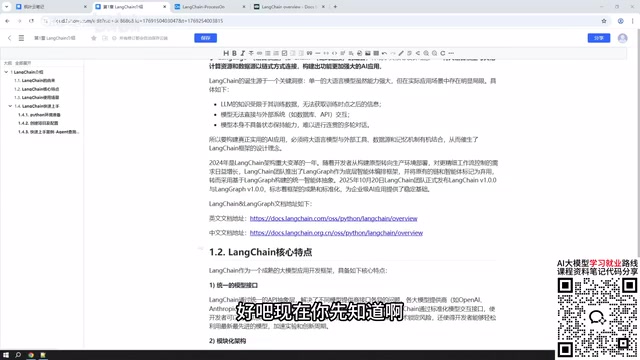
For beginners, you can start with the Chinese official website, whose content is beginner-friendly, but note that some content is missing or inaccurately AI-translated. Non-beginners are advised to read the English official website directly, with a translation plugin, to get the most complete information.
Graph flow (graph structure) is a way of modeling computational processes as directed graphs: nodes represent specific processing steps (such as calling a model, retrieving data, or executing a tool), and edges represent dependencies and data flow between steps. Compared with the relatively linear "Chain" organization in early LangChain, graph structures naturally support branching, loops, conditional jumps, and parallel execution, making them better suited to expressing Agent logic with complex control flows such as multi-round reflection, on-demand tool calling, and error retry. LangGraph is an orchestration framework built on this idea; it manages runtime state and execution order, while LangChain provides components such as model abstractions, prompt templates, and retrievers. After version 1.0 unified on graph flow, the two ecosystems form a consistent foundation from components to orchestration, so developers do not need to switch between two paradigms, and debugging, visualization, and persistent state are implemented more consistently.
Practical Directions for Enterprise-Grade Agent Development
With LangChain's capabilities, developers can build enterprise-grade Agents. Typical scenarios include:
- Knowledge base Q&A: Connect enterprise documents and databases so the model can answer based on internal knowledge.
- Multi-turn dialogue assistants: Use state management to deliver a coherent conversational experience.
- Automated workflows: Chain external APIs through tool calling to complete complex tasks.
These scenarios are exactly what native large models find difficult to achieve directly, and LangChain provides reusable components and patterns that lower the development barrier.
Related articles

LLM Application Development: A High-Paying Career Guide for Ordinary People
LLM application development offers fresh graduates up to 35K/month, with SP offers reaching 600K. This article explains the core skills, how to break in, and how ordinary people can seize AI opportunities through learning by doing.

Say Goodbye to AI Influencer Faces: A Complete Guide to Creating Visual Assets for AI Comic Dramas from Scratch
Bilibili creator shares a full workflow for zero-basics AI comic drama visual assets: use Doubao Work skills with script-first, visual references, and real-person texture to escape AI influencer faces, then lock character and scene consistency with asset sheet layouts, weapon detail images, scene nine-grids, and cinematic color palettes.

The AI Production Pipeline Behind Great Videos: From Research to Agent Validation
AI video production isn't just a model race. This article breaks down a transferable four-step pipeline: researching professional workflows, organizing a skill checklist, configuring agents, and experimental validation—and explains how general-purpose LLMs like DeepSeek can replace paid tools to run the entire process.