GitHub Daily · August 31: Local AI Servers and Training LLMs from Scratch

Today's GitHub trends spotlight training LLMs from scratch and turning PCs into local AI servers.
minimind lets developers train a 64-million-parameter LLM from scratch in just two hours, making it an outstanding learning resource. ODS turns any ordinary computer into a one-stop local AI server covering inference, chat, voice, RAG, and image generation. Today's dominant themes are AI localization and democratization, with Python maintaining absolute dominance across AI and security domains.
GitHub Daily · August 31
Today's Trending list reveals an interesting signal: AI is shifting from the cloud down to local machines and individual hands. Whether it's training a mini LLM from scratch or turning your old computer into a full-fledged AI server, the projects on today's list are all answering the same question: how can ordinary developers take control of AI themselves?
Beyond that, a game enhancement tool and an OSINT intelligence-gathering suite also made the list, covering gaming experience and security research respectively. Let's break them down one by one.
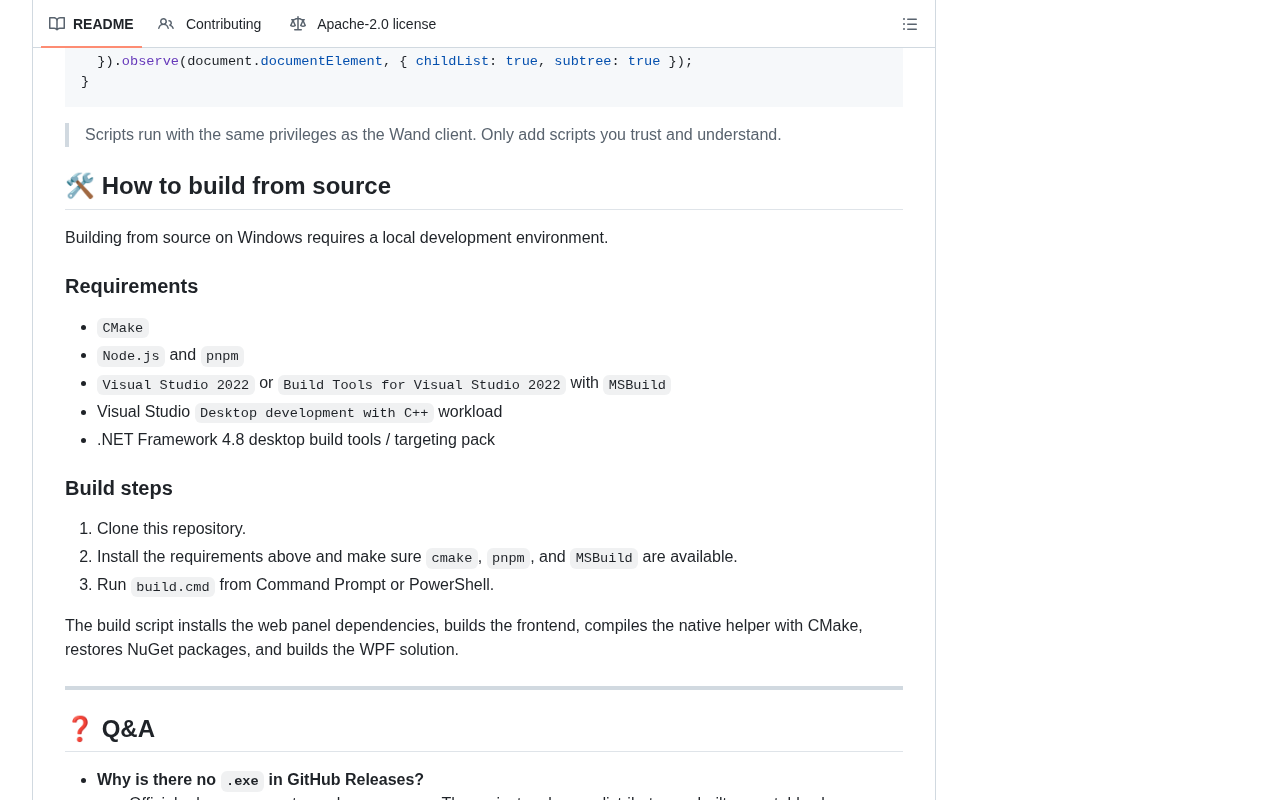
k1tbyte/Wand-Enhancer: A UX Upgrade for a Game Cheat Tool
This is an enhancement extension for Wand — the WeMod application. WeMod itself is a popular single-player game modifier platform that provides cheat codes and trainers for various games. Wand-Enhancer builds on top of it with UX and interoperability improvements.
Why does this project exist? Many game modifier tools are feature-rich but have terrible interfaces, or lack certain advanced capabilities. This extension is designed to optimize the experience for power users, making things smoother for hardcore gamers.
On the tech stack side, it uses C#, which is the mainstream choice for Windows desktop applications. It's a solid reference for anyone looking to build desktop extensions or plugin systems.
Here's an interesting data point: over 23,000 Stars, but Forks are a staggering 59,000+, with 700+ new Stars today. Normally, Forks are far fewer than Stars, but here it's the opposite — Forks are more than double the Stars. This kind of anomaly usually indicates heavy automation or inflated metrics, so I'd recommend taking these numbers with a grain of salt.
jingyaogong/minimind: Train an LLM from Scratch in Two Hours
This project's tagline is very compelling: train a 64-million-parameter LLM from scratch in two hours. It's the most educationally valuable project on today's list.
The problem it solves is very real. Today's LLMs routinely have tens of billions of parameters, making it impossible for ordinary people to participate in training — they can only call APIs. minimind compresses the entire process down to a toy-scale exercise, letting you complete the full pipeline from pre-training to fine-tuning on a single consumer-grade GPU in two hours.
The core highlight is that it breaks down every step of LLM training: data processing, tokenizer, model architecture, pre-training, supervised fine-tuning, and reinforcement learning alignment. You're not working with a black box — you can see exactly what every line of code is doing.
Who would use it? Students and engineers who want to truly understand how LLMs work under the hood. You can't learn this just by reading papers or calling APIs — you have to run through it yourself to know where the pitfalls are at each stage. The tech stack is pure Python plus PyTorch, and the code is very clean.
It currently has over 55,000 Stars with 470+ new ones today. Accumulating this level of attention shows just how hungry people are for reproducible, learnable LLM tutorials.
Osmantic/ODS: Turn Your Computer into an AI Server
This project has a very clear positioning: turn your PC, Mac, or Linux machine into a complete AI server.
It fills a real gap. Right now, if you want to run AI locally, you might need to install Ollama for inference, find a frontend for a chat interface, set up RAG separately, configure voice interaction, and then connect a workflow engine. Each component is a standalone tool, and stitching them together is a pain. ODS aims to be a one-stop solution, packaging everything into a single system.
Its feature list is extensive: LLM inference, chat interface, voice interaction, agents, workflows, RAG (Retrieval-Augmented Generation), and image generation. It basically covers every local AI capability you can think of.
The use cases are very concrete. Say you have an idle old computer or a Mac Mini and want to set up a personal AI assistant where your data never leaves your machine, without having to cobble together a separate environment for each feature — ODS is a perfect fit. It's especially friendly for privacy-conscious individual users and small teams.
The tech stack is Python. Currently at 5,100+ Stars with 330+ new ones today, growing at a steady pace. In the local AI space, this kind of comprehensive all-in-one solution will only become more popular.
kaifcodec/user-scanner: One Email Address to Uncover Your Digital Footprint
This is a two-in-one OSINT intelligence-gathering suite. OSINT stands for Open Source Intelligence. It can take just an email address or username and uncover a massive amount of associated information.
Its capabilities are impressive: it analyzes over 465 actively maintained scanning vectors, with 175+ targeting email addresses and 290+ targeting usernames. In other words, give it a username and it will check hundreds of platforms to see which accounts are registered under that name.
Why would you need it? Security research, penetration testing, and incident investigations can all benefit. For example, a security team assessing an employee's digital footprint exposure risk, or investigators mapping out an identity's online traces — this tool can dramatically improve efficiency.
Of course, tools like this are double-edged swords. They can be used for legitimate security research but could also be abused for doxxing. The author explicitly states it's intended for security research and investigations.
The tech stack is Python. Currently at 3,900+ Stars with 460+ new ones today — one of the fastest growth rates on the list. This shows that interest in OSINT and digital footprint topics remains consistently high.
Today's Trend Observations
Looking at today's four projects together, two clear themes emerge.
The first is the localization and democratization of AI. minimind lets you train from scratch; ODS lets you deploy locally. One handles learning the principles, the other handles practical deployment. Behind both is the same desire: developers don't want to be forever just consumers of cloud APIs — they want to truly control AI. This trend will become increasingly prominent in 2026, as consumer-grade hardware keeps getting more powerful and open-source models keep getting better.
The second is Python's absolute dominance. Three out of four projects today use Python. Whether it's training models, building AI servers, or doing intelligence analysis, Python is the go-to choice. This once again confirms its status in the AI and security domains.
One more thing worth noting: not a single heavyweight framework made the list today. Instead, every project is small, practical, and something an ordinary person can pick up and start using right away. This suggests the community's interest is shifting from chasing the biggest and newest to tools that can actually be put to use.
Today's Must-See TOP 3
Number one: jingyaogong/minimind. If you want to truly understand how LLMs are built, this is the best hands-on tutorial — you can complete the entire pipeline in two hours.
Number two: Osmantic/ODS. If you want a local AI system that's entirely your own without juggling a bunch of tools, this one-stop solution has you covered.
Number three: kaifcodec/user-scanner. Worth checking out for anyone doing security research or wanting to understand their own digital footprint exposure — but please make sure to use it legally and responsibly.
We'll continue watching the charts tomorrow to see how long this local AI wave keeps blowing.
Related articles

Genetic Algorithms + Neural Networks: How a 3D Robotic Arm Evolves to Reach Its Target
Deep dive into how genetic algorithms and MLP neural networks combine to drive autonomous evolution of a 3D robotic arm, covering neuroevolution, feature engineering, and AI-assisted coding.

OpenAI Cuts Off Cursor: A Wake-Up Call for the AI Programming Supply Chain
OpenAI will terminate model supply to Cursor by Nov 2026, triggered by SpaceX's acquisition. Analysis of impacts on developers, enterprises, and AI supply chain trust.

The AI Capability Growth Curve: Why We Haven't Even Reached the Halfway Point
Analyzing the AI capability growth curve to explore why we may be less than halfway to AGI, and what this means for practitioners and decision-makers.