GitHub Daily · November 16: Agent Skills Explode, Evaluation and Security Become the New Battleground
Agent ecosystem is stratifying: compute at the bottom, skill packs in the middle, evaluation governance at the top—with NVIDIA's SkillEvaluator growing fastest today.
Three trending projects map onto three layers of the agent stack: ggml as the local inference foundation, Claude-BugHunter turning security know-how into 82 reusable skills, and NVIDIA's SkillEvaluator bringing quality gates and skill evaluation. The trend: agent skills are becoming tradable assets, and governance is emerging.
GitHub Daily · November 16: Agent Skills Explode, Evaluation and Security Become the New Battleground
Today's Trending list is quite interesting. Three projects, each landing on a different layer. At the bottom is ggml, the veteran tensor library. In the middle is a security toolkit that loads skills into Claude Code. At the top is an agent skill evaluation framework from NVIDIA itself. Put together, they form a complete chain. First build compute, then pile on skills, and finally figure out how to evaluate whether those skills are actually reliable. This is no coincidence. When AI agents move from "can chat" to "can do concrete work," the community's first instinct is to give them toolboxes. And the more tools you pack in, the more someone needs to step up and ask: are these tools actually any good? NVIDIA's answer is an evaluation framework, and the security community's answer is a hands-on playbook with over 800 vulnerability cases.
ggml-org/ggml: The Foundation of All Local Inference
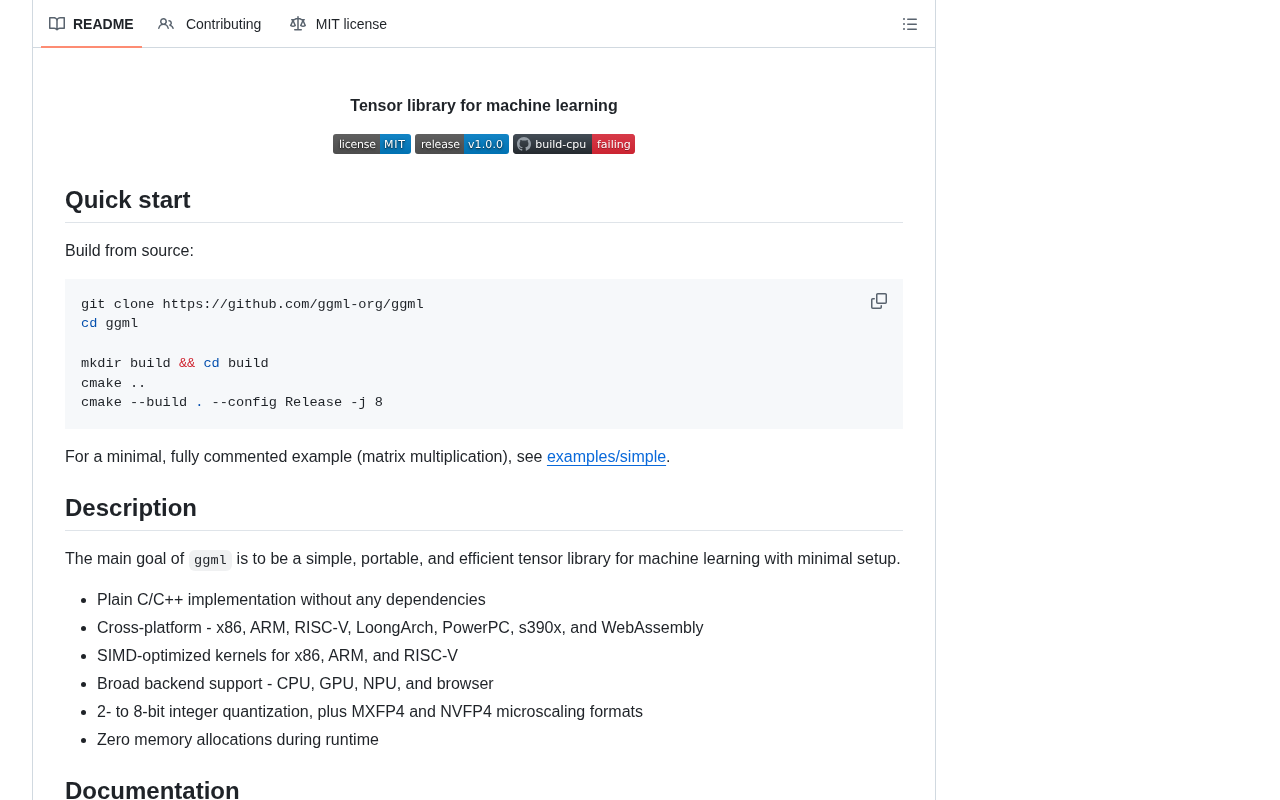
Project positioning: A machine learning tensor library written in C, and the real engine behind llama.cpp.
Problem it solves: Running large models has long been locked into the Python ecosystem and GPUs. If you want to run inference on a machine without an NVIDIA GPU, or squeeze a model onto a Raspberry Pi, phone, or router, you need a different approach. That's exactly what ggml does. It's written in pure C, has no runtime dependencies, and isn't picky about hardware. It runs on CPUs, Apple's Metal, Vulkan, and all kinds of ARM architectures. You see, that's why it's the common foundation for a whole stack of local inference projects.
Core features: It's a single dependency. Just compile it in and you're done—no need to install a pile of Python packages. It supports automatic multi-backend switching, so the same code can run on different hardware. It also does quantization and memory optimization, letting small 7B-level models fit into very little memory. More importantly, it uses a model format called gguf, which has now become the universal shelf for local model distribution.
Use cases: Who uses it? Developers who want to run models on edge devices, teams doing edge computing inference, and anyone using Ollama or llama.cpp. You're actually using it indirectly every day—you just don't notice.
Tech stack: Pure C and C++, built with CMake. Its value for developers is that it demonstrates how to build a high-performance computing library with minimal dependencies. That's very instructive for teams working on embedded systems and high-performance computing.
Stars/Forks analysis: Over 16,000 stars and 2,000+ forks, but only 43 new stars today. What does that tell us? It's entered maturity and is no longer the kind of project that blows up overnight. Its growth is steady, slowly pushed along by the entire local inference ecosystem. This kind of curve is actually the healthiest look for a foundational library.
elementalsouls/Claude-BugHunter: Equipping Agents with a Security Skill Set
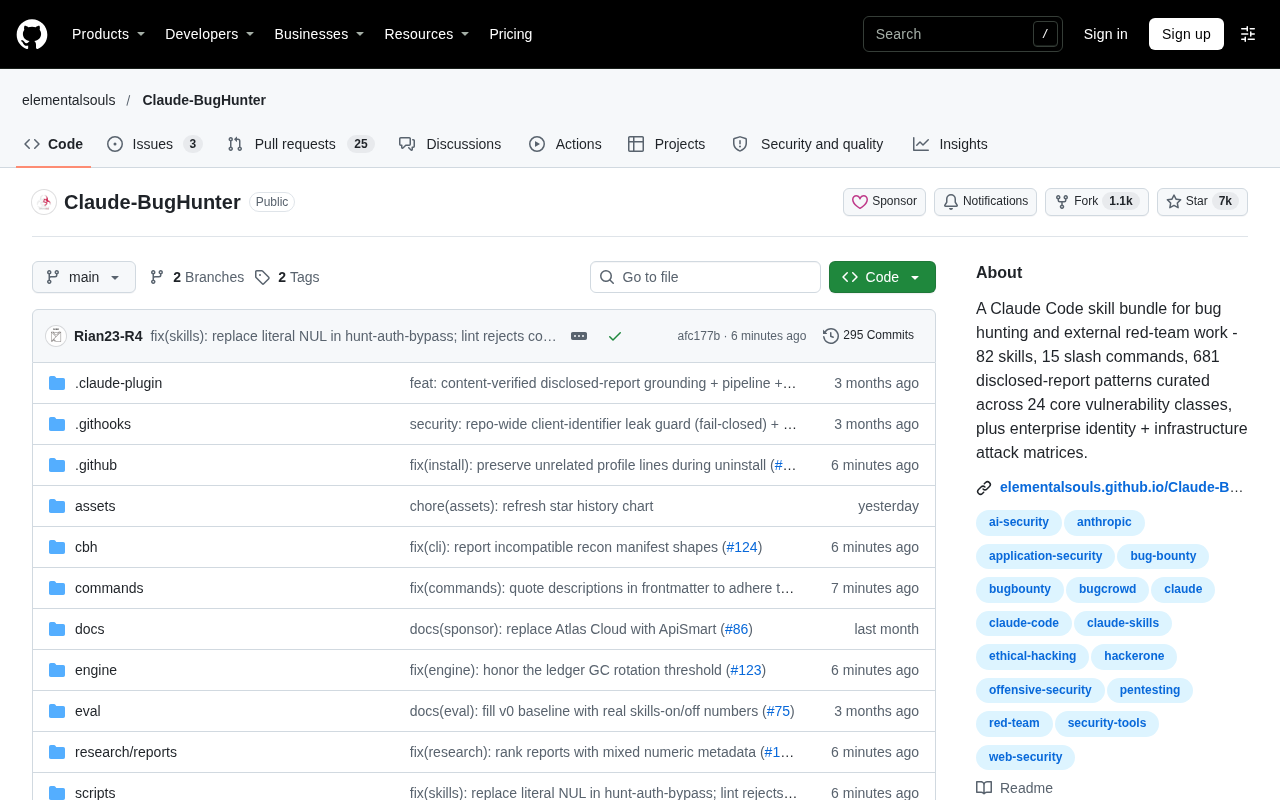
Project positioning: A skill pack collection for Claude Code, specifically serving vulnerability hunting and external red team work.
Problem it solves: Here's a very practical problem. Ask a general-purpose agent to do security testing, and it knows a little about everything but isn't deep in any of it. It doesn't know the typical shapes of certain vulnerability classes, and it hasn't seen cases disclosed in the real world. This project distills that experience into skills an agent can call directly. You see, it turns the knowledge scattered across blogs and reports in the security community into structured packages.
Core features: 82 skills, 15 slash commands. Behind those numbers are 24 core vulnerability categories. Even more impressive, it organizes case patterns from 681 disclosed reports. That means when the agent analyzes, it can cross-reference cases that actually happened. It also throws in attack matrices for enterprise identity systems and infrastructure, covering both offense and defense in the identity authentication space.
Use cases: Penetration testers, security researchers, and teams doing red team work. They use it for vulnerability assessment and attack path analysis within authorized scope. Please note that the use cases for these tools have clear boundaries—only use them within legally authorized scope.
Tech stack: Python. Its architectural approach is worth studying: break domain knowledge into small reusable modules, then attach them to the agent. This "skill pack" pattern is becoming increasingly common.
Stars/Forks analysis: Nearly 7,000 stars, 1,000+ forks, and 98 new stars today. That growth rate isn't explosive, but for a vertical-domain project it's quite substantial. It shows that the security community's acceptance of "using agents to do security work" is rising fast.
NVIDIA/SkillEvaluator: Who Judges the Agent's Skills?
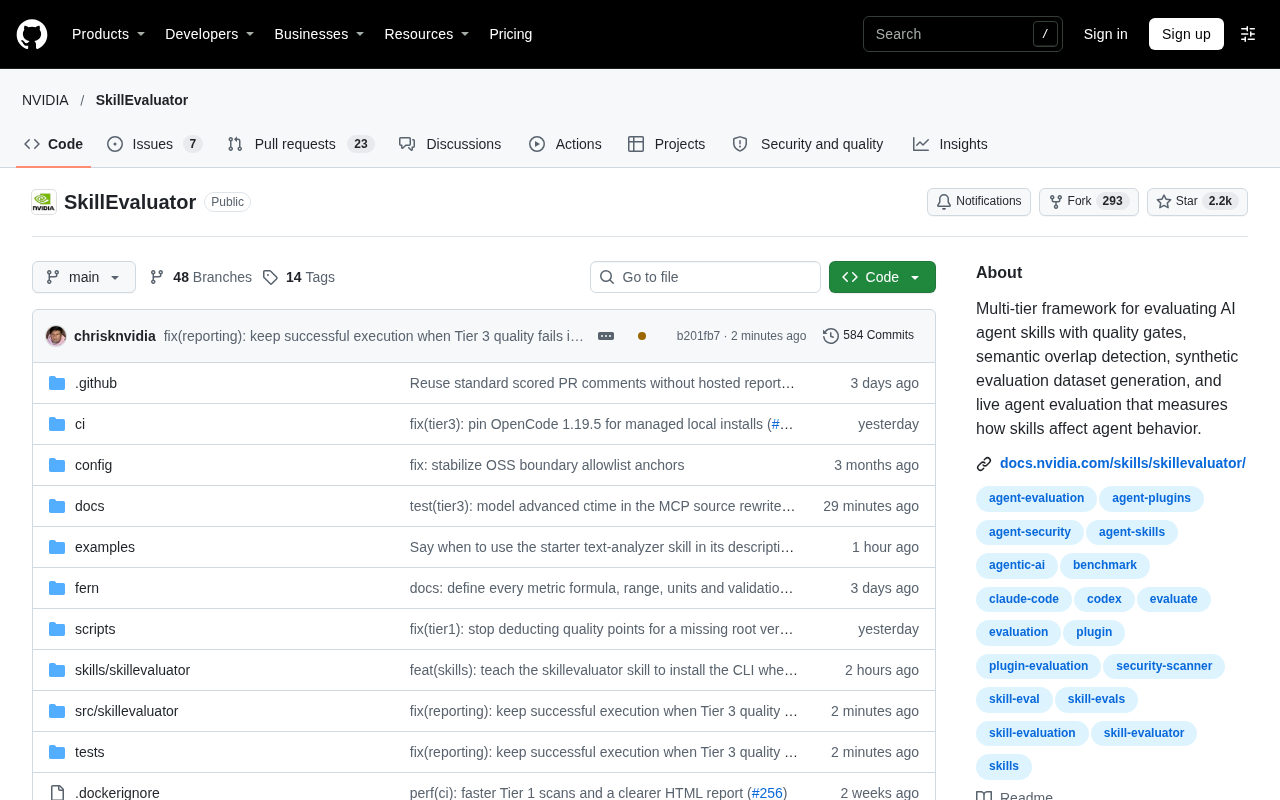
Project positioning: A multi-tier framework for evaluating the quality of AI agent skills.
Problem it solves: The previous project is desperately stuffing skills into agents, which raises a new question. The more skills you install, the more you need to know which ones are useful and which are noise. Are there skills with overlapping functionality? Does a given skill actually change the agent's behavior? These questions can't be answered by manual judgment. NVIDIA's project is here to solve this pain point. It fills exactly the gap in agent skill evaluation.
Core features: It has several layers of evaluation mechanisms. The first layer is quality gates, setting a passing bar for skills. The second layer is semantic overlap detection, which can identify functionally duplicate skills and help you trim. The third layer is synthetic evaluation dataset generation—in other words, it can create its own test cases. The final layer is real-time evaluation, directly measuring a skill's actual impact on agent behavior. Together, these four layers form a complete health-check process.
Use cases: Companies building agent platforms, teams managing large-model skills, and researchers studying agent behavior. Anyone piling skills onto agents needs this for quality control.
Tech stack: Python. Its value for reference is that it moves the quality gate and unit testing ideas from software engineering into agent skill management. This migration is quite interesting.
Stars/Forks analysis: Over 2,000 stars, 200+ forks, and 122 new stars today. Note that its absolute star count is the lowest, but its growth rate today is the fastest of the three. This suggests it may be in the early explosive phase. And it's an official NVIDIA release, a background that will help it move more smoothly on the enterprise side.
Today's Trend: The Agent Ecosystem Is Stratifying
Put the three projects side by side and a clear trend emerges. The agent ecosystem is stratifying, and every layer is being taken seriously.
At the bottom is compute and frameworks—projects like ggml that make models run and run cheaply. In the middle is the skill layer, with all kinds of skill packs being attached to agents: security, code, ops, one pack per domain. At the top is the governance layer—evaluation, quality control, deduplication—so the whole thing doesn't spiral out of control. In the past we only cared about how smart the model was; now the community is starting to care about what the agent actually did, and whether those capabilities are real or hollow.
Another signal is that skills themselves are becoming a tradable asset. With skill packs and evaluation frameworks, it's clear this market is starting to form. Whoever can produce high-quality, reusable skills will have a voice. And the emergence of evaluation frameworks means the industry is starting to set rules for this market.
Today's Must-See TOP 3
First, NVIDIA/SkillEvaluator. The reason is simple: it's today's fastest-growing project, and it sits right on the agent governance trend. NVIDIA officially entering the evaluation space is itself a strong signal. If you want to build an agent platform or manage a large number of skills, this is the one to read first today.
Second, elementalsouls/Claude-BugHunter. It externalizes the tacit knowledge of the security field into skills an agent can use. This pattern can be replicated across many vertical domains—it's an excellent sample of skill engineering.
Third, ggml-org/ggml. It isn't new, but it's the foundation of all local inference. Its appearance on today's list reminds us that beneath the bustling agent upper layers, there's still a layer of infrastructure quietly doing the work. Anyone working on edge devices and edge inference can't avoid it.
Outlook
One direction worth watching next is whether skill evaluation will become a standard. If NVIDIA's framework gets adopted by more platforms, then releasing skills in the future may require passing an evaluation gate first. That's good for the entire agent ecosystem—at least it will block a batch of filler skills. Another point of interest is whether security skill packs will keep multiplying, and how the industry will draw usage boundaries for these kinds of tools. The stronger the tools, the clearer the rules need to be.
Related articles
Claude-BugHunter: 82 Skills Powering AI-Assisted Vulnerability Discovery and Red Team Operations
Claude-BugHunter is an open-source skill pack for Claude Code with 82 skills, 15 slash commands, and 681 disclosed report patterns across 24 vulnerability classes.
NVIDIA Open-Sources SkillEvaluator: Adding Quality Gates to AI Agent Skills
NVIDIA open-sources SkillEvaluator, a multi-tier AI Agent skill evaluation framework with quality gates, semantic overlap detection, synthetic eval datasets, and live Agent evaluation to help teams systematically manage skill quality. 2,181 GitHub Stars.

Amazon's Zoox Robotaxis Join Uber, Debut in Las Vegas
Amazon's Zoox robotaxis officially join Uber, with Las Vegas users among the first to experience steering-wheel-free robotaxis. It's Uber's first purpose-built autonomous vehicle and Zoox's first opening to a third-party platform.