Giving AI Agents Long-Term Memory: Remembering Problem Suppliers Across Billing Cycles

LedgerMind revamps GST reconciliation with cross-cycle persistent memory so agents accumulate supplier-behavior judgment.
Targeting the stateless "reset every month" flaw in Indian GST reconciliation, LedgerMind proposes an AI agent with cross-month persistent memory. It reads purchase ledgers and GSTR-2B files for invoice matching and uses Vectorize's Hindsight memory to store supplier history, evolving from generic fixes to reused communication strategies to proactive deadline warnings. Deterministic Pandas code handles math while the LLM selects tools via function calling. The hackathon-stage project raises open questions on edge cases and memory reliability.
Indian enterprises spend enormous manual effort on GST reconciliation every month, and the biggest flaw in existing tools is that they "reset to zero every month"—recurring GSTIN errors or late filings by suppliers have to be rediscovered and rehandled by finance teams every filing cycle. LedgerMind, a team from HackwithBangalore 4.0 featured on Reddit, is trying to change this with "persistent memory."
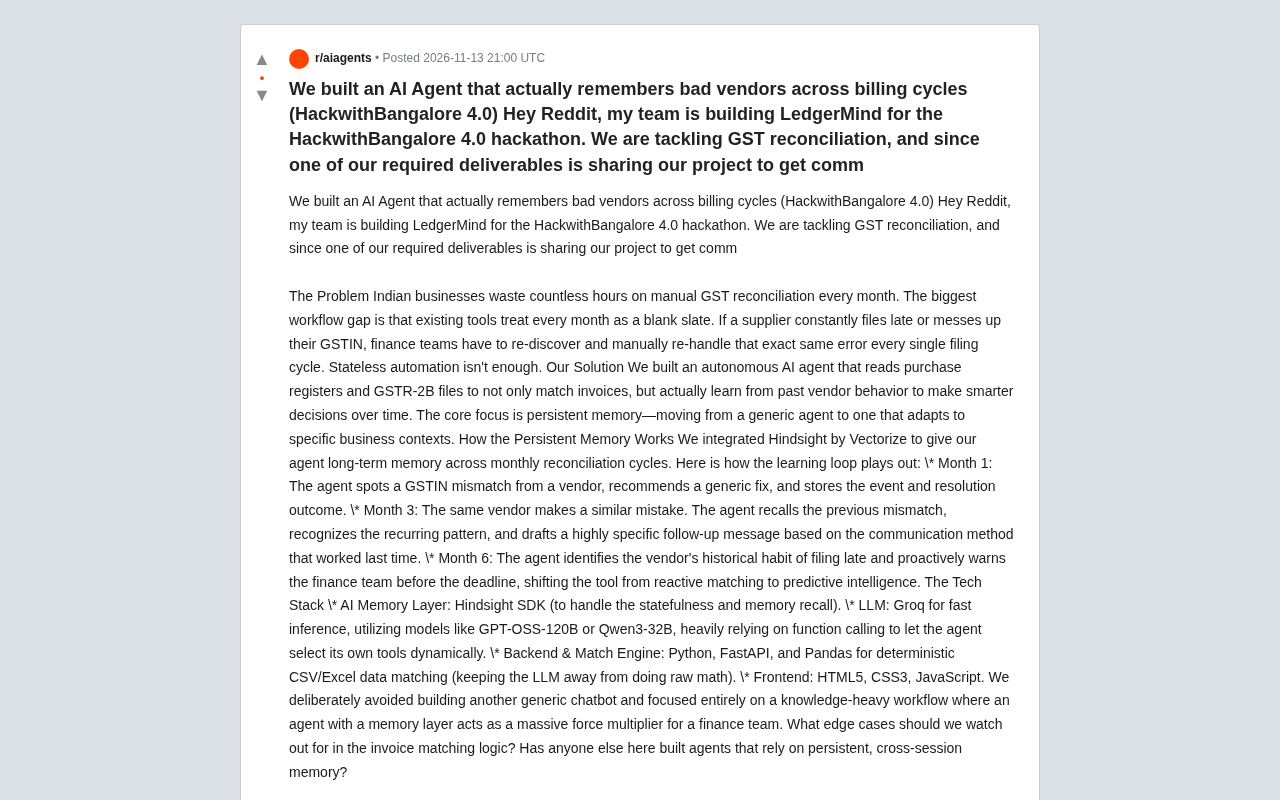
The Problem: Stateless Automation Can't Solve Recurring Errors
LedgerMind's description of the pain point is quite precise: the core contradiction in GST reconciliation isn't insufficient matching compute in any single month, but the continuity of supplier behavior. If a supplier consistently files late or frequently enters the wrong GSTIN, stateless automation tools can't bring "what happened last month" into this month's decisions, leaving finance staff to fall back on experience and manual memory.
According to the team's Reddit post, this constitutes the biggest gap between existing tools and real-world finance workflows. They attribute this class of problem to the limitations of "stateless automation"—tools can compute, but they can't accumulate judgment.
GST (Goods and Services Tax) is a multi-stage value-added tax system that India has implemented since 2017, levied on the supply of goods and services. GST reconciliation is a key step in corporate finance: enterprises must match their purchase ledgers against GSTR-2B (the auto-drafted input tax statement) generated by the government portal each month to confirm deductible input tax. If a supplier fails to file on time or enters an incorrect GSTIN (GST identification number), it can lead to failed input tax credits or tax notice risks. Reconciliation is therefore not just data comparison but also ongoing tracking of and communication about supplier filing behavior. Traditional automation tools typically process files independently on a monthly basis and lack cross-cycle state memory—precisely the root cause of the "reset to zero every month" problem that LedgerMind points out.
The Solution: A Memory Layer That Drives Cross-Cycle Supplier Profiles
LedgerMind's approach is to build an autonomous agent that can read purchase ledgers and GSTR-2B files, complete invoice matching, and learn from historical supplier behavior. A key technical piece is integrating Hindsight from Vectorize to give the agent long-term memory across monthly reconciliation cycles.
The focus of this design isn't to make the LLM do more computation, but to have it invoke the right memory at the right time. The team explicitly states that the goal is to move from a "general-purpose agent" to an agent "adapted to a specific business context."
How the Learning Loop Evolves Month by Month
The team provides a clear three-stage example in the post, which is also the most convincing part of the whole piece:
- Month one: The agent finds a GSTIN mismatch for a supplier, offers a generic fix suggestion, and stores the event and its resolution.
- Month three: The same supplier makes a similar error again; the agent recalls the earlier match record, identifies the recurring pattern, and drafts a highly specific follow-up message based on the communication approach that worked last time.
- Month six: The agent recognizes the supplier's long-term pattern of late filing, proactively reminds the finance team before the deadline, and pushes the tool from passive matching toward predictive judgment.
The value of this evolution path is that it turns "memory" from a technical selling point into quantifiable business actions—from spotting problems, to reusing communication strategies, to early warning. For finance teams, the effects at month three and month six are where the real labor savings lie.
Vectorize is a company that provides data retrieval and AI memory infrastructure, and its product Hindsight is a long-term memory layer designed specifically for AI agents. Unlike simple session caching, Hindsight allows agents to store, retrieve, and update structured memories across multiple independent sessions—for example, a supplier's historical behavior records, past communication strategies, and their effectiveness. In LedgerMind's scenario, Hindsight serves as an "experience repository" across monthly reconciliation cycles: the agent writes events and resolutions after each reconciliation, and in subsequent cycles recalls relevant memories by supplier identity to make more context-appropriate decisions. This persistent memory mechanism is the core technical prerequisite for shifting from a general-purpose agent to a business-context-adaptive agent.
Tech Stack: Letting Deterministic Computation and the LLM Each Play Their Part
LedgerMind's architectural choices deserve separate mention. According to the original post, its stack includes: Hindsight SDK for the AI memory layer, responsible for state and memory recall; Groq for the LLM layer for fast inference, calling models such as GPT-OSS-120B or Qwen3-32B and relying heavily on function calling to let the agent dynamically select tools; Python, FastAPI, and Pandas for the backend and matching engine, using deterministic code for CSV/Excel data matching; and HTML5, CSS3, and JavaScript for the frontend.
One design decision stands out: the team deliberately delegates raw math to deterministic logic such as Pandas, avoiding having the LLM directly handle amounts and matching computations. This is a pragmatic way to reduce hallucination risk in finance scenarios, and it shows a clear-eyed understanding of the LLM's capability boundaries.
The team also stresses that they didn't build another general-purpose chatbot, but focused on knowledge-intensive workflows, making the memory-equipped agent a "force multiplier" for finance teams.
Function calling is a capability of large language models: during reasoning, the model can output structured call instructions (such as specifying a tool name and parameters) based on the user's request and the list of available tools, and an external system executes the actual computation or data operation before returning results to the model to continue the conversation. In finance automation scenarios, this mechanism means the LLM doesn't have to handle amount calculations directly but instead plays the role of "orchestrator"—deciding when to call a Pandas matching function, when to query the memory layer, and when to generate a communication message. Groq, meanwhile, is an AI chip and cloud services company focused on low-latency inference; its LPU (Language Processing Unit) architecture is optimized for LLM inference and can deliver token generation speeds far above general-purpose GPUs, making it suitable for agent workflows with real-time responsiveness requirements.
Open Questions: Edge Cases and Memory Reliability
The post ends by posing two questions to the community: what edge cases should invoice matching logic focus on? Has anyone built an agent that relies on persistent cross-session memory? This precisely highlights two soft spots of this type of solution.
First, the robustness of matching logic. GST reconciliation involves complex situations such as format differences, similar names, and partial matches, and the deterministic engine needs to cover enough exception branches. Second, the correctness and timeliness of memory—if the historical records themselves are wrong, or are over-generalized and applied to different suppliers, the agent's "experience" can instead amplify errors. Such systems also need to consider mechanisms for updating and invalidating memories to avoid old conclusions polluting judgment over the long term.
It should be noted that the above information comes from a single-source share by the LedgerMind team on Reddit; the project is at the hackathon stage and has not yet disclosed measured data such as accuracy or processing scale. Its memory-driven approach offers a useful reference for the finance automation direction, but actual results still need verification.
One-line Summary
LedgerMind uses cross-cycle persistent memory to transform GST reconciliation, letting agents accumulate judgment about supplier behavior.
Paragraph Summary
Targeting the stateless "reset to zero every month" flaw of existing tools in Indian GST reconciliation, the LedgerMind team proposes an AI agent with cross-month persistent memory. The agent reads purchase ledgers and GSTR-2B files to complete invoice matching and uses Vectorize's Hindsight memory layer to store historical supplier behavior, evolving from generic fix suggestions in month one, to reusing effective communication strategies in month three, to proactive pre-deadline warnings in month six. On the tech stack, the team uses deterministic code such as Pandas for amounts and matching computation, with the LLM selecting tools via function calling to reduce hallucination risk. The project is still at the hackathon stage; the team publicly raises two open questions—matching edge cases and memory reliability—and actual results remain to be verified.
Related articles

Zed Editor Releases v1.29.2: Observations on a Routine Version Iteration
Zed editor releases patch v1.29.2, version bump by @JosephTLyons, commit verified via GitHub signature. This article covers the release's basic info, what a patch version means, and practical upgrade advice for users.

Anthropic IPO Questioned: Hacker News Debates Timing of Going Public
A Hacker News post titled "Just say no to Anthropic's IPO" sparks debate on the timing of Anthropic's public listing and AI capitalization, touching on valuation bubbles and mission independence.

Hands-On with the Genie 4 World Model: Directing Worlds in Real Time Like a Puppeteer
Google DeepMind's Genie 4 world model in depth: Special Guest X's hands-on demo of real-time scene direction via prompts, custom interactive apps in Project Genie, and prompts-as-seeds reproducibility.