GPT-6.2 Rainy Night Street Corner Drawing Test: Which of the Four Models Comes Out on Top?
GPT-6.2 dual-model rainy night SVG showdown: Sore is faster, Astra adds quality and cuts price.
A Bilibili creator used the Codex platform to have four AI models draw the same rainy night neon street corner SVG illustration in Ultra mode, comparing the GPT-6.1 and 6.2 generations of Sore and Astra. Results show 6.2 Sore took 16m26s, 3m42s faster than 6.1 Sore's 20m08s, with character actions closer to 'just seeing each other'; 6.2 Astra took 13m30s, 2m05s slower than 6.1 Astra's 11m25s, but with richer street scene details. On cost, Astra API prices were cut 20%, with the fee for 10,000 input and 20,000 output tokens dropping from $1.10 to $0.88. The experiment reflects GPT-6.2's differentiated positioning: Sore emphasizes efficiency, Astra emphasizes quality, letting users choose as needed.
A Rainy Night Street Corner Model Showdown
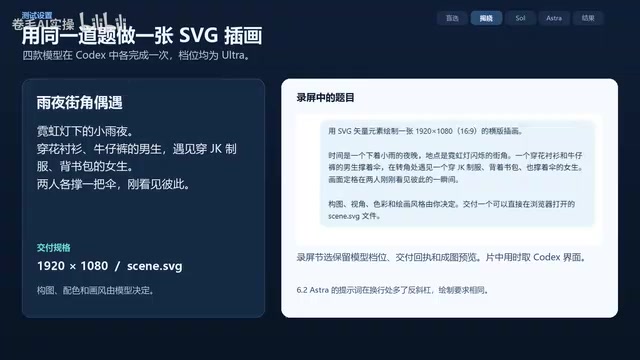
When the same drawing prompt is handed to four different AI models, what different visual interpretations will emerge? A Bilibili creator launched an interesting experiment on the Codex platform: having four models draw the same SVG illustration in Ultra mode — "a rainy night neon street corner, two people each holding an umbrella, just catching sight of each other." These four images not only reveal stylistic differences between the models, but also reflect the practical changes brought by the GPT-6.2 upgrade.
SVG Illustration Generation: SVG (Scalable Vector Graphics) is an XML-based vector image format. Unlike common bitmaps (such as JPEG and PNG), it describes graphics through mathematical paths and does not lose quality when scaled. In the AI drawing field, requiring a model to generate SVG code rather than directly outputting pixel images essentially tests the model's code generation and spatial reasoning abilities: the model must understand the relationships between objects in the prompt (such as two people each holding an umbrella and the neon at the street corner) and translate them into coordinates, paths, and style rules. This "drawing with code" approach relies more on the model's grasp of structure than directly generating images, and it also more easily exposes differences in how different models plan details.
Ultra Mode: On some AI platforms, Ultra mode usually refers to an enhanced reasoning or high-quality output mode that may invoke more complex internal processes or a larger compute budget to improve the refinement of generated results. In this experiment, Ultra mode was uniformly enabled to let the four models compete under the same high-quality setting, so that stylistic differences would better reflect the models' own design orientations rather than fluctuations caused by mode switching.
Model Positioning and Cost Analysis
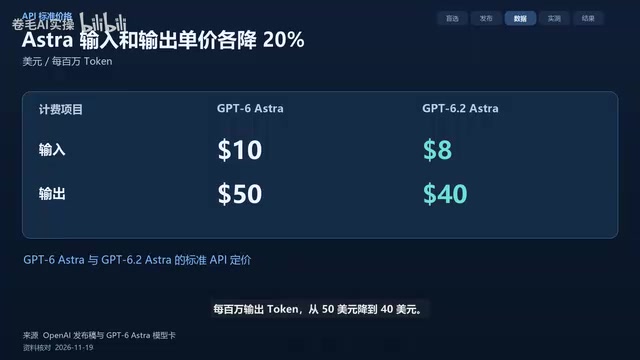
GPT-6.2 introduces two new models this time: Astra and Sore. According to the official introduction, Astra targets complex projects such as documents, spreadsheets, and programming, emphasizing the delivery quality of professional outcomes; Sore targets daily work, emphasizing efficiency in handling multi-step tasks. In terms of cost, Astra's standard API input and output prices were both reduced by 20%, with the price per million input tokens dropping from $10 to $8 and output from $50 to $40. Calculated based on the usage of 10,000 input and 20,000 output tokens in the image, the cost drops from $1.10 to $0.88. Sore uses the previous generation's API pricing, at $2 per million input tokens and $10 for output. In a third-party AA MirrorMix benchmark estimate, when task time dropped from 23.5 minutes to 8.5 minutes, the weighted average cost fell from $1.27 to $1.01. These data snapshots are dated November 19.
Tokens and API Pricing: A token is the basic unit of text processed by a language model, and can be understood as a word or word fragment. APIs generally price input and output separately per million tokens, which is standard industry practice. Input tokens refer to content such as the prompt sent by the user, while output tokens refer to the response generated by the model. In this article, "10,000 input and 20,000 output" means that one task consumes 10,000 input tokens and 20,000 output tokens, from which the cost per run can be calculated. Astra's standard API input price dropped from $10 per million to $8, and output from $50 to $40, both a 20% reduction, so the total cost fell from $1.10 to $0.88. Understanding token pricing helps compare the cost-effectiveness of different models.
Comparison of the Four Models' Performance
The experiment uniformly enabled Astra mode and required the models to draw SVG illustrations with code. Among the four images, A and B are the two generations of Sore, and C and D are the two generations of Astra.
Sore Group: Notable Speed Improvement
Image A came from 6.1 Sore and took 20 minutes 08 seconds; Image B came from 6.2 Sore and took 16 minutes 26 seconds. Both images depict two people stopping in the middle of the street, with warm and cool neon reflections spreading across the ground on the left and right sides. In terms of detail, however, the figures in Image A look more like they have stopped, while in Image B the young man is stepping forward and the young woman turns her head, with the street extending backward from the shop corner, closer to "the moment of just touching."

Astra Group: Richer Detail
Image C came from GPT-6 Astra and took 11 minutes 25 seconds; Image D came from 6.2 Astra and took 13 minutes 30 seconds. In Image C, cyan and pink tones echo the neon on both sides, the figures are closer to the camera, and the background reveals a neon-lit alley receding inward; in Image D, the record store, bicycle, and shimmering water on the wet ground add considerable detail to the street corner.

The Trade-off Between Speed and Quality
In this round, the new Sore was faster, while the new Astra was slower. The times were taken from the single-delivery records shown by Codex, with each model run once. For this rainy night illustration prompt, the creator felt that the character actions and street scene details in 6.2 were more to their liking.
From the experiment, it can be seen that GPT-6.2 significantly improved processing efficiency on the Sore model while reducing the cost of Astra. Although Astra's drawing speed decreased, its detail expression is stronger, making it more suitable for scenarios with high quality requirements. This differentiated positioning allows users to choose flexibly according to task needs.
Limitations of Single-Delivery Records: The times in this article are taken from the single-delivery records shown by Codex, with each model run once. A single sample is easily affected by random factors such as network conditions and load, and cannot fully represent a model's stable performance. However, combined with the performance of the four models on the same task, trends can still be observed: the new Sore is faster, and the new Astra offers higher quality, which corroborates the official positioning (Sore emphasizes efficiency, Astra emphasizes quality). For more rigorous conclusions, multiple repeated experiments should be conducted and averages taken.
Conclusion
The four models' rainy night street corner works each have their own merits. Which one do you like better? Feel free to leave your thoughts in the comments.
Related articles
LangChain Beginner's Guide: From LLM Limitations to Agent Development
What is LangChain? This guide covers the three key limitations of LLM APIs — knowledge cutoff, business data disconnect, and no session persistence — plus LangChain's positioning, 1.0 architecture changes with LangGraph, and how to get started.

T3 Code Hands-On: An MIT Open-Source Multi-Agent Coding Console
In-depth hands-on with MIT open-source T3 Code: no token reselling, directly takes over local official CLIs, supports ACP protocol and Git Worktree isolation for multi-agent parallel coding, auto review, and mobile remote approval.
Did AI Really Solve a Black Hole Physics Problem? Anthropic's Claim Is Questionable
Anthropic says Claude Fabel 5.2 helped solve two black hole physics problems, but the announcement names no problems and shows no derivation. We break down the claim.