Graph Engineering: The Core Paradigm and Design Patterns for AI Agent Orchestration

Graph engineering applies classical state machine and DAG patterns to orchestrate reliable AI agent systems.
Graph engineering abstracts AI agent execution flows into directed graphs of nodes and edges to balance flexibility with controllability. This article explores why the pattern is gaining traction for coding agents, and covers key design patterns including reflection and self-correction, branching and routing, human-in-the-loop, and parallel execution with aggregation—all aimed at making agent outputs more observable, debuggable, and reproducible.
Why Graph Engineering Is Suddenly Popular
Recently, "Graph Engineering" has become a hot topic in the AI development community. But let's be clear: graph engineering itself is not new—its underlying patterns have existed for a long time. What's actually changed is that more and more engineers are actively adopting these patterns, for a simple reason: they need to solve the persistent problem of inconsistent output quality from coding agents.
Coding agents are AI systems built on large language models that can autonomously perform software development tasks such as writing code, debugging, and refactoring. Representative products include GitHub Copilot Workspace, Devin, Cursor Agent, and others. The core challenge with these systems is that large language models are fundamentally probabilistic text generators whose outputs are influenced by multiple factors including temperature parameters, context window limitations, and training data distribution. Even with identical prompts, models may produce significantly different results across different runs. In code generation scenarios, this non-determinism is particularly dangerous—a minor logical deviation can cause program crashes or produce bugs that are extremely difficult to trace.
Once large language models are given the ability to execute tasks autonomously, a core pain point emerges: agent outputs are often unpredictable. The same task might yield near-perfect results one time, yet produce logical jumps, missing steps, or completely off-track outputs the next. This "uneven output" is one of the biggest obstacles to deploying agent applications in production today.
The core idea behind graph engineering is to abstract an agent's execution flow into a "graph"—a directed structure composed of Nodes and Edges—to constrain and guide agent behavior, thereby striking a balance between flexibility and controllability.
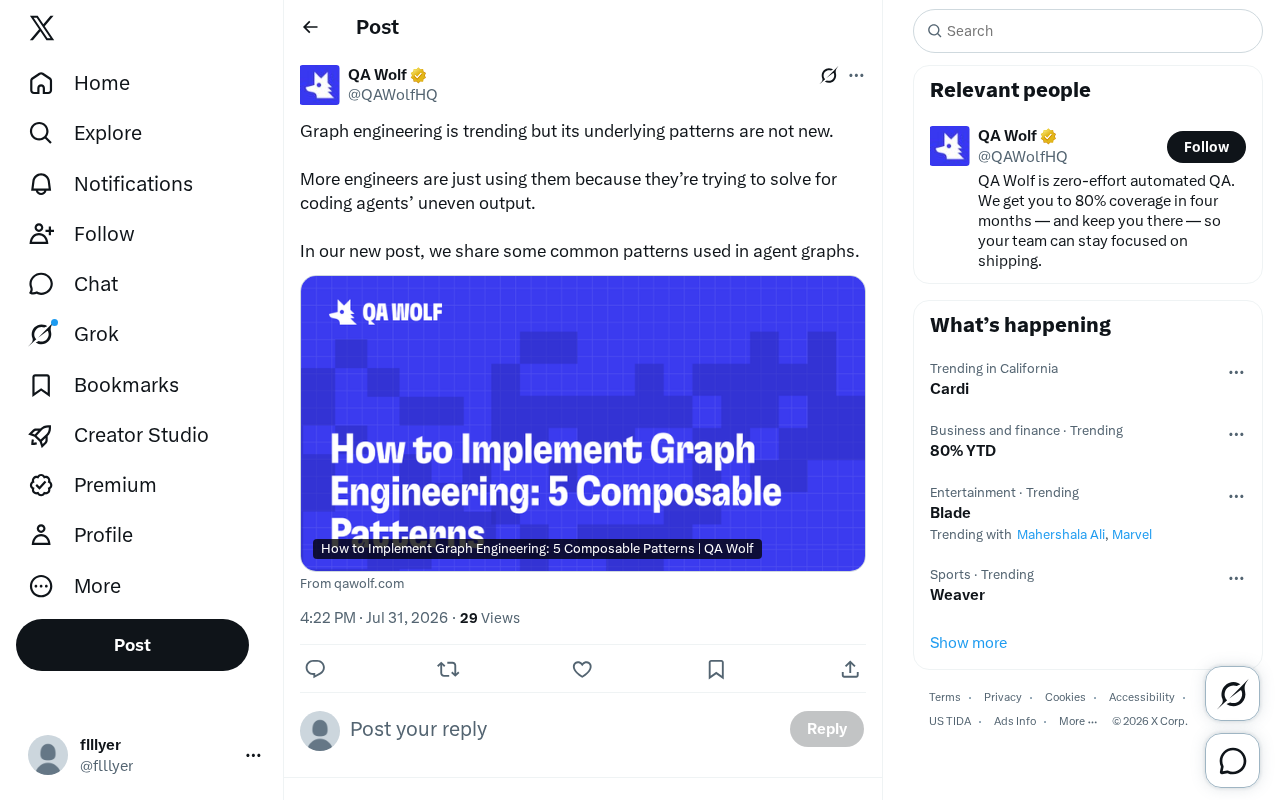
How Graph Structures Constrain Agent Behavior
From Linear Chains to Directed Graphs
Early agent frameworks mostly adopted linear "Chain" structures: inputs pass through a series of fixed steps to ultimately produce outputs. This approach is simple and straightforward but lacks flexibility—once a step requires loops, branching, or backtracking, linear structures quickly fall short.
Graph structures naturally support these complex control flows. Each node represents a well-defined processing unit (such as tool invocation, reasoning, or validation), and each edge represents a state transition path. By defining connection relationships and conditional jumps between nodes, engineers can precisely plan "what the agent should do next."
The Return of Classical Paradigms
The essence of this approach is reapplying classical paradigms that have long existed in software engineering—State Machines and Directed Acyclic Graphs (DAGs)—to AI agent orchestration.
A Directed Graph is a fundamental concept in graph theory, consisting of a set of vertices and a set of directed edges. A Directed Acyclic Graph (DAG) is a directed graph that contains no cycles, widely used in task scheduling, compiler optimization, data flow analysis, and other domains. The core abstraction of modern data orchestration tools like Apache Airflow and Prefect is the DAG. A State Machine is a classical model from computation theory where a system is in exactly one of a finite number of states at any given time, transitioning between states upon receiving inputs. In agent orchestration, the deterministic transition rules of state machines can effectively constrain the non-deterministic behavior of models, ensuring the system operates along predictable paths. LangGraph combines both of these abstractions to provide a graph-based orchestration framework for LLM applications.
What's called a "new trend" is simply old wisdom being reapplied in new contexts.
Common Design Patterns in Agent Graphs
When building agent systems in practice, the following graph design patterns are widely adopted, each addressing reliability concerns across different dimensions.
Reflection and Self-Correction Pattern
One of the most effective patterns for addressing output instability is introducing a Reflection Node. After generating preliminary results, the agent doesn't deliver them directly. Instead, the results flow via an edge to a dedicated "review" node that performs self-inspection. If issues are found, conditional edges route the flow back to the regeneration stage, forming a correction loop.
The reflection pattern draws inspiration from the concept of metacognition in cognitive science—"thinking about thinking." In terms of technical implementation, reflection nodes typically employ prompt strategies different from generation nodes—generation nodes are instructed to complete the task, while reflection nodes are assigned a critic role, scoring and diagnosing outputs according to predefined evaluation criteria (such as whether the code passes type checking, conforms to requirement specifications, or contains security vulnerabilities). In some advanced implementations, reflection nodes even run automated tests and static analysis tools to obtain objective feedback, then inject these signals into the context of the next generation round. The paper Reflexion: Language Agents with Verbal Reinforcement Learning systematically demonstrates the effectiveness of this pattern.
This "generate—review—correct" closed loop can significantly improve the final quality of coding tasks and is a core technique for addressing the inconsistency of AI agent outputs.
Branching and Routing Pattern
When facing different types of tasks, a single path is clearly insufficient. The Router pattern uses a decision node to determine the task type and dispatches it to the most appropriate sub-process. For example, code generation, code review, and documentation writing can follow entirely different execution branches.
The routing pattern is a foundational building block for Multi-Agent System design. In industrial practice, routing decisions can be rule-based (e.g., regex matching on task keywords), classifier-based (training dedicated intent recognition models), or LLM-based (having the model analyze the task type and select a path). Frameworks like Microsoft's AutoGen and CrewAI have built-in routing and task distribution mechanisms. In more complex implementations, different branches may invoke models of different scales or specializations—for example, simple format conversion tasks are routed to lightweight models to save costs, while complex architectural design tasks are routed to larger models with stronger reasoning capabilities. This "expert division of labor" approach is analogous to a system-level manifestation of Mixture of Experts models.
The routing pattern allows agents to maintain generality while enabling deep optimization for specific tasks, making it a foundational architectural pattern for building multi-functional agents.
Human-in-the-Loop Pattern
In high-risk scenarios, fully autonomous agents are undesirable. The Human-in-the-Loop (HITL) pattern places "checkpoint" nodes in the graph that pause at critical decision points and wait for human confirmation. This serves both as a quality assurance mechanism and as a necessary component for building trustworthy AI systems.
Human-in-the-loop is not an invention of the AI era—its roots trace back to human oversight mechanisms in industrial control systems and the "human-in-the-loop" decision principle in military domains. In agent systems, the engineering implementation of HITL typically involves asynchronous message queues, WebSocket long connections, or polling mechanisms to maintain the state of human-machine interaction sessions. Key design decisions include: at which nodes to set checkpoints (typically before irreversible operations), timeout policies (how to handle cases where humans don't respond for extended periods), and approval granularity (item-by-item confirmation versus batch approval). In enterprise deployments, HITL also needs to integrate with permission management systems to ensure that operations of different levels are approved by personnel with corresponding authority.
For scenarios involving irreversible actions such as code deployment and data operations, the human-in-the-loop pattern is virtually a mandatory choice.
Parallel Execution and Aggregation Pattern
For complex tasks that can be decomposed, graph structures support splitting them into multiple parallel nodes for simultaneous execution, then consolidating results through an aggregation node. This not only improves execution efficiency but can also reduce the randomness of individual outputs through techniques like "multi-path voting," enhancing result robustness.
The practice of executing multiple LLM calls in parallel and aggregating results has its theoretical foundation in Ensemble Learning and redundant system design. Specific aggregation strategies include: majority voting—selecting the answer that appears most frequently; best-of-N—generating N candidate solutions in parallel and selecting the optimal one via a scoring function; and synthetic aggregation—fusing the strengths of multiple outputs into a single, more complete answer. Research shows that even using the same model, best-of-N sampling can significantly improve accuracy on tasks like mathematical reasoning and code generation. This trade-off of computational resources for reliability has a deep tradition in the design philosophy of safety-critical systems.
The Value and Limitations of Graph Engineering
Core Value: Observable, Debuggable, Reproducible
The true significance of graph engineering lies in providing agents with an observable, debuggable, and reproducible execution framework. When an agent's behavior is explicitly modeled as a graph, engineers can clearly see where things went wrong and optimize accordingly. This stands in stark contrast to "black box" end-to-end invocations.
The tooling ecosystem for graph engineering is rapidly taking shape. LangGraph is a graph-based agent orchestration framework from the LangChain team that supports cyclic graphs and persistent state management; Microsoft's AutoGen uses conversation-driven multi-agent graph orchestration; workflow engines like Temporal and Inngest are increasingly being used for agent process orchestration, providing durable execution, automatic retries, and observability. On the visualization front, platforms like LangSmith and Braintrust offer real-time tracing and debugging capabilities for graph execution, enabling engineers to inspect inputs, outputs, latency, and token consumption node by node. The maturity of these toolchains directly influences how quickly graph engineering patterns are adopted in production environments.
Limitations to Be Aware Of
However, it's important to remain clear-eyed: graph engineering is not a silver bullet. Overly complex graphs introduce maintenance burden and may even constrain the model's own reasoning capabilities. The fundamental tension always remains: how much freedom to give the agent versus how much constraint to impose. Graph engineering provides a knob for adjusting this balance—not a once-and-for-all answer.
Conclusion
The popularity of graph engineering reflects a maturing shift in AI engineering from "pursuing model capabilities" to "pursuing system reliability." When engineers realize that even the most powerful models require careful orchestration to deliver stable results in production, those battle-tested classical software engineering patterns are once again brought back to center stage.
For developers building agent applications, understanding these graph orchestration patterns not only helps solve current output quality issues but also cultivates a systematic way of thinking—treating AI as an engineering system that requires designed workflows, controlled states, and exception handling, rather than merely a conversational black box.
Related articles
Under 200 Lines of Code: Building an Agent from Scratch and Demystifying OpenClaw
Build an Agent from scratch in under 200 lines of code. Covers LLM calls, while loops, history memory, system prompts, tool calling, and progressive skill disclosure.

AI Agent for Beginners: From Large Language Models to Intelligent Agent Development
A beginner's guide to AI Agent development: from AI, ML, and deep learning to Transformer and LLMs, plus a 4-stage learning roadmap covering Prompt engineering, RAG, MCP, and LangChain.
4 Top AI Models Build a Gladiator Game from Scratch: A Deep Dive into Multi-Agent Collaboration
A creator used Fable 5, Opus 5, GPT, and GROK in a multi-agent system to build a gladiator game from scratch. This breakdown covers orchestration loops, zero-context judging, Trippo 3D generation, and real failure cases where AI fooled its own reviewers.