AI Agent for Beginners: From Large Language Models to Intelligent Agent Development
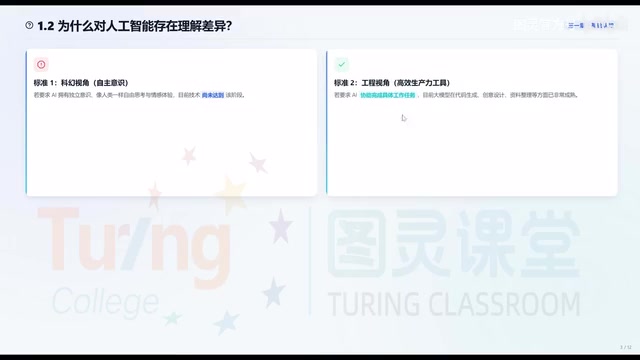
A complete beginner's map from AI fundamentals to Agent development, covering LLMs, Transformer, and a 4-stage learning path.
This article systematically maps the technical hierarchy from artificial intelligence and machine learning to deep learning and large language models, explaining how the Transformer architecture and attention mechanism underpin modern LLMs. It argues that AI role requirements have shifted from API usage to building autonomous Agents, and that everyday developers should focus on application-building rather than model research. A four-stage Agent learning roadmap is provided, covering ReAct, multi-agent collaboration, RAG, LangChain, and more.
Why AI Agent Development Is Now a Core Skill for AI Practitioners
The skill requirements for AI roles are evolving rapidly. Not long ago, knowing basic RAG retrieval and being able to call a large model API was enough to stand out. Today, that skill set no longer provides a competitive edge. The real dividing line is this: can you independently build an intelligent Agent that thinks autonomously, plans, calls various tools, and closes the loop on complex tasks?
According to an introductory large model course by Bilibili creator Jinze, the reason Agents matter is that they fundamentally change how humans and AI collaborate. An Agent doesn't just passively answer questions — it understands goals, forms plans, invokes tools to execute tasks, and completes a full intelligent loop. For example, ask it to analyze your company's sales performance, and it can automatically pull data, analyze trends, generate a report, and offer recommendations. This leap from "answering" to "acting" is exactly why Agent development is considered a core hard skill for AI practitioners.
Before Learning Agent Development, Clarify the Hierarchy of AI Concepts
Many newcomers to AI get the concepts confused. Some think artificial intelligence is just ChatGPT; others believe large models are all there is to AI; still others treat machine learning, deep learning, and large models as entirely separate technologies. In reality, these concepts have a clear hierarchical structure and developmental lineage.
Artificial Intelligence (AI) is the outermost domain — the study of how to give machines capabilities similar to human learning, understanding, reasoning, and action. It spans computer science, mathematics, statistics, linguistics, and even neuroscience. Rather than applying a science-fiction standard (like JARVIS's self-awareness), a more practical engineering perspective is useful: if a machine can complete tasks that previously required human effort, it can be considered to possess some degree of intelligence.
Two landmark moments stand out in AI history: IBM's Deep Blue defeating chess champion Garry Kasparov in 1997, and AlphaGo defeating Go champion Lee Sedol in 2016. Deep Blue relied on search algorithms — analyzing vast numbers of possible moves in advance and evaluating win probability using predefined rules. This works well in domains with clear rules. But countless real-world tasks (writing an essay, judging whether an image contains a cat) can't be exhaustively captured by preset rules — and that's what drove AI into its next phase.
The Three Paradigms of Machine Learning
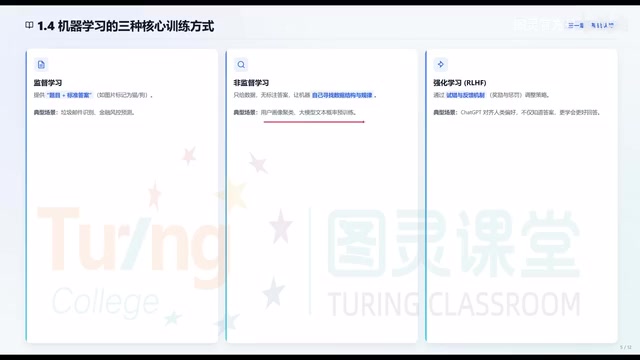
When rules can't cover every case, the alternative is to let machines learn patterns from data themselves. This is machine learning, which includes three classic paradigms:
Supervised Learning
The machine is given labeled data — questions paired with answers. Like a student working through practice problems, image A is labeled "cat" and image B is labeled "dog." The machine repeatedly learns the relationship between images and labels until it can correctly predict labels for new images. Spam email detection and financial risk systems mostly use this approach.
Unsupervised Learning
Data is provided without answers, and the machine finds hidden patterns on its own. For example, given large amounts of user data — age, browsing habits, purchase records — the model identifies which users behave similarly and can be grouped together. Large model training borrows heavily from this idea: feed the model massive amounts of text and have it learn language patterns by predicting missing content ("Tonight I'm going to ___").
Reinforcement Learning
Behavior is adjusted through trial-and-error and feedback — similar to a child learning to walk: fall down, adjust, succeed, receive positive feedback. After completing its foundational training, ChatGPT underwent further optimization through human feedback to improve response quality. This is the widely mentioned RLHF (Reinforcement Learning from Human Feedback), which teaches the model not just what to say, but how to say it better.
The RLHF process unfolds in three steps: first, supervised learning trains a base model capable of generating reasonable responses; second, human annotators rank multiple candidate responses, training a "reward model" to simulate human preferences; third, a reinforcement learning algorithm (typically PPO) continuously adjusts the language model so its outputs score highly on the reward model. The significance of this mechanism is that it addresses the limitations of pure text-prediction training — a model that learns to predict the next word doesn't automatically learn to be helpful, harmless, and honest. RLHF takes a model from "able to speak" to "able to speak well." The breakthrough user experience of InstructGPT and ChatGPT owes much of its success to this approach.
Deep Learning and Transformer: The Technical Foundation of Large Models
For tasks involving enormous amounts of information — image recognition, speech understanding, natural language processing — traditional machine learning hit a ceiling. Deep learning emerged to address this. Its core is the neural network, a computational model inspired by how neurons connect in the human brain. Information passes through multiple layers of processing: the first layer learns edges and colors, the second learns shapes and structure, the third learns how objects are composed. The more layers, the richer the information the model can learn. To address the problem of information loss in deep networks, residual connections (skip connections) became a crucial foundation for modern deep learning.
The true turning point came from a paper by eight Google researchers: Attention is All You Need. Human language is tricky — the same word can mean different things in different contexts, and language carries vast amounts of implicit information. The attention mechanism introduced by Transformer lets the model simultaneously attend to context and related information while processing any given word.
Take the sentence: "Apple released a new phone, and it has been well received by many users." The model needs to determine what "it" refers to. The attention mechanism allows the model to automatically connect "it" to "Apple's phone" from earlier in the sentence, establishing an accurate semantic link.
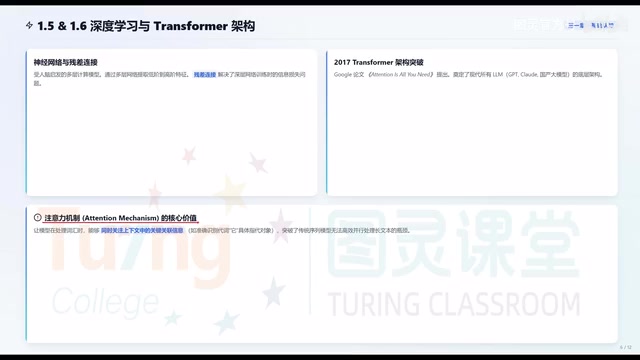
Transformer's greater value lies in its ability to efficiently process massive amounts of text data. Traditional Recurrent Neural Networks (RNNs) work like a chain of passing notes — when text is too long, earlier content gets forgotten. Transformer's attention mechanism analyzes multiple parts of a text simultaneously, making it possible to handle longer, more complex information. Researchers then discovered that continuously scaling up model size, adding training data, and increasing compute power leads to consistently improving capabilities — this is the core logic behind the explosion of large models.
Another key design in the Transformer architecture worth understanding is Positional Encoding. The attention mechanism itself is "orderless" — it looks at all words simultaneously but doesn't know their sequence. Positional encoding solves this by attaching position information to each word, enabling the model to capture both semantic relationships between words and sequential information like "the subject comes before the verb." Additionally, the original Transformer consists of an Encoder and a Decoder: BERT-style models use only the encoder and excel at understanding and classification tasks; GPT-style models use only the decoder and focus on text generation. Today's mainstream large models are essentially all decoder-only architectures, which explains why they naturally suit dialogue and content generation scenarios.
From Judgment to Creation: The Qualitative Shift of Generative AI
Looking back at AI's development path — rules → machine learning → deep learning → Transformer — a clear shift emerges: earlier AI primarily classified and judged (is this spam? is this a cat?), while generative AI gained the ability to create content from scratch.
Getting a computer to write an essay used to be enormously difficult, because writing requires understanding a topic, organizing structure, and choosing expression. Today's large models can generate complete articles, code, and images from simple prompts. Three key factors drove the explosion of ChatGPT 3.5: accumulated data scale, a leap in compute power (GPU clusters), and architectural breakthroughs (Transformer).
Large Language Models (LLMs) are, at their core, AI systems trained on massive amounts of text data that can understand and generate natural language. For those looking to enter the AI application space, there's no need to go deep into underlying model architecture — what matters more is learning to build practical applications on top of existing large models.
The Role for Everyday Developers: Build Applications, Don't Reinvent the Wheel
Large models have lowered the barrier to human-machine collaboration: developers use them to assist with code generation and analysis, operations teams use them to organize information and generate content, and businesses use internal knowledge bases to build intelligent assistants.
A memorable framing from the course: large models are currently best suited not to fully replace roles, but to act as highly efficient assistants — taking over large amounts of repetitive work and freeing up human time for goal-setting, decision-making, and creative work. It's like the invention of the automobile — the vast majority of people don't study engine mechanics; they learn how to drive.

Mainstream large models each have their strengths: OpenAI's GPT series covers the widest range of use cases; Claude excels at long-text analysis and logical reasoning (particularly popular among developers); Google's Gemini is a multimodal model that handles text, images, audio, and video. In China, options include Alibaba's Qwen (open-source), Baidu's ERNIE, and DeepSeek. The key to choosing isn't which is objectively best, but which fits your task type, environment, and goals — enterprise scenarios also need to factor in data security, private deployment, and cost control.
The Four-Stage Learning Path for Agent Development
For those who want to systematically master Agent development, the course outlines a four-stage roadmap:
- Foundational Basics: Thoroughly understand core Agent theory — planning modules, memory modules, tool calling, and other underlying components. Build a solid foundation.
- Core Advancement: Understand how Agents operate internally, master classic Agent paradigms like ReAct and Code, and make the leap from understanding concepts to understanding principles.
- Skill Enhancement: Learn multi-agent collaboration and how multiple Agents divide responsibilities, while also practicing Prompt tuning for more precise and controllable outputs.
- Real-World Application: Combine everything learned to build 2–3 complete hands-on projects, such as an intelligent decision assistant, an office automation Agent, or a multi-agent collaboration system.
The tech stack covered in this path includes prompt engineering, RAG, MCP, LangChain, LangGraph, and other mainstream frameworks. Following these four stages diligently will lead to a meaningful, real improvement in your technical competitiveness in the AI space.
A brief note on the frameworks mentioned in the roadmap: LangChain is currently the most popular large model application development framework, offering pre-built modules for chained calls, tool integration, and memory management — dramatically lowering the barrier to Agent development. LangGraph is an advanced framework from the LangChain team that uses a Graph structure to describe Agent state transitions, making it better suited for complex multi-step, multi-branch workflows. RAG (Retrieval-Augmented Generation) is the core technology for enabling large models to answer questions using external knowledge bases, solving the problems of model knowledge cutoff dates and access to private data. MCP (Model Context Protocol) is an open protocol proposed by Anthropic that standardizes how models connect to external tools and data sources — widely considered important infrastructure for Agent tool-calling. Understanding what each of these frameworks is designed for helps you make informed technology choices as you progress through the learning path.
Conclusion
From Deep Blue's rule-based search to AlphaGo's deep learning, from Transformer's attention mechanism to today's generative AI, the logic of AI's evolution is clear and traceable. Understanding this technological lineage is an indispensable cognitive foundation before diving into Agent development. For everyday developers, the opportunity lies not in rebuilding large models from scratch, but in combining existing capabilities with specific business contexts to build intelligent applications that genuinely solve real problems.
Related articles
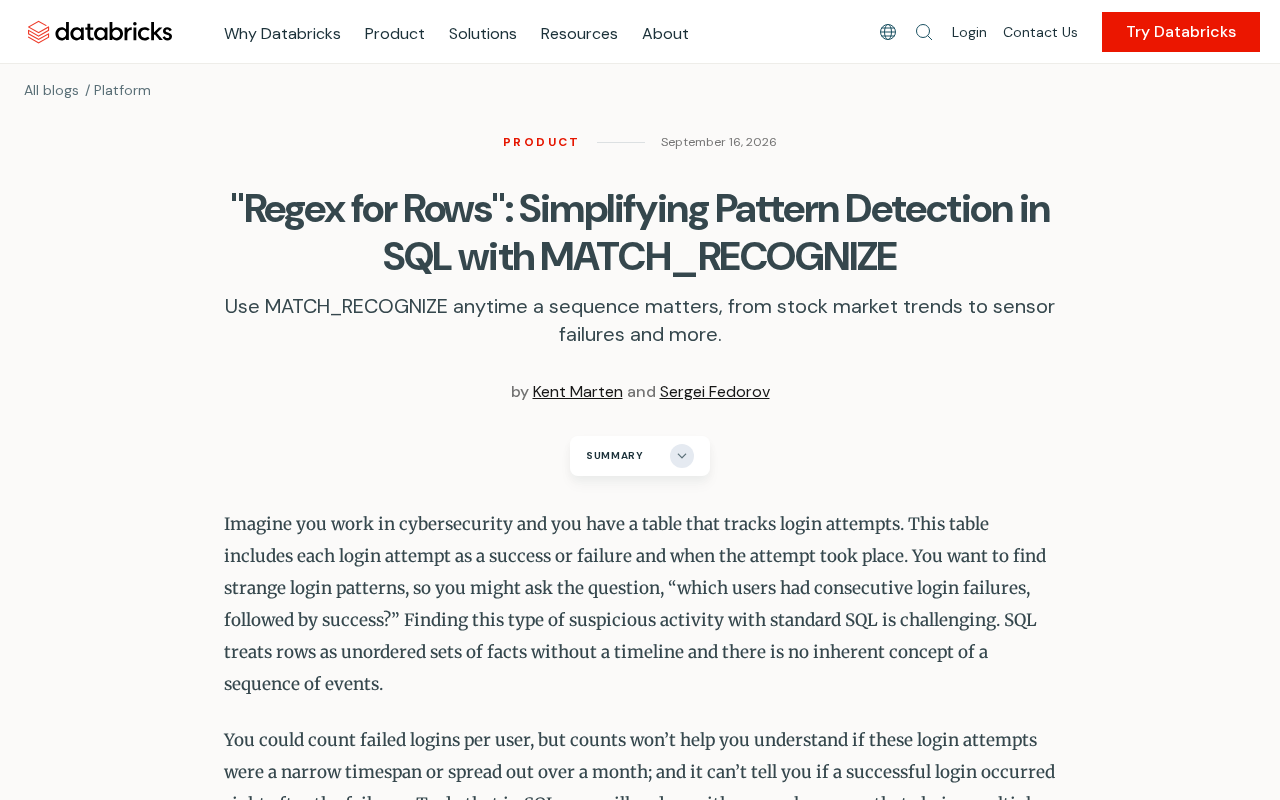
SQL Row Pattern Matching: Implementing "Row-Level Regex" with MATCH_RECOGNIZE
MATCH_RECOGNIZE gives SQL regex-like power over row sequences. Detect brute-force attacks, fraud patterns, and user behavior flows with clean, declarative syntax — no more messy self-joins.

Hackers Break Into Flock Surveillance Cameras, Exposing the Inner Workings of License Plate Recognition Systems
Hackers breached Flock Safety's ALPR cameras, exposing how license plate recognition systems collect data and the privacy and security risks they pose.
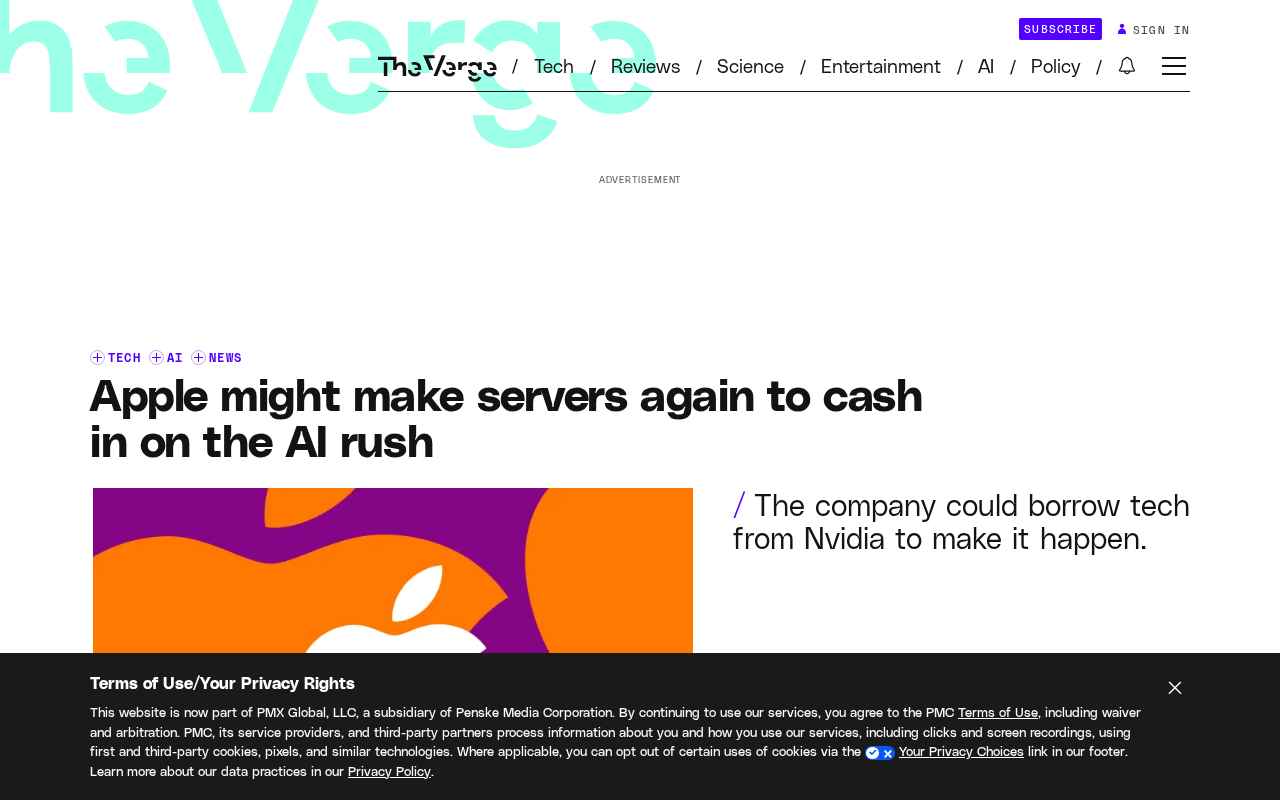
Apple May Return to the Server Market: Partnering with NVIDIA to Capture AI Computing Demand
According to The Information, Apple plans to re-enter the server market and may partner with NVIDIA to capitalize on surging AI computing demand — its first return to enterprise hardware since discontinuing the Xserve in 2011.