Hookdeck Inspect: A Free Webhook Testing Tool That AI Agents Can Use Too

Hookdeck Inspect simplifies webhook debugging with a zero-config real-time URL and targets AI Agent integration.
Inspect, released by Hookdeck on Product Hunt, is a zero-configuration webhook debugging tool that generates a real-time URL instantly, lets you view request headers, payload, and timestamps without registration, and includes mock templates for 500+ providers, eliminating the need for temporary services and NAT traversal. Its tagline "for you and your agent" shows it targets both human developers and AI Agents, giving Agents an observable event receiving entry point. Its free, no-account strategy makes it an entry point for Hookdeck's main product; it received 84 votes and ranked 6th on launch day. The article also notes that Inspect only covers receiving and viewing, lacks production-grade capabilities such as retries, persistence, and signature verification, and that public debugging addresses should not be used for sensitive data.
Webhook debugging has always been an easily overlooked yet frequently blocking part of the development workflow. The Inspect tool that Hookdeck released on Product Hunt attempts to solve this problem with a "zero-configuration" approach—designed not only for developers but also specifically for AI Agent scenarios.
An instantly usable webhook receiver
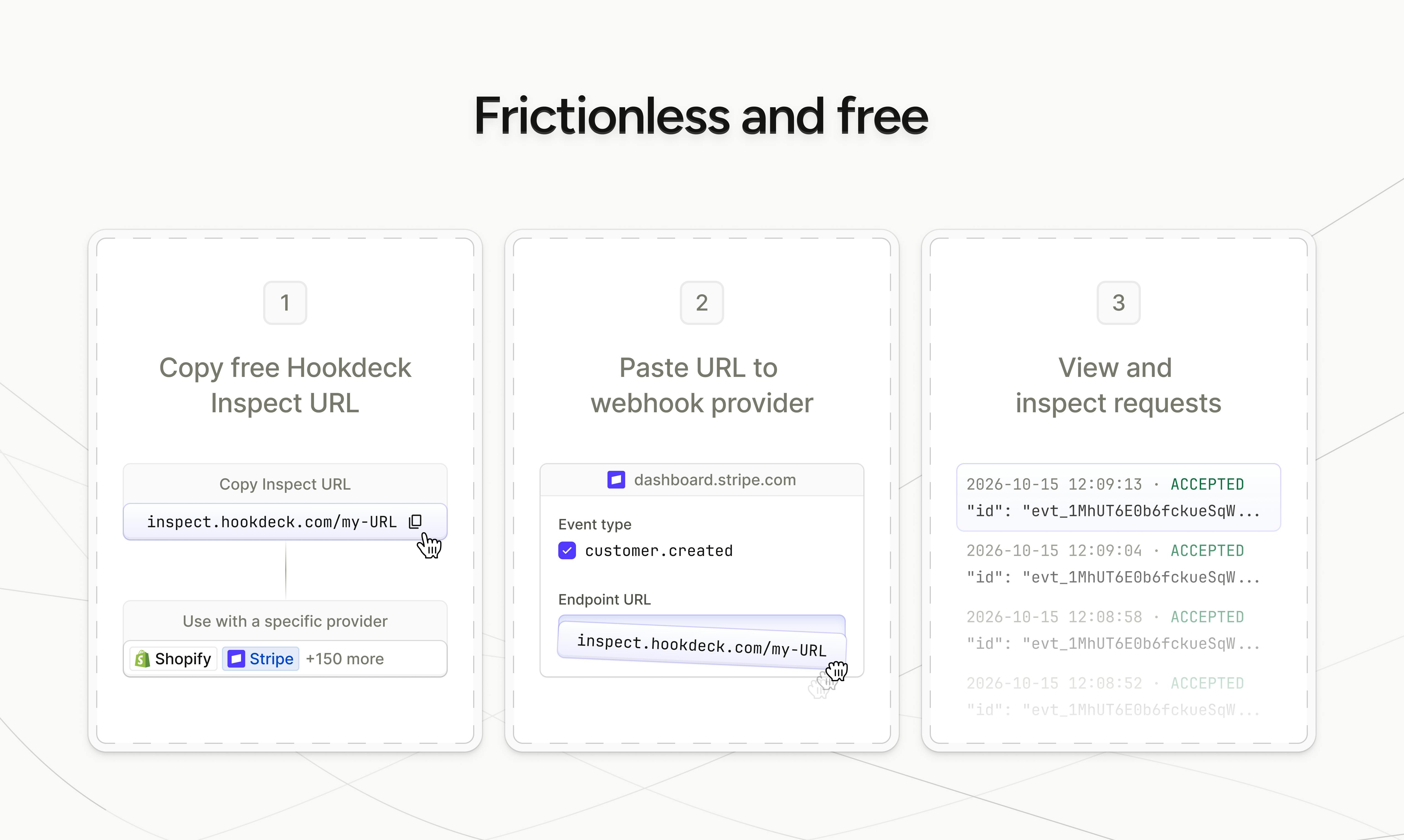
The core selling point of Hookdeck Inspect is straightforward: open it and use it, with no account registration and no initialization configuration required. It generates a real-time URL for you, and any external service can push webhook events to this address. On the page, you can see the complete content of the request—key information such as headers, payload, and timestamps.
This is very practical for debugging scenarios such as payment callbacks, message push notifications, and CI/CD events. The traditional approach often requires setting up a temporary service yourself, configuring NAT traversal, and writing log prints. Inspect compresses these steps into a single link.
According to the Product Hunt page, it includes mock webhook templates for 500+ providers. This means you don't need to actually trigger events from Stripe or GitHub to construct test data with a realistic structure and quickly verify the parsing logic of your receiving endpoint.
NAT traversal is a common obstacle when debugging webhooks locally: external services usually cannot directly access an HTTP service running on a developer's local machine, because the machine sits behind a router or corporate firewall and has no public IP. The traditional solution is to use tools such as ngrok or frp to establish a tunnel from the public internet to the local machine and forward external requests in. This process requires installing a client and configuring ports and authentication, which is too many steps for temporary debugging. Hosted receivers like Inspect take a different approach: they place the receiving point on a publicly accessible server, and developers only need to view the recorded requests on a page without forwarding requests back to the local machine, thus eliminating the tunnel configuration step. The tradeoff is that requests do not actually reach local code, making it suitable for verifying "what is sent" rather than end-to-end integration testing.
A webhook entry point designed for AI Agents
There is a notable difference in how this tool positions itself: its tagline says "for you and your agent." It is not just a debugging panel for human developers; it also provides a real-time URL that AI Agents can connect to.
The background for this design is that more and more automated workflows are driven by Agents—Agents need to receive event notifications from external systems and use them to make decisions or trigger downstream actions. The stable entry point and visual request records provided by Inspect allow developers to observe what the Agent actually received and whether it processed it correctly.
Putting "human debugging" and "Agent integration" in the same tool is in fact a response to a real need: when the consumer of a webhook changes from deterministic code to a probabilistic model, observability becomes even more important.
In the context of webhooks, signature verification is the standard means of determining whether a request comes from a trusted source. Take Stripe as an example: it includes an HMAC signature in the request headers computed from the request body and a secret key, and the receiver recalculates it with the same key and compares the results to confirm that the request has not been forged or tampered with. During debugging, skipping signature verification lets you see the payload content faster; but it also means that once the debugging address leaks, anyone can push forged events to it. This is especially critical in AI Agent scenarios: an Agent may automatically trigger downstream actions based on received events, and if the entry point lacks source verification, crafted events could induce it to perform unintended operations. Therefore, Inspect is suitable for observing request structure, while signature verification logic still needs to be implemented and tested on the actual receiving endpoint.
The product logic behind the free strategy
Inspect is explicitly labeled as free and requiring no account. For a developer tool, this usually means two things: first, it lowers the barrier to trial so developers can use it immediately when they encounter a webhook problem; second, as an entry-level product for Hookdeck's main product (a webhook infrastructure platform), it serves the functions of customer acquisition and brand awareness.
Judging from the feedback on Product Hunt, this strategy worked—it received 84 votes on launch day and ranked 6th on that day's list, categorized under both Developer Tools and Artificial Intelligence, indicating that the audience recognizes both its developer tool nature and its AI relevance.
Applicable boundaries and caveats
What needs to be clearly understood is that Inspect solves the "receiving and viewing" part and does not involve production-grade webhook management capabilities such as retries, persistent queues, and signature verification—these fall within the scope of Hookdeck's paid platform. It is reasonable to treat it as a temporary tool during development and debugging, but it is not appropriate to use it directly for webhook receiving in production.
In addition, for a free real-time URL that requires no account, developers need to assess data sensitivity themselves: do not push webhooks containing secrets or user privacy to a publicly accessible debugging address.
In Agent scenarios, observability refers to the ability to reconstruct the complete chain of "what was input, what happened internally, and what was output." When traditional code consumes webhooks, behavior is deterministic: the same input必然 yields the same processing, and problems can be located by reading the code. When an Agent driven by a large model processes the same event, however, the output may vary due to prompts, context, or model versions, and it is difficult to determine solely from the final result in the logs whether the problem lies in receiving, understanding, or decision-making. Only by retaining the original request records, timestamps, and the Agent's response trajectory can you distinguish between two types of failures: "the event was not received" and "it was received but processed incorrectly." This is also the practical significance of Inspect putting request visualization and Agent integration in the same product.
Summary
The value of Hookdeck Inspect lies in reducing the startup cost of webhook debugging to nearly zero while positioning itself early for the growing demand scenario of Agent integration. For developers who frequently deal with third-party callbacks, it is a lightweight option worth adding to the toolbox.
One-line Summary
Hookdeck Inspect simplifies webhook debugging with a zero-configuration real-time URL and positions itself for AI Agent integration scenarios.
Paragraph Summary
Inspect, released by Hookdeck on Product Hunt, is a zero-configuration webhook debugging tool that generates a real-time URL as soon as you open it. Without registration, you can view request headers, payload, and timestamps, and it includes mock templates for 500+ providers, eliminating the need to build temporary services and set up NAT traversal. Its tagline "for you and your agent" indicates that the product is aimed at both human developers and AI Agents, providing Agents with an observable event receiving entry point. Its free, no-account strategy makes it an entry point for Hookdeck's main product; it received 84 votes and ranked 6th on launch day. The article also notes that Inspect only covers receiving and viewing, does not include production-grade capabilities such as retries, persistence, and signature verification, and that public debugging addresses are not suitable for transmitting sensitive data.
Related articles

9 AI Subscription Plans Compared: The Real Cost Per 100M Tokens Revealed
Bilibili creator tests 9 AI subscription plans from Volcano, Alibaba, Tencent, Baidu, Zhipu, Xiaomi, MiniMax and more, converting them all to real cost per 100M tokens, breaking down fixed-quota vs. three-tier coefficient billing and how caching, time-of-day discounts, and window limits affect actual quota.

Vibe Coding for Beginners: Expressing Intent Instead of Handwriting Code
What is Vibe Coding? A 137-episode Bilibili course defines it: the core is expressing intent, not writing code. This article analyzes Vibe Coding's productivity logic, target audience, and entry expectations to help beginners decide if it's worth learning.

LangChain Beginner's Guide: An Agent Development Roadmap from LangGraph to Deep Agents
Clarify the encapsulation relationship among LangChain, LangGraph, and Deep Agents, and master the learning path and selection logic for agent development frameworks—suitable for beginners in large model development.