Intel Connection 2026: A Complete Guide to the AI Agent Developer Ecosystem

Intel Connection 2026 unveils how Intel is building its developer ecosystem for the Hybrid AI and AI Agent era.
At Intel Connection 2026, Intel rolled out a series of developer ecosystem initiatives around its Hybrid AI strategy: the AI Innovator Program for experts and community leaders, an AI Agent Skills Competition with ModelScope featuring 16 finalists, the HONOR × Intel AI Manufacturing Innovation Challenge for university students, and a deepened partnership with Volcengine's 19-city AIDC community. Intel also served as Premier Strategic Partner at the TMO AI Hackathon, setting a dedicated AIPC challenge tested over 48 hours of intensive development.
From the 4004 to the AI Era: Intel and Developers — Five Decades Together
Intel's developer ecosystem traces its roots back to the launch of the Intel 4004 processor in 1971. For more than half a century, advances in hardware have served as the foundational layer enabling software and intelligent agent innovation. At Intel Connection 2026, this five-decade-long connection was once again front and center — AI Agent innovation, the message made clear, depends on both a solid compute foundation and an active developer community.
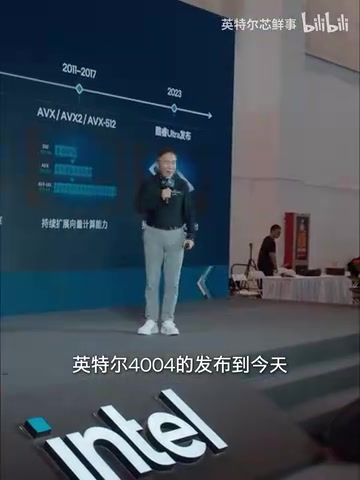
One of the conference's central themes was how Intel plans to reorganize its developer ecosystem for the Hybrid AI era. From community programs to university competitions, from platform partnerships to real-world deployment scenarios, Intel is working to consolidate fragmented innovation into a sustainable, self-reinforcing system.
Hybrid AI is the technical strategy Intel has been championing over the past two years. The core idea is to flexibly distribute AI inference workloads across cloud, edge, and on-device environments — rather than routing everything through cloud-based large models. In the PC context specifically, this means AI PCs equipped with NPUs (Neural Processing Units) can handle a portion of inference locally, reducing latency and protecting privacy, while seamlessly tapping cloud resources when local compute falls short. The strategy reflects Intel's read on the chip market: as on-device compute power rises rapidly, "which tasks run where" will become a central variable in developer architecture decisions — and Intel aims to make its platform a critical node in that orchestration chain through ecosystem development.
Intel AI Innovator Program Officially Launches
At the conference, Intel formally unveiled its AI Innovator Program. The bar for entry isn't restricted to any single type of person — technical experts, seasoned developers, and community leaders are all welcome to apply, as long as they have a passion for innovation and AI.
This kind of ambassador mechanism is a well-established practice in developer ecosystem management. The underlying logic is straightforward: empower a cohort of core contributors so they become nodes for technical outreach and community engagement. For Intel, it's both a way to broaden developer reach and a lever for translating hardware platform capabilities into real-world application scenarios.
On the Competition Floor: Putting Agent Skills to the Test
If a community is the soil of an ecosystem, competitions are the most direct stage for stress-testing what developers can actually build.
The AI Agent Skills Competition, co-organized by Intel and the ModelScope community, featured 16 finalists who each took the stage to present their work. Developers shared their projects and ideas live, while the audience could vote for their favorites — creating an authentic gauge of each Agent's practical value and creative merit. The "live demo + audience vote" format gave the competition a visceral energy rarely found in standard judging panels.

Also officially kicking off at the event was the HONOR × Intel AI Manufacturing Innovation Challenge. Open to university students nationwide, the competition encourages participants to translate AI ideas into deployable, real-world solutions — not just proof-of-concept demos.
ModelScope is the model community platform launched by Alibaba DAMO Academy, positioned similarly to Hugging Face. It aggregates a large number of open-source models, datasets, and development tools, and has a strong user base among Chinese-speaking developers. Co-hosting the AI Agent Skills Competition with Intel is designed to bridge ModelScope's model resources with Intel's on-device compute platform, enabling developers to call and deploy community Agent solutions directly on Intel hardware. At its core, this kind of joint competition between a platform provider and a chip manufacturer is about building a shared library of developer case studies that demonstrate "great performance on our combined solution."
Community Co-Building: Turning One Developer's Hard Lessons into Another's Head Start
A thriving ecosystem takes more than competitions — someone has to pave the road. Volcengine offered one of the conference's most resonant observations:
The measure of an AI community isn't how many articles it publishes. It's whether the lessons one developer learned the hard way can become the starting point for the next.

This gets at the real value of a developer community: the accumulation and reuse of knowledge. The AIDC city community network now spans 19 cities, and the HeroBuilder program is actively recruiting 100 core developers in an effort to build a complete pathway from learning to deployment. Intel also announced plans to deepen its collaboration with Volcengine's AI community across future developer events and content initiatives.
University Stage: A Real-World Trial for AIPC Capabilities
Some of the most energetic developer talent surfaces in university competitions. At the TMO AI Hackathon university track, Intel served as the Premier Strategic Partner and introduced a dedicated challenge focused on real-time multimodal video intelligence analysis and scene understanding.

From solution demos to 48 hours of intensive on-site development, participants were pushed to fully leverage on-device compute to complete their submissions. More than a competition, it was a genuine stress test of AIPC on-device capabilities. For Intel, placing on-device compute under real development pressure is precisely the kind of validation needed to demonstrate the viability of its Hybrid AI strategy.
An AI PC is a next-generation personal computer with a dedicated AI acceleration unit — typically an NPU — integrated into the chip. Intel, AMD, Qualcomm, and others have all launched product lines in this space. Unlike traditional PCs that rely on CPU or GPU for AI computation, NPUs are purpose-built for matrix operations and neural network inference, delivering significantly better energy efficiency when running lightweight local models. The challenge of "real-time multimodal video intelligence analysis and scene understanding" places particularly high demands on on-device compute — continuous, low-latency inference over live video streams is precisely the scenario where NPUs hold their clearest advantages over cloud-based approaches in terms of latency and privacy. That makes it an ideal pressure test for validating the real-world value of AI PCs.
Closing Thoughts: The Connections Are Deepening
From community programs to competitions, from ecosystem-building to strategic partnerships, Intel's connections with developers are growing stronger. And through this process, the possibilities of Hybrid AI are steadily expanding. Whether you're a university student just starting out or a seasoned technical expert, Intel Connection 2026 sent a clear signal: the stage for the Agent era has been built. Now it's up to developers to step into the spotlight.
Related articles

Random Pruning of the DPO Computation Graph: 1.4x Training Speedup and Lower Peak Memory
DPO training too slow and memory-hungry? This paper proposes a random pruning framework for the DPO computation graph, sampling independently across position, sequence, and branch dimensions; branch pruning achieves a 1.426x step-time speedup and cuts training time by about 30%, with in-depth attribution of memory and time gains.

Why Does JEPA Underperform MLM in Longitudinal EHR Representation Learning?
New study compares JEPA and MLM for longitudinal EHR representation learning on MIMIC-IV: three JEPA variants train stably without collapse but underperform MLM; target size, not heterogeneity, drives prediction error.

Transfer Learning + Visible Light Communication: A New Approach to Energy-Efficient Indoor Positioning
A study proposes a transfer learning-based visible light communication indoor positioning method, achieving 47% accuracy improvement on the BOSCH factory dataset, 67.5% model efficiency under high noise, and introducing the ME composite metric for energy-efficient positioning in energy-constrained industrial IoT scenarios.