Java + AI in Practice: A Development Guide to LangChain4j and Spring AI
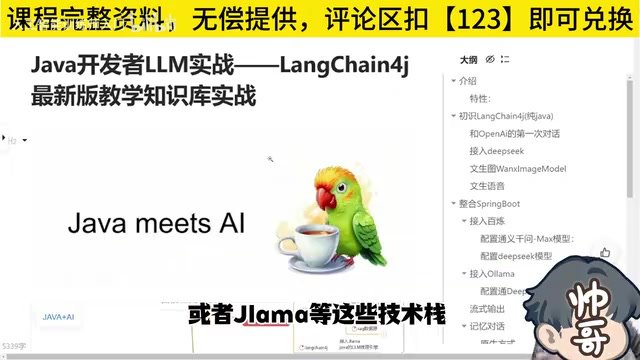
An AI application transition path for Java developers: use LangChain4j or Spring AI to engineer large models into production.
The article revolves around the "Java + AI" practical course, noting that falling large model costs and local deployment on consumer-grade GPUs are driving enterprise private deployment demand, making AI application development a popular transition direction for Java developers. The core is framework selection: LangChain4j encapsulates HTTP calls and parameter passing, simplifies Java integration with large models, and has built-in support for OpenAI, Ollama, Hugging Face, and multiple vector databases, while DeepSeek can be called using the OpenAI standard; Spring AI natively fits the Spring ecosystem and suits quick single-model integration, while LangChain4j has no framework dependency and is better for general platforms with dynamic multi-model switching. The article advises developers to master the Spring AI/LangChain4j/Ollama stack and leverage engineering strengths such as high concurrency for differentiation, ultimately completing implementation through projects like local knowledge bases and intelligent customer service.
As the cost of large models keeps falling, a single consumer-grade GPU is enough to run a local large model. This has led more and more enterprises to consider private deployment—after all, only by running models locally can data security truly stay in their own hands. Along with this trend, AI application development engineer has become a popular career direction for Java developers. This practical course on Bilibili revolves around "Java + AI," covering model selection, data cleaning, fine-tuning, and then developing intelligent customer service and local knowledge base systems with LangChain4j or Spring AI, in an attempt to establish a complete implementation path.
Why Java Developers Should Pay Attention to AI Application Development
The skill stack of traditional Java developers centers on enterprise engineering capabilities such as business logic, high concurrency, and high availability, while AI application development precisely requires integrating large model capabilities into existing systems in an "engineered" way. The course's advice on career transition is straightforward: put technology stacks such as Spring AI, LangChain4j, or Ollama on your resume, and pair them with an AI intelligent project—for example, using LangChain4j + Ollama to connect to a local large model and implement a local knowledge base system, while highlighting Java's engineering advantages, such as using a thread pool to handle high-concurrency Q&A requests. According to the instructor, such a combination "will absolutely put you ahead of 90% of traditional Java developers." This ratio is a direct quote from the course; whether it is precise is another matter, but the direction is worth considering: what enterprises lack is not people who can call APIs, but people who can reliably integrate large models into production systems.
What is Ollama? Ollama is an open-source local large model running and management system. It provides a command-line tool that lets you download and start open-source models such as Llama, Qwen, and DeepSeekAd with a single command, and exposes an OpenAI-style compatible HTTP interface locally. It encapsulates underlying details such as model quantization, VRAM scheduling, and GPU/CPU inference, enabling small-parameter models to run on consumer-grade GPUs or even pure CPU environments. For private deployment, Ollama means that model weights and the inference process remain within the enterprise intranet, and data does not leave the domain; for developers, it provides a "local model service" that can be called programmatically at extremely low cost, so it is often paired with LangChain4j to form the local knowledge base solution described in this article.
LangChain4j: A Framework That Simplifies Java Integration with Large Models
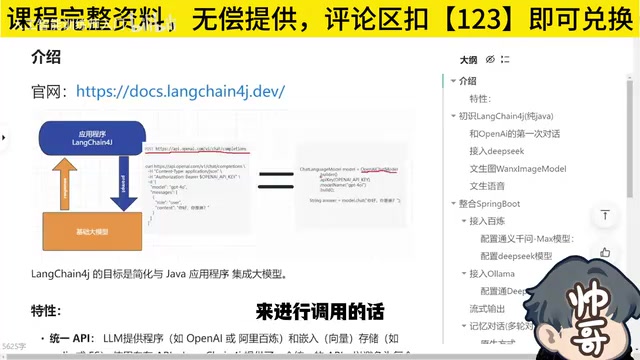
Even without frameworks like LangChain4j, Java programs can connect to large models, but you need to manually send requests to the model address using remote communication frameworks such as HTTP Client or OkHttp, and manually pass parameters at various levels. The value of LangChain4j lies in its upper-layer encapsulation, which simplifies the calling process and thereby improves the development efficiency of integrating large models into Java applications.
It does not support all large models; you need to check the built-in support list. Currently, it has built-in support for OpenAI, Alibaba, Hugging Face, Ollama, and other local large models, as well as some domestic vendors. As for DeepSeek, the instructor specifically explains that it uses the same standard as OpenAI, so DeepSeek large models can be called using the OpenAI standard, and the course will demonstrate this.
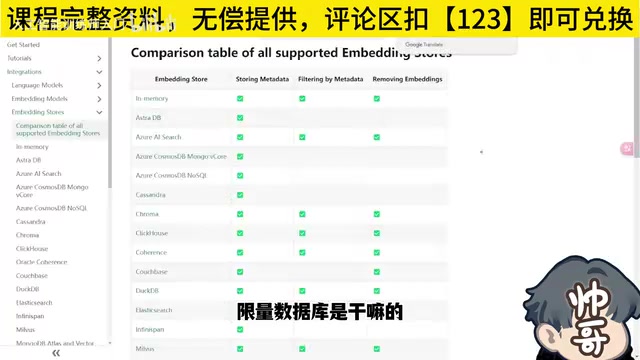
In terms of vector databases, LangChain4j supports components commonly seen in the Java technology stack, such as ClickHouse, Elasticsearch, Neo4j, Oracle, and Redis. The role of vector databases will be explained in detail when covering RAG (Retrieval-Augmented Generation); for now, just establish an impression.
What is LangChain4j? LangChain is an open-source framework in the Python ecosystem for building large model applications, and LangChain4j is its Java port. Its API design fits the habits of Java developers and also provides an optional integration module for Spring Boot. Its core idea is to abstract common patterns of large model applications (Prompt templates, conversation memory, tool function calling, RAG retrieval augmentation, and Agent orchestration) into unified interfaces, so developers only need to program against interfaces, and switching the underlying model to OpenAI, Ollama, or another vendor requires minimal changes. For Java engineers familiar with object-oriented design, this "component assembly" approach is more in line with existing engineering habits than handwritten HTTP requests, and it is also easier to test and replace.
What is a vector database? A vector database is a database specifically designed to store and retrieve "vectors" (a set of floating-point numbers). In AI applications, unstructured data such as text and images are first converted into vectors by embedding models, and content with similar semantics is also close in the vector space. When a user asks a question, it is likewise converted into a vector, and the database quickly recalls the most relevant pieces of content by similarity (such as cosine distance), which are then handed to the large model to organize an answer—this is a key part of RAG. Traditional relational databases excel at exact matching, while vector databases solve the problem of "semantic approximate search," so they are often used in combination with components such as Elasticsearch, Redis, and ClickHouse. The built-in support list of LangChain4j mentioned in the article refers precisely to these backends that can serve as vector storage.
How to Choose Between Spring AI and LangChain4j
Another framework in the Java technology stack for quickly integrating large models is Spring AI. The most core difference between the two lies in ecosystem dependency: Spring AI is launched by the Spring ecosystem, natively supports the Spring system, and can directly integrate with Spring or Spring Boot; LangChain4j has no framework dependency and can be used by any Java language project.
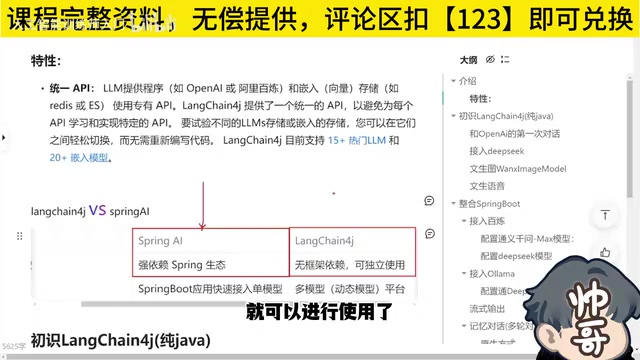
From this, the differences in application scenarios can be derived. Spring AI is suitable for quickly connecting a single model in a Spring application, and implementation is very convenient; but if you need dynamic switching among multiple models and want to build a general large model platform, LangChain4j is more suitable. The course gives an open-source project as an example—a general multi-model dynamic management platform that can dynamically enable or disable a certain large model in the system. Such scenarios are more convenient with LangChain4j. Both have their own advantages, and selection should be based on actual scenarios rather than simply comparing which is stronger.
From Learning to Implementation: A Replicable Path
The path planned by the course covers model selection, data cleaning, fine-tuning, and then developing intelligent application scenarios with LangChain4j or Spring AI, ultimately completing practical projects such as intelligent customer service or local knowledge base systems, forming a closed loop for "Java + AI application engineers." For Java developers, the value of this path is that it does not abandon existing engineering capabilities, but turns enterprise-level experience such as high concurrency and high availability into differentiated advantages for implementing AI applications. Readers who need video materials and code can obtain them in the comments section or via private message according to the course instructions.
It should be noted that this article is organized based on public video content. The technology selection suggestions and effect descriptions in the course carry the instructor's personal views, and actual implementation still needs to be verified against the team's technology stack and business requirements.
What is fine-tuning? Fine-tuning means continuing to train an already pre-trained large model for several rounds using labeled data from a specific domain, so that the model better fits a certain type of task or industry corpus. Compared with RAG, the two have different roles: RAG lets the model "look up materials" through an external knowledge base, and knowledge updates only require changing the database, not the model; fine-tuning "writes" knowledge or style into model parameters, so no retrieval is needed during inference, but it has higher data quality requirements, greater cost, and knowledge updates require retraining. In actual engineering, a common practice is to start with prompt engineering and RAG, and consider fine-tuning only when the results are insufficient; the two can also be used together. The course lists data cleaning and fine-tuning as path stages precisely to cover scenarios with higher requirements for answer style and domain accuracy.
One-line Summary
An AI application transition path for Java developers: use LangChain4j or Spring AI to engineer large models into production.
Paragraph Summary
The article revolves around the "Java + AI" practical course, pointing out that the declining cost of large models and the ability to deploy locally on consumer-grade GPUs have increased enterprises' demand for private deployment, making AI application development a popular transition direction for Java developers. The core content is framework selection: LangChain4j encapsulates HTTP calls and parameter passing, simplifies Java integration with large models, has built-in support for OpenAI, Ollama, Hugging Face, and multiple vector databases, and DeepSeek can be called directly using the OpenAI standard; Spring AI natively fits the Spring ecosystem and is suitable for quick integration of a single model, while LangChain4j has no framework dependency and is better suited for general platforms with dynamic switching among multiple models. The article suggests that developers master the Spring AI/LangChain4j/Ollama technology stack and use engineering capabilities such as high concurrency to create differentiated advantages, ultimately completing the implementation loop through projects such as local knowledge bases and intelligent customer service.
Related articles

FBI-Warned AI Hacking Tool ARTEX: Cost Disruption and Defensive Restructuring
The FBI-warned AI hacking tool ARTEX reduces penetration testing costs to $150-$1,500, causing financial data breaches and supply chain attacks. Learn how it works, real cases, and a five-step defense strategy.
FBI Warns: ARTEX AI Hacking Tool Breaches Systems in Three Hours
FBI warns the open-source AI pentesting framework ARTEX is being abused, with some intrusions gaining privileged access in under three hours, over 1,600 consoles exposed, and links to South Korean financial data breaches and the ConnectWise supply chain attack.

FBI Warns About Artex: AI-Driven Attack Framework Threatens Cloud Identity Security
FBI warns that the AI penetration testing framework Artex is being used for automated attacks: written in Go and driven by AI agents, it covers the full chain from reconnaissance to data exfiltration. This article analyzes its real threat to cloud identity and privilege security and key defense priorities.