LangChain Agent Authorization Control: Four Strategies and Production Practices
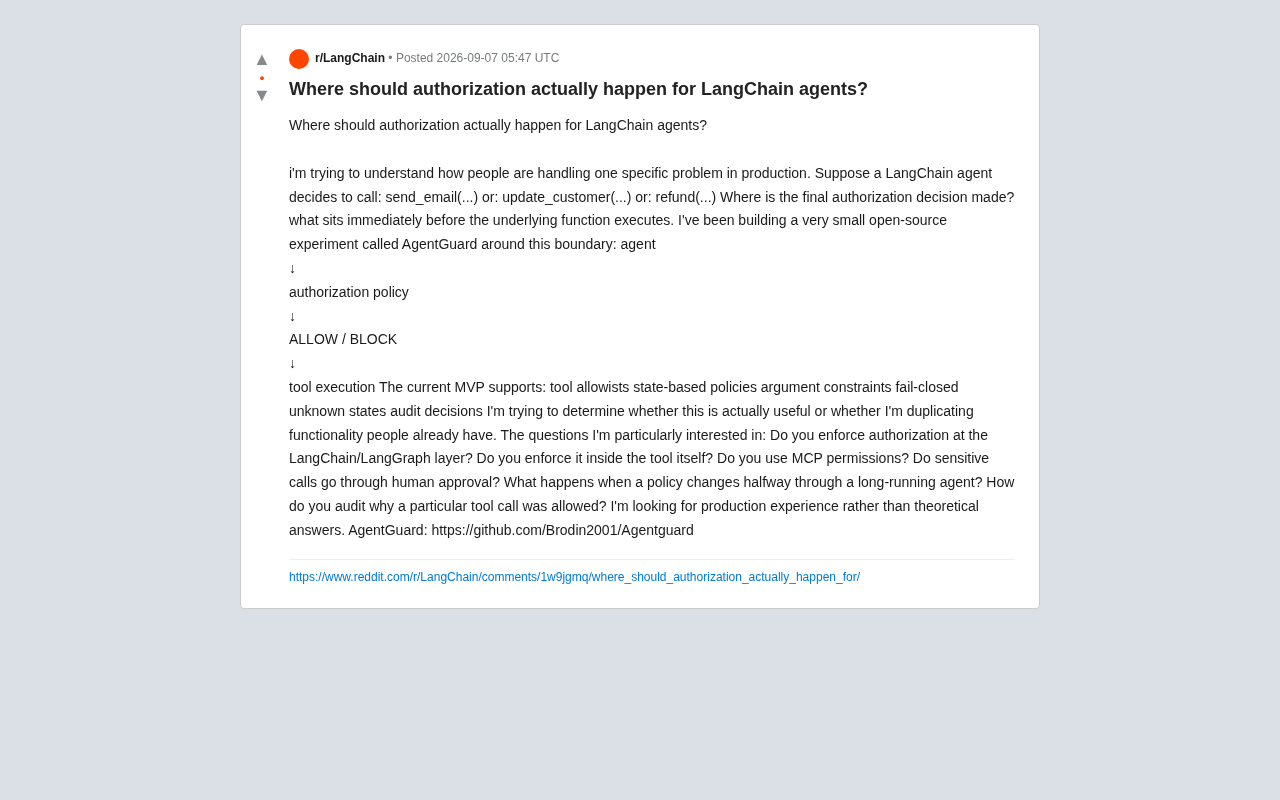
Four authorization strategies for securing LangChain Agents in production environments.
As LangChain Agents are deployed in production, authorization control becomes critical. This article examines AgentGuard, an open-source middleware that inserts an authorization policy layer between Agent decisions and tool execution. It compares four strategies — framework-level interception, tool self-validation, MCP permission systems, and human-in-the-loop — while addressing production challenges like dynamic policy changes, audit traceability, and the performance-security tradeoff.
The Problem: Authorization Challenges in Production Agent Systems
In production LangChain Agent environments, a core security issue is emerging: when an Agent autonomously decides to call sensitive operations like send_email(), update_customer(), or refund(), where should the final authorization decision be enforced?
LangChain Agent Technical Background
LangChain is an open-source framework specifically designed for building applications powered by large language models (LLMs). Agent is one of LangChain's core concepts, referring to an intelligent entity that can autonomously make decisions, select tools, and execute actions based on user input. Unlike traditional fixed-workflow applications, Agents have reasoning capabilities and can dynamically plan execution steps — for example, an Agent might first call a search tool to gather information, then use a computation tool to process data, and finally invoke an email tool to send results. This autonomy makes Agents extremely flexible, but it also introduces unprecedented security challenges: when AI decides on its own what actions to take, how do you ensure those actions are authorized and safe?
This is not a theoretical question. As AI Agents are increasingly deployed in real business scenarios, developers face a practical challenge — how to maintain Agent autonomy while ensuring every tool invocation undergoes proper permission verification.
Limitations of Traditional API Authentication Mechanisms
Traditional web application authentication typically relies on predefined Access Control Lists (ACLs) or Role-Based Access Control (RBAC). Developers know at coding time exactly which API endpoints users will access, so permission checks can be implemented at the routing layer, middleware layer, or controller layer. However, an Agent's execution path is generated in real-time by the LLM — the same user request might result in entirely different tool call sequences. This means it's impossible to enumerate all possible execution paths at development time. To make matters more complex, Agents may dynamically adjust subsequent actions based on intermediate results, creating conditional branches and loops that make static permission configurations unable to cover all scenarios. This requires us to rethink authentication architecture, shifting from 'configuring permissions for fixed endpoints' to 'building a policy engine for dynamic tool invocations.'
AgentGuard: An Agent Authorization Middleware Solution
To address this problem, developer Brodin2001 open-sourced an experimental project called AgentGuard. Its core approach is to insert an authorization policy layer between Agent decision-making and tool execution:
Agent Decision
  ↓
Authorization Policy Validation
  ↓
ALLOW / BLOCK
  ↓
Tool Execution
Architectural Inspiration from the Middleware Pattern
Middleware is a classic architectural pattern in web development, widely used in frameworks like Express.js, Django, and Spring Boot. Its core idea is to pass requests through a series of preprocessing functions before they reach business logic — for example, an authentication middleware validates JWT tokens, a logging middleware records request information, and a rate-limiting middleware controls access frequency. Each middleware focuses on a single responsibility and can be composed into a processing chain. AgentGuard borrows this pattern by abstracting authorization logic into an independent layer inserted between Agent decisions and tool execution. The advantages of this design include: keeping tool functions pure (focused only on business logic), enabling centralized permission policy management, supporting flexible policy composition, and reserving architectural space for future extensions (such as rate limiting and circuit breaking).
The current MVP version supports the following features:
- Tool Whitelisting: Explicitly defines which tools are allowed to be called
- Context-Aware Policies: Dynamically adjusts permissions based on current system state
- Parameter Constraint Checks: Validates whether tool call parameters fall within allowed ranges
- Default Deny: Automatically blocks execution when encountering unknown states
- Audit Trail: Records the basis for every authorization decision
How Context-Aware Policies Work
Context-aware policies mean that authorization decisions are based not only on static rules but also take into account the system's current runtime state. For example: allowing an Agent to automatically send marketing emails during normal business hours but requiring human approval outside business hours; prohibiting the Agent from executing refund operations when the account balance falls below a threshold; or dynamically adjusting the Agent's permission scope based on its recent error rate. Implementing such policies requires the authorization engine to access external state sources like databases, caches, configuration centers, or monitoring systems. Technically, this is usually done through a policy-as-code approach, writing policy functions in Python, JavaScript, or other languages that are evaluated at runtime. This is more flexible than simple static whitelists but also introduces complexity — the policy logic itself may contain bugs, fetching state data may impact performance, and how to test and verify policy correctness are all issues that need consideration.
Comparing Four Authorization Strategies for Production Environments
Based on community feedback and practical experience, there are currently four main implementation paths for LangChain Agent authorization control, each suited to different scenarios.
1. LangChain/LangGraph Framework-Level Interception
This is the approach AgentGuard takes — handling authorization logic uniformly at the framework level. The advantage is centralized management and easy auditing, but it may increase framework coupling. It's suitable for scenarios requiring unified policies across tools.
2. Tool-Internal Self-Validation
Each tool function implements its own permission checks internally. This approach makes tools more independent, but it easily leads to scattered permission logic that's hard to maintain and prone to gaps.
3. MCP (Model Context Protocol) Permission System
The MCP standard proposed by Anthropic includes permission mechanisms, but adoption is still relatively low. In theory, it could standardize permission control at the protocol layer, but it needs broader ecosystem support.
Technical Details of the MCP Standard
Model Context Protocol is an open protocol standard proposed by Anthropic in 2024, designed to standardize interactions between AI models and external tools and data sources. MCP defines a unified interface specification that allows different tool providers to expose capabilities to AI Agents in a standardized way, similar to the role of the OpenAPI specification in the REST API domain. The protocol includes mechanisms for resource discovery, parameter definition, and permission declaration, where the permission component allows tool providers to declare required permission Scopes, similar to the OAuth 2.0 authorization grant model. In theory, if both Agent frameworks and tools adopt the MCP standard, unified cross-platform permission control could be achieved. However, MCP is still in its early stages, primarily adopted within Anthropic's Claude ecosystem, with support in frameworks like LangChain and LlamaIndex not yet mature enough, and ecosystem tool adaptation still requiring time.
4. Human-in-the-Loop Approval Process
For high-risk operations (such as refunds or data deletion), decision authority is handed to humans. This is the most conservative but also the most reliable approach, at the cost of sacrificing automation.
Human-in-the-Loop Implementation Considerations
Human-in-the-Loop is an important safety mechanism in AI system design, referring to the introduction of human judgment at critical decision points. In Agent scenarios, human approval workflows are typically triggered for high-risk operations (involving funds, data deletion, external communications, etc.): the Agent proposes an action request, the system pauses execution and notifies relevant personnel, and humans review and decide to approve or reject. Implementation approaches include synchronous blocking (the Agent waits for human response) and asynchronous queuing (requests enter a pending approval queue). This pattern sacrifices automation and response speed, but is necessary in heavily regulated industries (finance, healthcare) or when system maturity is insufficient. The key challenge lies in designing reasonable trigger rules — overly frequent approvals lead to fatigue and rubber-stamping, while overly lenient rules defeat the purpose of protection. A common progressive strategy is: initially requiring human approval for most operations, then gradually expanding the Agent's autonomous permission scope as system stability improves and trust is established.
Key Challenges in Production Environments
From developer feedback, several particularly thorny scenarios emerge in production environments:
Dynamic Policy Changes: When a long-running Agent task is halfway through and the authorization policy changes, what happens? Does it take effect immediately or wait until the task completes? This involves policy version management and smooth migration.
Engineering Practices for Policy Version Management
In production environments, authorization policies are not static — business rule adjustments, security incident responses, and compliance requirement changes may all necessitate policy updates. But if an Agent task is expected to run for hours (such as batch data processing), mid-task policy changes can cause inconsistency: operations that were allowed when the task started are suddenly forbidden halfway through. Solutions include: (1) Policy versioning — each task is bound to the policy version at startup and is unaffected by new policies during execution; (2) Graceful degradation — new policies only apply to new tasks, with old tasks naturally switching after completion; (3) Forced upgrade — injecting policy updates into running tasks, but requiring handling of potential interruptions. This is similar to database schema migration and blue-green deployment concepts. In practice, supporting tools are also needed, such as policy diff comparison, impact scope assessment, and rollback mechanisms — advanced features that infrastructure like AgentGuard needs to consider.
Audit Traceability: When you need to retrospectively answer "why was this tool call allowed to execute," how do you provide a complete decision chain? This requires recording not just the outcome, but also the context at the time of the decision, the matched policy rules, and other relevant information.
Audit Log Design Requirements
In regulated industries such as finance and healthcare, audit trails are not just best practices — they're mandatory compliance requirements. For Agent authorization decisions, a complete audit log should include: (1) Who initiated the request (user identity); (2) What tool the Agent attempted to call and with what parameters; (3) Which authorization policy was applied; (4) The contextual state at the time of policy evaluation (e.g., account balance, time, system load); (5) The final decision result (allow/deny) and reasoning; (6) Timestamps and request trace IDs. This information needs to be stored in a structured format (e.g., JSON written to Elasticsearch) for subsequent querying and analysis. The technical challenge lies in performance — high-frequency tool calls can generate massive amounts of logs, requiring considerations like asynchronous writing, batch commits, and log tiering (detailed records for critical operations, simplified records for routine operations). Sensitive information redaction must also be considered to avoid leaking user privacy or business secrets in logs.
Balancing Performance and Security: Performing full permission verification for every tool call adds latency, but overly lenient policies create security risks. Finding the right balance between the two is an important consideration during actual deployment.
Implementation Recommendations and Future Outlook
For teams building production-grade Agent systems, the following practices are worth considering:
- Defense in Depth: Implement basic whitelisting and parameter validation at the Agent framework level, and implement business-level permission checks within tools, forming multiple layers of protection
- Policy as Code: Manage authorization policies in code form, supporting version control and change review
- Default Deny Principle: For operations not explicitly allowed, block by default rather than permit
- Comprehensive Audit Logs: Record all authorization decisions and their rationale for compliance reviews and troubleshooting
From a broader perspective, Agent authorization control is a critical component of AI systems engineering. The emergence of projects like AgentGuard indicates that the community is evolving from "getting Agents to run" to "making Agents run safely and controllably." As Agent applications deepen, we're likely to see more infrastructure tools like this emerge, much like how the early days of web development gradually gave rise to mature authentication frameworks.
Project repository: https://github.com/Brodin2001/Agentguard
Related articles
Internet Archive Fundraising Crisis: Server Operations Challenge Behind 800 Billion Archived Web Pages
The Internet Archive faces server operations funding pressure with 800 billion archived pages. Analysis of Wayback Machine cost challenges, nonprofit digital preservation survival crisis, and sustainable development paths.
Bentley Torcal EV: The Luxury Brand Transformation Challenge Behind Simulated V8 Sound
Bentley's Torcal EV features simulated V8 sound, balancing electric silence with mechanical emotion. An analysis of luxury brand identity challenges in the EV transition.

Can't Keep Up with AI Model Releases? Practical Strategies for Practitioners to Handle Information Overload
AI model releases are overwhelming. Learn how practitioners can overcome FOMO, establish evaluation criteria, filter information sources, and maintain focus amid the AI model explosion.