LangChain Beginner's Guide: Why Large Language Models Need This Framework

LangChain addresses three core LLM limitations to enable production-ready AI application development.
This beginner's guide explains why large language models need a framework like LangChain. It covers three key LLM limitations — knowledge cutoff dates, inability to access business data, and lack of conversation state management — and shows how LangChain addresses each through tool calling, state management, and plug-and-play architecture. The article also clarifies the evolving relationship between LangChain and LangGraph since version 1.0.
Introduction: Starting from the Limitations of Large Language Models
With the proliferation of large language model APIs from OpenAI, DeepSeekAd, Qwen, and others, more and more developers are trying to build AI applications. These large language models provide services to developers through RESTful APIs — developers simply send HTTP requests to get inference results from the models. This API-based service model has significantly lowered the barrier to AI application development: developers don't need to train models themselves or purchase GPU clusters; they only need to pay per API call to access powerful language understanding and generation capabilities. However, APIs essentially provide only a single-shot "text in, text out" inference capability. Building truly production-ready applications requires a great deal of engineering work.
Developers quickly discover that simply calling LLM APIs has clear limitations. It's precisely to break through these limitations that application development frameworks like LangChain emerged.
This article will walk through LangChain's origins, core positioning, and its evolving relationship with LangGraph, helping beginners build a solid knowledge framework.
Three Key Limitations of Large Language Models
Before understanding why LangChain exists, we need to recognize three core limitations of directly calling LLM APIs.
Limitation 1: Knowledge Cutoff Date
Every large language model's knowledge is frozen at the cutoff date of its training data. The model simply cannot answer questions about new content or events that occurred after its training period — because it has never seen that data. This means models inherently suffer from knowledge staleness.
From a technical perspective, the knowledge of a large language model comes from the corpus used during the pre-training phase. Take GPT-4 as an example: its training data has a specific cutoff date, and any events, published papers, updated regulations, or other information after that date falls outside its "cognitive scope." This is determined by the training mechanism of the Transformer architecture — model parameters are frozen once training is complete. Unless additional fine-tuning or continued pre-training is performed, the model cannot acquire new knowledge. Even fine-tuning is extremely expensive and carries risks such as catastrophic forgetting.
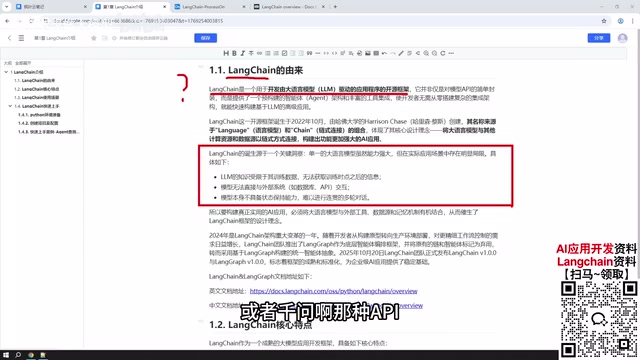
Limitation 2: Inability to Incorporate Business Data
LLM responses are based entirely on their historical training data and have nothing to do with your enterprise's business data. If you want the model to answer questions using your company's internal databases or business context, the native model simply has no ability to access external data. It cannot access your internal enterprise data, nor can it connect to external data sources.
Limitation 3: Lack of Conversation State Management
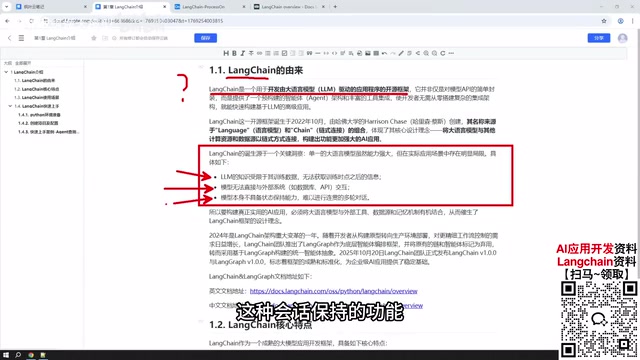
A standalone LLM has no "session persistence" capability — meaning it cannot maintain chat history and contextual state. Native models are fundamentally single-turn question-and-answer systems with no state and no memory. The "memory" features we commonly experience are actually implemented at the application layer after the fact, not built into the model itself.
Looking at the underlying mechanism, the inference process of large language models is essentially stateless. Each API call is independent, and the model does not "remember" the content of previous conversations. The "memory" we experience in products like ChatGPT is actually the application layer concatenating conversation history into the current request's prompt, allowing the model to "see" previous dialogue and simulate continuous conversation. This approach is limited by the model's context window length — when conversation history exceeds the window length, earlier content is truncated and lost. Therefore, how to efficiently manage, compress, and retrieve conversation history has become a critical engineering challenge in AI application development.
What Is LangChain?
Simple positioning: LangChain is an open-source framework for developing applications powered by large language models. Whenever LangChain is mentioned, you should immediately associate it with the label "AI application development framework."
The Origin of the Name "LangChain"
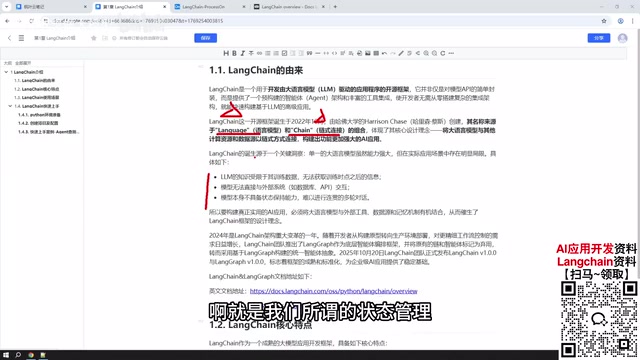
LangChain was released in October 2022. Its name consists of two parts:
- Lang (Language): Represents language models
- Chain: Represents chaining connections
Together, LangChain's core concept is "connecting language models in a chain-like manner," enabling large language models to build complete AI applications through chain-based orchestration.
The "Chain" concept draws from the pipeline philosophy in functional programming and the Chain of Responsibility design pattern. In chain-based orchestration, a complex task is broken down into multiple steps, where each step's output serves as the next step's input, forming a data flow chain. For example, a typical RAG (Retrieval-Augmented Generation) chain might include: user input → query rewriting → vector retrieval → context assembly → model inference → result formatting, among other stages. This design allows each stage to be independently tested, replaced, and optimized, greatly improving application maintainability and flexibility.
What Problems Does LangChain Solve?
LangChain is specifically designed to address the three limitations mentioned above. On top of native LLM capabilities, it extends a wide range of "plug-and-play" functionalities:
- Tool calling: Connect to external data sources, breaking through knowledge cutoff limitations
- State management: Store and manage chat history to enable session persistence
- Security management: Implement security controls at the application layer
"Plug-and-play" means these features can be applied individually as needed. This way, AI applications go beyond just model inference — they can connect to external data, maintain conversation state, and have their capabilities significantly expanded.
The Evolving Relationship Between LangChain and LangGraph
This is the point that beginners find most confusing, and it's an architectural change that deserves special attention when understanding the LangChain ecosystem.
From Independent Projects to Unified Foundation
In early versions, LangChain was LangChain and LangGraph was LangGraph — the two were unrelated. But after LangChain version 1.0, the framework underwent a significant architectural restructuring:
- Some capabilities in LangChain (such as Agents) are now actually powered by LangGraph;
- LangChain and LangGraph now share the same underlying graph-based flow architecture.
LangGraph introduced the concept of directed graphs to orchestrate the execution flow of AI applications. Compared to LangChain's earlier linear chain structure, graph structures can express more complex control flows — including conditional branching, loops, parallel execution, and state backtracking. This is especially important for building Agents, because Agents need to dynamically decide their next action based on environmental feedback, making their execution paths inherently non-linear. LangGraph's foundation is based on the state machine concept, where each node represents a processing step, edges represent state transition conditions, and the whole forms a controllable, observable execution graph. This is why LangChain migrated Agent capabilities to LangGraph after version 1.0 — graph structures are more suitable than chain structures for expressing an Agent's decision-making loops.
The purpose of this restructuring was clear — to make the entire open-source toolchain more usable and unified. For beginners, all you need to remember at this stage is: the LangChain ecosystem contains both LangChain and LangGraph, and their foundations have been unified since version 1.0. The detailed relationship between Agents and LangGraph is typically covered in advanced chapters.
Tips for Learning from LangChain's Official Documentation
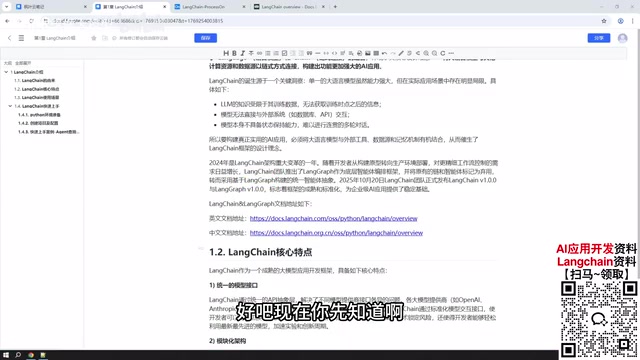
The LangChain website offers both English and Chinese versions. Here are some practical recommendations:
- Beginners: Start with the Chinese website. Its content is mostly AI-translated and is very beginner-friendly, helping you quickly build an overall understanding.
- Developers with some foundation: Go directly to the English website, optionally using a translation plugin.
An important caveat: although the Chinese version is based on LangChain v1.0, since it's AI-translated, there are issues with missing content and inaccurate translations. The English website is the most complete and authoritative source. Use the Chinese documentation for introductory understanding, and the English documentation to fill in any gaps.
Summary
LangChain's value lies in addressing three fundamental shortcomings of native large language models: knowledge staleness, business data integration, and conversation state management. With chain-based orchestration as its core philosophy, it uses plug-and-play features like tool calling and state management to upgrade "inference-only models" into "AI applications that can connect to real-world data."
With the unification of its underlying architecture with LangGraph after version 1.0, the LangChain ecosystem is evolving toward greater integration and ease of use. For developers looking to enter the field of AI application development, understanding this framework's positioning and design philosophy is the foundation for learning advanced topics like RAG, Agents, and MCP.
Among these, RAG (Retrieval-Augmented Generation) is the mainstream solution for addressing the knowledge cutoff problem — it retrieves relevant content from external knowledge bases and injects it into the prompt, enabling the model to answer based on the most current and relevant information. Agents are an AI application pattern capable of autonomous planning, tool usage, and iterative execution. Rather than producing an answer through a single inference, Agents complete complex tasks through observe-think-act loops. MCP (Model Context Protocol) is a protocol proposed by Anthropic to standardize how AI models interact with external tools and data sources, similar to a "USB interface standard" for the AI application domain. Together, these three form the core technology stack of modern AI application development.
Key Takeaways
Related articles

DeepCell: One-Click AI Generation of Documents, Spreadsheets, and Slides
DeepCell tops Product Hunt with one-click generation of documents, spreadsheets, and slides, using the .deepcell format for linked updates, designed for System 2 tasks like modeling and sales reviews.

Doneas: 15-Minute Daily Accountability Calls That Keep Indie Developers From Procrastinating
Doneas is a daily accountability tool for indie developers: plan tasks on Monday, join a 15-minute call with five builders each day, and log deliveries on a public progress page. This article analyzes its core mechanics, effectiveness, and potential issues around retention and matching.

Fastlane 2.0: Fully Automated AI Ad Campaigns, From Creative to Optimization
Fastlane 2.0 is an AI ad automation tool: enter your website and it learns your brand, generates video and image ads, and runs and optimizes them on Meta, TikTok, Instagram, and YouTube.