LangChain for Absolute Beginners: Core Concepts and Practical Invocation Explained

LangChain is a harness framework connecting models with tools, data, and memory to rapidly build agents.
Based on an introductory tutorial and official docs, this article breaks down LangChain for beginners. The core formula is "Agent = Model + Harness," where the model means LLMs like GPT, Claude, and DeepSeek, and the harness is LangChain—analogous to Spring in Java. LangChain solves three key problems: breaking model training time limits via internet tools, connecting internal/external data for RAG and knowledge bases, and managing multi-turn context. Its name comes from Language and Chain. Beginners are advised to start with LangChain, consult official docs, and run examples hands-on.
LangChain, a mainstream framework for building large language model applications, often overwhelms beginners with its many concepts. Based on a Bilibili creator's introductory tutorial, combined with official documentation and hands-on demos, this article breaks down LangChain's positioning, core capabilities, invocation methods, and common development pitfalls, helping readers with zero background quickly build a knowledge framework.
What Is LangChain: Model + Harness
The official documentation offers a concise definition: Agent = Model + Harness. The model refers to large language models such as DeepSeekAd, Claude, Gemini, and GPT, while the harness refers to the LangChain ecosystem. LangChain itself is one implementation of a harness.
The creator emphasizes in the video that LangChain is an open-source framework for developing applications driven by large language models. Think of it as analogous to Spring in the Java ecosystem—Spring helps developers rapidly drive web applications, while LangChain helps developers rapidly drive models. It's not just a wrapper around model invocation APIs; it also integrates tool calling, context management, external data access, and more, so developers don't need to build complex architectures from scratch.
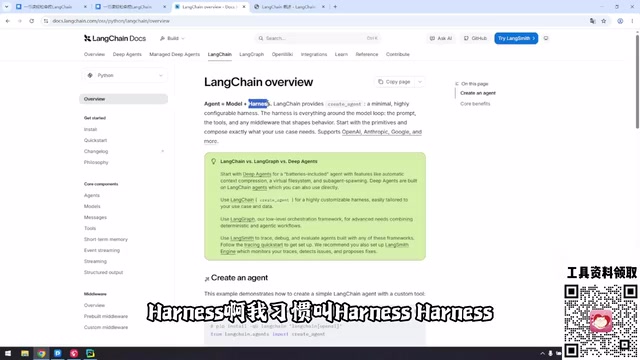
This positioning determines LangChain's versatility. Compared to the plugin or ecosystem solutions offered by OpenAI and DeepSeek individually, LangChain takes a more general-purpose approach. With well-developed official documentation and abundant starter demos, the creator recommends beginners start with LangChain to learn large model development.
The Three Core Problems LangChain Solves
The video distills LangChain's value into three dimensions. While its actual capabilities go far beyond these, these three best demonstrate the framework's necessity.
Breaking Through Model Training Time Limits
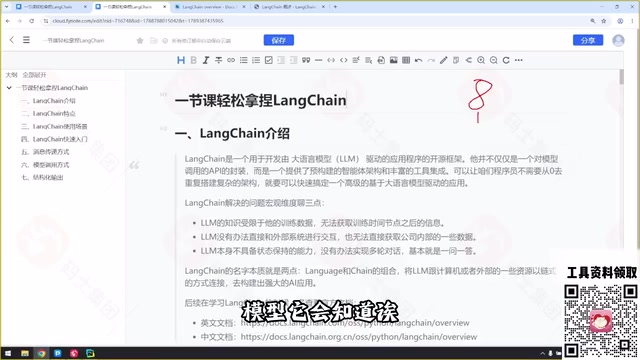
A large model's knowledge stops at its training cutoff. If the model finished training in June and you ask about something that happened in August, it can't answer. The model itself has no ability to directly call tools or access the internet, but it "knows" that it doesn't know—this is where the internet-access tools provided by the LangChain ecosystem come in to query on its behalf.
The creator specifically reminds viewers: when you send messages in products like DeepSeek, you're not interacting with the bare model directly. The product has already wrapped knowledge base or agent capabilities internally, with internet access functions. A pure model API doesn't have this capability.
Connecting External Data and Internal Systems
RAG, knowledge bases, vector databases, and similar application scenarios all essentially involve giving models access to external data. The model itself can't connect to a company's internal database, but LangChain can act as a bridge, handling data retrieval, provenance tracking, and more.
RAG (Retrieval-Augmented Generation) is a technical approach where the model first retrieves from an external knowledge base before answering, then incorporates the retrieval results into the prompt. The typical workflow is: split documents into chunks, convert them into vectors via an embedding model, and store them in a vector database; when a user asks a question, the question is similarly vectorized, a similarity search is performed in the database, and the most relevant fragments are retrieved as context for the model to generate an answer. The benefits are that knowledge can be updated at any time, answers can be traced back to original sources, and the probability of the model fabricating information (hallucination) is significantly reduced. Vector databases (such as Milvus, Chroma, FAISS) are components specifically designed to store and retrieve these high-dimensional vectors. They use approximate nearest neighbor algorithms to quickly find semantically closest content among massive fragments, serving as the retrieval foundation of RAG systems.
Managing Multi-Turn Conversation State
Models natively operate on a one-question-one-answer basis and don't reference previous rounds of conversation. LangChain provides context management mechanisms that make multi-turn communication possible. The creator notes that developers could implement this logic themselves, but LangChain makes it easier to handle.
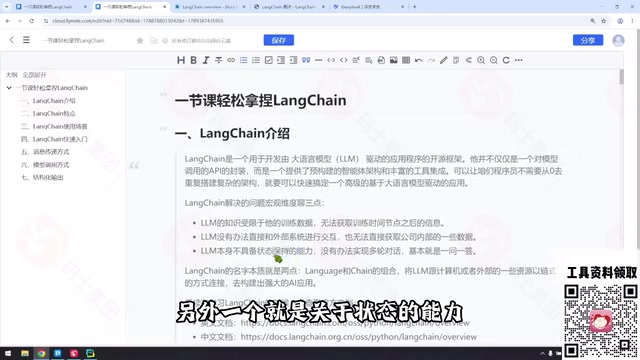
Common implementations of context management (memory) include: accumulating historical messages verbatim into the prompt, keeping only the most recent N rounds, summarizing and compressing earlier conversations, and storing history in external storage for on-demand retrieval. Since the model API itself is stateless, every request must re-insert "what it should remember" into the prompt. Therefore, the longer the context, the higher the token consumption and latency, and it may hit the model's context window limit. LangChain's memory components standardize this trimming, summarization, and persistence logic, so developers only need to swap out specific implementations to balance "remembering more" against "lower cost."
Ecosystem Integration and the Origin of the Name
The LangChain ecosystem has already integrated tool calling, context management, and a range of other capabilities. As the creator puts it, "The word Harness seems simple, but it involves a lot," and LangChain has already encapsulated this complex architecture for developers.
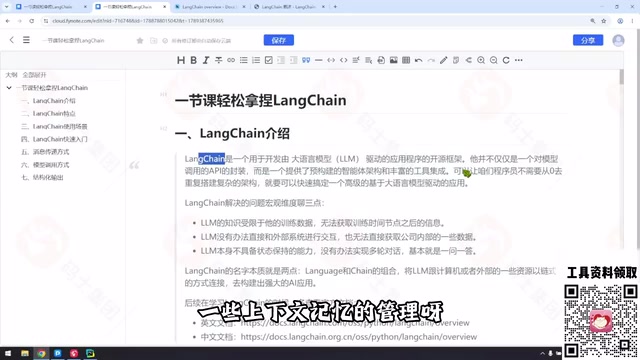
The name's origin also reflects the design philosophy: Lang stands for Language, and Chain stands for chaining/composition. LangChain's goal is to connect models with local computers or external resources in a chained fashion, ultimately building agents that can solve real-world problems.
Agents and tool calling are key to understanding the Harness. A regular invocation is "one question, one answer," while an Agent breaks tasks into multiple steps: the model first determines which tool to call (such as search, calculator, database query), the framework executes the tool and feeds the result back to the model, the model then decides the next step, and this loop continues until a final answer is reached. LangChain's tool abstractions, prompt templates, output parsers, and execution loops formalize this "model thinks—acts—observes" process. This is why it's called a harness framework rather than a mere API wrapper.
Learning Advice and Next Steps
The video emphasizes that LangChain isn't very difficult and has well-developed official documentation, offering everything from starter demos to code examples, making it suitable as a first stop for large model development. The original content doesn't fully cover message objects, invoke/stream/batch invocation, underlying principles, or detailed development pitfalls, but it lays a solid cognitive foundation for further learning. Readers are advised to study with both the official Chinese and English documentation side by side, run through the example code hands-on, and then gradually dive deeper into invocation patterns and engineering practices.
One-line Summary
LangChain is a harness framework that connects models with tools, data, and memory, helping you rapidly build agents.
Paragraph Summary
Based on an introductory tutorial and official documentation, this article breaks down LangChain's positioning and value for beginners. It points out that the official core formula is "Agent = Model + Harness," where the model refers to large language models like GPT, Claude, and DeepSeek, and the harness refers to implementations like LangChain—analogous to Spring in the Java ecosystem. LangChain primarily solves three types of problems: breaking through model training time limits by using internet tools to obtain new information; connecting internal databases and external data to support RAG and knowledge base scenarios; and managing multi-turn conversation context. The name derives from Language and Chain, aiming to connect models with external resources in a chained composition to create deployable agents. The article recommends beginners start with LangChain, consult both Chinese and English official documentation, and run through examples hands-on.
Related articles

Andrew Ng Teams Up with Anthropic: A Complete Walkthrough of the Claude Code Hands-On Tutorial
Andrew Ng and Anthropic launch a Claude Code short course covering clear context, parallel sessions, MCP servers, and three hands-on projects: a RAG chatbot, Jupyter data analysis, and Figma-to-frontend.

Only Three Agent Recommendations for Beginners: ZeroStack, Claude Code, and DeepSeek Harness
Bilibili creator recommends three beginner Agents: ZeroStack for lightweight devices, Claude Code with a mature ecosystem, and DeepSeek Harness for easy plugin integration. This article outlines use cases and practical tips for each tool.

How Does an AI Agent Control Your Computer? A Full Breakdown of Hermes' Three-Layer Toolchain
Bilibili creator Xiaoyou breaks down Hermes' three-layer toolchain for operating a computer: the built-in Terminal, file modification, and code execution foundation; optional web search, vision analysis, speech synthesis, and browser/desktop control; and an external ecosystem freely extended via CLI and MCP—plus why SSH connects but still can't operate.