LangChain.js Agent Architecture Deep Dive: An Advanced AI Agent Guide for Frontend Developers

A LangChain.js-based guide to AI Agent architecture for frontend developers, from Agent Loop to multi-agent systems.
This article uses LangChain.js as its backbone to systematically map the core knowledge landscape of AI Agent development. The central argument: with tools like Codex, Claude Code, and Cursor handling coding at speed, developers' real scarcity is business understanding and product architecture design. It contrasts workflow agents with general-purpose Agent Loop agents, walks through a progressive learning path from model calls and structured output to multi-agent collaboration, RAG, and MCP, and maps these skills to three interview tiers. TypeScript-only developers can replicate OpenClaw-style engines using LangChain.js, LangGraph, and DeepAgent — the key is mastering the engineering design that connects models, tools, knowledge bases, and streaming output.
Why Frontend Developers Need to Understand AI Agent Architecture
Over the past few months, the conversation around frontend-meets-AI transformation has been heating up steadily. As traditional frontend skills — engineering practices, frameworks, bundling, 3D visualization — are increasingly being handled by AI coding tools, a more fundamental question faces developers: in the AI era, what is the true competitive edge of a frontend engineer?
This article breaks down AI agent architecture and development practices using LangChain.js, drawing parallels with the OpenClawAd (referred to as "OpenCloud" in the video) engine's implementation approach. It maps out a complete mental model for TypeScript-native developers — from raw model calls all the way to multi-agent collaboration. The core thesis is clear: now that tools like Codex, Claude Code, and Cursor can rapidly produce working code, what developers truly lack isn't coding ability — it's business understanding and product architecture design.
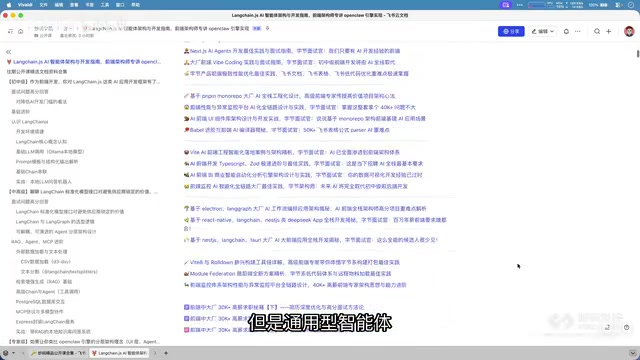
Workflow Agents vs. General-Purpose Agents
To understand Agent architecture, you first need to distinguish between two fundamentally different agent paradigms — and they're best understood by comparing them side by side.
Workflow Agents address the AI-driven transformation of standardized enterprise processes. Their execution paths are relatively fixed, making them well-suited for rebuilding existing business workflows with AI. They offer strong controllability, but limited flexibility.
General-Purpose Agents (Agent Loop style) hand over both the decision-making and planning layers to AI. The model continuously orchestrates and invokes relevant tools to complete tasks, forming a loop of "think → call tool → observe result → think again." This paradigm more closely resembles the underlying logic of general-purpose agent engines like OpenClaw, Codex, and Claude Code.
These two aren't mutually exclusive — they serve different scenarios. Use workflow agents for enterprise processes that require strict compliance and determinism; use Agent Loop-style agents for complex tasks that require open-ended exploration and autonomous decision-making.
The Core Knowledge Map of LangChain.js
The learning path built around LangChain.js can be broken down into several progressive modules:
Models, Messages, and Multimodality
The foundation layer covers model abstraction, the messaging mechanism, and multimodal capabilities. This is the bedrock of every Agent application.
From Chat to Structured Output
Many developers still use models at the "question and answer" chat level — which is actually the most basic usage. To truly unlock a model's potential, you must master structured output: getting the model to return JSON data or a specific data structure you define. Only with structured output can you reliably consume model results in your application code and enable streaming interactions.
Tool Calling and the Agent Loop
Tools give agents the ability to act; the Agent Loop orchestrates tool calls into an autonomous cycle. This layer is the heart of any general-purpose agent.
The Agent Loop's mechanics are worth unpacking. In each iteration, the model (LLM) receives the current task description and conversation history, then decides whether to deliver a final answer directly or call an external tool (such as a search engine, code executor, or database query interface). If it chooses to call a tool, the model outputs a structured invocation instruction; the runtime actually executes the tool and appends the result back into the context, after which the model reasons again. This "reason → act → observe" cycle (the ReAct pattern) continues until the model determines the task is complete. The core challenges of the Agent Loop are: preventing runaway loops (setting a maximum number of steps), handling error recovery when tool calls fail, and maintaining reasoning quality without degradation over long contexts.
Multi-Agent Systems, RAG, and MCP
The upper layers involve multi-agent collaboration, RAG (Retrieval-Augmented Generation), and MCP (Model Context Protocol). Together, these three define the capability ceiling of modern agent applications.
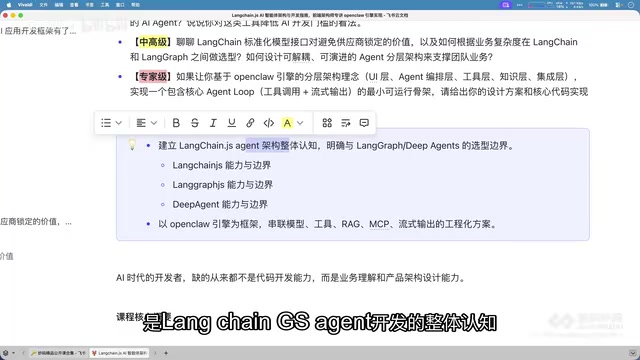
RAG (Retrieval-Augmented Generation) is the key technology that allows models to break free from the limitations of their training data. The basic flow is: private documents or real-time data are chunked, vectorized, and stored in a vector database. When a user asks a question, the most relevant text snippets are retrieved and injected into the prompt, enabling the model to answer based on up-to-date, private knowledge. MCP (Model Context Protocol), proposed by Anthropic, is an open protocol designed to standardize communication between models and external tools or data sources — essentially a "USB port" for the AI application layer. A tool provider only needs to implement an MCP server once, and any MCP-compatible client (including Claude, Cursor, etc.) can call it directly, dramatically reducing integration overhead. In multi-agent scenarios, the two are often used together: RAG handles knowledge retrieval, MCP handles tool dispatch.
Interview Perspective: Three Capability Levels
Mapping this knowledge to job interviews, you can clearly identify three levels:
- Entry to Mid-Level: Are you familiar with AI application development frameworks like LangChain.js? Have you built any Agents with it? Actual project experience alone makes you competitive.
- Mid to Senior Level: Can you clearly explain LangChain.js's standardized model, and articulate how to choose between LangChain.js and LangGraph for a given design?
- Senior Level: Can you explain the underlying implementation of general-purpose agent engines like OpenClaw, Codex, and Claude Code? Can you design an Agent architecture that integrates tool calling and streaming output, and get a minimal viable architecture running?
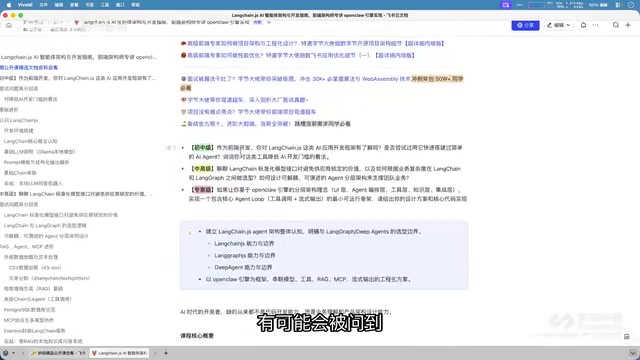
This tiered breakdown isn't just a reference for interviews — it's a self-assessment ruler for your learning path. The level you can answer up to roughly corresponds to your real depth in Agent development.
Replicating the OpenClaw Engine with TypeScript
A common question is: OpenClaw and similar engines are heavily Python-based — can I do this if I only know TypeScript? The answer is yes.
The key lies in your engineering design ability: how to wire together the right models, design the right tools, and implement streaming output through knowledge bases, MCP, and Skills. The process requires building understanding at two cognitive levels:
- A holistic understanding of LangChain.js Agent development — including the capability boundaries of LangChain.js, the capabilities and boundaries of LangGraph, and the positioning of DeepAgent. Together, these three form the complete picture of Agent development in the JS ecosystem.
- An implementation understanding of the OpenClaw engine — understanding how a general-purpose agent engine organizes models, tools, a knowledge base, and streaming output into a working system.
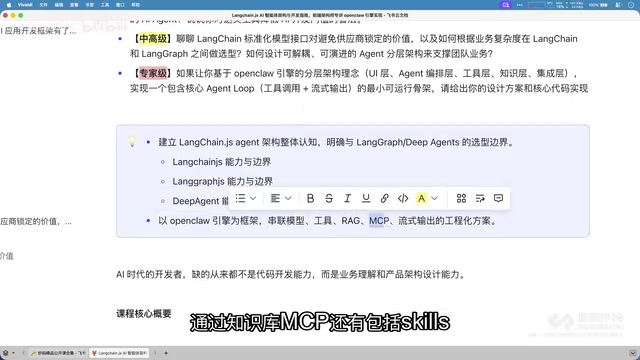
LangGraph is a framework within the LangChain ecosystem specifically designed for building stateful, cyclical graph-structured workflows — it complements LangChain.js rather than replacing it. LangChain.js excels at rapidly chaining together model calls, tools, and sequential logic; LangGraph provides explicit Node and Edge definitions, supporting conditional branching, parallel execution, and state persistence — making it suitable for building complex Agents that require fine-grained control over execution flow. DeepAgent typically refers to an Agent framework that wraps a higher-level abstraction on top of LangGraph, further simplifying the development complexity of multi-step, multi-tool collaboration. For frontend developers, understanding the positional differences between these three — LangChain.js for prototyping and simple pipelines, LangGraph for complex workflow orchestration, DeepAgent for business-layer abstraction — is a prerequisite for making Agent architecture decisions in the JS ecosystem.
The Real Moat for Developers in the AI Era
Circling back to the opening thesis: whether you're a frontend or backend developer, coding ability is no longer the bottleneck. Tools like Codex, Claude Code, and Cursor can already handle the full journey from design to working code with speed.
What truly determines your competitive edge comes down to two things: the ability to understand a business domain and the ability to design product architecture. These are also the essential capabilities required to genuinely empower organizations with AI. Mastering LangChain.js Agent architecture, understanding the trade-offs between Agent Loop and workflow approaches, and comprehending the implementation logic of engines like OpenClaw — at their core, these are all exercises in developing those two capabilities, not just accumulating API call experience.
Related articles

Chain of Thought Isn't Just for AI: How Humans Can Use CoT to Improve Thinking Quality
Chain of Thought isn't just a prompt trick for large models. Starting from a Hacker News discussion, this article analyzes why CoT works for human thinking too, breaks down actionable ways to transfer it, and highlights the key differences between human CoT and machine CoT.
Cloudflare Teams Up with OpenAI: Closi…
Cloudflare Teams Up with OpenAI: Closing the Loop from Vulnerability Discovery to Defense with AI
Cloudflare uses OpenAI Daybreak to investigate security vulnerabilities and generate reviewable remediation plans, while developers use Codex to boost coding efficiency and quality.

Orca Multi-Agent Orchestration in Practice: A Guide to Parallel Collaboration with Claude and Codex
Orca is Stable AI's free open-source agent workbench supporting 34 agents like Claude Code and Codex in parallel. Learn its Git worktree isolation, multi-model orchestration, and mobile management.