LangChain + MCP Practical Guide: From Tool Calling to Building AI Agents

LangChain + Agent + MCP: upgrading LLMs from "understanding" to actually executing enterprise business tasks.
LLMs are powerful reasoners but are limited to their training data, leaving them blind to real-time enterprise information. Binding tools bridges this gap, while LangChain handles the low-level engineering so developers can focus on business logic. Agents go further by managing conversation context, truly executing tool calls, and looping through perceive-decide-act cycles autonomously. MCP standardizes how tools and data sources are connected. Together, the three form the mainstream architecture for production-ready AI agents — and the core engineering advice is clear: use mature frameworks, don't reinvent the wheel.
Why You Need a Framework Like LangChain
The core value of large language models (LLMs) lies in their powerful reasoning capabilities — they can understand what you say and organize a pile of scattered documents into structured, logical content. But there's one fundamental limitation: a model's responses are essentially grounded in the data available at the time of its training. In other words, an LLM has no knowledge of your company's real-time internal business data.
This raises the first practical question: how do you get an LLM to work with your organization's internal data? The answer is to bind tools to the model. Once tools are bound, the LLM can not only understand your questions during a conversation, but also invoke those tools to retrieve internal business data or text content — then use its reasoning ability to compose a meaningful answer.
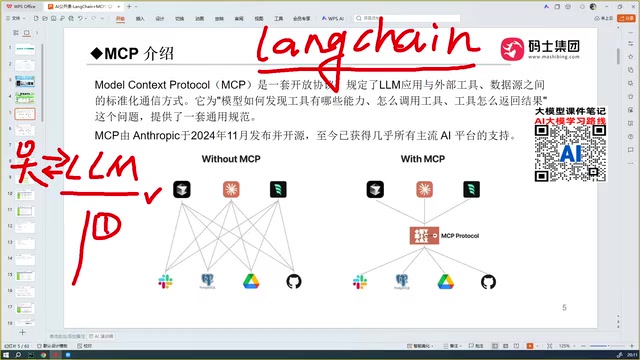
The problem is, if you write all the LLM invocation logic from scratch and manually manage your tools, your energy gets consumed by low-level concerns — how to call the model, how to manage tools, how to maintain conversation history. All of that pulls focus away from the business logic that actually matters. LangChain was created precisely to solve this pain point: it's a framework specifically designed for building LLM-powered applications (AI applications).
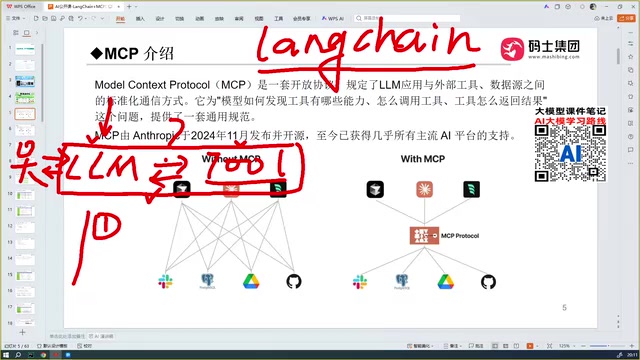
From Tool-Calling Conversations to Building Agents
Simply having "conversation + tool calling" isn't enough. The term you hear more often these days is Agent. An agent typically contains an LLM at its core, but represents a higher-level abstraction built on top of it.
This "higher-level abstraction" manifests in several concrete ways:
Automatic Conversation History Management
Conversations with an LLM generate a large amount of chat history. An agent can automatically manage this context for you, so you don't have to manually stitch together and maintain the message thread.
Actually Executing Tool Calls
This is a key distinction: when an LLM calls a tool on its own, it essentially only "knows" which tool to call and what parameters to pass — but it doesn't actually execute the tool itself. An agent, on the other hand, can truly carry out the action, invoke the tool, and retrieve the result.
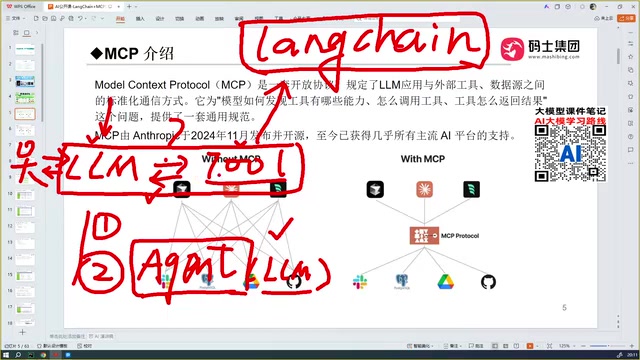
Deciding Whether to Continue Based on Results
Going further, once an agent receives the tool's output, it can interpret that result and decide whether to invoke additional tools. This "perceive → decide → act → re-decide" loop is the core capability that sets agents apart from ordinary conversational tool calls.
This loop is technically referred to as the ReAct (Reasoning + Acting) pattern, which forms the theoretical foundation of most mainstream agent architectures. Each cycle, the agent executes three steps: Thought → Action → Observation, and keeps looping until it determines the task is complete. For example: a user asks "Summarize this month's sales and send me an email." The agent first calls a database query tool to fetch the sales data, then — upon receiving the result — calls an email-sending tool, and finally confirms completion to the user. No manual intervention is needed at any intermediate step. This multi-step, autonomous decision-making capability is what elevates an agent from a "chat assistant" to an automated executor capable of handling genuinely complex tasks.
Beyond LangChain: Choosing the Right Framework
LangChain isn't the only option for building AI applications or agentic systems. You may have also heard of the Claude SDK, OpenAI's SDK, and others — all of which can be used to build AI applications.
There's a common misconception worth addressing here: some developers feel compelled to ask, "Can't I just write it all from scratch myself?" The author's clear recommendation is: don't. Yes, these frameworks were themselves built from scratch at some point — but since the giants have already built the wheel, you can stand on their shoulders and apply it. There's no need to hand-craft your own version of LangChain or the Claude SDK.
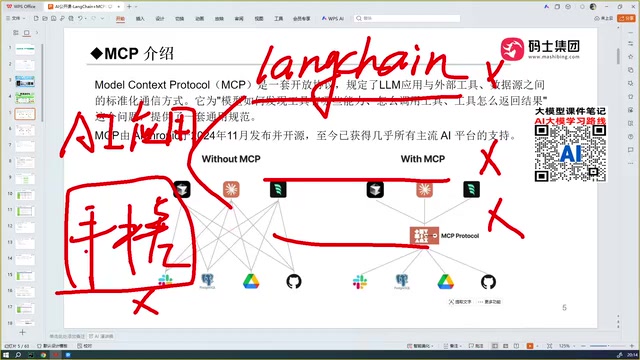
Spending your energy on low-level LLM calls, concurrency internals, state management, and conversation context handling is far less valuable than directing that energy toward real business outcomes. This is a pragmatic engineering principle: use mature frameworks rather than reinventing the wheel.
The Role of MCP
Once you understand that LangChain is a framework for building AI applications, it's natural to introduce MCP. Every agent needs to interact with external tools and external data sources — and MCP provides a standardized way to connect them.
MCP (Model Context Protocol) is an open protocol proposed and open-sourced by Anthropic, with the goal of unifying how LLMs connect to external tools and data sources. Before MCP, every AI application had to write custom adapter code for each individual tool, resulting in extremely high maintenance costs. MCP defines a kind of "plug standard" for AI applications: as long as a tool exposes its interface according to the MCP protocol, any MCP-compatible agent framework can connect to it directly — no custom adapter needed. This is the same idea behind USB ports unifying how peripherals connect to computers.
LangChain now natively supports MCP. Developers can use MCP Servers to quickly integrate databases, file systems, third-party APIs, and more into their agent applications — dramatically reducing the engineering complexity of tool integration.
With LangChain handling application orchestration and agent logic, and MCP handling standardized tool and data access, the two together enable you to build LLM-powered agents that are both grounded in enterprise business data and capable of actually executing real-world actions.
Summary
For anyone looking to get started with AI application development, this piece outlines a clear path: first understand the reasoning capabilities and data boundaries of LLMs; then extend them by binding tools to access business data; and finally use LangChain + Agent + MCP to upgrade from "can understand" to "can actually do."
Choosing the right framework and staying focused on business value is the very first step toward building production-ready intelligent agents from the ground up.
Related articles

Chain of Thought Isn't Just for AI: How Humans Can Use CoT to Improve Thinking Quality
Chain of Thought isn't just a prompt trick for large models. Starting from a Hacker News discussion, this article analyzes why CoT works for human thinking too, breaks down actionable ways to transfer it, and highlights the key differences between human CoT and machine CoT.
Cloudflare Teams Up with OpenAI: Closi…
Cloudflare Teams Up with OpenAI: Closing the Loop from Vulnerability Discovery to Defense with AI
Cloudflare uses OpenAI Daybreak to investigate security vulnerabilities and generate reviewable remediation plans, while developers use Codex to boost coding efficiency and quality.

Orca Multi-Agent Orchestration in Practice: A Guide to Parallel Collaboration with Claude and Codex
Orca is Stable AI's free open-source agent workbench supporting 34 agents like Claude Code and Codex in parallel. Learn its Git worktree isolation, multi-model orchestration, and mobile management.