LangChain Open-Sources OpenWiki: Automatically Generate and Maintain AI-Readable Wikis for Your Codebase

LangChain's OpenWiki auto-generates and maintains codebase wikis optimized for AI coding agents.
LangChain has open-sourced OpenWiki, a tool that automatically generates and continuously maintains wiki documentation for codebases, specifically designed to provide high-quality context for AI coding agents. By leveraging Git history to extract business logic and design decisions, integrating with GitHub Actions for automated updates, and injecting references via agents.md, OpenWiki creates a seamless closed loop that keeps AI assistants informed about your codebase's evolution.
When Documentation Becomes the Bottleneck for AI Programming
In an era where AI programming assistants are ubiquitous, a recurring question keeps surfacing: Does a Coding Agent truly understand your codebase? It can read code logic, but it often fails to grasp why things are implemented a certain way — the business context buried in Git commit histories, PR discussions, and team decisions.
Coding Agents are automated programming tools built on Large Language Models (LLMs), capable of understanding natural language instructions, reading code, generating patches, and executing multi-step tasks. However, the knowledge boundary of LLMs inherently creates a "context blind spot": models acquire general programming knowledge during training, not the specific business background of any particular codebase.
This blind spot has deep technical roots. Modern mainstream Coding Agents are built on the Transformer architecture, gaining statistical understanding of programming patterns through pre-training on massive code corpora. They essentially fit the probability distribution of "what code appears in what context." While the Transformer's attention mechanism excels at capturing long-range dependencies within sequences, its perception is limited by the Token cap of the Context Window. Even though models like GPT-4 have expanded their windows to hundreds of thousands of Tokens, a production project with years of history and hundreds of thousands of lines of code still can't fit into a single inference pass. Even with RAG (Retrieval-Augmented Generation) dynamically injecting relevant code snippets into the model's context window, RAG's retrieval process relies on semantic vector similarity matching — it's good at finding "snippets similar to the current code in question" but can't retrieve "why another implementation approach was rejected years ago." This type of tacit knowledge was never encoded into any vectorized code file; it only exists in PR comments, internal wikis, or engineers' memories. This structural deficiency causes AI programming assistants to frequently produce advice that is "technically correct but business-wise wrong" in complex business scenarios — one of the core challenges in deploying Coding Agents today.
LangChain's recently open-sourced OpenWiki targets precisely this pain point. Positioned as a "documentation generation and maintenance tool purpose-built for agents," its core goal isn't pretty documentation for humans, but high-quality codebase context for AI programming assistants. According to LangChain's official demo, you can get started with a single command — this minimalist onboarding experience is what sets it apart from traditional documentation tools.
Getting Started with a Single Command
OpenWiki's installation and usage flow has been compressed to the extreme. After installing via NPM, running openwiki init launches the guided setup.
During initialization, the tool will ask:
- Model provider: Supports both open-source and closed-source models; the demo chose OpenRouter;
- API Key: Paste the corresponding key;
- Specific model: Comes with several preset models (the demo used the GLM series), with support for custom Model IDs;
- LangSmith API Key (optional): Since OpenWiki is built on Deep Agents and LangSmith, providing this key enables tracking of every step the agent executes, making it easy to observe its internal reasoning.
About OpenRouter: OpenRouter is a unified LLM API gateway service that allows developers to call hundreds of models from different providers through a single interface, including mainstream closed-source models from OpenAI, Anthropic, Google, as well as open-source models like LLaMA and Mixtral. Its core value lies in model routing and cost optimization — developers don't need to separately manage API Keys and billing for each model provider, and the platform supports automatic routing strategies based on latency, price, or capability. Architecturally, OpenRouter is essentially an API Proxy Layer that establishes a unified OpenAI-compatible interface between the client and various model providers. Developers only need to modify the base_url parameter to switch models without rewriting any business logic code. OpenWiki's choice of OpenRouter as the demo provider reflects a design philosophy of avoiding deep binding to any single model while remaining open to better future models — especially important in the LLM landscape where iteration speed is extremely fast, and today's optimal model choice may be surpassed by a newer version within three months.
About LangSmith: LangSmith is LangChain's official Observability Platform, purpose-built for tracing, debugging, and evaluating the runtime behavior of LLM applications. In scenarios where a single agent task involves dozens of tool calls, traditional print debugging completely fails — you need to know which LLM call consumed the most Tokens, which tool returned incorrect results, and which node in the call chain caused the final reasoning deviation. LangSmith records the complete input/output, Token consumption, and end-to-end latency of each LLM call through an OpenTelemetry-compatible tracing protocol, presenting the agent's execution trajectory as a visual Call Tree. Its "Run Comparison" feature also supports cross-run comparative analysis, helping developers quantify the effects of Prompt modifications or model switches. It's a core component of the "observability" layer in the LLMOps (LLM Operations) toolchain.
About the GLM Series: The GLM (General Language Model) series is a large language model family jointly developed by Tsinghua University's KEG Lab and Zhipu AI. Its pre-training objective function adopts a general language model framework distinct from both the GPT series (autoregressive) and the BERT series (autoencoding), demonstrating competitiveness in both Chinese and English tasks. The GLM series excels particularly in Chinese comprehension, Chinese code generation, and Chinese long-text processing. Its appearance in the demo also suggests that OpenWiki's design considers use cases for non-English development teams — for teams where much of the business logic is documented in Chinese within PR descriptions and code comments, the model's Chinese comprehension ability directly impacts documentation generation quality.
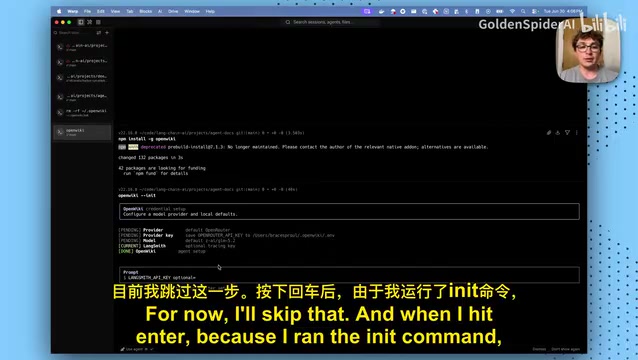
It's worth noting that since the project itself is open source, if you want to preset a model or provider that isn't yet included, you can submit a PR directly to the repository. This "community-driven presets" approach lowers the onboarding barrier for teams across different tech stacks.
What Does the Generated Wiki Look Like?
After running init, OpenWiki creates a directory called openwiki in the repository, containing several subdirectories and a core file: quickstart.md.
quickstart.md: The Documentation Entry Point
This file serves as the "gateway" to the entire documentation set. It contains a high-level overview of the repository — what the project is, what it does, what the important files are — while also serving as an index that links to other documentation directories and specific files in the codebase. This is the first file a Coding Agent checks when gathering repository information — serving both as a high-level description of the repository and as a navigation map for quickly locating content.
The design of quickstart.md follows the principle of "entry file as map": when a Coding Agent receives a new task, it typically performs "Repository Exploration" as its first step — looking for files that can quickly establish a global understanding, then planning subsequent deep-reading paths accordingly. The structured index in quickstart.md allows the agent to build a topological understanding of the repository without traversing the entire file system, significantly reducing the Token consumption during the exploration phase and reserving more context window space for actual task execution.
Layered Documentation Structure: Covering Every Aspect of the Codebase
Expanding the subdirectories reveals detailed documentation for different aspects of the repository. Using OpenWiki's own repository as an example, this includes the agent itself, agent architecture, CLI, various CLI operations, and several files for tracking OpenWiki's update history.
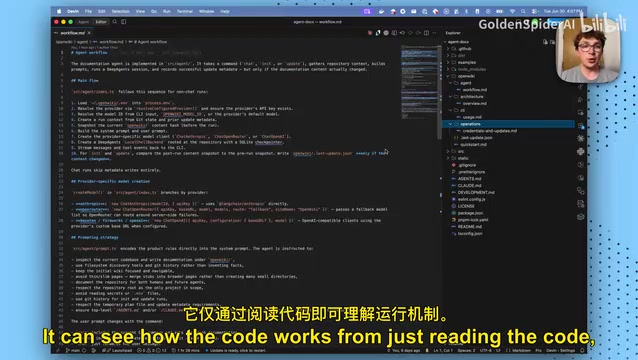
The value of these documents goes beyond technical descriptions. OpenWiki simultaneously records high-level business logic and decision context. Its reasoning is: an agent can understand how code works by reading the code; but understanding why the code was written a certain way requires mining information from Git commits, commit history, comments, and more.
Git History as a Knowledge Source: Git is not just a version control tool — it's a complete record of software evolution. Each commit contains code diffs, commit messages, and timestamps; Pull Requests carry issue descriptions, Code Review Comments, and discussion threads — together, this metadata forms a project's "Decision Archive." From a software engineering perspective, a mature project's Git history often contains thousands of small design decisions: why a function was split into two, why one third-party library was chosen over another, why a certain "temporary solution" still exists five years later. This type of information is extremely difficult to systematically record in traditional documentation systems, because it requires authors to anticipate — at the moment of decision-making — which decisions future readers will find worth recording. OpenWiki's use of Git history as raw material for documentation generation is essentially automating the solution to this "recording cost" problem — by having an LLM play the role of "historian," reverse-engineering design intent from existing change records. This is fundamentally different from traditional static analysis tools (like Doxygen or JSDoc): the latter rely on comments and type signatures in code, only able to describe what code is; whereas the Git history-based approach incorporates the time dimension into analysis, attempting to answer why and under what circumstances a decision was made. From an information theory perspective, Git history is the part of a codebase with the highest information entropy and the most difficult for AI to infer from the code itself — which is precisely why OpenWiki chose it as its core data source.
By integrating these clues, OpenWiki can generate documentation that records business logic and decision rationale, giving AI the most complete context possible when actually writing code.
Automatic Maintenance: Documentation That Never Goes Stale
Documentation's greatest enemy is becoming outdated. Manual maintenance is time-consuming and laborious, and OpenWiki's answer is automated updates.
The team provides a ready-to-copy GitHub Action that runs the openwiki update command once daily by default and automatically submits a Pull Request with documentation updates to the repository.
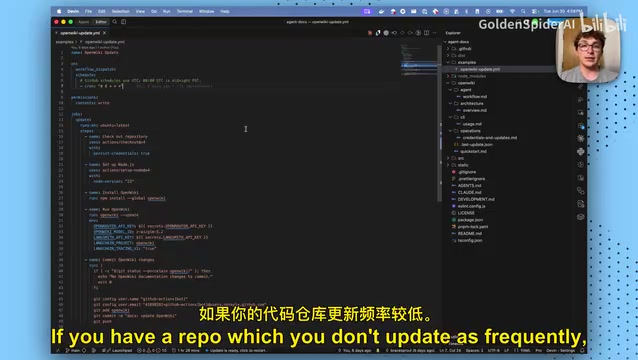
The core of the update mechanism is still Git: the tool records the commit hash from before the last documentation update, then examines every commit merged since then, analyzing code changes, PR descriptions, comments, and other content to determine whether documentation updates are needed. A Commit Hash is a 40-character hexadecimal string generated by Git using the SHA-1 algorithm that uniquely identifies the repository's complete state at a given moment — a composite digest of all file contents, directory tree structure, and historical commit records. In OpenWiki's design, the commit hash serves as a "Cursor" for incremental synchronization: the tool only needs to compare the current latest hash with the previously recorded hash to precisely locate the range of changes requiring analysis (via the git log <last_hash>..HEAD command), without needing to rescan the entire repository history each time. This design ensures both the precision and computational efficiency of updates, while also meaning that documentation timeliness is directly tied to Git commit granularity — the more atomic the commits (each commit does only one thing), the more precise the change descriptions OpenWiki can generate; conversely, bundling numerous unrelated changes into a single commit will reduce the semantic quality of the documentation. This also indirectly incentivizes development teams to follow good Git commit conventions.
This design delivers excellent flexibility:
- For repositories with infrequent updates, it can be set to run weekly;
- For highly active repositories with many daily commits, it can be set to run every 4 to 6 hours.
Since the agent works entirely based on Git history, its scheduling cadence can be fully decoupled from the code update rhythm, and teams can configure it freely based on their actual needs.
Beyond Generation: Conversational Interaction
Beyond the init and update commands, OpenWiki also supports direct conversation with the agent. Running openwiki enters a chat interface where you can:
- Switch model providers;
- Update or clear documentation;
- Ask questions about the repository and documentation, and search through generated content;
- Make targeted modifications to the documentation.
In other words, OpenWiki is both an automatic codebase documentation generator and a chatbot with deep knowledge of your codebase, usable for managing documentation and making precise adjustments. This "conversational documentation system" represents a new paradigm of human-AI collaboration: AI handles the initial draft generation and ongoing maintenance, while human engineers verify and correct documentation accuracy and completeness through natural language interaction. Compared to purely automated approaches, this design acknowledges LLM's limitations in understanding deep business logic, maintaining a human intervention channel as a quality backstop; compared to purely manual approaches, it dramatically lowers the maintenance barrier, turning "high-quality documentation" from a high-cost investment into a feasible everyday engineering practice.
How Do Coding Agents Actually Use This Documentation?
Once documentation is generated, how does a Coding Agent know to read it? The answer lies in the agents.md file (or claude.md for Claude Code users).
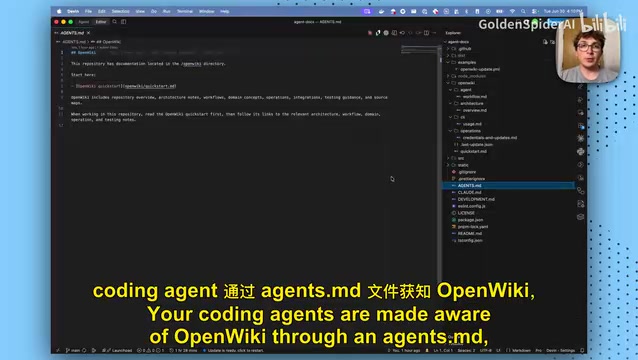
Modern AI programming assistants (such as Claude Code, GitHub Copilot, Cursor, etc.) broadly support customizing their behavior through specific configuration files. agents.md serves as the "system prompt injection point" for these tools — agents prioritize reading these files at startup, extracting conventions, preferences, and reference resources about the current project.
Understanding this mechanism requires knowledge of LLM Prompt Architecture: most programming assistants inject system-level instructions (System Prompt) into the context before processing user requests. System prompts carry different weight and priority from user messages during model processing, typically used to define the AI's role, behavioral boundaries, and project-level conventions. agents.md is the engineering method for solidifying these system-level instructions into repository files — an extension of the Infrastructure-as-Code philosophy applied to AI configuration management. This pattern is essentially the evolution of Prompt Engineering from ad-hoc conversational instructions to standardized repository configuration — development teams no longer need to repeatedly declare "we use TypeScript strict mode," "the testing framework is Vitest," or "the use of any type is prohibited" in every conversation. Instead, maintaining a single agents.md lets all agent sessions automatically inherit the same context baseline. From a team collaboration perspective, agents.md also solves the "inconsistent AI usage standards" problem: different engineers might provide entirely different context descriptions when interacting with Copilot or Cursor, causing AI behavior to vary from person to person; writing conventions into version-controlled agents.md makes the AI's "knowledge baseline" a shared asset maintained by the entire team. As AI programming assistants continue to penetrate engineering teams, agents.md is expected to evolve into an industry-standard convention similar to .gitignore or .editorconfig — a conventional "AI behavior configuration manifest" that becomes a standard part of codebase metadata.
OpenWiki automatically updates or creates these files, adding references to OpenWiki documentation and instructing Coding Agents on when, where, and how to use these documents — namely, whenever codebase context is needed.
This automated closed loop makes OpenWiki nearly "set up once, forget forever":
- Run
initto generate initial documentation; - Add the GitHub Action for automatic updates;
- OpenWiki automatically writes guidance paragraphs into
agents.md.
After that, you only need to merge the PRs when they come in. Any Coding Agent running in the repository will automatically read agents.md, thereby learning about OpenWiki's existence and usage — no additional prompts or references needed each time.
A Small Tool Pointing to a Big Direction
OpenWiki's current positioning is still relatively focused — purpose-built for Coding Agents, with lean and practical functionality. But it points to a trend worth paying attention to: documentation is shifting from "for humans to read" to "for agents to read," with its value metrics shifting from readability to "whether it provides sufficient context for AI."
Traditional software documentation is evaluated on readability, structural clarity, and example richness. But as AI programming assistants increasingly take over day-to-day development work, another critical audience for documentation — AI agents — is emerging. Machines read documentation in fundamentally different ways from humans: they don't need beautiful formatting, but have higher requirements for information density, semantic clarity, and contextual completeness.
Specifically, AI typically processes documentation in two phases: offline vectorized indexing (splitting documents into Chunks, converting them to high-dimensional vectors via Embedding models, and storing them in vector databases) and online semantic retrieval (vectorizing user queries and computing cosine similarity to recall the most relevant document fragments). This mechanism means that a document's "Retrievability" — whether each paragraph carries sufficiently unique semantic identifiers, whether it avoids heavy cross-paragraph dependencies — matters more than traditional "readability." A document that's very friendly for human readers (heavy use of pronouns like "it" and "this," relying on context to understand paragraph meaning), when split into Chunks, may become a pile of semantically incomplete fragments, causing retrieval quality to plummet. Furthermore, the Token limits of context windows require documentation to precisely balance information density (effective information per Token) and redundancy: over-compression leads to loss of critical context, while excessive detail consumes precious window space. This shift has given rise to the concept of "AI-First Documentation": documentation is no longer a project appendage, but a core variable affecting AI-assisted effectiveness.
Similarly, Anthropic's Model Context Protocol (MCP) is also exploring how to enable AI systems to acquire external knowledge in a more structured way. MCP defines a standardized client-server protocol that allows LLM applications to connect to various external information sources (databases, file systems, APIs, code repositories, etc.) through a unified JSON-RPC interface, achieving structured information retrieval through standardized "Tool Call" and "Resource Read" primitives. Compared to OpenWiki's approach of "building a codebase knowledge base for AI," MCP focuses more on real-time, dynamic information retrieval, while OpenWiki concentrates on distilling fragmented tacit knowledge into persistent explicit documentation — the two are complementary, both pointing in the same direction: building better AI Information Infrastructure to help agents evolve from "only seeing the surface of code" to "truly understanding the world behind the code."
As AI programming becomes increasingly prevalent, the context quality of codebases is gradually becoming the key variable determining agent performance. OpenWiki, with its combination of "Git history-driven + automated maintenance + agents.md integration," offers a lightweight yet pragmatic solution.
The LangChain team has also stated that the Wiki idea is "just getting started," with plans to continue exploring and welcoming community feature suggestions through PRs or Issues. For teams deeply invested in AI programming assistants, tools like this are well worth incorporating into your workflow.
Related articles
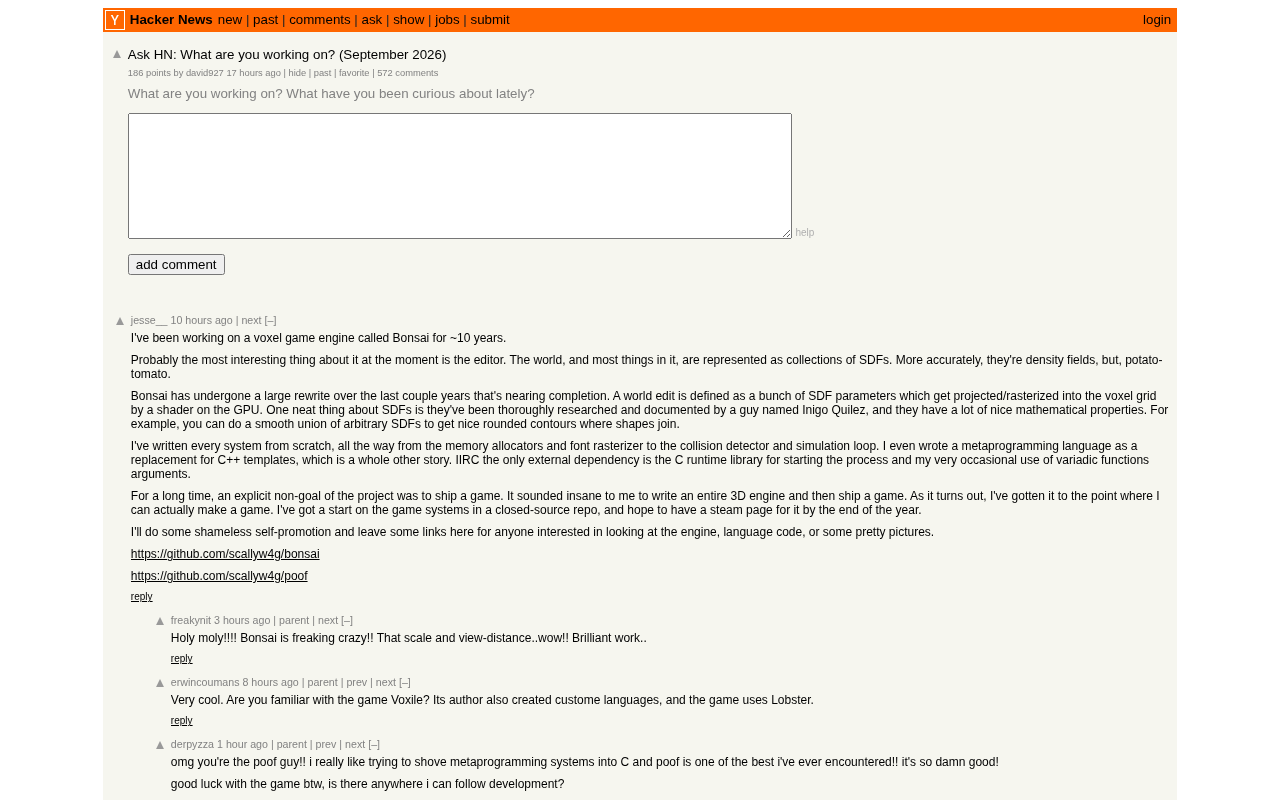
Hacker News Monthly 'What Are You Working On?' Thread: A Window Into the Developer Community
Hacker News's monthly 'What are you working on?' thread drew 180 upvotes and 558 comments. We explore why this community ritual persists and what it reveals about developer trends.
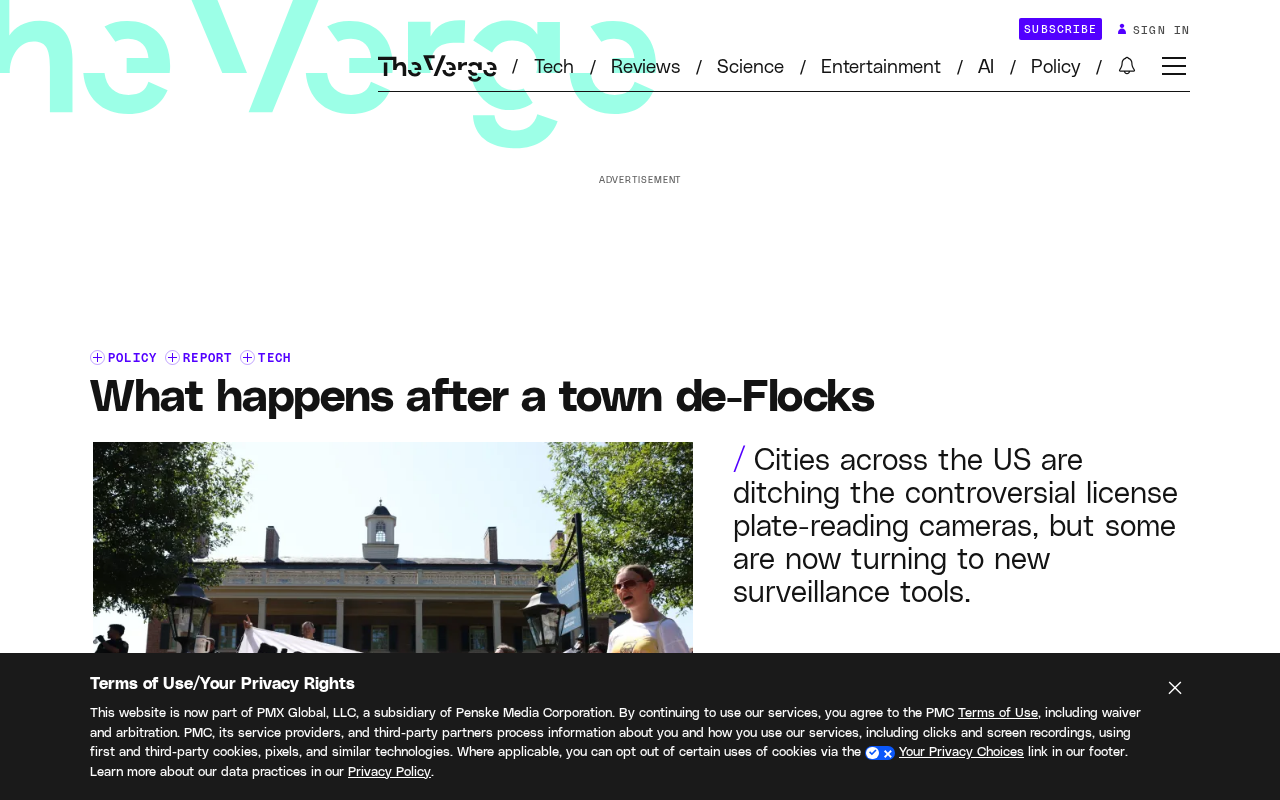
After Towns Cancel Flock Contracts: The Lingering Fallout of AI License Plate Recognition Cameras
Towns across the US are canceling Flock AI license plate camera contracts amid public backlash, but terminating contracts doesn't erase collected data. A look at the data retention risks that persist.
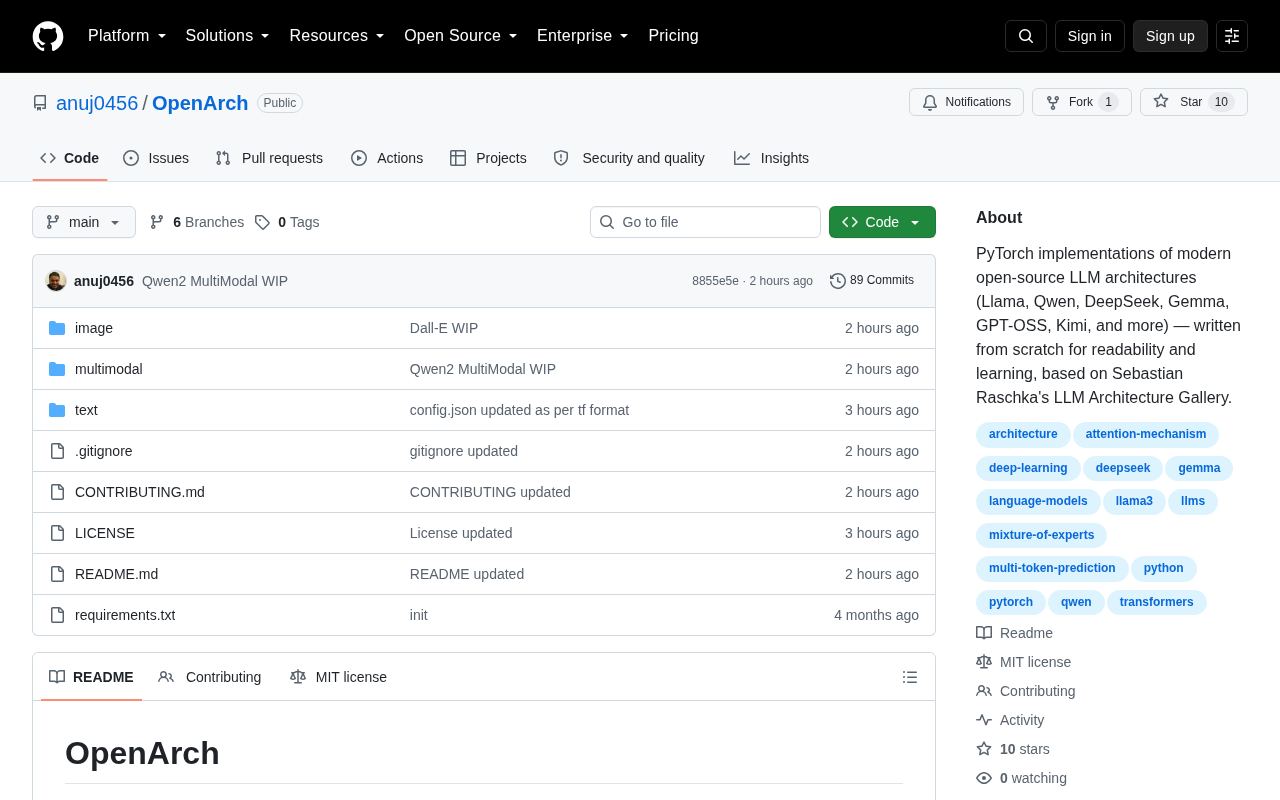
OpenArch: An Open-Source Project Reimplementing Modern LLM Architectures in PyTorch
OpenArch is an open-source PyTorch project reimplementing modern LLM architectures with a focus on clean, readable code. Learn about its value for learners and researchers.